-
Photographs: ‘Dream Big Dreams’
Here are two photographs pulled from the White House Flickr stream. I like both of them for very different reasons. I hope you enjoy them also.

This is an “Official White House Photo” taken by Pete Souza. President Obama and Jon Favreau, head speechwriter, edit a speech on health care in the Oval Office, Sept. 9, 2009, in preparation for the president’s address to a joint session of Congress. As a writer and editor, I just love to see the mark-ups. There’s a creative elegance to it.
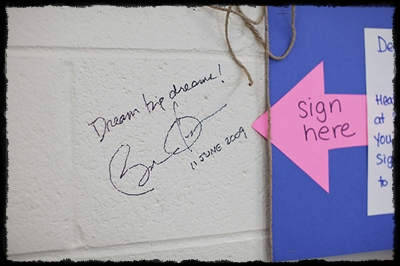
This photo’s also by Pete Souza. It shows Obama’s signature on a wall in a health classroom at Southwest High School in Green Bay, Wisconsin, June 11, 2009. The staff at the school, where the President attended a town hall meeting on health care, left a note asking him to sign the wall for future students to see. He wrote, “Dream big dreams” (or perhaps “Dream hip dreams,” which also is cool with me).
-
Happy Birthday, Gloria Steinem!
“The truth will set you free. But first, it will piss you off.”–Gloria Steinem

Feminist and journalist, Gloria Steinem was a key figure in the women’s movement from 1969. She founded Ms. magazine, starting in 1972. She is an outspoken advocate for the Equal Rights Amendment and helped found the National Women’s Political Caucus.
I met Ms. Steinem in New York City at a Women’s Funding Network gathering fundraiser in 2007. Happy birthday, Gloria (who turns 76 today) — and thank you.
-
BBC’s Two Part Show on Archbishop Oscar Romero
 The BBC’s Heart and Soul ran an incredible 2-part radio show on Oscar Romero this week on the 30th anniversary of Romero’s assassination. Join Julian Miglierini as he speaks to those who remember Romero, and travels to a village in El Salvador’s poor north, where he is revered as a saint.
“Thirty years ago, El Salvador’s Catholic Archbishop Oscar Romero was shot dead while celebrating mass. He knew he was in danger – not long before his death, he said that if he was killed – he would rise again in his people. Today, his face is everywhere in the country – on murals, T-shirts and key rings. Many compare him to Martin Luther King, Gandhi or even Che Guevara.
But how was it that this man of the church became such an outspoken advocate of the poor and oppressed? And why did he become such a threat to the rich oligarchy that someone wanted him dead?Listen to BBC’s Julian Miglierini as he speaks to those who remember Romero, and travels to a village in El Salvador’s poor north, where he is revered as a saint.”
BBC’s Heart and Soul Part I (28 minutes).
Every year on 24th March, the people of El Salvador remember the death of the man who throughout Latin America became known as the voice of the voiceless poor: Catholic Archbishop Oscar Romero, who was shot dead at the altar on 24th March 1980. But is the Catholic church he loved in terminal decline, in a country where more than one-third of the population now attend evangelical Protestant churches?
BBC’s Julian Miglierini goes to a Baptist megachurch in San Salvador where close to 80,000 people worship every week, and asks why its message should have such enormous appeal in a traditionally Catholic country. But while the Catholic church may be losing members, Oscar Romero himself seems to have lost little of his appeal. El Salvador’s new left-wing President, Mauricio Funes, calls him his inspiration. And this bookish Archbishop in his 60s has also become an unlikely icon of youth culture. Hear why the Hip Hop band, Pescozada, have just released a track in homage to him.
BBC’s Heart and Soul Part II (28 minutes).
-
Richard Killmer: Why Torture is Wrong
 Torture is an assault on human dignity — both the dignity of the victim and the inflicter. While the Obama administration has worked hard to try to reverse the abhorrent policies of the Bush administration on torture, there’s still a long way to go. The Guantanamo detention camp is still functioning. The “black sites” are still hidden and functioning around the world under shadowy CIA-leadership. Rogue dictators and militias still brutalize the innocent. In other words, the insidious underside of human sin is still dismembering people and their families in hidden cells around the world.
Richard Killmer, former head of the National Council of Churches, was profiled in the digital edition of U.S. News and World Report this week. Killmer now heads up the National Religious Campaign Against Torture, a leading coalition of faith groups in the U.S. trying to dismantle the torture policies. Killmer was interviewed by Alex Kingsbury in the article The Morality of Torture. This is a great piece to distribute in your church bulletins. It’s short and to the point. It appeals to political conservatives and liberals – and has Bible. Here’s a quote:
Before 9/11, there was national consensus on the illegitimacy of torture. After all, it was President Reagan who made the country a signatory in 1984 to the United Nations Conventions Against Torture, which both banned the practice and called for universal jurisdiction for its prosecution. But the events of the intervening years have changed the nation to the point where Killmer’s message is now that of a radical. “I don’t know what has gone so wrong,” says Killmer, sitting in his modest office across the street from the Supreme Court. “Whatever the political or security issues are, they don’t change the basic moral fact that some things are always, always, always wrong.”
Read the whole article here.
-
Romero: When the Word of God Gets Under Your Skin
 “A church that doesn’t provoke any crisis, a gospel that doesn’t unsettle, a word of God that doesn’t get under anyone’s skin, a word of God that doesn’t touch the real sin of the society in which it is being proclaimed, what kind of gospel is that? Very nice, pious considerations that don’t bother anyone, that is the way many would like preaching to be. Those preachers who avoid every thorny matter so as not to be harassed, so as not to have conflicts and difficulties do not light up the world they live in. … The gospel is courageous; it’s the good news of him who came to take away the world’s sins.”—Archbishop Oscar Romero (murdered March 24, 1980)
From The Violence of Love: The Pastoral Wisdom of Archbishop Oscar Romero, edited by James R. Brockman
-
You’ve Got Mail: Barack Sends His Thanks to YOU

President Barack Obama signs the healthcare reform bill Tuesday in the White House as 11-year-old Marcellus Owens looks on. CHARLES DHARAPAK / AP This morning I had a doctor’s appointment at Kaiser. I was sitting in the waiting room when the CBS special report came on the TV announcing that the President of the United States was making a speech before he signed into law historic legislation to reform how health care is delivered in this country.
All the hum of talk died down and everyone turned toward the television. “It’s about time,” said one. “Them Southern states are gonna fight it,” said another. “Let ’em try,” chimed in some one else. “Is this gonna help with my mother’s prescriptions?” somebody asked. And the whole room cried out, “Yes!”
When President Obama finally signed the bill (and signed and signed and signed it with all those “historic” pens), everyone sitting around me gave a little cheer — nurses, patients, doctors, janitors, everybody.
In the President’s speech today, he thanked YOU. Because it’s been the push from every corner of the country that kept health care reform from dying. It’s not a perfect bill. It’s not universal coverage. It leaves out the undocumented workers among us. But in order to build a new house, you first have to pour a foundation. That’s what this bill is — a solid foundation on which to build. I know you all are working hard out there on many issues that you care about. But take a moment to savor this change and to drink in a President of the United States telling you thanks for your good work. Here’s an excerpt from his speech:
After a century of striving, after a year of debate, after a historic vote, health care reform is no longer an unmet promise. It is the law of the land. It is the law of the land. And although it may be my signature that’s affixed to the bottom of this bill, it was your work, your commitment, your unyielding hope that made this victory possible. When the special interests deployed an army of lobbyists, an onslaught of negative ads, to preserve the status quo, you didn’t give up. You hit the phones and you took to the streets. You mobilized and you organized. You turned up the pressure and you kept up the fight. When the pundits were obsessing over who was up and who was down, you never lost sight of what was right and what was wrong. You knew this wasn’t about the fortunes of a party — this was about the future of our country.
And when the opposition said this just wasn’t the right time, you didn’t want to wait another year, or another decade, or another generation for reform. You felt the fierce urgency of now. You met the lies with truth. You met cynicism with conviction. Most of all, you met fear with a force that’s a lot more powerful — and that is faith in America. You met it with hope. Despite decades in which Washington failed to tackle our toughest challenges, despite the smallness of so much of what passes for politics these days, despite those who said that progress was impossible, you made people believe that people who love this country can still change it. So this victory is not mine — it is your victory. It’s a victory for the United States of America.
For two years on the campaign trail, and for the past year as we’ve worked to reform our system of health insurance, it’s been folks like you who have propelled this movement and kept us fixed on what was at stake in this fight. And rarely has a day gone by that I haven’t heard from somebody personally — whether in a letter, or an email, or at a town hall — who’s reminded me of why it was so important that we not give up; who reminded me why we could not quit. …
Now, as long a road as this has been, we all know our journey is far from over. There’s still the work to do to rebuild this economy. There’s still work to do to spur on hiring. There’s work to do to improve our schools and make sure every child has a decent education. There’s still work to do to reduce our dependence on foreign oil. There’s more work to do to provide greater economic security to a middle class that has been struggling for a decade. So this victory does not erase the many serious challenges we face as a nation. Those challenges have been allowed to linger for years, even decades, and we’re not going to solve them all overnight.
But as we tackle all these other challenges that we face, as we continue on this journey, we can take our next steps with new confidence, with a new wind at our backs — because we know it’s still possible to do big things in America — because we know it’s still possible to rise above the skepticism, to rise above the cynicism, to rise above the fear; because we know it’s still possible to fulfill our duty to one another and to future generations. So, yes, this has been a difficult two years. There will be difficult days ahead. But let us always remember the lesson of this day — and the lesson of history — that we, as a people, do not shrink from a challenge. We overcome it. We don’t shrink from our responsibilities. We embrace it. We don’t fear the future. We shape the future. That’s what we do. That’s who we are. That makes us the United States of America.
Read the whole address here.
-
Caprica: Does a Robot Have a Soul? (Episode 2)
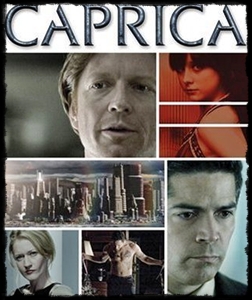 Back in February I posted about the new SciFi hit Caprica. Since I don’t have cable TV, I’m catching the show as I can when the episodes are uploaded to the Syfy channel Web site.
Episode 2 – Rebirth spent a lot of time establishing the connection between the Cylon robot and Zoe’s avatar. The change in camera so that the viewer sometimes sees out of Zoe’s eyes and sometimes sees the Cylon robot was oddly off-putting. Rather than increasing empathy for Zoe and emphasizing her sense of separation locked inside the Cylon body, the effect served more to just dislocate the viewer. But I’m intrigued that Zoe’s religious “sense of mission” in getting to the planet Gemanon where her monotheistic community will welcome her is still intact even as her avatar is downloaded into the Cylon body.
The other fascinating scene in this episode is the mass memorial gathering after the terrorist attack. Amanda Greystone takes the stage and announces that her daughter, Zoe, was one of the terrorists. This sparks a riot in the crowd and Amanda barely escapes. I found this scene both emotionally moving and somehow false. Amanda Greystone is a smart woman of achievement; a doctor, researcher, and scientist. Yes, she’s under emotional stress from her daughter’s death – but it doesn’t seem believable that she would take the stage for a public confession or that her husband (a futuristic Bill Gates) and his handlers would “let” it happen.
As I mentioned before, there’s a great conversation on the ethics, religion, and spirituality in Caprica going on over at Religion Dispatches. Here are a few quotes responding to Episode 2:
Diane Winston writes: Caprica’s landscape is littered with families that aren’t families. The gifted Graystones don’t communicate. Alone in their aerie, Daniel and Amanda jealously guard memories of their daughter. How could Daniel not mention the avatar? Why would Amanda hide her concerns about Zoe’s loyalties? Life is no easier in the Adams’ apartment where the adults pull in different directions. Grandma yearns for the old country; Joe for new beginnings. No wonder young Bill grows up to find community, purpose and identity in the military’s ranks. High Priestess Clarice Willow’s polygamous household looks like it might offer something better: big love and shared purpose. But the profusion of furtive glances and angry accusations give lie to what is heralded as an extended family. Even “found” families are treacherous. Zoe kept secrets from Lacy, Lacy deserts Zoe and Ben when they run away, Ben kills Zoe in his holy holocaust. I can only wonder what kind of family Zoe hoped to find on Gemenon.
Henry Jenkins writes: I continue to be intrigued by Caprica’s ongoing exploration of media and the effects of mediation. I don’t just mean the central representations of artificial consciousness and virtual worlds, but also more mundane forms of media practices which show how information gets recorded and transmitted. This week, for example, we have some throwaway lines about Uncle Sam Adama’s tattoos, which we are told signal to others in his community who he is and what he has done. His “tats” are a kind of information appliance which has been inked directly onto his body—and indeed, this is often the way tattoos function in contemporary criminal societies—as markers of affiliation, as statements of fidelity, and as records of accomplishments. Is there any parallels to be drawn here between how memories are imprinted through Sam’s tatoos and the ways that Zoe’s memories are imprinted onto computer chips for example?
Read more from Capricology here.
-
The DREAM Walkers: Undocumented and Unafraid
 There were 250,000 people on the National Mall on Sunday to demand comprehensive immigration reform for the United States. One story that touched me deeply was that of the DREAM Walkers: Juan, Carlos, Felipe and Gaby. Four undocumented students who walked nearly 1,500 miles from Miami to Washington, D.C. to stand up for undocumented people.
“Throughout our journey, we have listened to the same repeated stories: mothers being afraid of driving their kids to school because of the ever-present fear of getting detained and/or deported, and high school seniors feeling completely hopeless on graduation date because they can’t continue their studies in higher education. We think about how millions of people undergo the same fear everyday because of their undocumented status and this has to stop. That’s way we’re walking to DC; that’s why thousands gather in DC on Sunday and millions celebrate this historic day throughout the nation.”
During their journey, nearly 25,000 people signed on (you can sign on too) to support their call for leaders to fix our failed immigration system. They also faced down the Klan in south Georgia and collected stories of uninvestigated hate crimes against undocumented workers.
These brave kids–from Brazil, Venezuela, Ecuador and Colombia–were brought to the U.S. by their families when they were young, have excelled in school, worked hard, and contributed to their communities. They all face the threat of being deported. They have no access to funding for going to college. So they walk in support of the DREAM Act (“Development, Relief, and Education for Alien Minors Act of 2009”). Juan, Carlos, Gaby and Felipe chose to walk because they have run out of options. There are currently no legal pathways for them to gain citizenship, which is why they are calling on President Obama and other leaders to do everything in their power to pass real reform this year.
Here’s a 2 minute video of their trip.
-
César Baldelomar: Why I’m a Vatican II Catholic
 César J. Baldelomar, a grad student at Harvard Divinity School, is a regular blogger over at God’s Politics. He’s also the executive director of Pax Romana Center for International Study of Catholic Social Teaching.
I appreciated his recent post Vatican II 101: Social Justice is Part of Catholic Identity. It’s part review of James Carroll’s new book Practicing Catholic and part personal reflection on how Catholic Social Teaching brought César back into the church.
With the creeping “reform the reform” movement that is blossoming under Pope Benedict, it is very important for Vatican II Catholics to give witness to why it is vital to the church (see also Hermeneutic of Dysfunction for more on this). Here’s an excerpt from his post:
Not too long ago, I considered myself a former Catholic. I asked, “How could I, in clear conscience, choose to remain in a church that often seems to forget its call to social justice and that covers up the terrible abuses of children at the hands of priests and bishops?” The answer to my angst now seems somewhat clear: If I leave the church, I would be dishonoring the legacy of the council fathers, who, in a span of some four years, rocked the foundations of an ancient edifice. Moreover, I would be “selling-out” the prophetic figures who followed in the Vatican II spirit – figures like Oscar Romero, Gustavo Gutierrez, Dorothy Stang, Jon Sobrino, Leonardo Boff, and several other less known men and women.
Though born twenty-one years after Vatican II, I consider myself a Vatican II Catholic. When I struggle whether to remain a Catholic, I simply recall the council fathers’ heroic and prophetic stances in favor of religious liberty, peace, social justice, the vernacular liturgy, and recognition of Jews as older brothers in faith. The council fathers and those following in their spirit remind me that being Catholic means emulating Jesus by practicing love and compassion for all, but especially the marginalized and oppressed. I can only hope to not disappoint these heroic figures!
Read the whole post here.
-
Listen to Latino USA this Weekend – What’s “Preferential Option for the Poor”?
 While preparing for an interview on the radio show Latino USA (to air on NPR stations on the weekend of March 26,27,27), I put together some notes on this question about what it means to have a “preferential option for the poor.” Show host Maria Hinojosa asked me and theologian Ernesto Valiente to speak about the 30th anniversary of Archbishop Romero’s assassination and on what “option for the poor” the life and faith of people today.
The option for the poor is a basic principles of Catholic Social Teaching. It was a fundamental principle embraced by the Catholic Bishops of Latin America at conferences both in Medellin (1968) and Puebla (1979).
As a developed theological principle it was further articulated by the Dominican priest Gustavo Gutierrez in A Theology of Liberation. The principle is rooted in both the Old and New Testaments and claims that a preferential concern for the physical and spiritual welfare of the poor is an essential element of the gospel.
The justice of a society is tested and judged by its treatment of the poor. God’s covenant with Israel was dependent on the way the community treated the poor and unprotected—the widow, the orphan and the stranger (Deut. 16.11-12, Ex. 22.21-27, Isa. 1.16-17). Throughout Israel’s history and in the New Testament, the poor are agents of God’s transforming power. In the gospel of Luke, Jesus proclaims that he has been anointed to bring good news to the poor (4.1-22). Similarly, in the Last Judgment, we are told that we will be judged according to how we respond to the hungry, the thirsty, the prisoner and the stranger (Matthew 25.31-46).
To understand the “poor” in the Bible as a reference to spiritual poverty only is to miss an important message. Indeed, faith without an understanding of justice for the poor is a gospel full of holes—incomplete and in tatters. Now, as in biblical times, financial poverty and spiritual poverty grow up together—but not in the way Christianized capitalism has told us the story.
Material poverty does not occur because one is spiritually poor. Rather, in a society where there are extremes of wealth and poverty, there exists a general spiritual poverty experienced by all. When the wealthy are dying from diseases of overabundance and the poor are dying from inadequate health care, poor diets, and stress-related illnesses, there is a spiritual disease in the society as a whole. How do Christians address poverty in all its forms?
Some Christians are confused on why the gospels demand that we give special attention to the poor—or as Catholic theology puts it, why we have a “preferential option for the poor.” It is not because God loves the poor more than the rich. It is not because God’s salvation is limited in any way. It’s because in order for us to have the society that God intended—one that protects all human dignity—then the needs of the poor take priority over the desires of the rich when making personal, communal, and political decisions.
“Option” in this sense is to be read as a verb, not a noun. Every Christian must choose, make a conscious choice to prioritize the needs of vulnerable over the needs of the secure. It’s how we keep our souls and conscience in shape. (See Economic Justice for All: Pastoral Letter on Catholic Social Teaching and the U.S. Economy by the U.S. Catholic Bishops, 1986).
-
Subscribe
Subscribed
Have a WordPress.com account? Log in now.

