-
Thomas Merton: ‘Where is Our Peace?’

Where is silence? Where is solitude? Where is Love? Ultimately, these cannot be found anywhere except in the ground of our own being. There, in the silent depths, there is no more distinction between the I and the Not-I. There is perfect peace, because we are grounded in infinite creative and redemptive Love. There we encounter God whom no eye can see… –Thomas Merton
Love and Living by Thomas Merton, (New York: Harcourt, 1965, p. 20)
-
Second Openly Gay Bishop Elected in Worldwide Anglican Communion

Mary Glasspool reacts during her election with Bishop Jon Bruno behind her. I was very pleased to note that the Anglican Church/Episcopal Church USA has elected two women–Mary Douglas Glasspool and Diane Jardine Bruce–to serve as assistant bishops in the Los Angeles diocese. Of note is the fact that Canon Glasspool is openly lesbian and has been in a committed relationship since 1988. With her election she becomes the second openly gay bishop in the worldwide Anglican Church. Bishop Gene Robinson was the first. Also last fall, the Church of Sweden (which is Lutheran, but in communion with the Anglican Church of England) consecrated Eva Brunne, also a partnered lesbian, as Bishop of Stockholm.
As a Roman Catholic, I’m interested in how other denominations are working through the complex issues of sexuality and the call to serve the church in ordained ministry. Over at Ekklesia, Savi Hensman wrote a nice piece (Liberating the Anglican Understanding of Sexuality) that tracks some of the journey of the Episcopal Church on the issue of sexuality:
Indeed the Episcopal Church’s openness to lesbian bishops is the result of a long process of reflection and study in keeping with the advice of numerous Anglican gatherings and the principles of international canon law. The “duty of thinking and learning” is a theme that has come up repeatedly at international gatherings. The church should learn from the work of scientists, calling upon “Christian people both to learn reverently from every new disclosure of truth, and at the same time to bear witness to the biblical message of a God and Saviour apart from whom no gift can be rightly used”, and should welcome “the increasing extent of human knowledge” and the “searching enquiries of the theologians”. In 1978 the Lambeth Conference called for “deep and dispassionate study of the question of homosexuality, which would take seriously both the teaching of Scripture and the results of scientific and medical research”, “pastoral concern for those who are homosexual” and “dialogue with them”. As understanding of human sexuality grew, and more theologians made the case for full inclusion, many in the Episcopal Church came to believe that being a woman or gay should not result in being treated as a “second-class citizen”, let alone an outsider.
Concern for justice and commitment to human rights was another theme, including, from the 1980s, those of “homosexual orientation”. In the USA and other countries covered by the Episcopal Church, LGBT people at times face persecution and violence. While opposition to such mistreatment does not automatically lead to acceptance of same-sex partnerships as a proper lifestyle for Christian leaders, it does make it harder to depersonalise a particular minority and ignore the realities of their lives. This concern for justice has also led to greater self-examination. For instance, the Anglican Consultative Council in 1990 called on “every Diocese in our Communion to consider how through its structures it may encourage its members to see that a true Christian spirituality involves a concern for God’s justice in the world, particularly in its own community.”
Various denominations have excellent new theological papers reflecting their developing understanding of human sexuality within Christian thought. Here are links to a few of them:
Human Sexuality: Gift and Trust (Evangelical Lutheran Church in America)
Some Issues in Human Sexuality: A Working Paper of the House of Bishops (Church of England)
-
More Healthcare: Leading U.S. Catholic Newspaper Stands With Sisters on Healthcare
 In more late-breaking news, the nation’s leading Catholic newspaper the National Catholic Reporter, released an editorial backing the passage of the current health-care reform bill before Congress. “Congress, and its Catholics, should say yes to health care reform,” states NCR.
This move aligns NCR with thousands of Catholic sisters and millions of lay Catholics (see Catholic Nuns Pick Up Where Bishops Fall Down) , but puts it at odds with U.S. Catholic bishops, who said earlier this week that they could not support the current bill.
We do not reach this conclusion as easily as one might think, given the fact that we have supported universal health care for decades, as have the United States Conference of Catholic Bishops, the Catholic Health Association and other official and non-official organs of the Catholic church. There are, to be sure, grave problems with the bill the House will consider in the next few days. It maintains the squirrelly system of employer-based health care coverage that impedes cost reduction. Its treatment of undocumented workers is shameful. It is unnecessarily complicated, even Byzantine, in some of its provisions. It falls short of providing true universal coverage.
Nevertheless, NCR sees passing healthcare reform as a giant step forward in correcting a failed system and putting the country on the right track for continued improvements. NCR acknowledges that much of the heated debate as we get closer to victory will be around the abortion issue.
All sides agreed to abide by the spirit of the Hyde Amendment, which for more than 30 years has banned federal funding of abortion. But the Hyde Amendment applies to government programs only, and trying to fit its stipulations to a private insurance marketplace is a bit like putting a potato skin on an apple. Pro-choice advocates could not understand why a government that currently subsidizes abortion coverage through the tax code should balk at subsidizing private plans that cover abortion in the insurance exchanges the bill establishes. They have a point. Pro-life groups understandably worry that opening the door to federal funding of abortion, even indirectly, risks further encroachments on Hyde. They have a point, too.
NCR also addresses the diverging opinions this week between the pro-passage stance taken by Catholic Health Association and Network, a Catholic social justice lobby representing more than 59,000 Catholic sisters and the anti-passage stance taken by the U.S. Conference of Catholic Bishops. I appreciated NCR delineating the different roles each sector plays.
[The Catholic Health Association] actually knows how health care is provided at the ground level. The USCCB’s inside-the-beltway analysis is focused on possible scenarios, many of them worst-case scenarios. The U.S. bishops’ conference is right to worry about such things and the sisters are right to put those worries in perspective.
In the final analysis, NCR reiterates that the current legislation is not “pro-abortion,” and there is “no, repeat no, federal funding of abortion in the bill.”
What is being debated is not the morality of abortion but the politics of abortion, concludes NCR, and there is plenty of room for honest and respectful disagreement among Catholics about politics. Amen to that!
-
Healthcare: Catholic Nuns Pick Up Where Bishops Fall Down

Sr. Carol Keehan, Catholic Health Association president This week as seen a bizarre split in Catholic allegiances on passing the health care bill. On Monday, 15 March, U.S. Catholic bishops, who have been a strong, clear, and powerful advocate for health care reform have backed off from it over concerns that the language written by pro-life Dems Ben Nelson and Bob Casey doesn’t go far enough in preventing federal funding for abortion.
The bishops announced that they must “regretfully hold that it must be opposed unless and until these serious moral problems are addressed.” Yesterday, Catholic commentator E.J. Dionne wrote in his Washington Post column:
Yet on the make-or-break roll call that will determine the fate of health-care reform, bishops are urging that the bill be voted down. They are doing so on the basis of a highly tendentious reading of the abortion provisions in the Senate measure. If health reform is defeated, the bishops will have played a major role in its demise.
What a shame! But, where the Catholic bishops have dropped the banner, American Catholic sisters have picked it up.
Sister Carol Keehan, President and CEO of the Catholic Health Association (the largest Catholic health organization in the country, representing 1200 Catholic health facilities and 800,000 employees), issued a statement (The Time is Now for Health Reform) on Monday, maintaining support for the health care bill and explaining how the current provisions will work:
The bill now being considered allows people buying insurance through an exchange to use federal dollars in the form of tax credits and their own dollars to buy a policy that covers their health care. If they choose a policy with abortion coverage, then they must write a separate personal check for the cost of that coverage.
There is a requirement that the insurance companies be audited annually to assure that the payment for abortion coverage fully covers the administrative and clinical costs, that the payment is held in a separate account from other premiums, and that there are no federal dollars used.
In addition, there is a wonderful provision in the bill that provides $250 million over 10 years to pay for counseling, education, job training and housing for vulnerable women who are pregnant or parenting. Another provision provides a substantial increase in the adoption tax credit and funding for adoption assistance programs.
Two days after Sr. Keehan’s statement of support for the health care bill, more Catholic sisters representing hundreds of communities sent letters to Congress also in support of passing the health care bill.
NETWORK, a national Catholic social justice lobby, headed up by Sr. Simone Campbell, released the text of the letter they delivered to each member of Congress on St. Patrick’s Day. NETWORK represents 59,000 Catholic sisters and more lay Catholics.
We write to urge you to cast a life-affirming “yes” vote when the Senate health care bill (H.R. 3590) comes to the floor of the House for a vote as early as this week. We join the Catholic Health Association of the United States (CHA), which represents 1,200 Catholic sponsors, systems, facilities and related organizations, in saying: the time is now for health reform AND the Senate bill is a good way forward.
As the heads of major Catholic women’s religious order in the United States, we represent 59,000 Catholic Sisters in the United States who respond to needs of people in many ways. Among our other ministries we are responsible for running many of our nation’s hospital systems as well as free clinics throughout the country. …
The health care bill that has been passed by the Senate and that will be voted on by the House will expand coverage to over 30 million uninsured Americans. While it is an imperfect measure, it is a crucial next step in realizing health care for all. It will invest in preventative care. It will bar insurers from denying coverage based on pre-existing conditions. It will make crucial investments in community health centers that largely serve poor women and children. And despite false claims to the contrary, the Senate bill will not provide taxpayer funding for elective abortions. It will uphold longstanding conscience protections and it will make historic new investments – $250 million – in support of pregnant women. This is the REAL pro-life stance, and we as Catholics are all for it.
Of course, as all this plays out, conservatives against health care reform — including Americans United for Life, which is running a $350,000 ad campaign aimed at eight Democratic lawmakers who supported the Stupak-Pitt’s amendment which prohibited federal funding for abortion and allowed individuals to purchase private insurance that may or may not cover abortions — are cranking back up their machines and may be strong-arming behind the scenes to push House Speaker Nancy Pelosi (also a Catholic) toward the “deem to pass” or “self-executing” option.
CHA president Sr. Keehan wrote for Sojourners last November. I appreciated her clear, concise, and profoundly educated approach when she said:
“Health care must respect and protect human dignity from conception to natural death. In that spirit, coverage for everyone is a moral imperative and a matter of social justice.”
Once again, I’m proud to see Catholic women leading the way toward sane and humane governance and policy.
-
‘Shaping Our Future’: Church of England Leads on Climate Change
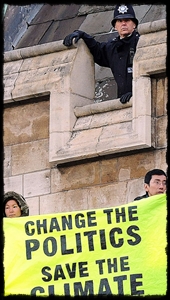 In a recent post Outlook Good: The Shifting Sands of Young Evangelicals and Climate Change, I cited as study that shows how important it is for religious leaders to lead well on climate change issues.
In that light, I was heartened to see a release this week on how the Church of England is asserting itself on environmental issues.
The ‘third sector’ [civil society], including the Church of England, has a crucial role to play in using its voice to increase public demand for government action to make low carbon options available and attractive to the public, the Church said in a press release today.
Government and third sectors will work together over the next five years to tackle key environmental issues such as climate change and sustainable development, according to the vision set out in Shaping Our Future, a new report published this month.
Government and UK civil society and religious organizations have agreed on a joint mission statement for a 5 year plan:
“The third sector shapes the future by mobilizing and inspiring others to tackle climate change and maximizing the social, economic and environmental opportunities of action.”
Stephen Hale, writing in the Third Sector foreword to the Shaping Our Future report, says:
The future is what we make it. The third sector provides the voice for society’s ambitions about the kind of world we want to live in, and has been the engine of progressive change. We secured the right to vote for women, and have won many battles in the struggle for equality and human rights, and against poverty and injustice. Climate change is now the most pressing of the challenges facing humanity. … Climate change is not simply an environmental issue. It profoundly threatens many other causes that the sector holds dear. It threatens the struggle to defeat poverty and inequality in the UK and globally. It threatens our health, our local environment, the cohesion of our communities, and the struggle for peace and security. For all these reasons and more, it is above all an issue of social justice. A step change in our response to this threat is in our interests, and a moral imperative. The transition to a low-carbon economy and society also provides some specific opportunities for the sector; to create resilient communities, new jobs, sustainable public services and a better quality of life. It’s time to seize them.
Of course, making social change from inside the power structure always needs a multi-pronged approach. While the Church of England is working with the government to inspire society toward a lower carbon diet, the Church must also be applying effective shareholder pressure to the mining and oil companies where the C of E holds massive investments.
-
St. Thomas: ‘Anticipate the Needs of the Poor’
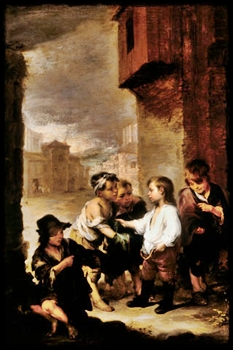
St.Thomas Villanueva (Cincinnati Museum of Art) “If you want God to hear your prayers, hear the voice of the poor. If you wish God to anticipate your wants, provide those of the needy without waiting for them to ask you. Especially anticipate the needs of those who are ashamed to beg. To make them ask for alms is to make them buy it.”–St. Thomas de Villanueva
-
Mario Savio Wrote the Handbook on How to Lead a Successful Student Movement
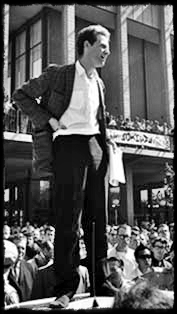
Mario Savio atop police car. I’ve always had an interest in Mario Savio, icon of the 1960s Free Speech Movement and a Catholic. When Savio died in November 1996, I wrote a short news item about him in Sojourners.
In December 1964, after three months of student resistance to the curtailing of political activity on the Berkeley campus, Mario Savio climbed atop a police car and shouted the words that became a preamble to the 1960s’ student movement. Savio’s whole life had prepared him for that pivotal moment. He grew up in Queens, New York, in a strong Italian Catholic family; attended Catholic schools; considered becoming a priest. He trained with the Student Nonviolent Coordinating Committee in Mississippi, saying, “I became involved in the Civil Rights movement because of the one moral principle foundational to my Catholic upbringing: Resist evil.”
In 1964, Clark Kerr, president of the University of California, described the university as a “factory” for filling students’ empty minds. Savio, son of a machine punch operator, responded by putting his body “upon the gears” and stopping the machine. He was arrested and served 120 days in jail, with students ranging from Democratic Socialists to Goldwater Republicans. In the end they secured their rights to free speech and political activity; they went from being children of the “factory” to citizens of the nation. Savio was a leader, a movement friend said, “not because of anger or eloquence but because he spoke with an indelible moral clarity that was rooted in his Catholic faith.”
Last year, Robert Cohen published Freedom’s Orator: Mario Savio and the Radical Legacy of the 1960s, the first comprehensive biography of Savio. Not only does Cohen lay out the groundwork for the education of this thoroughly American radical, but he also gives a generous look at Savio’s commitment in the second half of his life: against “Reaganite Imperialism” in Central America and the corporatization of higher education.
Knowing Mario Savio’s life, strategies, and motivations is necessary for activists leading the new student movements happening on campuses today. Scott Saul published good review (A Body on the Gears) of Freedom’s Orator in this month’s The Nation. Here’s an excerpt from Saul’s analysis:
By necessity [the new Savio biography by Robert Cohen] Freedom’s Orator is a dual biography of a man and his movement, and almost half the book follows less than four months of Savio’s life, the pivotal fall semester of 1964. The [Free Speech Movement] FSM ran what we might call a textbook student-activist campaign in that interval–if we overlook the fact that the textbook didn’t exist yet. President Nixon’s 1970 Commission on Campus Unrest termed militant student protest “the Berkeley invention,” and rightly so, since the FSM pioneered the use of civil rights strategies of direct action in a university setting, demonstrating how such disruptive tactics could mobilize a majority of students and even win the sympathies of a formerly passive faculty.
The FSM had the benefit of a cadre of experienced organizers, many seasoned like Savio in civil rights work, and a university administration that couldn’t shoot straight. What began as a seemingly minor dispute over civil liberties on campus–could students hand out political literature on a twenty-six-foot strip of land owned by the university?–spiraled quickly into a battle royal in which the meaning of the university and American liberalism seemed to be at stake. The central events have since passed into ’60s legend: the seizure of a police car, wherein thousands of students surrounded a police cruiser holding an arrested civil rights activist, immobilizing it for thirty-two hours while speaker after speaker used the car’s roof as their podium; the December 2 sit-in, wherein almost 800 students were arrested after occupying Sproul Hall, the central administrative building, to protest disciplinary action against four movement leaders; and the December 7 Greek Theatre incident, wherein Savio walked onstage to speak to the assembled student body and was immediately grabbed at his throat and arms by police and dragged offstage–an administration fiasco that UC president Clark Kerr called “an accident that looked like fascism.”
In all these events, Savio played no small part in the theater of protest. It was he who first mounted the roof of the police car, taking off his shoes so as not to dent it–a quite sincere act of decorum, though not one that prevented him from comparing the police to Adolph Eichmann (they all “had a job to do”). It was Savio who, before the sit-in, famously urged students to put their “bodies upon the gears and upon the wheels, upon the levers, upon all the apparatus, and…make [the machine] stop”–updating Luddism for the age of the Organization Man. And it was Savio who, at the Greek Theatre, publicly offered his own body to the cause, making his “machine” speech seem much more than mere metaphor.
Read Scott Saul’s complete review here.
-
T.R. Reid: Universal Health Care Reduces Abortion Rate
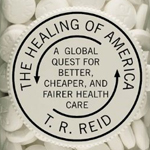 T.R. Reid, a longtime correspondent for The Washington Post and regular commentator for NPR, published a great Op Ed in Sunday’s Post (Universal health care tends to cut the abortion rate) on why people who want to lower abortion rates in the United States should be 100% in support of universal health care.
Writes Reid: The latest United Nations comparative statistics, available at http://data.un.org, demonstrate the point clearly. The U.N. data measure the number of abortions for women ages 15 to 44. They show that Canada, for example, has 15.2 abortions per 1,000 women; Denmark, 14.3; Germany, 7.8; Japan, 12.3; Britain, 17.0; and the United States, 20.8. When it comes to abortion rates in the developed world, we’re No. 1.
Reid, who is also a Catholic, has been researching health-care systems in industrialized countries for several years in preparation for his book The Healing of America: A Global Quest for Better, Cheaper, and Fairer Health Care. Reid includes has a very lovely story in his commentary about Cardinal Basil Hume, who was the senior Roman Catholic prelate of England and Wales when Reid lived in London.
Writes Reid: In Britain, only 8 percent of the population is Catholic (compared with 25 percent in the United States). Abortion there is legal. Abortion is free. And yet British women have fewer abortions than Americans do. I asked Cardinal Hume why that is.
The cardinal said that there were several reasons but that one important explanation was Britain’s universal health-care system. “If that frightened, unemployed 19-year-old knows that she and her child will have access to medical care whenever it’s needed,” Hume explained, “she’s more likely to carry the baby to term. Isn’t it obvious?”
Now, I take a little issue with Reid when he argues “The failure to recognize this plain statistical truth may explain why American churches have played such a small role in our national debate on health care. Searching for ways to limit abortions, our faith leaders have managed to overlook a proven approach that’s on offer now: expanding health-care coverage.” From my location, American churches have been extremely involved in our national health-care debate, especially the Catholic church. But I appreciate his summary of why universal health-care is an issue rooted in basic moral values that nearly everyone can support for the common good.
Writes Reid: When I studied health-care systems overseas in research for a book, I asked health ministers, doctors, economists and others in all the rich countries why their nations decided to provide health care for everybody. The answers were medical (universal care saves lives), economic (universal care is cheaper), political (the voters like it), religious (it’s what Christ commanded) and moral (it’s the right thing to do). And in every country, people told me that universal health-care coverage is desirable because it reduces the rate of abortion.
It’s a great piece, read the whole thing here.
-
Video: Salvadoran Archbishop Romero Last Sunday Sermon (The Appeal to Soldier to Lay Down Their Guns)
Here’s a very moving 3-minute video of images (some graphic) from El Salvador’s war and the voice over of Archbishop Romero’s last Sunday sermon on March 23, 1980, in which he appeals to the members of the Army to put down their weapons. Romero was shot and killed while celebrating Mass the following day.
The 30th anniversary of Romero’s assassination will be in March 24, 2010. I’ll be interviewed on NPR’s Latino USA by Maria Hinojosa with Salvadoran theologian Ernesto Valiente who teaches at Boston College. The English translation of an excerpt of Romero’s sermon is below the video.
Archbishop Romero:
“We want to greet the entities of YSAX, which for so long have awaited this moment which, thanks to God, has arrived. We know the risk that is run by our poor station for being the instrument and vehicle of truth and justice, but we recognize that the risk has to be taken, for behind that risk is an entire people that upholds this word of truth and justice….We give thanks to God that a message that doesn’t mean to be more than a modest reflection of the spoken Word finds marvelous channels of outreach and tells many people that, in the context of Lent, all of this is preparation for our Easter, and Easter is a shout of victory. No one can extinguish that life which Christ revived. Not even death and hatred against him and against his Church will be able to overcome it. He is the victor!
As he will flourish in an Easter of unending resurrection, it is necessary to also accompany him in Lent, in a Holy Week that is cross, sacrifice, martyrdom; as he would say, “Happy are those who do not become offended by their cross!” Lent is then a call to celebrate our redemption in that difficult complex of cross and victory. Our people are very qualified, all their surroundings preach to us of cross; but all who have Christian faith and hope know that behind this Calvary of El Salvador is our Easter, our resurrection, and that is the hope of the Christian people….
Today, as diverse historical projects emerge for our people, we can be sure that victory will be had by the one that best reflects the plan of God. And this is the mission of the Church. That is why, in the light of the divine Word that reveals the designs of God for the happiness of the peoples, we have the duty, dear brothers and sisters, to also point out the facts, to see how the plan of God is being reflected or disdained in our midst. Let no one take badly the fact that we illuminate the social, political, and economic truths by the light of the divine words that are read at our Mass, because not to do so would, for us, be un-Christian….
-
Beltway Buzz: D.C.’s Fancy Bees and the ‘First Beehive’ at 1600 Pennsylvania Ave
 Bees bring joy to life. The more bees there are in the District of Columbia the better off we’ll be. First Lady of Cool Michelle inaugurated the First Beehive last year at the White House along with the First Organic Garden. DCist blogger Vanessa Schipani has a nice update on how those Obama Bees are going. (My favorite part is that White House beekeeper Charlie Brandts rides the subway with his buzzy little friends. Ah yes, it recalls the psalm, ” They surrounded me like bees, they blazed like a fire of thorns” 118:12.)
White House beekeeper Charlie Brandts has transported more than one thousand bees using Metro — on more than one occasion. Brandts was the guest speaker at the D.C. Department of Parks and Recreation urban beekeeping course last Monday, the second class in a series of four. A carpenter for the White House, Brandts keeps bees at his home in Maryland. When President Barack Obama got word about Brandts’s hives, a green-eyed commander in chief asked Brandts to set up one for the White House — the First Beehive. In its first full year’s harvest, the hive produced a considerable amount of honey — all told, around 134 pounds — went into the Obama family’s bellies. Fresh honey is delicious, no doubt, but Obama had other, less hedonistic, reasons for harboring thousands of stinging insects next to his organic garden: Bees are pollinators, and bees are dying. A worldwide disappearance of honeybees, known as colony collapse disorder, is thought to result from a combination of disease and environmental factors. …
Urban hives produce exquisite honey. It’s extremely unique and flavorful because the bees collect nectar from myriad types of flowers that grow in our backyards and parks. This is another reason bees should have a home in our cities, especially DC, which has more floral variety than you might imagine. As for living and working alongside a potential enemy — bees will sometimes sting people, of course — it shouldn’t be an issue in a city for which division and acrimony is a cottage industry. As Brandts said, “Bees are more interested in nectar than politics.”–Vanessa Schipani (Read the whole piece here.)
In other news, the luxury hotel chair Fairmont is housing bees on their hotel rooftops around the world, including here in downtown D.C.’s West End neighborhood. So sweet!
In response to the nation’s Honey Bee shortage and as part of the Fairmont Washington DC’s environmental stewardship program, the hotel has recently welcomed 105,000 Italian honey bees to their new home. The rooftop of The Fairmont Washington, DC is now abuzz with three honey beehives and their residents. The bees will enhance the hotel’s culinary program along with its interior courtyard garden that already provides fresh herbs and flowers such as edible pansies, and the plants, trees and flowers in the surrounding West End neighborhood.
-
Subscribe
Subscribed
Have a WordPress.com account? Log in now.

