-
News Flash:Palestinians Allowed to Travel to Jerusalem for Easter
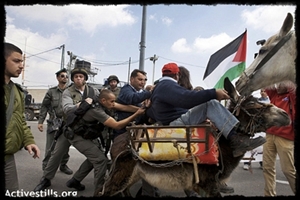 The Israeli Embassy has confirmed this afternoon with Sojourners that travel restrictions preventing Palestinian Christians from entering Jerusalem for Holy Week and Easter have been lifted.
[UPDATE since this story was first posted at 5pm 3/31/2010 : According to representatives from Holy Land Trust, two staff members of which are still in prison after a nonviolent demonstration against such restrictions: By “lifting” travel restrictions from the West Bank to Jerusalem, Israeli officials are merely referring to ending a total curfew imposed a few days ago on access even to people previously granted selective permission to get into Jerusalem. This does not mean that all Palestinian Christians are now allowed entry into Jerusalem to freely celebrate Easter. This only means that Christians who applied for a permission (not all did or could) and who got one (not all did or could) can now take advantage of the permission (if they got it) that “allows” them to enter from one occupied territory into another through the long and humiliating process of going through the checkpoints. Even then, restrictions have already been put in place on access to the Old City for the Holy Fire service on Holy Saturday, which is the most important ceremony for the Greek Orthodox and the Eastern rite communities. Israeli army radio reported 10,000 permits were granted this year; not even a quarter of the Christians in the West Bank. ]
This afternoon, Rev. Michael Kinnamon, the General Secretary of the National Council of Churches, received a telephone call from Dr. Michael Oren, Israel’s Ambassador to the United States, stating that travel restrictions that prevented Palestinian Christians from visiting Christian sacred sites in Jerusalem were at least temporarily lifted.
“I received a call from (Oren) indicating he had been in touch with Israeli officials,” said Kinnamon in a press release, “and that they have now assured him that travel restrictions on Palestinian Christians from the West Bank have been lifted for Easter — and that we should notify him directly if there are reports from check points that these orders are not being followed.”
NCC press secretary Philip Jenks told Sojourners that Rev. Kinnamon had sent a letter to the Middle East Council of Churches notifying them of the phone call. The letter stated:
“The National Council of Churches in the USA has been deeply disturbed with reports of travel restrictions on Christians from the West Bank who may try to reach Jerusalem for Easter-related events and services. In that regard we enlisted the help of Jewish leaders in the United States, and they urged the Israeli government to rethink this policy.
On Wednesday morning I received a call from Israeli Ambassador to the U.S., Michael Oren, indicating that he had been in touch with Israeli officials and that they have now assured him that travel restrictions on Palestinian Christians from the West Bank have been lifted for Easter — and that we should notify him directly if there are reports from check points that these new orders are not being followed.”
Joshua Silverberg, press secretary for the Israeli Embassy in Washington, D.C., confirmed that the facts of this announcement were true and consistent with what the Ambassador had conveyed. Sojourners has not yet been able to confirm with Palestinian Christians or the Ecumenical Accompaniment Teams if the checkpoints are open.–by Rose Marie Berger
Rose Marie Berger, an associate editor at Sojourners, blogs at www.rosemarieberger.com. She’s the author of the forthcoming book Who Killed Donte Manning?: The Story of an American Neighborhood (Apprentice House, April 2010).
-
Australia: What Does Resurrection Look Like Down Under?
I was glad to see the blog post by Australian Christian Jarrod McKenna with a video of four Christian peace activists who entered Swan Island, one of Australia’s most secret military installations near Queenscliff, Victoria, in March seeking to disrupt the supply chain for the war in Afghanistan. “Both Swan Island and the war on Afghanistan are out of sight, out of mind. It’s time to end further suffering of the Afghan people and our soldiers by bringing our troops home,” the group said.
Said McKenna, “The kairos moment during Holy Week is a moving meditation on a man who taught and lived the nonviolence of the cross in ways that socially witnessed to resurrection. This is made all the more potent for those of us in Australia given the courageous actions of The Bonhoeffer Peace Collective who yesterday with a fierce nonviolent love exposed further connections of the Australian government with the war in Afghanistan.”
Watch the video:
Bonhoeffer 4 Trailer from julian masters on Vimeo.
Rev. Simon Moyle (Baptist Minister), Jacob Bolton (Community Worker), Jessica Morrison (University Lecturer) and Simon Reeves (Social Worker) have called themselves the Bonhoeffer Peace Collective after Australian Prime Minister Kevin Rudd’s favorite theologian Dietrich Bonhoeffer, who was also an antiwar activist.
-
Watch ‘MLK: A Call to Conscience’ on PBS Tonight
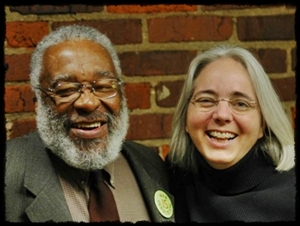
Dr. Vincent Harding and Rose Berger “MLK: A Call to Conscience” premieres on PBS tonight, March 31, 2010 at 8 p.m. (check local listings). “Tavis Smiley Reports” will delve into one of Dr. Martin Luther King, Jr.’s greatest speeches, “Beyond Vietnam: A Time to Break Silence,” which he delivered on April 4, 1967, at Riverside Church in New York City.
Smiley will also interview the speech writer Dr. Vincent Harding, who is also a Sojourners contributing editor, about his role in the civil rights movement and the circumstances that resulted in King’s first major anti-war speech.
In the “Riverside speech,” Dr. King decisively and publicly expands his ministry to include opposition to the U.S. war against Vietnam. He was vilified for this move by his “friends” as well as his detractors. The Riverside speech, which names the sickness eating the American soul as “the giant triplets of racism, extreme materialism, and militarism,” was a watershed moment in American history. A year later, to the day, Dr. King was assassinated.
I was honored to interview civil rights leader and historian Dr. Vincent G. Harding on this topic for Sojourners back in 2006 (see Dreaming America). He said he’d written the speech written over his Christmas vacation in 1966. King made a few minor changes but essentially delivered Harding’s original text.
In tonight’s PBS special, which will also include interviews with Susannah Heschel and Cornel West, Tavis Smiley will examine the context of Dr. King’s words on liberty, responsibility and freedom, against the backdrop of the fight for civil rights and an increasingly unpopular war, and examine the implications of his words today, particularly in light of President Obama’s decision to increase U.S. troops in Afghanistan.
-
Nonviolence: What About Hitler?
 In any in-depth conversation about the effectiveness of nonviolence as a strategy, this question always comes up: Would these nonviolent strategies have worked against the Nazis? What about Hitler?
Even the great Mohandas Gandhi – progenitor of modern nonviolence – knew that nonviolence against Hitler would cost many lives.
“The doctrine of Satyagraha works on the principle that you make the so called enemy see and realize the injustice he is engaged in. It can work only when you believe in God and the goodness of the people to see that they are wrong. As a satyagrahi, I do believe that non-violence is a potent weapon against all evils. I warn you however, that the victory will not come easy- just like it will not come easy with violent methods such as fighting with weaponry.”
(Also read Gandhi’s 1939 letter Is Non-Violence Ineffective? on the actions of Martin Niemoeller and the Confessing Church.)
Jørgen Johansen, a lecturer in conflict studies, has led nonviolence trainings in Israel, Mozambique, India, and Chechnya. He recently posted an essay called Hitler and the Challenge of Non-Violence that briefly takes on this issue.
“What effect could nonviolence have had against Hitler?” says Johansen. “This is one of the most frequent questions I get when I lecture on nonviolence. And it is a good one. To answer we need to look at different phases of the conflict and recognise the complexity of a world war.”
Below is an excerpt:
The German army was well prepared to meet armed resistance, but less able to cope with strikes, civil disobedience, boycotts and other forms of nonviolent action. A famous example is when the Norwegian teachers were told to join the Nazi party and teach Nazism in schools or face the consequences. When 12,000 teachers signed a declaration against the new law, 1000 were arrested and sent to prison camps. But the strike continued and after some months the order was cancelled and they were allowed to continue their work. In a speech, Quisling summarised: “You teachers have destroyed everything for me!” We can just imagine what would have been the consequences if many professions had followed in the footsteps of these teachers. Or if they had prepared such actions well in advance and even had exercises prior to the invasion.
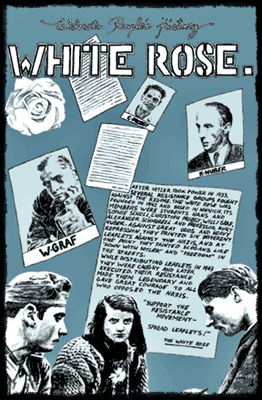
Independent news is crucial for any opposition movement. That is why censorship is enforced when a regime wants to control the masses. Despite threats of brutal punishment, illegal newspapers were published by many clandestine groups in occupied territories during WWII. In France the first leaflet was published as early as September 1940. In Munich, the “White Rose” students initiated a leaflet campaign from June 1942 to February the following year calling for active opposition to Hitler’s regime. The original group was arrested and executed but later their manifesto was distributed in Scandinavia and the UK and even dropped over Germany from Allied planes. What would have been the result of such actions if they had been well planned and executed in most cities suffering under German atrocities?
Despite massive propaganda and brutal punishment for those who refused to take part, many opposed this genocide. In Denmark almost all Jews survived because they were helped by the resistance movement to escape to Sweden and avoid the gas chambers.
In Bulgaria most of the country’s 48,000 Jews were saved when leaders of the Orthodox Church and farmers in the northern stretches of the country threatened to lie across railroad tracks to prevent Jews from being deported. This pressure encouraged the Bulgarian parliament to resist the Nazis, who eventually rescinded the deportation order, saving almost all of the country’s 48,000 Jews.
Even in Germany itself people opposed the arrests. In one famous example 6000 “Aryan” German women took part in a nonviolent protest in February and March 1943, outside the prison in Rosenstrasse in Berlin, to get their Jewish husbands and friends released. Thanks to these brave women 1700 prisoners were indeed released. These examples illustrate that some groups have more impact than others. It was difficult for the Nazis to attack German women.
Read Johansen’s whole article here.
-
Why Was I Carrying an M-16 in the Garden of Eden?
This was the question that prompted one American soldier to question his conscience while fighting in Iraq: Why was I carrying an M-16 in the Garden of Eden? From this question and others like it a Truth Commission on Conscience in War developed that draws on soldiers, religious leaders, philosophers, ethicists, historians, and others to lead a public conversation on freedom of conscience in time of war.
Watch the video trailer to learn more:
Check out the incredible group of veterans and experts who testified at the March 21-22 public hearing at Riverside Church in New York.
The Truth Commission on Conscience in War, a national gathering of community and religious leaders, advocacy groups, and artists, will receive personal testimony from veterans and briefings from expert witnesses about:
* moral and religious questions facing soldiers both before and during combat
* moral and religious criteria of just war
* international agreements governing the justification and conduct of war
* limits of military regulations on Conscientious ObjectionTruth Commission proceedings will launch conversations about just war, international law, and greater freedom of conscience for our nation’s service members, conversations led by the Commissioners.
What are others saying about the Commission on Conscience in War?
One of the issues we wrestled with throughout the apartheid years was that of military service (a minimum of two years required of all white male youths), as well as issues of just war, just revolution, and the defensive use of violence. One of the struggles the End Conscription Campaign waged was to try and get the state to recognize the moral rights of persons who might not necessarily be pacifists, to refuse to fight in certain conflicts. I applaud the effort of the Truth Commission on Conscience in War and wish you every success.–Rev. Prof. Peter Storey, former President of the South African Council of Churches
This Truth Commission, rather than focus on troop deployments or withdrawals, has been designed to step back and ask the most important questions: Are the wars in Iraq and Afghanistan just? Are they permissible under international law? Are they moral? And if they are not, as I believe they are not, what are the options for a person of conscience serving in uniform?–Mr. Chris Hedges, Pulitzer-prize-winning war correspondent for The New York Times and author of War is a Force That Gives Us Meaning
I am heartened by this conversation between those whose faith commitment leads them to nonviolence and those who adhere to a just war ethic. This is not always an easy conversation, but it is a vital conversation for our common ground far exceeds our differences.–David B. Miller, Associate Professor of Missional Leadership Development, Associated Mennonite Biblical Seminary
Giving testimony – and bearing witness. These are practices as old as the hills and as needed today, in the midst of two wars, as much as they have ever been. Let’s hear the voices of the traumatized echo in our midst – and be moved to justice anew for all who serve in the armed forces and willingly sacrifice on our behalf. –Rev. Dr. Serene Jones, President of Union Theological Seminary and author of Trauma and Grace
Since the wars in Iraq and Afghanistan dominate much of current U.S. foreign policy, I cannot think of a more timely moment for this Truth Commission. It holds the promise of bringing moral ideas too often hidden in narrow academic circles into a setting of lively public discourse, thereby making a principled contribution to an urgent, fractious national debate. The focus on conscientious objection centralizes the core question of individual, citizen moral rights in relation to the practical interests of the nation-state.–Rev. Dr. Traci C. West, Professor of Ethics and African American Studies, Drew University Theological School
Current requirements for Conscientious Objector status require opposition to “war in any form.” This requirement denies freedom of conscience to any service member who believes that some wars may be morally justified while others are not. Service members who oppose a particular war, such as those in Iraq or Afghanistan, have no legal basis for refusing to deploy. Instead, they face sanctions, and even court martial and prison for following their conscience.
The rightful place of Christians an the Church is beside these men and women as they make painful and liberating decisions of conscience. Where does your church stand?
-
What Palm Sunday Really Looks Like – Even the Donkey Got Arrested
After Jesus had said this, he went on ahead, going up to Jerusalem. … As he rode along, people kept spreading their cloaks on the road. As he was now approaching the path down from the Mount of Olives, the whole multitude of the disciples began to praise God joyfully with a loud voice for all the deeds of power that they had seen, saying, “Blessed is the king who comes in the name of the Lord! Peace in heaven, and glory in the highest heaven!” Some of the Pharisees in the crowd said to him, “Teacher, order your disciples to stop.” He answered, “I tell you, if these were silent, the stones would shout out.”–Luke 19:28

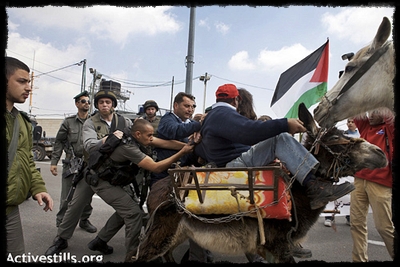
Protesters crossed the main gate in the separation wall between Bethlehem and Jerusalem on Palm Sunday 2010. Around 200 Palestinians, Israelis, and internationals walked from the Nativity Square toward Jerusalem, against the restrictions imposed by the Israelis. These restrictions were tighter than usual and directed toward the right to worship as many Christians will not be able to go to Jerusalem to celebrate Easter.
The crowd managed to outnumber and surprise the Israeli soldiers and security forces at Bethlehem checkpoint and managed to walk through. After having walked 300 meters on the road to Jerusalem, they were stopped by Israeli soldiers. After having declared the march over and as they were walking back to Bethlehem, Israeli soldiers attacked the crowd and arrested around 15 persons, among them a Palestinian cameraman, an Israeli photographer, members of the popular committee from Al Ma’sara, and staff from Holy Trust.
Here’s one account:
“More than 100 native Palestinian Christians and Muslims and internationals including Israelis, breached the tight security separating the Palestinian cities of Bethlehem from the occupied city of Jerusalem. Donkeys and people both were arrested! We were initially some 150 strong and started from the Church of Nativity at 11:45 AM carrying palm leaves and banners asking for freedom of worship and movement (as demanded by international law). The demonstration included individuals riding 2 donkeys and a horse. Appropriate since Jesus entered Jerusalem on a donkey. Like him, we knew this was not going to be an easy entry but we did believe in the goodness of humanity. We arrived at the main gate used for tourist buses at around 12:30 p.m. and decided to just keep going. The few soldiers and police at the gate tried to close it but we managed to get in and the huge 8 meter high metal gate stopped half way, perhaps as a safety mechanisms since there were dozens of people passing and they could be crushed if it continued.
The Israeli security forces tried to close other fences but we kept going. As word reached their offices, the Israeli army was mobilizing its forces and soon several army jeeps arrived and blocked the road half way between the gate and Deir Mar Elias (the monastery at the edge of the city). They blocked our way.
Ibrahim Salah riding his donkey was speaking to them in Hebrew and saying why can’t we go to Jerusalem. It is our right to travel. He was the first to be violently knocked down off his donkey and arrested. The next was an American girl, then some Palestinians. All were violently wrestled to the ground when even many were just peacefully walking back to the gates. It seemed like a calculated move to punish some of us so that others get the message not to try this again.
Some 60 of us ended up being rounded up in between a wall, a hill, a gate, and a cordon of police officers. We all expected to be arrested. The occupation soldiers instead plucked random people that they thought were the key people.
We had significant local and national and international media coverage. The people are willing to pay the price. Israeli forces released 4 Israelis and the one American student. They kept 11 Palestinians that they kidnapped and are charging them with “incitement”, “participating in an unauthorized demonstration” “entering ‘Israel’ without a permit “, and “interfering in police business”.
Oh and yes, a donkey and a horse belonging to Ibrahim were also arrested by the mighty army of apartheid Israel for they too need permits from the Israeli military to get in.
-
Holy Week: Merton’s Hope in the Cross
 This, then, is our desert: to live facing despair, but not to consent. To trample it down under hope in the Cross. To wage war against despair unceasingly. That war is our wilderness. If we wage it courageously, we will find Christ at our side. If we cannot face it, we will never find Him. –Thomas Merton
Thoughts in Solitude by Thomas Merton (Farrar, Straus and Giroux, 1999, p. 8).
-
‘Defensiveness and Self-Protection Are Not Gospel Values’
 On Saturday’s Weekend Edition, NPR host Scott Simon talked with John Allen, who reports on the Roman Catholic Church as a senior correspondent for the National Catholic Reporter on the Vatican facing renewed pressure amid charges that Pope Benedict XVI mishandled priest sex abuse cases while serving as archbishop of Munich in the 1980s. Allen calls the scandal “unprecedented” and a “global crisis.” (Listen to the interview here.)
When Simon asked how this scandal has affected Mass-going, financial donations, or dioceses spinning off from the Roman church, Allen responded:
From the beginning of this crisis there has always been the fear that this is going to cause some kind of fundamental rupture that is that it will cause the large number of people to stop going to Mass, it will cause large numbers of Catholic to stop making financial contributions to the church, and that some of them may decide to opt out of the system all together and create a parallel church.
To date the empirical evidence that we have is that really has not happened. At the end of the day the reason for that is fairly simple: Most typical Mass-going Catholics learned a long time ago to make a distinction between what their faith is really based on — which is God, the encounter with Jesus Christ, the supernatural dimension of the church — to distinguish between that and the very fallible human beings who at any given time may be running the show.
Additionally, Washington Post columnist E.J. Dionne Jr. wrote How the Catholic Church Could End Its Sex Scandal in which he said:
The church needs to show it understands the flaws of its own internal culture by examining its own conscience, its own practices, its own reflexives when faced with challenge. As the church rightly teaches, acknowledging the true nature of our sin is the one and only path to redemption and forgiveness.
Of course, this will not be easy. Enemies of the church will use this scandal to discredit the institution no matter what the Vatican does. Many in the hierarchy thought they were doing the right thing, however wrong their decisions were. And the church is not alone in facing problems of this sort.
But defensiveness and institutional self-protection are not Gospel values. “For whoever wants to save his life will lose it, but whoever loses his life for me will find it.”
The church needs to cast aside the lawyers, the PR specialists and its own worst instincts, which are human instincts. Benedict could go down as one of the greatest popes in history if he were willing to risk all in the name of institutional self-examination, painful but liberating public honesty, and true contrition.
Read Dionne’s whole article here.
-
Radio Interview: The Legacy of Oscar Romero
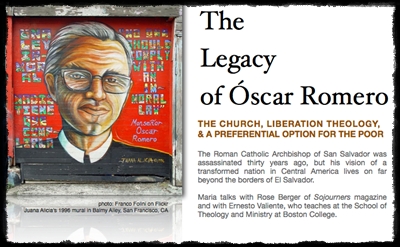
If you get a chance listen this weekend to my interview on NPR’s Latino USA on the 30th anniversary of Archbishop Romero’s assassination. It was a wonderful conversation with host Maria Hinojosa and theologian Ernesto Valiente on Romero’s legacy and also the current state of liberation theology. It was fun to have the radio tech come to the Sojourners office and set up the recording equipment for the phone interview. I was nervous about it — but Maria was lovely and put both Ernesto and I at ease. I’m grateful to my friend Sean Collins for helping arrange the whole thing.
You can listen to the interview from the LatinoUSA Web site or check your local NPR listings to hear it on the radio.
****
Sojourners Magazine Listen to Sojourners associate editor Rose Marie Berger and theologian Ernesto Valiente speak with NPR’s Latino USA about El Salvador’s Archbishop Oscar Romero and the current state of liberation theology: http://su.pr/2iI0rd
-
Video: Join the 200,000+ Who Marched for Immigration Reform
For those of you who couldn’t be in Washington, D.C., last weekend for the pro-immigration reform rally, here’s a 2-minute video.
I helped lead the Sojourners worship service in the morning, then spent the rest of the afternoon on the Mall people-watching and selling SojoSwag.
-
Subscribe
Subscribed
Have a WordPress.com account? Log in now.

