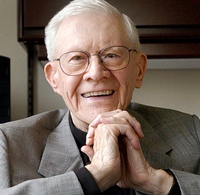
This has been a week of illness and loss among our community of elders:
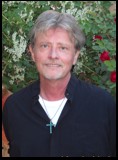
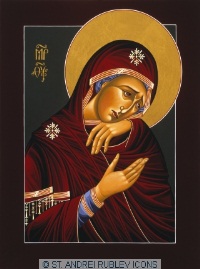
Fr. Bill McNichols, the iconographer of Taos, had a massive heart attack on Friday, April 27. He’s on total life support in Albuquerque. Bill is the artist behind the beautiful icons that many of us have. (This news came from John Dear through Shelley and Jim Douglass.)
Walter Wink (right, with June) broadly considered one of the most important social and political theologians of the 20th century, is in hospice care and is likely to pass within the next few days. Walter’s series of books on the “powers” — Naming the Powers, Unmasking the Powers, and Engaging the Powers — unpacks the spiritual significance of political and societal institutions (the biblical “principalities and powers”) and their role in systemic injustice. (Read Sojourners 2010 interview.) (This news came from June Keener Wink through Bill Wylie Kellermann.)
Fr. Bill Shannon, founder of the International Thomas Merton Society, died on Sunday. Bill was an adamant reformer in the tradition of Vatican II and a professor of theology to several generations of radical Catholics. You can read Bill’s obituary here. “It’s not only fair, but right, to describe him as a prophet,” said Christine Bochen, professor of religious studies at Nazareth College. “A prophet sees clearly what Scripture is calling us to. He took very, very much to heart to see beyond the concerns of institutionalism and formalism, to get at the very heart of what it means to be a Christian—and that is to embrace the Gospel and live the Gospel.” (This news came from Michael Boucher of Word and World.)
This week the Rolling Ridge Study Retreat Community in West Virginia is grieving the loss of two of its early visionaries, founders, and members: Ellen Peachey and Verle Headings.
Verle Headings (left, with Jannelle Hill and Dr. Carolyn Broome), died early Friday morning, April 27 in his home at Rolling Ridge after a three month struggle with illness. His wife Vivian was with him. Verle said more than once that he planned to “die on this mountain,” and so he has. Verle taught genetics at Howard University for many years and was a leader in the Mennonite community and friend to many at Sojourners. (This news came from Bob Sabbath and the Rolling Ridge Community.)
Ellen Shenk Peachey died on Thursday, April 26, in Harrisonburg, Virginia. Ellen is the great-aunt of Sojourners’ Larisa Friesen Hall and a friend of many at Sojourners. Ellen spent years living in Europe and Japan doing post-war relief work of reconstruction and peace building through the auspices of the Mennonite Central Committee. She lived in Washington, D.C. for 25 years as a member of Hyattsville Mennonite Church and, with her husband Paul, were the first permanent residents of the Rolling Ridge Study Retreat Center in West Virginia where they lived for 14 years. Of their years at Rolling Ridge, Ellen said, “Our 15 years of living here at Pinestone have been rewarding. Guidelines that emerged in our monthly meetings during the early decade—simplicity, use of on-site materials, low profile, solar heating, adaptability—took shape in this modest cottage.” (This news came from Larisa Friesen Hall, Bob Sabath, and the Rolling Ridge Community.)
“Pray for the dead. Fight like hell for the living.” –Mary Harris Jones
The author of The Glorious Art of Peace says history is usually studied and written from the perspective of war, and can look very different when viewed from the perspective of peace. The author John Gittings was part of the UK’s nuclear disarmament movement and an editor and writer for The Guardian. He’s also associate editor of The Oxford International Encyclopaedia of Peace. Here’s an excerpt from an interview with Gittings from The Browser:
Your book tours us through peace “from the Iliad to Iraq.” What core point did you most want to get across with it?
What I wanted to get across is that there is more than one perspective from which one can look at history. A lot of our history has been written from the perspective of war, and the moment you start looking at it from the perspective of peace, you get very different answers. That is why I began with “The Iliad,” because most people would regard it as a tale of war and not of peace.
You wanted to draw particular attention to Book 18 – why?
I would say, first of all, that throughout “The Iliad” there is a counter-narrative of lost opportunities for peace. Obviously, if peace had been achieved there would have been no Trojan war or it would have come to an end sooner. But Homer reminds us from time to time that there were alternatives. There’s a very remarkable scene in book two, near the beginning, when the entire Greek army, misunderstanding a speech by their commander Agamemnon, turns on its heels and runs to the boats, hoping to go back home. Homer is telling us that the rank and file were not bent on fighting to the end. The gods, on that occasion, intervene to stop the Greek army from sailing away. Even the wily Odysseus is unable to stop his men from launching their boats.
Book 18 is significant because it describes the making of a new shield for Achilles, who had withdrawn from battle. His friend Patroclus had borrowed his armor in his place and been killed, and his armor had been seized by the Trojans. So Achilles needed a new suit of armor, which was made for him by the heavenly blacksmith Hephaestus. If you read other accounts of Greek warriors, what you put on your shield is invariably something to frighten the enemy – a Gorgon’s head or a serpent or a wild lion. Homer instead describes a set of images on Achilles’ shield, almost all of which are concerned with peace not war – including young men and women dancing, laborers in the field bringing in the harvest grapes or plowing the fields, and a council in which a case is arbitrated by peaceful means. This assembly of images, in my view, is designed to tell us that there is, or should be, a peaceful alternative to war.
So Homer, or whoever wrote “The Iliad,” had a peace agenda?
This is also an example of the passages in Homer which lead me to believe he was a single individual, because if it was stitched together from epic material then a scene such as the above would not appear – there would be stock images of a much more conventional shield instead. Homer, like Shakespeare, encompassed all humanity in his work, and in “The Iliad” he encompasses peace as well as war. A number of Homeric scholars have pointed out that the text, as we have it, is divided roughly into three thirds. The central third is almost entirely concerned with war and fighting. But the first third, where the plot is developed, is very different, and so is the final third. So the subject matter of “The Iliad” is war, but the feelings and emotions of the people concerned are much more complex.
My buddy Mari Castellanos’ commentary A Supreme Case for the Court is a good preparation for the Supreme Court hearings on the racist anti-immigrant laws in Arizona.
I call the laws “racist” and “anti-immigrant” because they are. But there are legitimate questions that need to be raised about overhauling our immigration system so that it responds humanely to new needs and the massive migrations that are happening around the world. The current spate of “anti-immigrant” laws are rooted in views of “scarcity of resources” and histories of white supremacy.
How can the church model a way of approaching these issues rooted in human dignity and a love that drives out fear? Read Mari’s whole post, and below is an excerpt:
On Monday April 23rd, the Supreme Court will begin to hear oral arguments in a landmark case, State of Arizona v. United States, which challenges the authority of a state to enact its own immigration enforcement laws instead of following federal regulations. On the surface, this case is about a state usurping a federal power. Underneath the surface it is about a lot more.
At the heart of the Arizona legislation are some dangerous provisions that we had hoped to be done with in this country—at least legally, if not in practice as many of us know. A key provision requires any law enforcement officer to verify the immigration status of every person stopped or detained, regardless of how trivial the infraction, if the officer has a reasonable suspicion that the person may be in the country illegally (Section 2B). Reasonable suspicion, one can just as reasonably assume, may be triggered by dark skin, short stature, or poor English language skills. If a person fails to yield the right of way, she or he can be assumed to be an illegal alien and arrested, if the person has no identification other than a driver’s license. Under similar circumstances, most people would receive merely a citation. Persons who “look Latina/o” and have no immigration papers will go to jail. It is also a crime, under Arizona law, for people who fail to carry their “alien registration document” (Section 5C). One could be justified in thinking that Arizona has legalized racial profiling. Similar, if not more insidious laws have been enacted by other states, such as Utah, Alabama and South Carolina. ….–Mari Castellanos, United Church of Christ
Abbot Philip is part of Christ in the Desert monastery in Abiquiu, New Mexico. I’ve visited there only once and it was a profoundly transforming experience. He writes:
One of the great challenges of the spiritual life is that of accepting ourselves as we are, even when others may not understand us nor accept us.
Each of us must walk a path of righteousness, seeking to do what is right in our own lives and in the lives of our families or communities. That sounds, as always, fairly simple. It never is. Why is it that others always have the answers to our lives when they seem unable to navigate well in their own? Why is it that others think that they should be able to make the decisions in our lives? These are questions that are asked of me from time to time. I see these questions played out in our own community and in relationships. In a monastic community, we get used to having others involved in our lives. It is part of living in community.
We monks are never to make decisions just by ourselves. Married couples are supposed to do the same thing in their family lives. Even the abbot cannot make decisions in a totally autonomous manner in the monastic life. I have to consult a Council or a Chapter on almost every important decision. It is not just that I have to do that, it is also that doing so is a real help in living the monastic life and serving a community.There are times when the advice or the votes of the Chapter or Council are not what I want to hear. There are times in a marriage when one spouse really does not want to listen to the other. That is the nature of advice.
If we always agreed with one another, there would be not much need to listen to one another. Ultimately, of course, each of us must make his or her own decisions when they are decisions of the deepest levels of our lives. We must listen carefully first, we must weigh carefully all that is told to us—and we must make a decision. Most of the time in the spiritual life, we are not making earth-shattering decisions. I do not have to decide every day that I am going to remain a monk! I do not have to decide every day that I will try to pray! Daily spirituality is mostly about trying to do well the things that I have already decided to do. That is why it can get so very boring at times! There are times in everyone’s life that an important decision must be made. My personal experience is that those types of decisions have become less and less as I mature. There are decisions that I must make in my own life, but they are not the direction setting decisions of my younger years.
Now it is a matter of faithfully living out what I have promised and decided. For me, this is one of the reasons that life is more peaceful as I mature. One decision builds on top of another. If the first decisions are well made and strong, everything built on them remains strong. Sometimes I see people struggling so very much because they have never made good decisions. Or they made good decisions and later abandoned them. I certainly wavered about lots of decisions when I was younger, but in due time I reaffirmed those decisions and kept on the path which they indicated. Spiritually, it is very important to make good decisions, especially about the most important things in life. With good decisions, we have something on which our lives can be built.–Abbot Philip, OSB (The Abbot’s Notebook for Wednesday Apr 18, 2012)
photo by Ben Curtis“It’s much easier to condemn the world than to help save it, much easier to say what you disapprove of than to go and do something useful. ‘In the evening of life you will be examined in love,’ said St. John of the Cross. What you have condemned won’t figure on the exam paper at all–it’s the wrong subject. ‘Those who believe in him are not condemned’ [John 3]. The word ‘belief’ comes from an old word, ‘lief,’ now obsolete, meaning ‘love.’ There cannot be real belief without love.”–Living With Christ(April 18)
“The way to find the real ‘world’ is not merely to measure and observe what is outside us, but to discover our own inner ground. For that is where the world is, first of all: in my deepest self.”–Thomas Merton
My friend Joseph Ross has released his first collection of poems titled Meeting Bone Man from Main Street Rag. He is an phenomenal, hard-working poet who investigates the hairline fractures in our souls and applies just enough pressure to stimulate healing before we snap in two.
Here’s Joe reading to a packed house at Busboys & Poets on Sunday, April 15, in Washington, D.C. This is his poem “First and Last” (for his mom).
Acclaimed poet Ethelbert Miller says Joe gives us a collection of poems that “traces words down the center of the back of death. Like a graffiti artist he tags our emotions. Ross takes us from the streets of DC to the land of Darfur. After every poem we are forced to ask – what is the deep truth? When Basquiat meets the Buddha only the Bone Man can tell the tale. Ross writes like a witness to a new religion. Have faith in these poems; they are filled with the type of light the darkness would love to kiss.”
Feb. 18, 1970, edition of National Catholic Reporter (NCR photo/Toni-Ann Ortiz) Brian Terrell has a great column in the National Catholic Reporter (April 16, 2012) tracing the origin of one of Dorothy Day’s most famous phrases: “Our problems stem from our acceptance of this filthy, rotten system.” And he found a surprise! The Occupy Movement has taken up Dorothy’s phrase as one of their slogans to indict an unjust economic system. But for people of faith, we need to dig a little deeper into Dorothy’s original intent. Here’s an excerpt from Brian’s piece:
My efforts to find the origins of this quote were inconclusive. The archivist for the Catholic Worker papers at Marquette University, Phil Runkel, could find no reference to the quote earlier than the poster itself, which was published by WIN magazine in 1973.
One of Dorothy’s biographers, Jim Forest, did a search of the word rotten and found this in a column by Dorothy from 1956: “We need to change the system. We need to overthrow, not the government, as the authorities are always accusing the Communists of conspiring to teach to do, but this rotten, decadent, putrid industrial capitalist system which breeds such suffering in the whited sepulcher of New York.”
Tom Cornell, former managing editor of The Catholic Worker, offered a promising lead: “My clear recollection is that [Day] said these words in an interview in the offices of theNational Catholic Reporter in Kansas City, that she did not expect to be quoted, and that when she saw the words in print she was offended to be quoted using language which she considered vulgar and crude.”
By this time, though, I was tired of the whole matter and gave it up.
The ringing denunciation of the filthy, rotten system as the source of our problems could not be quieted, though, whatever its origins. In the intervening years, as if doubts cast on its authenticity breathed new life into it, scholars and Workers alike used the quote more than ever, attributing Dorothy’s authority to it without question. In the last few months, moreover, the analysis that “our problems stem from our acceptance of this filthy, rotten system” has found resonance in the Occupy Wall Street movement.
Encouraged by images of hand-lettered placards attributing this scathing critique of the system to Dorothy Day popping up at Occupy encampments, I decided to renew my search of its genesis and forwarded Tom’s recollection to a friend on the staff of NCR, Joshua McElwee.
Joshua found the interview Tom remembered in NCR’s Feb. 18, 1970, issue, in which the editors interviewed Dorothy and writer Gary MacEoin and presented their conversation as a Lenten reflection under the headline “Money and the middle-class Christian.”
The editors put a large box in the body of this article with a subhead proclaiming in large, bold type: “Dorothy Day: Our problems stem from the acceptance of this lousy, rotten system.”
Cornhuskers and the Keystone XL: Next Steps? by Rose Marie Berger
Wednesday afternoon the Nebraska state legislature approved a bill (LB1161) that will allow Nebraska to proceed with a $2 million study to find a route for TransCanada’s proposed Keystone XL tar sands pipeline through the state. Gov. Dave Heineman is expected to sign the measure into law. It’s a case of Big Red going for the black by jeopardizing the green. But what does this mean?
First, it means that the global “people power” movement against the Keystone XL pipeline beat back the energy and oil industry in January when President Obama and the State Department denied TransCanada’s pipeline permit. Our “united we stand” organizing strategy was effective. It forced TransCanada to switch tactics.
Now the oil industry is pushing a “divide and conquer” tactic. The plan is to break the pipeline up into state-sized parts and negotiate on each section. But defensive wars are won more often than offensive ones. And Americans against the pipeline are fighting a defensive war to protect our land against a self-serving foreign oil company. Our forces are more agile in fighting state-based regional battles than TransCanada’s blunt money-shoving weapon. While proposed route changes away from the environmentally sensitive Sandhills are very laudable and should be supported, one doesn’t want to spend too much time praising the alignment of the Titanic’s deck chairs when the sirens are sounding.
Second, it means that Nebraska needs cash and the proud Cornhuskers in the lege will do what’s necessary to get it. Since the oil industry lobbyists have convinced the Obama administration to allow new routes to be proposed, Nebraska is leaping into the new maneuvering space – in part to keep filling the state’s depleted coffers with funds from the TransCanada cash cow. The bill approved today will re-start the pipeline “review” process on the state level. And, the bill requires TransCanada to reimburse the state for the route study. Ka-ching!
Nebraska’s Gov. Dave Heineman (Republican) has been walking a fine line between the pressure for “jobs” in his depressed Midwestern state and environmental concerns about running an oil pipeline through “America’s well,” the Oglala aquifer. Earlier this year Heineman was strongly against the pipeline because of the effects of an oil spill could have in the Sandhills, where water tables — including those of the massive Ogallala Aquifer – are high. A spill would be devastating for drinking water and for agricultural water needed to keep Nebraska steers watered for producing those fine Omaha steaks. In 2011, TransCanada had 12 oil spills in the U.S. Fears are well-founded.
Third, it means it’s time for Nebraskans to turn up the heat on their governor and legislators. The re-ignited Keystone review will likely fast-track eminent domain powers by the state. Anyone along the new proposed route will be offered pretty money up front by TransCanada to sell their inheritance for pottage. If that doesn’t work, then the state will start exercising its right to take land and homes and pay bottom dollar for the property.
Finally, a reminder. It’s misleading for news reports to call the Keystone XL a “crude-oil pipeline.” It’s not—at least not in any common understanding of the phrase. It is a “synthetic oil and bitumen” or “tar sands oil” pipeline. This is a non-standard petroleum product that cannot be transported safely through traditional pipelines. It’s even more toxic than traditional crude oil.
The political shenanigans around the Keystone XL pipeline will continue through the election season. President Obama is fearful of alienating his Big Oil funders. States desperately need money and will look to private industry to get it – even if it means cutting off your nose to spite their face.
But let’s keep the big picture in mind. The Canadian tar sands are the second largest carbon reserve in the world. Mining these reserves already involves clear-cutting boreal forests, breaking indigenous treaties, irreversibly damaging water quality, and introducing toxic waste into the food chain affecting human health, especially the health of pregnant women and their developing babies. And it takes 8,800 pounds of earth and tar sands, plus an average of 155 gallons of fresh water, to produce one barrel of tar sands oil, which will fill half a tank of a Chevy Suburban. The U.S. Environmental Protection Agency points out that Canadian tar sands carbon emissions are “82 percent greater than the average crude refined in the U.S., on a well-to-tank basis.”
This pipeline is a climate killer – no matter what route it takes.
Rose Marie Berger, a Sojourners associate editor, was an organizer for the Tar Sands religious witness.
Thanks to the good folks over at PICO National Network for calling out House Budget Chairman Paul Ryan on his federal budget. He likes to say it’s rooted in Catholic Social Teaching — but it’s not. Here’s PICO’s take on the topic:
If it became law, House Budget Chairman Paul Ryan’s federal budget would decimate food stamps, Head Start, higher education assistance, Medicaid, Medicare, job training and other programs that help vulnerable working families make it through tough times and live better lives. It would push more Americans into poverty, while dramatically cutting taxes for the richest people in the country.
“It’s the height of hypocrisy for Rep. Ryan to claim that his approach to the budget is shaped by Catholic teaching and values,” said Fr. John Baumann, S.J., founder of PICO National Network. The United States Conference of Catholic Bishops has been clear about where they stand on protecting the poor in the federal budget.
The Catholic Church not only sponsors a vast array of anti-poverty programs and initiatives, but has been at the forefront of lobbying Congress to reject the radical proposals to cut social programs for the vulnerable while reducing taxes on the wealthy. During last year’s budget debate, the Bishops, along with leading Evangelical and Mainline Protestant religious leaders said in their Circle of Protection statement1 that any effort to reduce the deficit must not increase poverty or inequality. The Bishops reiterated that clear standard of assessing budget proposals based on whether they promote the common good and protect “the least of these” (Matthew 25) in their March 6, 2012 letter to Congress:
“A central moral measure of any budget proposal is how it affects “the least of these” (Matthew 25). The needs of those who are hungry and homeless, without work or in poverty should come first.” ….
 Fr. Bill McNichols, the iconographer of Taos, had a massive heart attack on Friday, April 27. He’s on total life support in Albuquerque. Bill is the artist behind the beautiful icons that many of us have. (This news came from John Dear through Shelley and Jim Douglass.)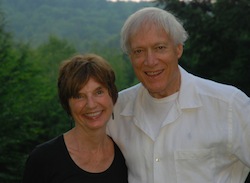
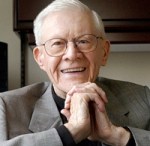
 Verle Headings (left, with Jannelle Hill and Dr. Carolyn Broome), died early Friday morning, April 27 in his home at Rolling Ridge after a three month struggle with illness. His wife Vivian was with him. Verle said more than once that he planned to “die on this mountain,” and so he has. Verle taught genetics at Howard University for many years and was a leader in the Mennonite community and friend to many at Sojourners. (This news came from Bob Sabbath and the Rolling Ridge Community.)
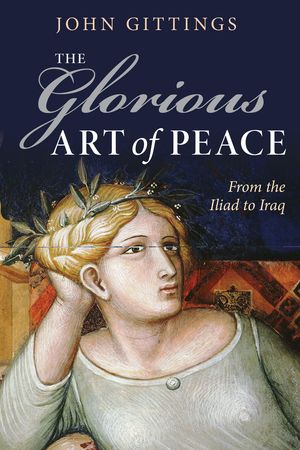 The author of The Glorious Art of Peace says history is usually studied and written from the perspective of war, and can look very different when viewed from the perspective of peace. The author John Gittings was part of the UK’s nuclear disarmament movement and an editor and writer for The Guardian. He’s also associate editor of The Oxford International Encyclopaedia of Peace. Here’s an excerpt from an interview with Gittings from The Browser:
 My buddy Mari Castellanos’ commentary A Supreme Case for the Court is a good preparation for the Supreme Court hearings on the racist anti-immigrant laws in Arizona.
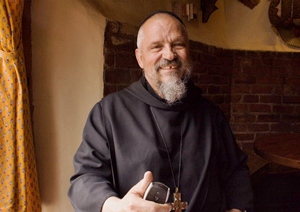 Abbot Philip is part of Christ in the Desert monastery in Abiquiu, New Mexico. I’ve visited there only once and it was a profoundly transforming experience. He writes:
 “The way to find the real ‘world’ is not merely to measure and observe what is outside us, but to discover our own inner ground. For that is where the world is, first of all: in my deepest self.”–Thomas Merton
 Cornhuskers and the Keystone XL: Next Steps? by Rose Marie Berger
 Thanks to the good folks over at PICO National Network for calling out House Budget Chairman Paul Ryan on his federal budget. He likes to say it’s rooted in Catholic Social Teaching — but it’s not. Here’s PICO’s take on the topic: