-
Irish Priest: We Will No Longer Be the ‘Silent People of God’
 The Association of Catholic Priests (ACP) in Ireland is holding an gathering this week in Dublin entitled “Towards an Assembly of the Irish Catholic Church” aimed at restoring the Spirit of Vatican II.
More than a thousand showed up for conference that took place in the weeks following the Vatican censure of several progressive Irish priests, in what appears to be a blatant attempt to deflect the spotlight away from the Vatican’s failure to protect and defend Irish Catholics against predatory priests within the hierarchy. The ACP hopes to move toward a national dialogue on the Irish Catholic Church. Other countries are looking at similar gatherings.
Fr. Desmond Wilson, a priest who has served in West Belfast since the mid-1960s, wrote this thoughtful letter to the Congregation for the Doctrine of the Faith out of his experience of the Irish context. It sheds light on the American situation of the Vatican’s harassment of Catholic sisters:
Dear Friends in The Congregation for the Doctrine of theFaith,
You may be aware that we in Ireland have a special reverence for our Saint Columbanus. He was one of our saints who disagreed with a Pope and said so. You may be more acquainted with Saint Catherine of Siena who did the same, although she had the disadvantage of having to disagree with three possible popes at one time.
Some of us view with dismay then, but no great alarm, your decision to censor some of our fellow citizens and fellow members of the Catholic Church who have done nothing at all so serious.
We are puzzled – naturally and supernaturally – by the fact that you and we preach the presence and inspiration of the Holy Spirit and then you tell us, so inspired, to stop talking – as if we had nothing important to say. This is not a matter of doctrine, it is one of logic and we in Ireland are inclined to judge these things by logic as well as doctrine and not too often by emotion. We remember the Gamaliel principle – you remember it too, when forced to make a decision, he told his colleagues, If this be of God it’s useless to oppose it, if it be of human planning it will fade away in any case, so we should not take extraordinary measures for ordinary happenings.
-
Video: Fr. James Martin Says “Thank a Sister”
-
Episcopal Bishop Packard: ‘Arrests Are Badges of Honor’
Very nice piece by Chris Hedges (The People’s Bishop) about retired Episcopal Bishop George Packard’s ministry to and with the Occupy movement. I have only one question. Where are the Catholic bishops? Here’s an excerpt:

Retired Episcopal Bishop George Packard is detained by police after Occupy Wall Street protesters attempted to use a lot owned by Trinity Church as a camp site, in New York. (Ozier Muhammad/NYT) “Retired Episcopal Bishop George Packard was arrested in Vietnam Veterans Memorial Plaza in New York City on Tuesday night as he participated in the May 1 Occupy demonstrations. He and 15 other military veterans were taken into custody after they linked arms to hold the plaza against a police attempt to clear it. There were protesters behind them who, perhaps because of confusion, perhaps because of miscommunication or perhaps they were unwilling to risk arrest, melted into the urban landscape. But those in the thin line from Veterans for Peace, of which the bishop is a member, stood their ground. They were handcuffed, herded into a paddy wagon and taken to jail. …
‘‘Arrests are not arrests anymore,” Packard said as we talked Friday in a restaurant overlooking Zuccotti Park in New York. ‘‘They are badges of honor. They are, as you are taken away with your comrades, exhilarating. The spirit is calling us now into the streets, calling us to reject the old institutional orders. There is no going back. You can’t sit anymore in churches listening to stogy liturgies. They put you to sleep. Most of these churches are museums with floorshows. They are a caricature of what Jesus intended. Jesus would be turning over the money-changing tables in their vestibules. Those in the church may be good-hearted and even well-meaning, but they are ignoring the urgent, beckoning call to engage with the world. It is only outside the church that you will find the spirit of God and Christ. And with the rise of the Occupy movement it has become clear that the institutional church has failed. It mouths hollow statements. It publishes pale Lenten study tracts. It observes from a distance without getting its hands dirty. It makes itself feel good by doing marginal charitable works, like making cocoa for Occupy protesters or providing bathrooms from 9 to 5 at Trinity Church’s Charlotte’s Place. We don’t need these little acts of charity. We need the church to have a real presence on the Jericho Road. We need people in the church to leave their comfort zones, to turn away from the hierarchy, and this is still terrifying to a lot of people in the church and especially the church leadership.”–Chris Hedges
Read the rest at The People’s Bishop by Chris Hedges
-
Feast of Lady Julian of Norwich
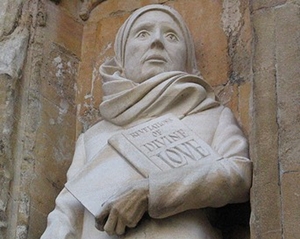 It’s the feast day of Julian of Norwich, great mystic and theologian of the church. I’m grateful to Richard Rohr for his reflections below:
At this time in history, the contemporary choice offered most Americans is between unstable correctness (liberals) and stable illusion (conservatives)! What a choice! It has little to do with real transformation in either case. How different from the radical orthodoxy of T. S. Eliot, who can say in Little Gidding,
You are not here to verify,
Instruct yourself or inform curiosity
Or carry report. You are here to kneel…There is a third way, and it probably is a way of “kneeling.” Most people would just call it “wisdom.” It demands a transformation of consciousness and a move beyond the dualistic win/lose mind of both liberals and conservatives. An authentic God encounter is the quickest and truest path to such wisdom, which is always non-dual consciousness and does not take useless sides on non-essential issues.
Neither expelling nor excluding (conservative temptation), nor perfect explaining (liberal temptation) is our task. True participation in God liberates us from our control towers and for the compelling and overarching vision of the Reign of God—where there are no liberals or conservatives. Here, the paradoxes—life and death, success and failure, loyalty to what is and risk for what needs to be—do not fight with one another, but lie in an endless embrace. We must penetrate behind them both—into the Mystery that bears them both. This is contemplation in action.
Read my favorite mystic, Julian of Norwich (1342-1420), and she will show you how to be a most traditional Christian, while breaking all the rules and orthodox ideas at the very same time. On the night of May 8, 1373, God “showed himself” to her and it took her more than twenty years to unpackage the experience. This English laywoman well deserves to be a doctor of spirituality. Her Revelations of Divine Love is a bottomless well of wisdom, love, and truth, and one of the few books I could return to every month and find something new—which, for me, is a sign of perennial and radical orthodoxy.–Richard Rohr, ofm
Adapted from Contemplation in Action by Richard Rohr. Read more by Richard Rohr and learn about the Center for Action and Contemplation.
-
Connecting the Climate Dots in D.C.
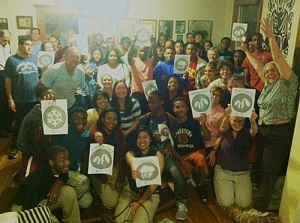
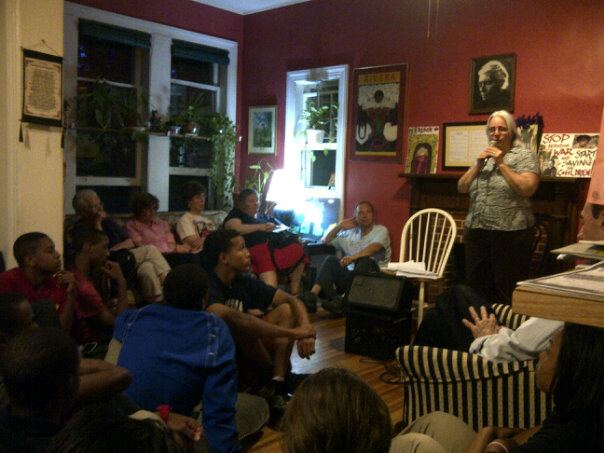
More than 50 people gathered on May 4, 2012, at Dorothy Day Catholic Worker in Washington, D.C., to discuss climate change and the seven principles of Catholic Social Teaching. Sojourners’ Rose Marie Berger spoke to the group, which included 25 students from Bishop McNamara high school.
The students and others identified signs of climate change in D.C.: No snow this last winter, increased allergies, increased number of mosquitoes and other insects, more asthma, birds not migrating, and more severe thunderstorms and tornadoes. As part of 350.org’s global “Connect the Climate Dots” event on May 4-5, participants hold up “dots” for “no snow,” “drought,” and “severe weather.”

(Photos by Heidi Thompson and Alycia Ashburn)
-
Mark Silk: Why Go After the Nuns?
 I’ve been trying to decide what to post about the Vatican’s most recent attack on American Catholic women. “Hat tip” to Heidi Thompson who pointed out the Religion News Service blog post by Mark Silk, a professor of Religion in Public Life at Trinity College and director of the college’s Program on Public Values. I think he sums it up nicely.–RMB
Why Go After the Nuns? by Mark Silk
The denunciation of the Leadship Conference of Women Religious (LCWR) by the Vatican’s Congregation for the Doctrine of the Faith (CDF, formerly known as the Roman Inquisition) puts this medievalist in mind of the Church’s 15th Ecumenical Council, which wrapped up its business in Vienne exactly 700 years ago next week.
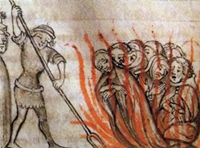
It was not a happy time for the papacy. In 1305, the tumultuous politics of the Italian peninsula had forced Pope Clement V to relocate the curia to the north, ushering in the “Babylonian Captivity of the Church” in Avignon that lasted for most of the century. The move put Clement under the thumb of King Philip the Fair of France, who was vigorously consolidating administrative control of the monarchy. To that end, Philip arrested the Knights Templars, seized their property, and got them to confess to heresy and sodomy by torture and burning at the stake. The main business of the Council of Vienne was the suppression of the venerable crusading order, which Clement seems to have agreed to do in exchange for Philip dropping heresy charges against a previous pope, Boniface VIII.
-
Today 2 Alabama State Senators Join Immigration Law Protest
http://c.brightcove.com/services/viewer/federated_f9?isVid=1
Two Alabama state senators, Bobby Singleton, D-Greensboro, and Quinton Ross, D-Montgomery, joined an immigration law protest on Thursday, May 3, 2012, outside the doors of the Senate chamber in Capitol in Montgomery, Alabama. The six Christian protesters from Alabama Rising were detained by police. A few of them were from Micah’s House community in Birmingham.
Send a “thank you” note to Sen. Singleton [bsingle164 (at) yahoo (dot) com] and Sen. Ross [Quinton.ross (at) alsenate (dot) gov] for joining in and raising a stink for not being arrested along with the others.
To read more, check out Immigration law protesters detained outside Alabama Senate.
-
Seven Year Later, D.C. Still Asks: Who Killed Donte Manning?
 A shout out to John Muller who published a piece in today’s Washington Informer about Donte Manning’s murder. His killing 7 years ago was the provocation to and lens through which I wrote my book “Who Killed Donte Manning? The Story of an American Neighborhood.” Thanks to John for keeping Donte’s memory alive. Here’s an excerpt from his article:
“More than seven years has passed since the shooting and subsequent death of 9-year-old Donte Manning but the Metropolitan Police Department is still seeking information that will lead to an arrest in the case.
Although Donte’s memory may have faded from the public consciousness, it still looms large to police and local writer Rose Marie Berger, 48, who authored the book, “Who Killed Donte Manning?” two years ago.
“Donte still haunts me,” said Berger of Columbia Heights in Northwest Washington. “Not as a ghost, but as an angel of conscience. His young life and his murder pricks our conscience as a city just like the murder of Trayvon Martin in Florida has turned a mirror to the violence at the soul of our nation.”
“The fact that his killer remains free means two things: the first is that there is a young man out there who lives with the murder of a child on his conscience, and he has not made amends to Donte’s family or to society for his actions. The second is that violence is so endemic that police are not able or not willing in some cases to pursue justice,” Berger said.”–John Muller, Donte Manning’s Death Remains a Mystery
Buy a copy of Who Killed Donte Manning? by Rose Marie Berger
-
Gay Rabbis: A Conservative Decision
 For the first time gay and lesbian rabbinical students will be ordained as Conservative rabbis in Israel. The Board of Trustees of the Schechter Rabbinical Seminary voted on April 19 to accept gay and lesbian students for ordination beginning with the 2012-13 academic year. Out of the 18 rabbis that attended, all voted to admit homosexual students, with one rabbi abstaining.
“The Schechter Rabbinical Seminary views the serious process leading to this decision as an example of confronting social dilemmas within the framework of tradition and halacha,” or Jewish law, Hanan Alexander, chair of the seminary’s Board of Trustees, said in seminary’s statement. “This decision highlights the institution’s commitment to uphold halacha in a pluralist and changing world.”
Rabbi Mauricio Balter, President of the Israeli Conservative Movement Rabbinical Assembly expressed his support of the move. “I see it as a very important development in Jewish law,” Rabbi Balter told Haaretz, adding: “It is the right thing to do. We were all made in the image of god, and as such we are all made equal. For me this is a very important value. I always said we should admit gay and lesbians into our ranks.”
“I’m glad we had the vote and that it went the way it did,” Rabbi Balter continued. “The decision to hold a vote was correct as can be seen by the fact that there wasn’t a single dissenting vote,” he said.
Shmuel Rosner interviewed Professor Hanan Alexander, chair of the board of trustees of the Conservative Movement’s Schechter Rabbinical Seminary in Israel, on the vote.
Shmuel Rosner: You told the Associated Press that the decision to ordain gay rabbis will allow Conservatives “to uphold Jewish religious law in a pluralist and changing world.” Can you briefly explain the halakhic considerations that make such decision compatible with “religious Jewish law”?
Hanan Alexander: Jewish law has always allowed for the possibility that more than one interpretation is correct. It has similarly adapted over time to changing circumstances and social concerns. In response to changing social mores around the year 1000, for example, Rabbeinu Gershom of Mainz decreed that a Jewish man is forbidden to marry more than one woman, a practice that is permitted by the Torah. Although binding on Ashkenazi Jews, it was not accepted by Sephardim until the establishment of the State of Israel in 1948.
This idea of halakhic pluralism in response to changing historical and social circumstances is especially important to Masorti/Conservative jurisprudence. When leading opinion makers and researchers in the field of human sexuality subjected traditional beliefs about homosexuality to hard criticism, a number of rabbis and laypeople within the Masorti/Conservative movement became uncomfortable with the exclusion of gays and lesbians from all levels of participation in Jewish life. A lengthy discussion ensued over a number of years within the movement’s Committee on Jewish Law and Standards concerning the permissibility of ordaining openly gay and lesbian individuals as rabbis.
Following the pluralistic principle, in 2006 two decisions among a number of others were approved by the committee. Rabbi Joel Roth took the view that gays and lesbians should not be ordained based on a traditional reading of the prohibition for a man to lie with a man as if with a woman found in Leviticus 20. Rabbis Elliot Dorff, Daniel Nevins, and Avraham Reisner, on the other hand, offered an alternative interpretation of that verse as referring only to male-male anal intercourse, thereby permitting other forms of monogamous homosexual intimacy. They further argued that respect for human dignity requires admitting openly gay and lesbian students to the rabbinate.”
Read the rest of this fascinating interview.
-
Abbot Philip: ‘Aware of God’s Loving Presence’
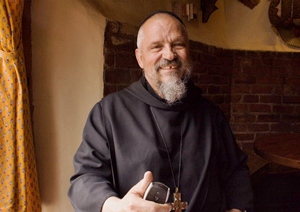
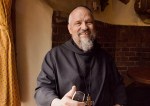 In April, our brothers at Christ in the Desert Monastery released a new disc of music titled “Blessings, Peace and Harmony: Monks of the Desert.” I urge you to practice mutual aid by purchasing this music. You will receive much more than you give!
Abbot Philip writes this week about the importance of spending time allowing God to love you:
“If I were to name one aspect of life that is the most important, not only for the monk but for anyone who is seriously following Christ, I would immediately think of that deep and intimately personal relationship of prayer. As we seek to do God’s will, the most important aspect of life is deepening our relationship with God and that is done in prayer. If we don’t have a strong and deep relationship with God, it becomes practically impossible to seek His will and strive to do His will. The deepest question for me, many times, is this: do I really want to do His will? I have to admit that my answer is not always positive! But I work at it.If we are going to pray, we have to take the time to pray. Some people are able to do a million things and keep their hearts set on God. Most of us need to focus on being still and trying to keep our heart on God. Even for us monks who spend several hours a day in formal prayer and other time in personal prayer and adoration, there is a challenge to keep our hearts set on God.
Personally, I must take time every day just to sit in silence, aware of God’s loving presence. It is really important to my life that I deepen my awareness that God loves me personally just as I am right now. Being aware of God’s love for me allows me to love others in a very strong and wonderful way. Being aware of God’s love for me allows me to go about my life with energy, joy and compassion. There are stages in my life when I have abandoned God—never entirely, thanks be to God. There are times when I lived my life externally but inside was in complete rebellion.
Thanks be to God for the grace of staying and persevering. Why do we pray? Somehow God has touched our lives and in that touching, we have found that prayer is important. God has drawn us to Himself, even when we are not always sure what that means. As we grow older and continue to try to do what is right, try to respond to this touch of God in our lives, there can be a wonderful flowing of faith and commitment.”–Abbot Philip, OSB (Abbot’s Notebook, May 2, 2012)

-
Subscribe
Subscribed
Have a WordPress.com account? Log in now.

