The United Church of Christ, a reformed Protestant denomination of with more than 5,200 congregations and one million members, voted yesterday to divest from fossil fuel companies as a step toward serious action to combat climate change. They are the first church body in the world and the first national body of any kind to call for divestment from fossil fuel companies as a way of addressing climate change.
[This report is compiled from several news sources.]
“This resolution seeks to use movement toward divestment to increase awareness of the damage to our environment and to create public pressure on fossil fuel companies to leave 80 percent of fossil fuel reserves in the ground,” UCC pastor Vicki Kemper said at the annual meeting of the Massachusettes UCC region that sent the resolution to the General Synod. “That’s right – we’re essentially asking them to walk away from $20 trillion in resources.”
Kemper acknowledged that if all religious groups and colleges and universities – where the divestment movement began – divested, only 2 percent of fossil fuel stock would be impacted. But, she said: “The only power we have in this challenge is the moral, spiritual power to revoke the social licenses of these companies to continue to profit from wrecking the earth. The question is – will we exercise that power?”
According to the news report: The resolution, brought by the Massachusetts Conference and backed by 10 other conferences, calls for enhanced shareholder engagement in fossil fuel companies, an intensive search for fossil fuel-free investment vehicles and the identification of “best in class” fossil fuel companies by General Synod 2015.
In an exit letter that is as rare as it is remarkable, a resigning nonprofit executive’s final act of leadership is an apology.
Yes, that’s right, an apology.
And it’s a real apology at that – not a Dwight Schrute version. This one that includes an acknowledgment of harm, ownership of full responsibility for the transgression, a statement of empathy for those who were hurt and a promise to do better in the future.
This rare artifact of modern-day management via email came today and I immediately reached out to the author to express my appreciation – and ask for his permission to share it. (more…)
WFP Executive Director Ertharin Cousin. Photo: WFP/Rein Skullerud In the boring list of the pope’s daily “play book,” (yes, I’m that geeky that I read the press release of his daily meetings), I found this tidbit. Today Pope Francis had a private meeting with Ertharin Cousin, head of the World Food Program.
While most of his visitors are of the male variety, he’s also met with some super-cool women, such as the International Union of Superiors General–some 800 leaders of women’s religious communities worldwide. I guess I’d throw in Argentina’s President Cristina Kerchner. And now Ms. Cousin.
I just like the idea of Pope Francis and Ms. Cousin deep in conversation about Syria, etc. The more smart, strong, effective women he can have around him, the better off he’ll be.
ROME/VATICAN CITY – His Holiness Pope Francis this morning granted a private audience to Ertharin Cousin, Executive Director of the United Nations World Food Programme (WFP). The meeting took place immediately upon Cousin’s return from Syria and following her recent visit to Israel and Palestine.
During her Papal Audience, Cousin briefed Pope Francis on the urgent needs of those affected by conflict in Syria, where WFP is planning to feed 3 million people in July, in addition to assisting almost one million refugees in the region. She also expressed concern about the deteriorating food security of one third of households in Gaza and the West Bank.
Cousin emphasised the key role played by WFP’s nutritional programmes in the first 1,000 days of life and subsequently, through the school meals it provides to almost 25 million children in 60 countries.
“I was deeply moved by the dedication and the valuable support for the hungry which Pope Francis expressed not only today during our conversation but many times on previous occasions, from his inaugural Papal Mass to the recent Papal Audience with participants of the 38th United Nations Food and Agriculture Organization (FAO) conference,” Cousin said on her return from the Vatican.
“As an advocate for policies that will help eliminate hunger, support just peace processes and promote fruitful dialogue among people as well as religions, the Catholic Church carries enormous global influence. We need the voice of His Holiness. I implored him to please use his influence. In response, His Holiness thanked me for the work of WFP and confirmed the commitment of the Catholic Church, including Caritas and CRS, for humanitarian access in conflict situations like Syria and to advocate for the reduction of structural poverty globally.”
WFP works on a regular basis with many Catholic institutions and NGOs inspired by Catholic values. These include Caritas Internationalis and its various national agencies with whom WFP has partnerships in 21 countries. These partnerships are especially important in Africa where WFP also works with the Catholic Relief Services (CRS). There is also productive collaboration with the Rome-based Comunità di Sant’Egidio, with whom WFP runs food assistance and health programmes in Guinea and Mozambique as well as with the Jesuit Refugee Service (JRS) which supports food distribution in Malawi.
It’s always so humbling to hold in one’s hands the print edition of a book you’ve helped birth – even in just a small way.
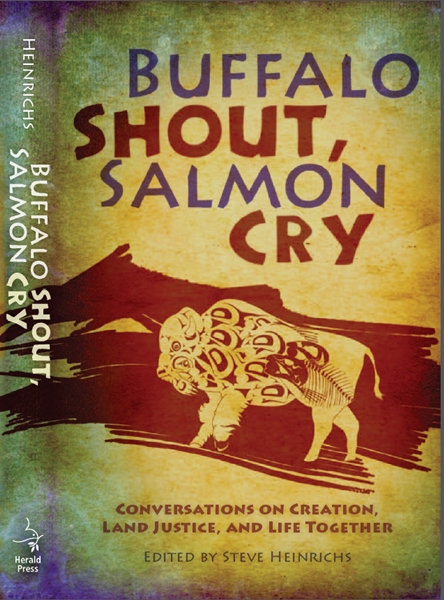
Today I received copies of Buffalo Shout, Salmon Cry: Conversations on Creation, Land Justice, and Life Together, edited by Steve Heinrichs. As I hold the finished work in my hands, it still smells like fresh ink. And the amazing cover art by Jonathan Erickson (Nak’azdli, Carrier-Sekani) of the Buffalo carrying with her the life and bones of the Salmon pushed me to tears. It’s so beautiful.
Steve contacted me more than a year ago asking if I’d write a poetic response to Randy Woodley’s brilliant essay “Early Dialogue in the Community of Creation.” I was honored, but really had no idea what a watershed book I was being invited into. (See the Table of Contents.) I contributed adapted sections of my unpublished poetry manuscript Saarinen’s Arch and Steve was kind enough to include them.
Buffalo Shout, Salmon Cry is a book that deeply engages the question: How can North Americans come to terms with the lamentable clash between Indigenous and settler cultures, spiritualities, and attitudes toward creation?
Buffalo Shout offers up alternative histories, radical theologies, and subversive memories that can unsettle our souls and work toward reconciliation. It showcases a variety of voices–both traditional and Christian, Native and non-Native.
Many of the Native writers are theologians and scholars affiliated with the 10-year-old North American Institute for Indigenous Theological Studies (NAIITS), which was formed “in response to the inability of the Christian evangelical church to include Native North Americans in a manner that affirmed who their Creator has shaped them to be.”
NAIITS has just signed an agreement with George Fox University, where Randy Woodley teaches indigenous studies, to deliver theological education for Native North Americans and other indigenous people using a curriculum developed by NAIITS. Buffalo Shout, Salmon Cry will likely be a primary textbook for this new joint venture.
Here’s an excerpt from Steve Heinrich’s introduction:
…[The prophet] Jonah is not a white Mennonite settler like me, but stands among and with the colonized. He’s a word-swinging Lakota warrior (think Vine Deloria Jr.), a Sto:lo poet of colonial deconstruction (think Lee Maracle), a shouting buffalo, a weeping salmon, coming out from the shadows of the rez and urban occupied territories to confront the privileged powerful. This Jonah speaks unsettling truths, not to save the empire, but to stop its rapacious ways in defense of all relations, including us settlers.
This is what the book in your hands is about. It’s a Jonah text, perhaps as scandalous, implausible, and necessary as that old anti-imperial myth. A bunch of Jonahs and several settler-ally friends have come together to speak a word to, against, and for the dominant settler-colonial culture in North America. Some employ sharp rhetoric akin to that of the disgruntled prophet; others speak in more hopeful terms. They certainly don’t agree on everything. But they all do sound (with maybe one or two exceptions) a common warning: the controlling culture is violently sick, devastating people and lands. The need is urgent: repent, resist, do something.”
Supreme Court ruled that Section 4 of the landmark 1965 Voting Rights Act is unconstitutional. This is the formula used to determine which states and localities need preclearance before changing their voting laws.
Watch the video of Mrs. Hamer addressing the Democratic National Convention in 1964 on voting rights, before she was cut off by an “emergency press conference” from President Johnson’s White House aimed at getting her off national television.
By a 5-to-4 vote, the court invalidated the formula — adopted most recently in 2006 — used to determine which states had to get federal approval for changes in their voting laws. The law applied to sixteen jurisdictions (nine states plus parts of seven other states) and required any changes in voting laws or procedures in the covered jurisdictions to be approved in advance by the U.S. Justice Department or a federal court in Washington, D.C. A jurisdiction with a clean record for 10 years was permitted to be excused from the mandate. With this new ruling, citizens can bring their court case of voting irregularities only after the election is completed, rather than raising a flag about discriminatory laws in advance of an election.
President Obama today gave a speech that marks a turning point in U.S. energy policy and the foundation for comprehensive climate change policy. He also, unexpectedly, addressed directly the question of the Keystone XL pipeline.
“… We can’t just drill our way out of the energy and climate challenge that we face. That’s not possible. I put forward and passed an “all of the above” energy strategy, but that strategy can’t just be about producing more oil.
By the way it, it certainly must be about more than just building one pipeline. Now, I know there’s been for example a lot of controversy surrounding the proposal to build the pipeline, the Keystone pipeline, that would carry oil from Canadian tar sands down to refineries in the Gulf. And the State department is going through the final stages of evaluating the proposal, that’s how it’s always been done.
But I do want to be clear, allowing the Keystone pipeline to be built requires a finding that doing so would be in our nation’s interest. And our national interest will be served only if this project does not significantly exacerbate the problem of carbon pollution. The net effects of the pipeline’s impacts on our climate will be absolutely critical to determining whether this project is allowed to go forward. …”–President Obama, during climate address today at Georgetown University in Washington, D.C.
Sierra Club executive director Michael Brune said in The Washington Post, “The president realizes that you can’t combat climate change without a direct confrontation with the fossil fuel industry. What has us most encouraged by the president’s speech is he is lacing up his gloves and getting ready for that fight.”
“Not only is this by far the most comprehensive and ambitious administrative plan proposed by any president, it’s also common sense and very popular with the public,” said Gene Karpinski, president of the League of Conservation Voters.
President Obama’s comments on the Keystone XL are not substantially different from what he has said in the past. They key quote is: “Our national interest will be served only if this project does not significantly exacerbate the problem of carbon pollution. The net effects of the pipeline’s impacts on our climate will be absolutely critical to determining whether this project is allowed to go forward.”
So far, the Environmental Protection Agency has determined that the net effects of the pipeline’s impact will significantly increase carbon pollution. The State Departments reports have indicated that there will be no net increase (using data provided to them by TransCanada, which presumably has a vested interest in the data). One crucial issue will be naming the new head of the EPA. Will a new director mean a different outcome on the Keystone climate impact?
But it is startling that President Obama brought Keystone up at all, when he wasn’t expected to. As I say, everyday without the Keystone is another day of victory.
It’s important to keep all of this in perspective. The U.S. economy must become largely fossil-fuel independent by 2050. All of the things President Obama announced are steps in that direction. Most are modest steps. Some might turn out to be large steps.
But everything we do from now on out must pass the climate litmus test: Does this decision take us closer to fossil-fuel independence? If yes, okay. If no, then don’t do it–and don’t waste time arguing about it. For Christians this kind of conversion is familiar. We keep our eyes on the prize. When we fall down, we get back up through God’s grace. We can be the ones to model Spirit-powered change for our nation and our world.–Rose Mare Berger
In May, First Church in Boston, a Unitarian Universalist church, held an important conversation. A panel took up the question “What are the Moral and Practical Considerations of a Fossil Fuel Divestment Strategy?”
Bill McKibben of 350.org has called for the divestment of fossil fuel stocks as a key strategy in the fight against climate change. Thoughtful professionals within the socially responsible investment and liberal religious communities have taken reasoned and moral positions both for and against this strategy. The video is a little more than an hour long. It is an key conversation in understanding how we can pressure fossil fuel companies to 1) leave fossil fuels in the ground, 2) let go of their stranglehold on American politics, 3) speed up their transition to renewable energies.
Below are my very rough notes from the video. I found the conversation of such value that I wanted to pass it along.
“Leonard Cohen’s song, “Anthem,” states in the refrain: “There is a crack in everything. That’s how the light gets in.” It sounds a lot like Paul’s statement about carrying “the treasure in earthen vessels” (2 Corinthians 4:7). These are both much more poetic ways of naming what we unfortunately called “original sin”—a poor choice of words because the word sin implies fault and culpability, and that is precisely not the point! Original sin was trying to warn us that the flaw at the heart of all reality is nothing we did personally, but that there is simply “a crack in everything” and so we should not be surprised when it shows itself in us or in everything else. This has the power to keep us patient, humble, and less judgmental. (One wonders if this does not also make the point that poetry and music are a better way to teach spiritual things than mental concepts.)
The deep intuitions of most church doctrines are invariably profound and correct, but they are still expressed in mechanical and literal language that everybody adores, stumbles over, denies, or fights. Hold on for a while until you get to the real meaning, which is far more than the literal meaning! That allows you to creatively both understand and critique things—without becoming oppositional, hateful, arrogant, and bitter yourself. Some call this “appreciative inquiry” and it has an entirely different tone that does not invite or create “the equal and opposite reaction” of physics. The opposite of contemplation is not action; it is reaction. Much of the “inconsistent ethic of life,” in my opinion, is based on ideological reactions and groupthink, not humble discernment of how darkness hides and “how the light gets in” to almost everything. I hope I do not shock you, but it is really possible to have very “ugly morality” and sometimes rather “beautiful immorality.” Please think and pray about that.”–Richard Rohr, OFM
“This is a man who gave us the warrantless wiretapping scheme as a kind of atrocity warm-up on the way to deceitfully engineering a conflict that has killed over 4,400 and maimed nearly 32,000 Americans, as well as leaving over 100,000 Iraqis dead. Being called a traitor by Dick Cheney is the highest honor you can give an American.”–NSA whistleblower Edward Snowden after former vice president Cheney called Snowden a “traitor”
You gotta love a Pope who sets aside his speech and lets students just ask him unscripted questions. Wow! I promise to lighten up on the pope-stuff. I retain my hermeneutic of suspicion. But it’s just such a breath of fresh air to have a real pastor of a global church serving as Bishop of Rome.
Friday morning the Pope met with students from Jesuit-run schools in Italy and Albania. He said, “I’ve prepared a text but it’s five pages and that’s a little long. Let’s do this: I’ll give it to the Provincial Father and Fr. Federico Lombardi [director of the Holy See Press Office] so that you all can have it written and then some of you will ask me questions and I’ll answer them. That way we can talk.”
One student asked about the doubts regarding belief in God that he sometimes has and what he could do to grow in faith. Francis answered:
“Journeying is an art because, if we’re always in a hurry, we get tired and don’t arrive at our journey’s goal. If we stop, if we don’t go forward and we also miss the goal. Journeying is precisely the art of looking toward the horizon, thinking where I want to go but also enduring the fatigue of the journey, which is sometimes difficult … There are dark days, even days when we fail, even days when we fall. [Sometimes] one falls but always think of this: don’t be afraid of failures. Don’t be afraid of falling. What matters in the art of journeying isn’t not falling but not staying down. Get up right away and continue going forward. This is what’s beautiful: this is working every day, this is journeying as humans. But also, it’s bad walking alone: it’s bad and boring. Walking in community, with friends, with those who love us, that helps us. It helps us to arrive precisely at that goal, that ‘there where’ we’re supposed to arrive.”

 In an exit letter that is as rare as it is remarkable, a resigning nonprofit executive’s final act of leadership is an apology.
 It’s always so humbling to hold in one’s hands the print edition of a book you’ve helped birth – even in just a small way.
 President Obama today gave a speech that marks a turning point in U.S. energy policy and the foundation for comprehensive climate change policy. He also, unexpectedly, addressed directly the question of the Keystone XL pipeline.
 You gotta love a Pope who sets aside his speech and lets students just ask him unscripted questions. Wow! I promise to lighten up on the pope-stuff. I retain my hermeneutic of suspicion. But it’s just such a breath of fresh air to have a real pastor of a global church serving as Bishop of Rome.