-
Pope Francis: ‘Let Everything that Breathes Praise the Lord’

“We must all care for life, cherish life, with tenderness, warmth … to give life is to open our hearts, and to care for life is to give oneself in tenderness and warmth for others, to have concern in our hearts for others. Caring for life from the beginning to the end. What a simple thing, what a beautiful thing…
Calling to mind the teaching of Saint Irenaeus that the glory of God is seen in a living human being, [I] encourage all of you to let the light of that glory shine so brightly that everyone may come to recognize the inestimable value of all human life. Even the weakest and most vulnerable, the sick, the old, the unborn and the poor, are masterpieces of God’s creation, made in [God’s] own image, destined to live for ever, and deserving of the utmost reverence and respect. [I] pray that the Day for Life will help to ensure that human life always receives the protection that is its due, so that ‘everything that breathes may praise the Lord.’ So, go forth and don’t be discouraged. Care for life. It’s worth it.”–Pope Francis
-
Joan Chittister: ‘A Lust for Joy’

“Sitting out in the middle of the channel in a little nineteen-foot fishing boat with ocean freighters and large sailboats passing us on both sides, I remember the wild and crazy joy of it: no desk, no phone, no speeches, no airplanes. Just four of us, a hot sun, an empty fish bucket, a parade of boats, and the rocking of the waves. I cast with all my might, caught the top of the channel light, and, laughing my heart out, cut free just in time to avoid wrapping the next sail in fishing line. Life, bare and simple, is a wonderful thing. How do we learn that? And what does it mean for the spiritual life itself?
We learn it by seeing it, I think. When I was a young sister, in the days before the church had negotiated a kind of truce with the world and the monastery reflected the emotional sterility that the standoff implied, Sister Marie Claire, steadfastly opposed to the suppression of joy in the name of holiness, went to her music room every Sunday afternoon to listen to records of symphonies, scores of operas, collections of piano performances. We didn’t go to concerts in those days, and only music teachers were allowed to have record players. She would sit in her rocking chair all afternoon and simply listen. I remember being very moved by the model of such bold and wanton delight in the face of such institutionalized negation of it. The lesson served me well. There are times in life when the only proper response to the dreary and the difficult is to ignore them. The person of hope, the person who knows that God is in the daily, knows joy.
Embodied love, with all the joy and pleasure and beauty it brings, has been made the great enemy of the spiritual life, as if learning to be dour were a dimension of sanctity. We were trained to beware the beautiful and the pleasurable, as if beauty and pleasure distracted us from the God who made the world beautiful and gave us all a capacity for pleasure. “There is no such thing as a sad saint,” the poster says. Having come out of a Jansenist spirituality, it took me a little while to get beyond the sourness of sin to the delight of fishing boats and party times and wedding feasts at Cana. But I finally came to understand that there is no such thing as “loving God alone.” If we love God, we love everything God made because all of them are reflections of the Love that made them.
To lust for joy is to lust for the God of life. To make joy where at first it seems there is none is to become co-creator with the God of life. When we make joy, we make a holier, happier life.”–Joan Chittister, OSB
Excerpted from Called To Question by Joan Chittister
-
John O’Donohue: Abandoning the ‘Lowlands of Complacency’

“Once the soul awakens, the search begins and you can never go back. From then on, you are inflamed with a special longing that will never again let you linger in the lowlands of complacency and partial fulfillment. The eternal makes you urgent. You are loath to let compromise or the threat of danger hold you back from striving toward the summit of fulfillment.”–John O’Donohue, Anam Cara: A Book of Celtic Wisdom
-
What the Taliban Didn’t Want: Malala’s Celebrates Her 16th Birthday at U.N.
http://c.brightcove.com/services/viewer/federated_f9?isVid=1&isUI=1
Education activist Malala Yousafzai marks her 16th birthday today at the United Nations by giving her first high-level public appearance and statement on the importance of education and the power of nonviolence.
Malala became a public figure when she was shot by the Taliban while travelling to school last year in Pakistan — targeted because of her committed campaigning for the right of all girls to an education. Flown to the United Kingdom to recover, she is now back at school and continues to advocate for every child’s right to education.
In support of the UN Secretary-General’s Global Education First Initiative (GEFI), on 12 July – declared as “Malala Day” — the President of the UN General Assembly and the UN Special Envoy for Global Education with the support of A World at School initiative are organizing the UN Youth Assembly, where more than 500 young leaders from around the world will convene to accelerate the goal of getting all children, especially girls, in school and learning by 2015.
Here’s a link to the transcript of Malala’s speech.
-
Force-feeding at Gitmo: ‘What you have said in darkness, shall be proclaimed in light’

A “feeding chair” at Guantanamo. Today there will be a public witness in front of the White House at noon to demand the closing of Guantanamo and a restoration of the rule of law. As Ramadan starts, there are 106 prisoners on hunger strike and at least 45 are being force fed.
Luke 12:3 seems appropriate here: “Whatever you have said in the dark will be heard in the light, and what you have whispered behind closed doors will be proclaimed from the housetops.”
Below is a note from the Dorothy Day Catholic Worker in D.C. and Witness Against Torture:
“Where is the world to save us from torture? Where is the world to save us from the fire and sadness? Where is the world to save the hunger strikers?” — Adnan Latif, Yemeni Guantanamo prisoner held for ten years without ever having been charged with a crime and cleared for release on four separate occasions, found dead in his cell on September 8, 2012.
July 12 will be day 156 of the Guantanamo hunger strike. As many as 120 prisoners are now participating in the hunger strike. The military admits that 45 are being forcibly fed by tubes snaked through their noses twice a day because they have lost so much weight.
Prisoners have appealed to doctors not to participate in this forced feeding. Obama, who knows force feeding is condemned by the AMA and the United Nations, said on May 17, as he once again promised to close Guantanamo, “Look at the current situation, where we are force-feeding detainees who are holding a hunger strike. Is that who we are?”
Apparently it is. And as Andy Worthington says, “We wait and we wait and still nothing happens.” Instead an additional 125 U.S. troops were recently sent to the prison to “contain” the situation.
On July 8 U.S. District Judge Gladys Kessler dismissed a Syrian detainee’s request to end force-feeding saying she lacks jurisdiction to rule on conditions at the prison. However, she condemned the military’s practice of force-feeding detainees as “painful, humiliating and degrading” and said President Obama has the authority to stop it.
The vast majority of the 166 men have been held for more than 11 years without any charge or fair trial, with no end to their detention in sight although 86 have been cleared for release for years. Nearly two months has passed since Yemeni officials seeking the repatriation of the 56 Yemenis cleared for release agreed to set up a rehabilitation center to help reintegrate them. But nothing has happened since Obama lifted his ban on their repatriation.
Finally, word of the resistance actions is making it to the men at Guantanamo, and making an enormous difference to them. An attorney for several men at Guantanamo recently wrote Witness Against Torture to say:
I was at GTMO all week meeting with clients. I wanted to share with you the following words from . . . Moath al-Alwi, a Yemeni national who has been in U.S. custody without fair process since 2002.
Moath was one of the very first prisoners to reach GTMO, where the U.S. military assigned him Internment Serial Number (ISN 028). He has been on hunger strike since February and the U.S. military is now force-feeding him. Moath shared the following during our meeting, translated as accurately as I could from the Arabic:
“I recently had an interesting conversation with one of the Navy officers in charge of my force-feeding here at Guantanamo. He told he was here to make sure I was treated humanely as I was being force-fed. So I answered through the interpreter, saying:
‘What I am enduring now is torture and the American people will tell you as much. Humanitarian organizations, various human rights bodies, as well as American groups such as Witness Against Torture and Doctors Without Borders have all declared that what is taking place at Guantanamo is a violation of human rights and that it amounts to torture.’
The officer’s face changed and he walked away.”
The men at GTMO are fully aware of your work and their eyes literally tear up when I describe the various protest actions you and your fellow activists have undertaken in solidarity with their plight. To say they are grateful would be an understatement.
In response to this moving statement, WAT members Jeremy Varon and Datt Daloisio wrote: “Our eyes fill with tears as we contemplate the significance of what Moath shared: that our actions — however inadequate we feel them to be — help the men at Guantanamo resist assaults on their dignity and confront their persecutors, with added confidence in the justice of their position and the world’s concern for their plight. There can be no greater affirmation of the value of our efforts, nor greater motivation for us to work harder.”
-
Berger: ‘Why Are White People So Mean?’

THE METRO IS crowded today, and the 20-something, well-dressed white man has to stand, one hand holding the bar and the other his smartphone. It’s the end of the day. All the commuters—but one—are turned toward home. The young man’s face, like most of the others, is dulled with exhaustion. No one makes eye contact.
In a seat near the door, one woman sits facing everyone, looking backward. She studies the young man’s face intently, uncomfortably. He shifts. She rearranges the bags at her feet. Her reflection in the window shows an ashy neck above her oversized T-shirt collar. The train hums and clicks through a tunnel. As if in preparation, she takes another sip from the beat-up plastic cup she’s holding.
At last, she raises her voice and asks: “Why are white people so mean?” Boom! The electricity of America’s third rail crackles through the train. Faces fold in like origami or turn blank like a screensaver. …–Rose Marie Berger
Read the whole essay here: http://sojo.net/magazine/2013/08/why-are-white-people-so-mean
-
What President Obama’s Climate Talk Means to Faithy Millennials
 Dan DiLeo wrote an excellent analysis in the Millennial Journal about President Obama’s June 25 climate address. (Dan works for the Catholic Coalition on Climate Change.)
There are so many ways to unpack this very important speech that it’s hard to choose one angle in — but this is a start in listening to young people of faith forging their future.
Here’s an excerpt from DiLeo’s essay President Obama on Climate Change:
On Tuesday, June 25, 2013, President Obama unveiled the most ambitious plan to date by any U.S. President to address the increasingly urgent climate crisis. Although the speech was addressed to both the nation and the world, the address is particularly relevant for millennial Catholics. This is first due to the fact that he unveiled his plan to young people at Georgetown University and spoke directly to “your generation.” Additionally, the Catholic Church has explicitly and repeatedly advocated for public policies to address the climate crisis. Finally he mentioned two issues that have found resonance on Catholic college campuses and with millennials: the Keystone XL Pipeline and divestment from carbon-intensive industries.
The President began by recounting the scientific facts of climate change: “scientists ha[ve] known since the 1800s that greenhouse gases like carbon dioxide trap heat, and that burning fossil fuels release those gases into the air [. . .] The overwhelming judgment of science — of chemistry and physics and millions of measurements — has put all [of the uncertainty around climate science] to rest. Ninety-seven percent of scientists, including, by the way, some who originally disputed the data, have now put that to rest. They’ve acknowledged the planet is warming and human activity is contributing to it.”
-
Pope Francis Drives Ford Focus
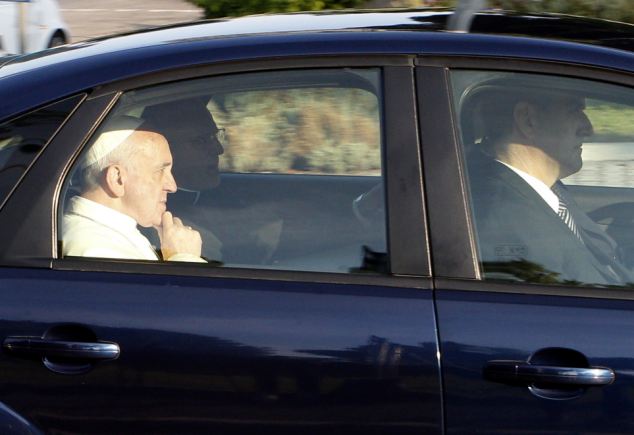
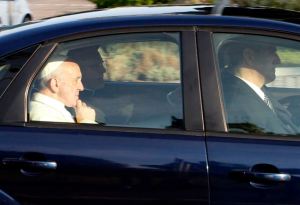 When Pope Francis needs to get from one place to another in his domain of Vatican City, the smallest state in the world, he drives a “humble” Ford Focus. On Saturday, he encouraged new priests and nuns to adopt humility in their choice of transportation and gadgets–a word, I think, that applies to all Christians.
As part of his drive to make the Catholic Church more austere and focus on the poor, Francis told young and trainee priests and nuns from around the world that having the latest smart phone or fashion accessory was not the route to happiness.
“It hurts me when I see a priest or a nun with the latest model car, you can’t do this,” he said.
“A car is necessary to do a lot of work, but please, choose a more humble one. If you like the fancy one, just think about how many children are dying of hunger in the world,” he said. …
The ANSA news agency said the pope’s car of choice for moving around the walled Vatican City was a compact Ford Focus.–Read whole story here
There was no word yet on whether the Vatican’s Ford Focus fleet was electric or not.
-
Pope Francis: The Danger of Being ‘Merely Philanthropists’
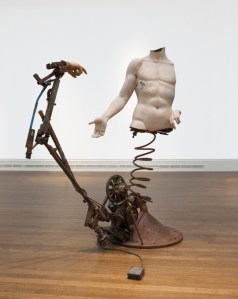
Doubting Thomas poking at Christ’s chest wound by Michael Landy (Picture: National Gallery) Below I include Pope Francis’ reflections this morning on the Feast of St. Thomas offered during Mass in the Santa Marta guest house where he lives. The accompanying art by Michael Landy illustrates to me the dangers of “mechanizing” our experience of touching of the wounds of Christ:
“After the Resurrection Jesus appears to the apostles, but Thomas is not there: He wanted him to wait a week. The Lord knows why He does such things. And He allows the time He believes best for each of us. He gave Thomas a week. Jesus reveals himself with His wounds: His whole body was clean, beautiful and full of light, but the wounds were and are still there, and when the Lord comes at the end of the world, we will see His wounds. Before he could believe, Thomas wanted to place his fingers in the wounds. He was stubborn. But that was what the Lord wanted – a stubborn person to make us understand something greater. Thomas saw the Lord and was invited to put his finger into the wounds left by the nails; to put his hand in His side. He did not merely say, ‘It’s true: the Lord is risen’. No! He went further. He said: ‘God’. He was the first of the disciples to confess the divinity of Christ after the Resurrection. And he worshipped Him.
And so, we understand what the Lord’s intention was when He made him wait: He wanted to take his disbelief and guide him not just to an affirmation of the Resurrection, but an affirmation of His Divinity. The path to our encounter with Jesus-God are his wounds. There is no other. In the history of the Church several mistakes have been made on the path towards God. Some have believed that the Living God, the God of Christians can be found by the path of meditation, and indeed that we can reach higher levels through meditation. That is dangerous! How many are lost on that path, never to return? Yes, perhaps they arrive at a knowledge of God, but not of Jesus Christ, Son of God, the second Person of the Trinity. They do not arrive at that. It is the path of the gnostics, isn’t it? They are good, they work, but they have not found the right path. It is very complicated and does not lead to a safe harbour.



-
Subscribe
Subscribed
Have a WordPress.com account? Log in now.

