-
Video: Spirit Warriors Pray Back the Devils
Skrillex and Damian “Jr. Gong” Marley song “Make It Burn Them” animates this short video of Indian power defending the local community. It gives me chills to watch it.
Another apartment building in my neighborhood has been “flipped.” The white guys from West Virginia arrived to forcibly remove the black and brown families. Garbage bags of clothes thrown on the sidewalk. Broken dishes. Sleeper couches dumped. A granddaughter trying to collect her grandmother’s family photos so they won’t get broken and lost.
So I offer this video as medicine and prayer to strengthen our Spirit-warriors and all of us to act like human beings.
-
Abbot Philip: Distracted by Unhelpful Thoughts?
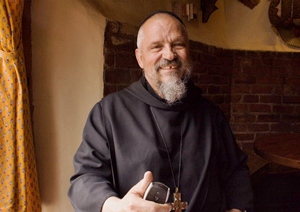
“… Inner silence and inner peace. What wonderful gifts are inner silence and peace in our lives. We have to work every day to maintain such silence and peace. It does not matter where we live or if we are married or if we are religious. All of us have challenges in our lives in order to remain silence and peaceful in our hearts. Almost every day of my adult life, I have had to take some time to refocus my mind and my heart. When I get distracted by unhelpful thoughts, by anger, by lust, by jealousy or even by laziness, I have to make a commitment to placing my life in the hand of God, of Jesus Christ.
-
Pope Francis: ‘War is the Suicide of Humanity Because it Kills the Heart’
 I was impressed by the strength of Pope Francis’ message against the madness of war as he addressed military families, particularly those who have members in Afghanistan, on Italy’s “Memorial Day.” Would that more Christians would speak with such love and clarity. While the U.S. bishops spoke strongly against the Iraq war, I would bet that none of them preached as sermon like the Pope’s on Memorial Day. In his homily, the Pope commented on the gospel story of the centurion who asks Jesus to heal his slave.
“Our God is personal. He listens to everyone with his heart and He loves ‘wholeheartedly’. Today we have come to pray for our dead, for our wounded, for the victims of the madness that is war! It is the suicide of humanity because it kills the heart. It kills precisely that which is the Lord’s message: it kills love! War grows out of hatred, envy, and the desire for power, as well as—how very many times we see it—from the hunger for more power.”
“So many times we’ve seen the great ones of the earth wanting to solve local problems, economic problems, and economic crises with war. Why?” the Holy Father continued. “Because, for them, money is more important than people! And war is just that: it is an act of faith in money, in idols, in the idols of hatred, in that idol that leads to killing one’s brother, that leads to killing love. It reminds me of God our Father’s words to Cain, who, out of envy, had killed his brother: ‘Cain, where is your brother?’ Today we can hear this voice: it is God our Father who weeps, weeps for this madness of ours, who asks all of us: ‘Where is your brother?’ Who says to the powerful of the earth: ‘Where is your brother? What have you done!’”
“[Pray that the Lord might] take all evil far away from us, … even with tears, with the tears of the heart [pray]: “’Turn to us, O Lord, and have mercy on us, because we are sad, we are in anguish. See our misery and our pain and forgive our sins’; because behind war there are always sins: the sin of idolatry, the sin of exploiting persons on the altar of power, of sacrificing them. ‘Turn to us, O Lord, and have mercy, because we are sad and in anguish.’ … We are confident that the Lord will hear us and will do everything to give us the spirit of consolation. So be it.”–Pope Francis
Read the whole article.
-
George Schmidt: Niebuhr’s Realism in ‘Game of Thrones’
 George Schmidt, candidate for the Master of Sacred Theology degree at Union Theological Seminary, has written a complex and fascinating theological analysis of Game of Thrones. I read all of George R.R. Martin’s books in the Song of Ice and Fire series. I loved them and hated them. After reading Schmidt’s essay I think I know why.
When push comes to shove, I usually land in the “faithful, rather than effective” camp. I’m an idealist. If I have to choose between my values and an effective outcome, I generally choose my values. Because life without values is life without meaning — and life without meaning leads to despair and despair separates one from God. (Ask me about this tomorrow and I may phrase that all differently but I think you get what I mean.)
I’m not saying that I avoid effectiveness. I actually value it highly — because if God gives you a job to do, you should do it very well. But the foundational assumption is that the mission is carried out under certain parameters. So when Satan tells Jesus he’ll show him how to turn stones into bread with the implication that Jesus can fill the bellies of all the hungry poor, why doesn’t Jesus do it? Wouldn’t that be a highly effective way of carrying out the practicalities of God’s mission?
No. It wouldn’t. Because turning stones into bread comes with certain requirements. Namely, placing Satan’s name higher than God’s. And one of the foundational assumptions is God is God of all and we shall have no idols before God. Therefore, the means do not justify the end.
So back to Game of Thrones. As Schmidt points out, George R.R. Martin’s books take readers into a pea soup fog between realpolitic, Christian politcal realism ala Neibuhr, and the tragedy of mercy. Read Schmidt’s whole essay, but here’s an excerpt below:
… Placing traditional theodicy aside for a moment, the question after all this misery is simple: Why did Eddard die? At the outset, identifying Eddard’s death as a simple tragedy misses an important point that is often made by Christian realists. Tragedy, as Reinhold Niebuhr observed in The Irony of American History, elicits “admiration as well as pity” for a man like Eddard. We pity him for such a terrible finality while we admire his conviction and compassion for Cersei and her children.
However, tragedy does not account for the way in which, to quote Niebuhr once again, “virtues are vices.” This lack of dialectical thinking, according to which human agency is essentially either virtuous or sinful, is unthinkable in Christian realism. An idealist who quickly classifies an event as tragic fails to take into account the evil that is an “inevitable consequence of the exercise of human creativity”: the evil that is in the good.
-
Joan Chittister: ‘We Have A Spiritual Obligation to Accept Reality’

“Surrender is what cleans off the barnacles that have been clinging to the soul. It is the final act of human openness. Without it I am doomed to live inside a stagnant world called the self. The problem is that the self is a product of my own making. I myself shape the self. I construct it one experience, one attitude, one effort at a time till the person I become — rich in reality or starved for it — is finished. I shape me, great or small, wizened or insulated, out of the tiny little measures of newness that I allow to penetrate the depths of my darkness one dollop at a time. What I do not let into my world can never stretch my world, can never give it new color, can never fill it with a new kind of air, can never touch the parts of me that I never knew were there. What I once imagined must forever be, what I relived in memory for years, is no more. Openness saves me from the boundaries of the self and surrender to the moment is the essence of openness.
Surrender does not simply mean that I quit grieving what I do not have. It means that I surrender to new meanings and new circumstances, that I begin to think differently and to live somewhere that is totally elsewhere. I surrender to meanings I never cared to hear — or heard, maybe, but was not willing to understand. Try as I might to read more into someone’s words than they ever really meant, I must surrender to the final truths: She did not love me. They did not want me. What I want is not possible.
And, hardest to bear of all, all arguments to the contrary are useless. I surrender to the fact that what I lived for without thought of leaving, I have now lost. Try as I might to turn back the clock, to relive a period of my life with old friends, in long-gone places, out of common memories, through old understandings and theologies of the past, I come to admit that such attempts are the myth of a mind in search of safer days. The way we were is over. They are in fact, laughable to many, resented by some, essentially different in intimation to each of us.
Surrender is the crossover point of life. It distinguishes who I was from who I have become. Life as I had fantasized is over. What is left is the spiritual obligation to accept reality so that the spiritual life can really happen to me.–Joan Chittister, OSB
An excerpt from Scarred by Struggle, Transformed by Hope by Joan Chittister (Eerdmans)
-
Video: Lana Finikin and Women Doing Serious Theater
Lana Finikin, 59, from Jamaica is an activist using theater to address violence against women. “The saying is, when women and girls are safe, then everybody else will be safe,” she says. Watch her 3-minute video above.
In 1977, Finikin co-founded the Sistren Theatre Collective, which uses performances to explore problems concerning poor women in rural and urban communities in Jamaica – issues include violence, HIV/Aids, domestic work, housing, land tenure, environment and unemployment.
Finikin uses drama as a tool to share experiences and to empower communities on a grassroots level so they can resolve their own problems. Sistren develops the stories for its plays out of people’s experiences and narrations. At a recent UN conference in New York on the status of women, Finikin showed her approach in a two-hour-long condensed workshop.
According to the UN, globally 7 out 10 women will be beaten, raped, abused, or mutilated in their lifetimes with most of the violence is taking place in intimate relationships.
-
Pope Francis: ‘The Disciples’ Solution is for Everyone to Take Care of Themselves’
 The U.S. Congress is approving huge funding cuts to food stamps/SNAP and other food assistance programs. At the same time, a study released this week reveals that one in six Americans live in households that cannot afford adequate food.
Of these 50 million people, nearly 17 million are children. Food insecurity has jumped by 14 million between 2007-2011.
Pope Francis led a procession on foot through the Italian streets yesterday in celebration of the Feast of Corpus Christi (“The Body of Christ”). The gospel reading focused on the “Loaves and Fishes” or the “Feeding of the 5,000,” a kind of family reunion hosted by Jesus. Here’s an excerpt from Pope Francis’ sermon:
“The invitation that Jesus extends to his disciples to feed the multitude themselves is born of two elements: most of all from the crowd that, having followed Jesus, now finds itself outside, far from inhabited areas, as evening falls, and then, from the disciples’ concern, who asked Jesus to dismiss the crowd so that they might seek food and lodging in the nearby towns. Faced with the crowd’s needs, the disciples’ solution is for everyone to take care of themselves. … How many times do we Christians have this temptation! We do not care for the needs of others, dismissing them with a pitiful, ‘May God help you’. … But Jesus’ solution goes in another direction … He asks the disciples to seat the people in communities of fifty persons. He raises his eyes to heaven, recites the blessing, breaks the loaves, and gives them to the disciples to distribute.”
“It is a moment of profound communion. The crowd, whose thirst has been quenched by the word of the Lord, is now nourished by his bread of life. … This evening, we too are gathered around the Lord’s table … It is in listening to his Word, in nourishing ourselves with his Body and his Blood, that He makes us transforms us from a multitude into a community, from anonymity to communion. The Eucharist is the sacrament of communion, which brings us out from our selfishness to live together our journey in his footsteps, our faith in him. We all ought, therefore, to ask ourselves before the Lord: How do I live the Eucharist? Do I live it anonymously or as a moment of true communion with the Lord and also with the many brothers and sisters who share this same table?”–Pope Francis’ sermon on the Feast of Corpus Christi, 2013
-
Richard Rohr: Living in the Communion of Saints

Ernest Withers’ “I Am A Man” photo as D.C. wall mural by artist JR “Living in the communion of saints means that we can take ourselves very seriously (we are part of a Great Whole) and not take ourselves too seriously at all (we are just a part of the Great Whole!) at the very same time. I hope this frees you from any unnecessary individual guilt—and more importantly frees you to be full “partners in God’s triumphant parade” through time and history (2 Corinthians 2:14). You are in on the deal and, yes, the really Big Deal. You are all a very small part of a very Big Thing!”–Richard Rohr, ofm
-
Keystone XL: A Victory in Slow Motion
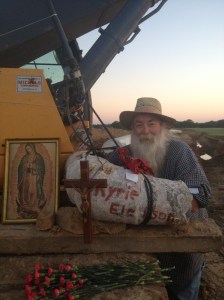
Catholic Worker Bob Waldrop, 60, locked to Keystone construction equipment on May 13, 2013. It’s been more than two years since the oil industry predicted an easy win on permitting the Keystone XL pipeline and still no new tar sands pipeline has crossed the Canadian border. Bill McKibben gives an update (Keystone: What We Know) on this quintessential David vs Goliath climate fight:
… Gradually, the silliness of the arguments for the pipeline has begun to erode their credibility. It’s possible that somewhere in America someone believes the American Petroleum Institute statement this week that approval of KXL would lower gas prices this summer, but it’s hard to imagine quite who. By now most people know that the project’s jobs have been routinely overstated, and that the oil is destined to be shipped abroad.
7) And gradually the horror of climate change is convincing more and more people what folly it would be to hook us up to a project that guarantees decades more of fossil fuel use. Since we started, the U.S. has seen the hottest year in its history, an epic Midwest drought, the largest forest fires in southwest history, and oh yeah a hurricane that filled the New York subway system with the Atlantic ocean.
8) One more thing — since it’s entirely clear that stopping Keystone by itself won’t solve the climate crisis, the green movement has shown it can go on offense too. Charged up in part by the KXL battle, student groups around the nation have launched a full-scale campaign for divestment from fossil fuels that has spread to over 300 campuses and inspired city governments from Seattle to San Francisco to explore selling their stocks.
There’s still that one thing we don’t know, however, and that’s what Barack Obama will do. Congress isn’t going to take this decision off his hands; a shoddy State Department environmental study, which even his own EPA rejects, won’t be much help. The decision will be the president’s. If he blocks Keystone then he’s got himself a climate legacy as well as a bargaining chip — he’d be the first world leader to block a big project because of its effect on the climate. If he doesn’t — well, no beautiful speech on the dangers of climate change will convince anyone.
It was two years ago that the National Journal polled its 300 “energy insiders” and 91 percent of them predicted a quick approval for the project. Since then we’ve kept half a billion barrels of the dirtiest oil on earth in the ground. The smart money still says we’re going to lose, but it’s not quite as sure: the Canadian business press is reporting this week that no one wants to buy tarsand leases or finance new projects — prospects for the future have become “uncertain.” And it’s not just Keystone — analysts said earlier this spring that in the wake of the KXL battle it’s likely every new pipeline will face a battle. Tarsands barons like the Koch brothers still have all the money, and they’ve still got the odds in their favor. But the smart money has lost a few IQ points. —Bill McKibben
Read the whole article.
-
Sirach: “Don’t say, ‘God is so merciful that even all my sins will be forgotten’”
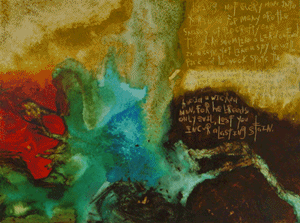
Sirach 11 by Michael Keck From today’s daily lectionary readings … the wisdom of Sirach.
“Don’t rely on your wealth, and say, “I’m a powerful individual.”
Don’t be driven by your appetites and ambition
and succumb to the passions of the heart.
Don’t say, “I am my own authority,”
for the Almighty will certainly call you to judgment.
Don’t say, “So I sinned; nothing has happened to me–”
YHWH can wait as long as necessary.
Don’t presume God’s forgiveness–
that’s adding sin to sin.
Don’t say, “God is so merciful
that even all my sins will be forgotten,”
for God is both merciful and jealous;
the corrupt feel the heavy hand of God’s wrath.
Don’t procrastinate about returning to YHWH;
don’t put it off a single day, for God’s vengeance
can be sudden and swift, and you’ll be
completely destroyed in a flash.
Don’t trust in your money or your ill-gotten gains;
it will have no value on the day of your judgment.”
—Sirach 5:1-10




-
Subscribe
Subscribed
Have a WordPress.com account? Log in now.

