Foreign Policy’s The Cable provided insight today into backroom negotiations between the Iraqi government and the Obama administration about allowing American drones to bomb “al-Qaeda affiliated militants” in Iraq. So bad on so many levels. Apparently, the Obama administration finally gave a definitive “no.”
Here’s a snippet from The Cable:
For weeks, Iraqi officials have been publicly floating the idea of using American drones to hit the increasingly lethal al-Qaeda-affiliated militants on their soil. But the ordinarily drone-friendly Obama administration is apparently in no mood to open up a new front in global campaign of unmanned attacks. An administration official tells The Cable that American drone strikes in Iraq are now off the table.
Though neither Iraqi nor U.S. officials will say who called off the drones, it’s no secret who began discussing them in the first place. In an August 17 trip to Washington, Iraqi Foreign Minister Hoshyar Zebari told reporters that Baghdad is seeking U.S. advisers, air surveillance or drone strikes to combat al-Qaeda’s grip on the country. “We cannot fight these increasing terrorist” threats alone, he said. Speaking of drone strikes specifically, he said as long as they were used to “target al-Qaeda and their bases,” without “collateral damage,” Iraqis would welcome them.
Also read Sojourners‘ excellent coverage on why people of faith are against the new drone arms race: What’s Wrong With Drones? by Duane Shank
“The truth of the matter is that all of life, at any age, is about ripening. Life is about doing every age well, learning what we are meant to learn from it and giving to it what we are meant to give back to it.
The young give energy and wonder and enthusiasm and heart-breaking effort to becoming an accomplished, respected, recognized adult. And for their efforts they reap achievement and identity and self-determination.
The middle-aged give commitment and leadership, imagination and generativity. They build and rebuild the world from one age to another. And for their efforts they get status, and some kind of power, however slight, and the satisfaction that comes from a sense of accomplishment.
The elderly have different tasks entirely.
The elderly come to this stage of life largely finished with a building block mentality. They have built all they want to build. It is their task in life now to evaluate what has become of it, what it did to them, what of good they can leave behind them. They bring to life the wisdom that comes from having failed as often as they succeeded, relinquished as much as they accumulated. And this stage of life comes with its own very clear blessings.
1. Perspective. Given the luxury of years, the elders in a society bring a perspective on life that is not possible to the young and of even less interest to the middle aged whose life is consumed with concern for security and achievement. Instead the elders look back on the twists and turns of life with a more measured gaze. Some things, they know now, which they thought had great value at one age, they see little value in later. The elders know that what lasts in life, what counts in life, what remains in life after all the work has been completed are the relationships that sustained us, not the trophies we collected on the way. The Elders are blessed with insight.
2. Time. For the first time in life, the elderly have time to enjoy the present. The morning air becomes the kind of elixir again that they have not known since childhood. The park has become an observation deck on the world. The library is now the crossroads of the world. The coffee shop becomes the social center of their lives. And small children a new delight and a companion it not leaders as they explore their way through life again. The blessing of this time is appreciation of the moment … .”–Joan Chittister, OSB
This article originally appeared in The Huffington Post. To read the five other blessings of being elderly: Freedom, Newness, Tale-Telling, Relationships and Transcendence, click here.
The comedic interrupters Yes Men showed up at TransCanada’s “trade show” dressed in nearly identical blue shirts and khakis to answer questions about the Keystone XL pipeline and its cousin, the Energy East pipeline. Watch the video to see how you too can interrupt immoral corporate shenanigans.
Context: TransCanada is a mining company that wants to make money off one of the last massive tar sand deposits in the world. Climate scientists agree that expanding tar sands mining will force a massive amount of carbon pollution into the earth’s atmosphere and tip our planet over it’s energy budget. It is our moral duty to stop this from happening.
God established a liveable zone for human thriving. As strange as it seems, immoral leadership – both in politics and business – is wreaking havoc on the basic stuff of life – air, water, soil, and the most vulnerable in our communities — the unborn, the elderly, and those who are sick or weak.
Stopping TransCanada from expanding tar sands mining by stopping the pipelines through which tar sands sludge will be shipped is just one front on which we are called to wage peace, environmental stewardship, and the right to life.
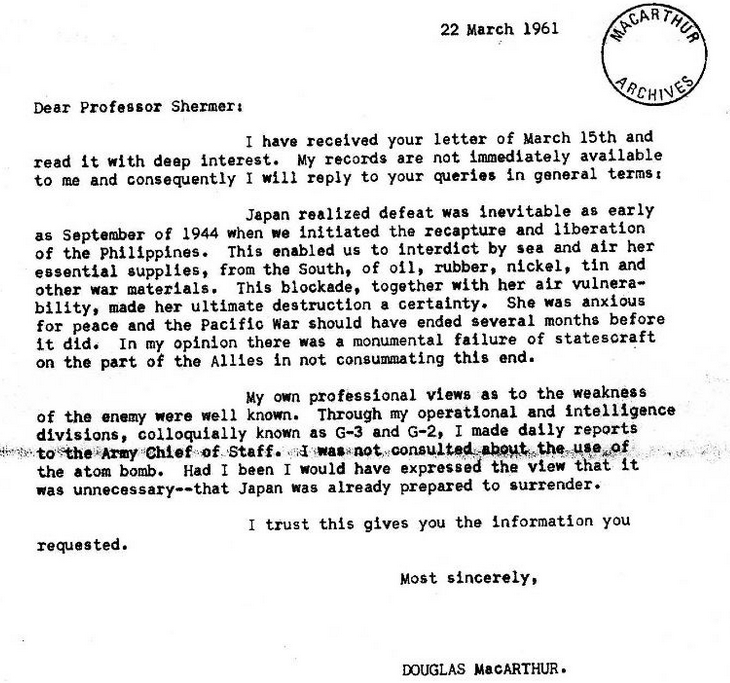
In my years as a peace activist, I get two challenges from people with whom I speak. One, “nonviolence didn’t work against Hitler.” (To which I have two responses: Denmark and the Huguenots of Le Chambon.) Two, “Dropping the atomic bombs on Hiroshima and Nagasaki in Japan saved tens of thousands of American lives.”
Below is an important document addressing the second question. Gen. Douglas MacArthur is commonly understood to be one of the most important military leaders in U.S. history. This is Gen. MacArthur’s response to the question about whether it was militarily necessary for the United States to attack Japan with nuclear bombs by targeting Hiroshima and Nagasaki, the only use of nuclear weapons in human history.
Excellent article in the National Catholic Reporter by Catholic theologian Hans Kung on Pope Francis’ opportunity to take action on long delayed reforms, including inviting divorced Catholics or women who have had an abortion, use birth control, or have had artificial insemination back into the sacraments, and voluntary celibacy for the priesthood. Read Kung’s full essay:
“Pope Francis shows courage: not only in his brave appearance in the favelas of Rio de Janeiro, but also by entering into an open dialogue with critical nonbelievers. He has written an open letter to leading Italian intellectual Eugenio Scalfari, founder and longtime editor in chief of the major liberal Roman daily newspaper La Repubblica. These are not papal instructions, but a friendly exchange of arguments on equal levels.
Among the 12 questions from Scalfari printed in La Repubblica Sept. 11, the fourth seems to me of particular importance for a church leadership ready for reforms: Jesus perceived his kingdom not to be of this world — “Render to Caesar the things that are Caesar’s, and to God the things that are God’s” — but the Catholic church especially, writes Scalfari, all too often submits to the temptations of worldly power and represses the spiritual dimension of the church in favor of worldliness. Scalfari’s question: “Does Pope Francis represent after all the priority of a poor and pastoral church over an institutional and worldly church? …”
Saul Landau in ChileSaul Landau, professor, activist, and author, died yesterday (see more below).
He died on the eve of the 40th anniversary of the Chilean coup that ousted democratically elected Allende and led to Gen. Pinochet’s reign of terror, atrocious Dirty Wars, turned the verb “disappeared” into a noun, and into which Landau was a leading investigator of human rights abuses.
In 1984, I had the great honor of studying Latin American History under Landau at the University of California, Davis. It was the height of the U.S.-funded wars in El Salvador, Nicaragua, and Guatemala. I was involved locally through my church in the Sanctuary movement to illegally harbor war refugees and the Pledge of Resistance movement that vowed to risk arrest if the U.S. invaded Nicaragua. It was Professor Landau that helped me put what I was doing at church into the context of U.S. history and the mechanics of Empire. I’ve still got the “text books” he assigned.
Thank you, Saul. Presente!
Democracy Now! has a brief recap of Professor Landau’s life and work:
The award-winning journalist, filmmaker, author and professor Saul Landau has died at the age of 77. His death was confirmed by the Institute for Policy Studies where he was a senior fellow and vice chair of the IPS board. Landau made more than 45 films and wrote 14 books, many about Cuba. “He stood up to dictators, right-wing Cuban assassins, pompous politicians, and critics from both the left and the right,” IPS Director John Cavanagh said in a statement from the group. “When he believed in something, nobody could make him back down. Those who tried would typically find themselves on the receiving end of a withering but humorous insult.”
Landau’s recent film, “Will the Real Terrorist Please Stand Up?” exposed U.S. support for violent anti-Castro militants. Last year, Landau appeared on Democracy Now! to discuss the history of the Cuban Five and U.S. support for a group of anti-Castro militants who have been behind the bombing of airplanes, the blowing up of hotels and assassinations. Today, they are allowed to live freely in the United States. “What did Cuba do to us?,” Landau asks. “Well, the answer, I think, is that they were disobedient, in our hemisphere. And they did not ask permission to take away property. They took it away. They nationalized property. And the United States … has never forgiven them.”
“A spirituality of work is based on a heightened sense of sacramentality, of the idea that everything that is, is holy and that our hands consecrate it to the service of God. When we grow radishes in a small container in a city apartment, we participate in creation. We sustain the globe. When we repair what has been broken or paint what is old or give away what we have earned that is above and beyond our own sustenance, we stoop and scoop up the earth and breath into it new life. When we wrap garbage and recycle cans, when we clean a room, when we care for everything we touch and touch it reverently, we become the creators of a new universe. Then we sanctify our work and our work sanctifies us.
A spirituality of work draws us out of ourselves and, at the same time, makes us more of what we are meant to be. My work develops myself. I become what I practice all my life. “Excellence,” Samuel Johnson wrote, “can only be attained by the labor of a lifetime; it is not to be purchased at a lesser price.”
My work also develops everything around it. There is nothing I do that does not affect the world in which I live. In developing a spirituality of work, I learn to trust beyond reason that good work will gain good things for the world, even when I don’t expect them and I can’t see them. In that way, I gain myself. Literally. I come into possession of a me that is worthwhile, whose life has not been in vain, who has been a valuable member of the human race.
Finally, a spirituality of work immerses me in the search for human community. I begin to see that everything I do, everything, has some effect on someone somewhere. I begin to see my life tied up in theirs. I begin to see that the starving starve because someone is not working hard enough to feed them. And so I do. It becomes obvious, then, that the poor are poor because someone is not intent on the just distribution of the goods of the earth. And so I am. I begin to realize that work is the lifelong process of personal sanctification that is satisfied only by saving the globe for others and saving others for the globe. I finally come to know that my work is God’s work, unfinished by God because God meant it to be finished by me.”–Joan Chittister, OSB
 Foreign Policy’s The Cable provided insight today into backroom negotiations between the Iraqi government and the Obama administration about allowing American drones to bomb “al-Qaeda affiliated militants” in Iraq. So bad on so many levels. Apparently, the Obama administration finally gave a definitive “no.”
 Excellent article in the National Catholic Reporter by Catholic theologian Hans Kung on Pope Francis’ opportunity to take action on long delayed reforms, including inviting divorced Catholics or women who have had an abortion, use birth control, or have had artificial insemination back into the sacraments, and voluntary celibacy for the priesthood. Read Kung’s full essay: