My ears perked up this morning when I heard talk on the radio about investment gurus doing “God’s work” and a journalist calling for Christians to rise up against usury and abuse of the poor. Wow!
In a London Times interview with John Arlidge, the CEO of Goldman Sachs, Lloyd Blankfein, defended the bank’s massive profits, saying Goldman is, quote, “doing God’s work.” The four largest firms—Goldman Sachs, Merrill Lynch, Morgan Stanley, JPMorgan Chase—took in $22.5 billion in profits through September, according to MarketWatch. The top six banks set aside $112 billion for salaries and bonuses over the same period.
Democracy Now’s Amy Goodman interviewed former-LA Times journalist Robert Scheer this morning on this topic. Here’s quote from Scheer below:
It’s interesting that he should say he’s “doing God’s work,” Blankfein, the head of Goldman Sachs. And my goodness, if Scripture is clear on anything, it’s condemnation of those who take advantage of the poor. You know, after all, Jesus threw the money changers out of the temple. Scripture is devastating in its condemnation of usury, the immorality of usury.
Robert Scheer
And yet, you mentioned Chris Dodd is trying to get a bill passed that would cap interest rates. You know, where is the Christian Right? Where are the Christians? Where are the Jews, for that matter? Or the Muslims? At least the Muslims, in their religious practice, don’t believe in interest as a principle, but the idea that we’re jacking up credit cards to 30, 35—this is loan sharking. And we can’t even get a bill passed through Congress that would cap interest payments.
The other thing is, their rationalization is they’re somehow saving the economy. It’s the old blackmail thing. They ruined the economy; they got the legislation, the radical deregulation they wanted, that permitted them to become too big to fail—Citigroup and these companies; and then they turn around and say, “If you don’t throw all this money at us, the economy is going to go into the Great Depression.”
But they haven’t solved the main problems. Mortgage foreclosures this month are higher than they’ve been in ten months. We have the commercial housing market exploding, you know, apartment building rentals exploding, going into mortgages. And so, you know, they are not dealing with the fundamentals. What has happened is an incredibly expensive band-aid was put on this. And these people don’t even have—they’re not even embarrassed.–TruthDig’s Robert Sheer
I was also interested to note that in John Arlidge’s London Times profile on Goldman Sachs that CEO Lloyd Blankfein said, “I know I could slit my wrists and people would cheer.” Another GS staffer said, “We don’t club baby seals. We club babies.”
What’s the difference between an apologist and an apologizer? Australian Prime Minister Kevin Rudd is both. He’s an unabashed Christian who wrote his doctoral dissertation on Dietrich Bonhoeffer and is a ease with the convictions of his faith (a Christian apologist).
But Rudd is also leading the world in modeling political apologies as a way of healing the souls of nations. In February 2008, he publicly expressed regret, remorse, and sorrow for the way Australia as a nation had injured and wronged the aboriginal community.
This week, Rudd publically apologized to the generations of Forgotten Australians and former child migrants who were taken from their families and kept in government institutions often under terrible conditions. Read the text of his speech below.
“As children, many of us experienced horrors in the places that were supposed to care for us: serious and often criminal physical, sexual and emotional abuse, neglect and assault,” said Caroline Carroll from the Alliance for Forgotten Australians. “As adult survivors, we need acknowledgment of, and an apology for, the harm that was done to us.”
In Donald Shriver’s 1998 book An Ethic for Enemies: The Politics of Forgiveness, Shriver defines forgiveness as a moral concept that is actualized in human relationships. The first level of relationship occurs by remembering the wrongs conducted, taking a moral assessment. Once consensus is built on what wrongs were committed by both parties involved, the second transaction is to discuss and enact the proper restitution that “should be leveled against the offender.”
Shriver makes clear that whatever restitution means, it must mean “the abandonment of vengeance” or “forbearance”, to stop the cycle of violence. The third level of relationship is one of empathy for the enemy’s humanity. Finally, the relationship between former enemies is renewed through the fourth transaction as a “civil relationship between strangers.”
I’d call what Rudd is doing in Australia as an “experiment in Truth,” as Gandhi put it. I find it inspiring to watch unfold.
Rudd’s apology to Forgotten Australians is here:
We come together today to deal with an ugly chapter in our nation’s history. And we come together today to offer our nation’s apology. To say to you, the Forgotten Australians, and those who were sent to our shores as children without your consent, that we are sorry. Sorry – that as children you were taken from your families and placed in institutions where so often you were abused. Sorry – for the physical suffering, the emotional starvation and the cold absence of love, of tenderness, of care. Sorry – for the tragedy of childhoods lost – childhoods spent instead in austere and authoritarian places, where names were replaced by numbers, spontaneous play by regimented routine, the joy of learning by the repetitive drudgery of menial work. Sorry – for all these injustices to you as children, who were placed in our care.
As a nation, we must now reflect on those who did not receive proper care. We look back with shame that many of you were left cold, hungry and alone and with nowhere to hide and nobody to whom to turn. We look back with shame that many of these little ones who were entrusted to institutions and foster homes – instead, were abused physically, humiliated cruelly and violated sexually. We look back with shame at how those with power were allowed to abuse those who had none.
And how then, as if this was not injury enough, you were left ill-prepared for life outside – left to fend for yourselves; often unable to read or write; to struggle alone with no friends and no family. For these failures to offer proper care to the powerless, the voiceless and the most vulnerable, we say sorry. We reflect too today on the families who were ripped apart, simply because they had fallen on hard times. Hard times brought about by illness, by death and by poverty. Some simply left destitute when fathers, damaged by war, could no longer cope. Again we say sorry for the extended families you never knew.
We acknowledge the particular pain of children shipped to Australia as child migrants – robbed of your families, robbed of your homeland, regarded not as innocent children but regarded instead as a source of child labour. To those of you who were told you were orphans, brought here without your parents’ knowledge or consent, we acknowledge the lies you were told, the lies told to your mothers and fathers, and the pain these lies have caused for a lifetime. To those of you separated on the dockside from your brothers and sisters; taken alone and unprotected to the most remote parts of a foreign land – we acknowledge today the laws of our nation failed you. And for this we are deeply sorry.
We think also today of all the families of these Forgotten Australians and former child migrants who are still grieving, families who were never reunited, families who were never reconciled, families who were lost to one another forever. We reflect too on the burden that is still carried by your own children, your grandchildren, your husbands, your wives, your partners and your friends – and we thank them for the faith, the love and the depth of commitment that has helped see you through the valley of tears that was not of your making. And we reflect with you as well, in sad remembrance, on those who simply could not cope and who took their own lives in absolute despair.
We recognise the pain you have suffered. Pain so personal. Pain so profoundly disabling. So, let us therefore, together, as a nation, allow this apology to begin healing this pain. Healing the pain felt by so many of the half a million of our fellow Australians and those who as children were in our care. And let us also resolve this day, that this national apology becomes a turning point in our nation’s story. A turning point for shattered lives. A turning point for Governments at all levels and of every political colour and hue, to do all in our power to never let this happen again. For the protection of children is the sacred duty of us all.—Australian Prime Minister Kevin Rudd
We are not perfectly free until we live in pure hope. For when our hope is pure, it no longer trusts exclusively in human and visual means, nor rests in any visible end. He who hopes in God trusts God, Whom he never sees, to bring him to possession of things that are beyond imagination. Hope is the gateway of contemplation, because contemplation is an experience of divine things and we cannot experience what we do not in some way possess. –Thomas Merton
Sri Lanka: Women’s Nonviolent PeaceforceMohandas Gandhi once said: “There are many causes I am willing to die for. There is not a single one I am willing to kill for.” The Nonviolent Peaceforce is the embodiment of Gandhi’s statement.
Here’s a great 18-minute documentary on the unarmed civilian peacekeeping work of Nonviolent Peaceforce and their global work of reducing armed conflict through third party, nonviolent intervention.
Nonviolent Peaceforce is an unarmed, professional civilian peacekeeping force that is invited to work in conflict zones worldwide. With international headquarters in Brussels, Nonviolent Peaceforce has worked in the conflict areas of Sri Lanka, the Philippines and Guatemala.
Among other activities, it works with local groups to foster dialogue among parties in conflict, provide a proactive presence and safe spaces for civilians, and develop local capacity to prevent violence. Its staff includes veterans of conflict zones and experienced peacekeepers.
I’ve been tangentially involved with NP founders Mel Duncan and David Hartsough since they first began dreaming up a trained nonviolent intervention force. I hope you enjoy this short video. It’s a great one to show to a church group or social justice/peace group or youth group. View it here:
I got a note today from Pat Mahon over at Pax Christi South saying he’d been banned from speaking in the Diocese of Venice, Florida. He was scheduled to lead a retreat on Thomas Merton but the retreat was canceled by the chancellor. Pat speculates that this was because of his support for Catholic women’s ordination to the priesthood. Here’s an excerpt from Pat’s reflections:
I immediately began finalizing arrangements and the materials for a retreat on Merton I was giving to a parish peace and justice group on Florida’s west coast this Friday and Saturday. Then, out of the blue, I was notified Wednesday evening that the retreat was canceled because I was no longer approved to speak in the Diocese of Venice. I had been approved last March to speak on Merton in San Marco and understood that once approved, further approval was not necessary. The retreat coordinator in October was told that I was approved when he inquired to make sure. What?
I arose early after a restless night and called the contact person. The chancellor had had the person in charge of the deacons call the deacon who was coordinating the retreat to deliver the message. Speaking of dialogue, openness and transparency! The only reason I have been able to find so far is that I support the ordination of women as priests. I now join a select group of people who I been told are banned in Venice–Joan Chittister, Charlie Curran, Anthony Padovano. I also suspect that Roy Bourgeoise and John Dear are on the list.
Read Pat’s whole post here and send him a suportive note.
This tactic of “banning” speakers that someone in Catholic hierarchy doesn’t approve of is becoming more popular. In October, the diocese of Richmond refused to allow Pax Christi to meet in Holy Family Church — even though a bishop was one of the keynote speakers! Pax Christi had to hold its meeting at the local Methodist college.
It’s important to note that technically the diocese can only “ban” speakers who are holding events on diocesan-owned property. So if you hold your events elsewhere, the hierarchy can “ban” all they want but to no effect.
I find it ironic that when judges were deciding on financial settlements for priest sex abuse cases in the dioceses of Portland and Seattle, the dioceses made it clear to the judges that the churches were the property of the parishioners. This was a strategy to reduce the diocesan “assets” and therefore limit the financial exposure of the diocese. The courts saw through this and determined that the churches were part of church property. But if the diocese can make that determination once, maybe parishioners should join together into an ownership model for their parishes.
I’d love to hear other people’s experiences with diocesan approval for speakers and events.
Ever since Pope John XXIII threw open the “windows of the church” to let a new wind blow through the Catholic church, there have been forces at work to dismantle the authenticity of Vatican II. A commentary in this week’s National Catholic Reporter asserts that the traditionalist “reform of the reform” movement within Catholicism has been given ever greater rein under Pope Benedict and, especially Cardinals Levada and Rodé.
Rodé, who is in charge of the two current investigations in to American Catholic sisters, is known for his love of living the life of a medieval cardinal with all the excesses and masculine narcissism associated with the era.
But nostalgia is not the crux of our salvation – no matter how hard some in Catholic leadership try to convince us to the contrary. We can conserve the best of our Catholic heritage without clinging to outmoded traditions that impede the life force of the gospel.
To quote my father (who claims he’s paraphrasing the Buddha): A conservative carries a raft to cross the river. A traditionalist keeps the raft on his back when there are no more rivers to cross.
It has been an open secret that powerful forces in the church’s leadership have strongly opposed the reforms set in motion by the Second Vatican Council and have worked quietly yet assiduously during the past 40 years to roll back what has been accomplished. The regression is usually couched in Orwellian churchspeak, which lavishes praise on the council even as its intentions are reversed. Or sometimes in this parallel universe the argument is made that nothing really happened during the gathering of the world’s bishops over a four-year period to redirect the church and its mission.
Then along came Cardinal Franc Rodé, head of the Congregation for Institutes of Consecrated Life and Societies of Apostolic Life, who has vaulted to notoriety as the person overseeing the investigation of U.S. women religious. He is quoted in this issue, from a talk he gave in September 2008, as blaming the problems of Vatican II on a misguided “hermeneutic” or interpretation, which he calls “a hermeneutic of rupture and discontinuity.” That is a rather elaborate way of saying that one believes nothing really happened at the council. To Rodé’s credit, in more recent comments to John Allen (NCR, Oct. 30), he changes tone. In his latest pronouncement, it wasn’t the interpretation, but the council itself that was the problem. In his conversation with Allen, he credits the council with some muscular intent, and sees its documents holding the language of significant change. Otherwise why would he make the shocking charge that the council caused “the greatest crisis in church history … the first truly global crisis” in the church?
No doubt he spoke for other Roman curia members who would never utter such a brash assessment publicly.
What is it, though, that the cardinal finds so disastrous? What would he have us return to? Would he want to go back to the days when the church condemned separation of church and state?
Would he want us to return to a condemnation of religious liberty? Three popes since the council have upheld the principle of religious liberty as a fundamental human right, an assertion that would have been unthinkable before 1965.
Maybe his objection is to Nostra Aetate, the document on church relations with non-Christian religions. Perhaps he would want us to return to the days of open hostility toward Jews in our prayers and sermons.
Or does he feel that modernity and ecumenism have so infected the church that we should return to those days when Catholics were prohibited from attending the funerals of friends if held in a Protestant church, or when we were barred from attending a non-Catholic college without the permission of the local bishop?
Does he want a return to the 19th-century papal condemnation of freedom of conscience?
Or is he upset that most do not prefer, as he does, dressing up in the trappings of royalty, the yards of silk in the cappa magna, the canopies and throne chairs and all the rest — being attended by his minions, younger priests in lacy surplices, birettas and old-fashioned vestments encrusted with gold thread and jewels — all the while speaking in a dead language, facing a wall, his back to the people?
All of this was the preconciliar church. Which elements does he want restored?
Or possibly he regrets the fact that laypeople have wide access these days not only to the scriptures but also to the documents of Vatican II, and thus can say with authority that his version of church, dependent on a thin culture of nostalgia, holds no promise of the future.
Against that culture, the people of God can say convincingly that our worldwide church, in elaborate deliberation, has decided to go forward, not backward, and that the authors of that change wrote compellingly of the need for new and more inclusive ways of conducting ourselves as 21st-century Catholics.—Editorial, National Catholic Reporter
So, the planets in peril. Yeah. That’s bad. But hand-wringing never solved anything. U.K.’s Giles Fraser, canon chancellor at St. Paul’s cathedral in London, says the motto “Let’s make huge sacrifices in order to make nothing happen” is not the way to run a successful social movement!
“The climate-change campaign needs a sense of can-do enthusiasm”, says Fraser. The language of “hope” and “salvation” comes to mind as a way religious folk can contribute to a global shift in consciousness about all of us living lightly on the earth.
Why is the climate-change campaign failing to change hearts and minds? Or perhaps it is changing hearts and minds (we all do our little bit: recycling, green toothpaste, and so on), but is failing to affect our fundamental thirst for energy which drives the deeper changes that are taking place. Why?
One explanation is that many climate-change campaigners sweat gloom about the future. That hardly gives them a Henry V leadership style. It can sometimes seem as if their message is that if we try extremely hard, then we can just about stop any more changes. In other words: let’s make huge sacrifices in order to make nothing happen. With that message, it is hard to imagine how you might persuade someone to get out of bed.
At Lambeth Palace last fortnight, religious leaders got together to press a different message. We are the generation that is being called on to be heroes, to make a difference, to save the planet. Now that is the right emphasis.
The climate-change campaign needs a sense of can-do enthusiasm. It would be really something if that was what faith leaders were able to add to the mix: replacing gloomy defeatism with a secularised version of something we call hope.
Moreover, we may find that those who have sneered at the very idea of salvation will come to see the importance of this type of language. A biblical-sounding crisis requires a language and a philosophy commensurate with the size of the threat.–Giles Fraser
Good news this morning! It appears that some good old-fashioned communicatin’ is going on between the heads of Catholic women’s communities and their sister, Mary Clare Millea, who has been tapped by Rome to investigate them.
(As far as I know, this does not affect any change in the investigation process of the Leadership Conference of Women religious who meet with Bishop Blair in Baltimore on Nov. 24.)
U.S. women religious superiors will no longer have to supply to the Vatican some of the most controversial information it had requested as part of a three-year study of religious congregations, writes Tom Fox in the National Catholic Reporter, according to a Nov. 5 letter obtained by NCR.
Information no longer being requested as part of the Vatican Apostolic Visitation, which began last January, includes the properties owned by the congregations, their most recent financial audits, ages of the sisters, and the ministries they are involved in. Word of the change in procedures came in a letter dated Nov. 5 sent to the women religious superiors by Apostolic Visitator Mother Mary Clare Millea. Millea explained in her letter why she had dropped the request for the information.
“Many major superiors have already addressed concerns to the Apostolic Visitation Office regarding confidentiality and protection of privileged information about their congregation, the sisters themselves and their apostolate. Although our canonical and civil advisors concur that the Apostolic See has the right to all the information contained in the questionnaire, in response to your legitimate questions, I have determined that documents number 5, 6, 7, requested in Part C of the questionnaire, are not to be submitted to the Apostolic Visitation Office as part of this visitation. This change in design of the questionnaire was made after listening to your concerns and after considerable prayer and counsel. “
Read the whole story here. Nice work by Tom Fox and NCR staff.
Author Sharon Autenrieth works with the Church of the Nazarene’s Good Samaritan Ministries in East St. Louis. She writes, “There are now over 185 Catholic Worker houses of hospitality, including three in St. Louis, and it all started with soup and coffee in Dorothy’s kitchen.”
Here’s an excerpt from Autenreith’s article:
Dorothy Day never abandoned her anarchism or pacifism. Her politics were a scandal to Christians who felt the church should serve as chaplain to the state and maintain the status quo. Her religion was incomprehensible to the anarchists, Socialists and Communists with whom she’d spent her youth. But Dorothy continued to reach out to both sides, seeing herself as a faithful daughter of the church, and yet a radical called to disturb the comfortable – even when the comfortable were in the pews, or the prelate’s office. And so she often found herself, as she once wrote in her column “On Pilgrimage”, talking “economics to the rich and Jesus to the anarchists.” It wasn’t an easy path.
Joan Chittister writes, “Joy gives us strength for the unknown.”
The older one gets, the more one encounters the unknown.
So developing disciplines of joy are essential for living into the fullness of life.
Read Chittister’s insights below:
Life is not meant to be a burden. Life is not a problem to be solved. It is a blessing to be celebrated.
Every dimension of life, its gains and its losses, are reason for celebration because each of them brings us closer to wisdom and fullness of understanding.
From each and every moment of life we learn something that makes us more alive because we are now more knowing than we were before. Loss and loneliness, darkness and depression all sear the soul and cleanse it of its sense of self-sufficiency. Suffering directs it to the God of life.
But so does bounty and beauty and abundance. These give us a foretaste of wholeness. These are the palpable manifestations of the goodness of God in our lives. Both of these things come unbidden. They are not signs of either our sin or our sinlessness. They are simply signs that the God of life is a living, loving God.
Learning to celebrate joy is one of the great practices of the spiritual life. It confirms our trust in God. It affirms the greatness of creation. It seals our dependence on God. It attests to the beauty of the present and asserts our confidence in the beauty of the future. It recognized the mercy and love of God.
Every year in celebrating our birthdays and the birthdays of those we love we are called to remember the gift of life itself. We take time out to ask ourselves what we have done with our lives. We see again the potential of every single life in the world.
When we celebrate the good things in life, we trace them to the Creator who gives without merit, open-handedly, out of the very goodness of community, love, and support that are by nature at the base of the human condition.
Joy gives us strength for the unknown. It leads us into the emptiness of life with hope in the God of surprise with a smile on our faces.–Joan Chittister, OSB


 What’s the difference between an apologist and an apologizer? Australian Prime Minister Kevin Rudd is both. He’s an unabashed Christian who wrote his doctoral dissertation on Dietrich Bonhoeffer and is a ease with the convictions of his faith (a Christian apologist).
 We are not perfectly free until we live in pure hope. For when our hope is pure, it no longer trusts exclusively in human and visual means, nor rests in any visible end. He who hopes in God trusts God, Whom he never sees, to bring him to possession of things that are beyond imagination. Hope is the gateway of contemplation, because contemplation is an experience of divine things and we cannot experience what we do not in some way possess. –Thomas Merton
 I got a note today from Pat Mahon over at Pax Christi South saying he’d been banned from speaking in the Diocese of Venice, Florida. He was scheduled to lead a retreat on Thomas Merton but the retreat was canceled by the chancellor. Pat speculates that this was because of his support for Catholic women’s ordination to the priesthood. Here’s an excerpt from Pat’s reflections: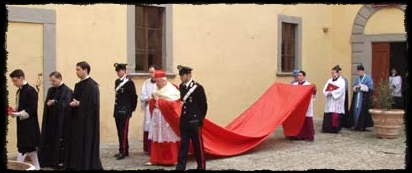
 So, the planets in peril. Yeah. That’s bad. But hand-wringing never solved anything. U.K.’s Giles Fraser, canon chancellor at St. Paul’s cathedral in London, says the motto “Let’s make huge sacrifices in order to make nothing happen” is not the way to run a successful social movement!
 Good news this morning! It appears that some good old-fashioned communicatin’ is going on between the heads of Catholic women’s communities and their sister, Mary Clare Millea, who has been tapped by Rome to investigate them.