-
Wendell Berry: Feed My Lambs
 XI.
XI.by Wendell Berry
Though he was ill and in pain,
in disobedience to the instruction he
would have received if he had asked,
the old man got up from his bed,
dressed, and went to the barn.
The bare branches of winter had emerged
through the last leaf-colors of fall,
the loveliest of all, browns and yellows
delicate and nameless in the gray light
and the sifting rain. He put feed
in the troughs for eighteen ewe lambs,
sent the dog for them, and she
brought them. They came eager
to their feed, and he who felt
their hunger was by their feeding
eased. From no place in the time
of present places, within no boundary
nameable in human thought,
they had gathered once again,
the shepherd, his sheep, and his dog
with all the known and the unknown
round about to the heavens’ limit.
Was this his stubbornness or bravado?
No. Only an ordinary act
of profoundest intimacy in a day
that might have been better. Still
the world persisted in its beauty,
he in his gratitude, and for this
he had most earnestly prayed.“XI.” by Wendell Berry, from Leavings. © Counterpoint, 2009. Reprinted in full without permission.
-
Is It Time to ‘Green’ Your Sex Life?
[Warning: Frank talk about sex stuff.]

Sustainably grown mahogany sex enhancer The October 26, 2009, Time magazine ran Kathleen Kingsbury’s article titled Sex and the Eco-City. Who knew that “green” creep had made it into the bedroom? Kingsbury describes a market of organic lubricants, biodegradable whips and handcuffs, vegan condoms, and glass or mahogany vibrators (even hand-crankable models, eliminating the need for batteries).
To top it off, some Catholic church folks have incorporated these green concepts into their teaching on Natural Family Planning! NFP is now the “back-to-nature” method of birth control. As the old Catholic joke goes: What do you call couples who practices NPF? Answer: Parents.
Here’s an excerpt from Kingsbury’s article:
As the green movement makes its way into the bedroom, low lighting is a must–to conserve electricity–but so are vegan condoms, organic lubricants and hand-cranked vibrators. Another big enviro-sex trend: birth control that’s au naturel.
Like all good Catholics, my husband and I had to attend church-run marriage prep before we tied the knot last year. I was surprised, however, during the hard sell on natural family-planning (NFP), that this updated version of the rhythm method was being advertised not only as morally correct but also as “organic” and “green.” I was even more surprised when I found out that some of the most popular instructors of NFP–known in secular circles as the Fertility Awareness Method–are non-Catholics who praise it as a means of avoiding both ingesting chemicals and excreting them into rivers and streams.
The search for phthalate-free alternatives helps explain the increase in sales of sex toys made of such materials as stainless steel, mahogany–yes, you read that correctly–and glass. …
The Roman Catholic Church is catching on to the organic trend. “People pay $32 for eye cream because they’re told it is good for them and the planet,” says Jessica Marie Smith, who repackaged the NFP program at the diocese of Madison, Wis. “We figured we could do the same with NFP.”
NFP detects ovulation by monitoring a woman’s temperature and the amount of cervical mucus. But this process is not 100% accurate. And several studies on climate change note that the best way to protect the planet is to have fewer children. “Around the world, more than 40% of pregnancies are unintended, and full access to birth control is still unmet,” says Jim Daniels, Trojan’s vice president for marketing. “Meeting that unmet need would translate into billions of tons of carbon dioxide saved.”
To that end, Trojan makes latex condoms as well as ones made of biodegradable lambskin. Other brands offer a vegan variety that replaces the dairy protein in latex condoms with cocoa powder. And no, they don’t all taste like chocolate.
Read the whole article Sex and the Eco-City by Kathleen Kingsbury. And a shout out to Cindy for spotting this article.
-
Joan Chittister: Ten Thoughts on Thanksgiving
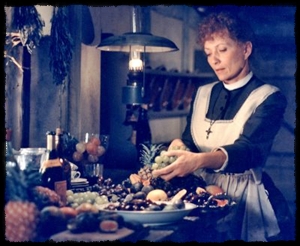
Scene from film "Babette's Feast" Whether you will be wrapped in the loving chaos of family on Thanksgiving or eating turkey burgers with friends at a local dive or serving bird with all the fixings at church or the local soup kitchen, I pour out the blessing of gratitude on all your heads. Here are thoughts from Benedictine sister and writer Joan Chittister for you to carry with you:
1. It’s important to dot our lives with unscheduled as well as scheduled feast days. That way we remember that we are able to make joy as well as to expect it. Or as Lin Yutang, the Chinese philosopher put it: “Our lives are not in the lap of the gods, but in the lap of our cooks.”
2. Food and feasting are the things that remind us of the unending glory, the limitless love, of God. Voltaire said of it: “Nothing would be more tiresome than eating and drinking if God had not made them a pleasure as well as a necessity.”
3. A Jewish proverb teaches us that “Worries go down better with soup.” Treating food as a sacrament rather than a necessity reminds us that, in the end, there is always more good in life than bad. The trick is to notice it.
4. To love good food is a measure of our love of life. Food preparation teaches us to do everything we can to make life palatable, spicy, comforting, full of love.
5. Sitting down to a meal with the family—table set, food hot, salad fresh, water cold, dishes matched and food served rather than speared—may be the very foundation of family life in which we celebrate our need for one another. The loss of the family feast may do more to loosen the family bonds than any other single dimension of family life.
6. One purpose of feasting is to get back in touch with the earth that sustains us, to glorify the God that made it and to pledge ourselves to save the land that grows our food.
7. In this country, we are conditioned to think that taking time to eat together, to make a meal an event rather than an act, takes time from the important things of life. That may be exactly why we are confused now about what the important things of life really are. “Happiness,” Astrid Alauda writes, “is a bowl of cherries and a book of poetry under a shade tree.”
8. Good food is the hallmark of every season: fresh fruit in summer, roasted chestnuts in the fall, warm bread in winter, oyster stew in the spring. Leslie Newman says of it. “As the days grow short, some faces grow long. But not mine. Every autumn, when the wind turns cold and darkness comes early, I am suddenly happy. It’s time to start making soup again.” Good food is the sacrament of life everlasting.
9. Food doesn’t have to be exotic to be wonderful. Peasant societies give us some of the best meals ever made. It is always simple, always the same—and always different due to the subtle changes of sauce and cooking style that accompany it. As the Polish say: “Fish, to taste right, must swim three times—in water, in butter and in wine.”
10. To be feasted is to be loved outrageously.
-
What to Read for the New Feminist?

Recently, I attended a She’s Geeky: Women and Technology “un-conference” in D.C. It was a fascinating mix of women from diverse ages, ethnicities, and work locations who are all “tech geeks.” There were women from Microsoft, the Veterans Administration, start-up data and software companies, federal government agencies, nonprofits, private bloggers, etc.
I joined a conversation on “women helping women” in the workplace. How do you deal with the “glass ceiling” that women still face and how do you recognize and respond to the “glass elevator” that men still are afforded?
Several of the 15 or so women in the group had no education in gender issues or male/female power analysis. They were suffering from the effects of male dominance but didn’t recognize it, didn’t have a vocabulary for it, and had no idea how to deal with it except “helping each other.”
I volunteered to draw up a basic primer reading list. I’m looking for material that is secular, not too academic, and fairly “hands on.” Below is what I’ve put together so far. What would you add? I’ll try to keep updating this list.
A Reading List on
Gender, Power, Male Privilege, & Building Equality
Articles
Definitions by Ethel Cantu
Power, Effectiveness, and Gender: Women Helping Women
Think women have achieved equality? Think again.
Books
Gender Inequality: Feminist Theories and Politics by Judith Lorber (3rd edition)
Gender Power, Leadership, and Governance edited by Georgia Duerst-Lahti, Rita Mae Kelly (1995)
Women, Men, and Power by Hilary M. Lips (Mayfield Press, 1991)
Gender Basics: Feminist Perspectives on Women and Men, by Anne Minas (Wadsworth/Tompson, 2000)
Backlash: The Undeclared War Against American Women, by Susan Faludi (2006)
American Feminist Thought at Century’s End: A Reader, by Linda S. Kaufmann (1993)
Brothers: Male Dominance and Technical Change, by Cynthia Cockburn (Pluto, 1985)
Course Syllabi
Women, Gender, and Power (College of New Rochelle)
Blogs or Online Zines
-
Hip-Hop News: Jasiri X on Afghanistan
Hip-Hop News: It’s what the kids are listening to.
This Week With Jasiri X is the groundbreaking Hip-Hop news series by Pittsburgh-based Nation of Islam minister Jasiri X.
Each episode of This Week With Jasiri X features him reporting the national news over the rap and hip-hop tracks. “Using lyrical skills, controversial subject matter, and phat beats, Jasiri X shows that real Hip-hop is not dead,” says his Web site.
Chuck D of Public Enemy once said that “Hip-hop was the CNN of the ghetto.” No artist embraces and embodies that concept better than Jasiri X.
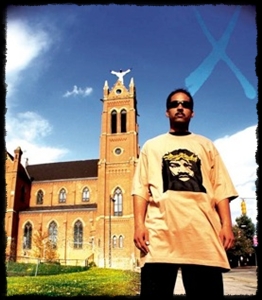 His newest video is on Afghanistan. It examines what lead up to Afghanistan’s intimate and volatile relationship with the U.S.
 In the classic tradition of Romantic poetry, Jasiri X identifies Afghanistan as a woman and examines her relationship with the Men (and their armies) surrounding her. The strategic use of video from Dr. King and the resonant refrain “Bring the Troops Home” is powerful!
Jasiri X’s putting the prophetic politics back into hip-hop, returning it to its roots from Public Enemy, with its reference to John Dillinger who was named by the FBI during the Great Depression as “Public Enemy Number 1” (though many of the hungry poor public referred to Dillinger as a “Robin Hood”).
Jasiri X is a MC, activist and entrepreneur who made his way onto the national and international hip-hop scene with the controversial hit song “FREE THE JENA 6,” which played on more than 100 radio stations across the U.S. It was also named “Hip-hop Political Song of the Year” and won “Single of the Year” at the Pittsburgh Hip-Hop Awards in 2007.
Afghanistan (HerStory) was produced by Kai Roberts and directed by Paradise the Arkitech of X-Clan. Check out more videos at Real Talk Express and Justin Richardson’s page at The Gathering for Justice.
Afghanistan, Chuck D, draft resistance, Gathering for Justice, Great Depression, hip-hop, Jasiri X, Jena 6, John Dillinger, Justin Richardson, Kai Roberts, Martin Luther King, music, Nation of Islam, nonviolence, Paradise the Arkitech of X-Clan, peace, Pittsburgh, poetry, Public Enemy, rap, Real Talk Express, Robin Hood, video, X -
Marina Silva: “Forest Time vs City Time”
 When international climate negotiators meet in December in Copenhagen, Brazilian Catholic Amazonian activist Marina Silva will serve as the conference’s conscience. A native Amazonian who grew up in a community of rubber-tappers, Silva worked with murdered Catholic activist Chico Mendes, won the prestigious Goldman Environmental Prize in 1996, and served as Brazil’s minister of the environment under President Luiz Inácio Lula da Silva from 2002 to 2008, when she resigned in protest.
Of her early faith, Silva writes: “One of my biggest problems during my childhood was to find out who God was and where He had come from. Even if I had never seen a Bible and had never entered church, I started a journey” (see Marina Silva: Defending Rainforest Communities in Brazil). She’s also known for her deeply held beliefs in nonviolence. “I have a great admiration for people who struggle in the way Gandhi did: at once activist and pacifist, ” she said in a 1995 interview.
Washington Post‘s environment reporter Julie Eilperin interviewed Marina Silva when she was in town this month. Here’s an excerpt:What inspired you to do environmental work?
It was a combination of things. First, the sensibility I gained from living with the forest, from being born there and taking my sustenance from it until I was 16 years old. Second was my contact with liberation theology, with people like Chico Mendes, a connection that raised social and political consciousness about the actions of the Amazonian rubber-tappers and Indians who were being driven out of their lands because the old rubber estates were being sold into cattle ranches. These encounters made me become engaged with the struggle in defense of the forest. Later, I discovered that this was about “the environment” and the protection of ecosystems. It was an ethical commitment that these natural resources could not be simply destroyed.
How does your Amazon upbringing affect the way you see the issues at stake?
Without doubt, the experience of living in one of the most biologically and culturally diverse regions of the world has affected how I see the world. I see two time frames: forest time and city time. Forest time is slower; things have to be more fully processed; information takes a long time to get there, so people didn’t have access to new information. When a new idea arrived, you thought about it, elaborated on it, talked about it for a long time. So this way of thinking, reflecting on and developing ideas, helps me have a sense of the preservation of things, to not make rushed decisions.
Read the whole interview here.
-
Choose Your Role Model: Mel Gibson or Michael Moore?

Fr. Ron Rolheiser Catholic columnist Ron Rolheiser (priest and member of the Missionary Oblates of Mary Immaculate) has a great column this month on civility in public and church discourse titled Respect for Each Other in a Polarized Community (11-15-09). The whole column is worth a close read, but here’s the section I liked best:
Biblical scholar, Ernst Kaseman, once suggested that what’s wrong in both the world and the church is that the liberals aren’t pious and the pious aren’t liberal. How true. It’s rare to see the same person leading both the peace-march and the rosary. Liberals are better at one, conservatives at the other. Each has its own models, its Mel Gibsons and Michael Moores, patron saints of piety or justice. What’s needed is a patron saint for both.
Perhaps we might look for that in Dorothy Day, someone whom both sides, liberal and conservative, respect and recognize as a saint and who is soon to be canonized by the church. She was both pious and liberal, a woman equally comfortable leading a peace-march or leading the rosary. She was also able to stand up strongly for truth, for life, and for justice, without bracketing what has to be forever fundamental within all relationships and discourse – charity, respect, wide compassion, and a sense of humor!
-
‘Drizzly November in My Soul’

Some things are best said through great literature.
Whenever I find myself growing grim about the mouth; whenever it is a damp, drizzly November in my soul; whenever I find myself involuntarily pausing before coffin warehouses, and bringing up the rear of every funeral I meet; and especially whenever my hypos get such an upper hand of me, that it requires a strong moral principle to prevent me from deliberately stepping into the street, and methodically knocking people’s hats off–then, I account it high time to get to sea as soon as I can. This is my substitute for pistol and ball. With a philosophical flourish Cato throws himself upon his sword; I quietly take to the ship. There is nothing surprising in this. If they but knew it, almost all men in their degree, some time or other, cherish very nearly the same feelings towards the ocean with me.–Herman Melville, opening of Moby Dick
-
Joan Chittister: Who’s In Charge – God or Us?
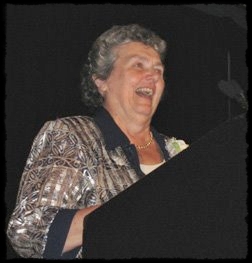 In June 2009, scientists and spiritual leaders gathered in Cortona, Italy, for the International Conference on Science and Spirituality. Catholic Benedictine sister Joan Chittister was one of the participants. Her team produced 8 fantastic 3-minute podcasts from the conference summarizing the discussion of the day.
Below is podcast #3 on the topic of the mystery of order. Is order immanent or transcendent? What is the source of the order in the universe? Can concepts such as evolution and emergence offer valid and sufficient answers?
Watch more of Sr. Joan.
-
Video: The Young Are Dreaming Dreams
In June 2009, 19 young Israelis and Palestinians, who have been working together for three years, came together in Tel Aviv to show that music can overcome conflict by creating a unique track and this 5-minute video.
The project is a collaboration between peace organization Windows for Peace and pioneering London-based music college Point Blank Learning. This video ‘Step for Peace’ is the final result of all their hard work.
For me, it’s a contemporary expression of Joel 2:28-29: “And it shall come to pass afterward, that I will pour out my spirit upon all flesh; and your sons and your daughters shall prophesy, your old men shall dream dreams, your young men shall see visions: And also upon the servants and upon the handmaids in those days will I pour out my spirit.”
“At first [working on the project] was kind of weird. We all have different stories. We all had a bit of trouble trying to understand each other. Just our traditions are different; we are living different lives. After some time, we got to know each other and be friends.” – Natalie, Palestinian from Bethlehem, 15.
“It has changed my life. Before, I thought Israeli people were bad and that they thought of us as bad. When I met the group it was a shock for me – now I’ve changed my thoughts about Israelis” – Tamara, Palestinian from Bethlehem, 15.
“It’s fantastic we are talking, because we are supposed to be enemies. I came here because I wanted to understand more the other side. It’s hard for me to talk about the hard things [Palestinians] go through. There is something in their voice that blames me and I can’t blame them for that” – Gili, Israeli from Tel Aviv, 14.
“[The song] won’t make people meet the other side, but it will change the way they think about the conflict” – Orin, Tel Aviv resident, 14.
-
Subscribe
Subscribed
Have a WordPress.com account? Log in now.

