-
Merton: ‘Simple and Primitive’
 Photograph by Thomas Merton, taken on May 13, 1968 on the Pacific Shore
“People who watch birds and animals are already wise in their way. I want not only to observe but know living things, and this implies a dimension of primordial familiarity which is simple and primitive and religious and poor. This is the reality I need, the vestige of God in His creatures. And the light of God in my own soul.”–Thomas Merton
From A Search for Solitude: The Journals of Thomas Merton, Volume 3
-
Radical Openess
Sr. Joan Chittister is one of my heroes in the faith. Rooted in her life modeled after the 1500-years-old disciplines of St. Benedict, she writes and speaks from a position of prophetic wisdom.

The home of whites that has never had a person of color at the supper table is a home that has missed an opportunity to grow. People of color who have never trusted a white have missed a chance to confirm the humanity of the human race. The man that has never worked with a woman as a peer, better yet as an executive, has deprived himself of the revelation of the other half of the world. The comfortable contemplative who has never served soup at a soup kitchen, or eaten lunch in the kitchen with the cook, or clerked in a thrift shop, or spent time in inner-city programs lives in an insulated bubble. The world they know cannot possibly give them the answers they seek. The adult who has never asked a child a question about life and really listened to the answer is doomed to go through life out of touch and essentially unlearned.
“When someone comes to the gate,” the Rule of Benedict instructs, “say ‘Benedicite.’” Say, in other words “Thanks be to God” that someone has come to add to our awareness of the world, to show us another way to think and be and live beyond our own small slice of the universe. –Sr. Joan Chittister, OSB (Illuminated Life)
-
Poem: Annie Finch’s Summer Solstice Chant
I studied with Annie Finch at the Stonecoast MFA creative writing program at the University of Southern Maine. She’s now the director.
Tupelo Press has just released a CD of Annie reading all of the poems in her 2003 collection titled Calendars, with musical interludes played on Celtic harp with Anglo-Saxon tunings by Mac Ritchey of the ensemble 35th Parallel. Here’s an appropriate selection:
Summer Solstice Chant
June 21by Annie Finch
The sun, rich and open,
stretches and pours on the bloom of our work.In the center of the new flowers,
a darker wing of flowerpoints you like a fire.
Point your fire like a flower.
From Calendars by Annie Finch (Tupelo Press).
-
McChrystal v Obama: Battle of the ‘Hard Hearts’?

General McChrystal's gold engraved nunchuks. Photograph by Mikhail Galustov for Rolling Stone/Redux Yesterday U.S. top Afghanistan warrior General Stan McChrystal was very publicly called to the carpet in the Oval Office. Sources say his job is on the line. President Obama wants McChrystal to answer for comments he made in a Rolling Stone interview (July 8-22, 2010 issue).
The short form is that McChrystal disses the counterterrorism strategy advocated by Vice President Joe Biden, calling it “shortsighted,” saying it would lead to a state of “Chaos-istan.” He outright insults Special Representative to Afghanistan Richard Holbrooke, and says he feels betrayed by the US ambassador in Kabul Karl Eikenberry. Overall, McChrystal conveys a deep-seated contempt for civilian leadership.
And, despite the “it’s a tough slog, but we are winning the Afghani hearts and minds” rhetoric from the White House, the civil societies in the countries of our NATO allies have forced their governments to change direction on the failed war policy in Afghanistan. (Having watched The Princess Bride numerous times, they apparently learned the lesson: “Never get involved in a land war in Asia.”)
In the Rolling Stone article, author Michael Hastings writes:
Opposition to the war [in Afghanistan] has already toppled the Dutch government, forced the resignation of Germany’s president and sparked both Canada and the Netherlands to announce the withdrawal of their 4,500 troops. …
But facts on the ground, as history has proven, offer little deterrent to a military determined to stay the course. Even those closest to McChrystal know that the rising anti-war sentiment at home doesn’t begin to reflect how deeply f*&^%d up things are in Afghanistan. “If Americans pulled back and started paying attention to this war, it would become even less popular,” a senior adviser to McChrystal says. Such realism, however, doesn’t prevent advocates of counterinsurgency from dreaming big: Instead of beginning to withdraw troops next year, as Obama promised, the military hopes to ramp up its counterinsurgency campaign even further. “There’s a possibility we could ask for another surge of U.S. forces next summer if we see success here,” a senior military official in Kabul tells me.
While the White House is debating whether or not to fire McChrystal and what the fall-out might be on U.S. military strategy in Afghanistan, Rabbi Arthur Waskow frames the argument differently: “The ‘strategy’ is already a failure, and the ‘civil-military issue’ is the Constitution at stake, not a failed and stupid war.”
Waskow sets Obama’s current dilemma in historical context:
Harry Truman knew what to do: When the issue was insubordination by General MacArthur over whether to escalate a stupid war with China that MacArthur had brought on (beyond defending South Korea), Truman fired MacArthur. (I remember Congress begging MacArthur to address a special joint session. I remember how he ended with a bathetic, bedraggled song: “Old soldiers never die, they just fade away.”) Right. Despite the resulting furor, the arrogant old soldier did indeed fade away. …
McChrystal’s strategy was arrogant & stupid; it has already failed because it was arrogant & stupid; and many of us, including Biden & Ikenberry, did indeed tell them so. …
The trouble is that Obama accepted the arrogant, stupid advice from McChrystal — and now has to face the consequences in a failing and mistaken war. When John Kennedy came new into the White House, he accepted similarly stupid & arrogant advice from the CIA about the Bay of Pigs invasion of Cuba — and when he realized how stupid it was, he fired the lot of them and refused to get trapped into more arrogance and more escalation.
Now we will see what Obama is made of: whether he has the guts and good sense of Truman & Kennedy.
But beyond the political power struggles that are as old as the military strategies of Uzziah in II Kings 15, there is a deeply spiritual issue. It is the issue of arrogance. It is always arrogance that hardens the heart and impedes the ability to listen.
“Refusing to listen breeds stupidity,” writes Rabbi Waskow. “Stupidity arising from a spiritual failure, not an IQ failure, breeds political disaster. There is a deep relationship between the arrogance of the Generals and the CIA in their contempt for China, Cuba, Iraq, Afghanistan — and their contempt for civilian leadership. And the contempt of BP for the oceans, the forests, the air. The obsessive belief that Conquest and Control are all that matters.”
The consequence of King Uzziah’s failed military strategy is summarized by a proverb from King Solomon: “Pride goes before destruction and a haughty spirit before a fall” (Prov. 16:18).
McChrystal – who carries around a gold, custom-made, set of nunchuks engraved with his name and four stars – has got pride and arrogance in spades. (Read the entire Rolling Stone article to get the full experience of this.)
But Rabbi Waskow reminds that pride and arrogance are not the marks of a great military leader. Instead, he says, the Talmud teaches: “Who is the greatest [military] hero? The person who can master his own impulses … and the person who can turn his enemy into his friend.”
Rose Marie Berger, an associate editor at Sojourners, blogs at www.rosemarieberger.com. She’s the author of Who Killed Donte Manning? The Story of an American Neighborhood (Apprentice House, April 2010).
2 Kings 15, Afghanistan, Arthur Waskow, Asia, Biden, Canada, counterterrorism, Eikenberry, General MacArthur, Germany, Harry Truman, Holbrooke, Holland, John Kennedy, Kabul, McChrystal, Michael Hastings, military, Obama, Princess Bride, Proverbs 16:18, Rolling Stone, Shalom Center, Solomon, Talmud, Uzziah -
Why the Oil Spill is Not an ‘Act of God’
 Robert Parham had a good post at the On Faith blog of the Washington Post. He corrected some politicians who have called the oil catastrophe an “act of God.” Why do we blame God and defend BP, Parham challenges? He’s executive editor of EthicsDaily.com and executive director of its parent organization, the Baptist Center for Ethics. Here’s an excerpt from his post:
Six weeks after oil began gushing into the Gulf of Mexico, the United States faces what appears to be its worst manmade ecological disaster. Yet too few Americans have framed the issue in moral terms.
One exception is Gov. Rick Perry (R-Texas). He told the U.S. Chamber of Commerce two weeks after the BP eruption, “From time to time there are going to be things that occur that are acts of God that cannot be prevented.”
At a meeting, where Perry rambled against the government–anti-regulation, anti-health care reform, anti-taxation–and said trust the private sector, he chose predictably to defend BP and inexplicably to blame God.
Contrary to Perry’s morally absurd claim, God is not to blame for BP’s corporate greed, America’s sloth or prideful confidence in technological infallibility.
Traditional Christianity identifies greed, sloth and pride as three deadly sins–sins that manifest themselves in BP’s disaster. –Robert Parham
Read his whole post here.
-
BP: Is It Time to Ban Companies Again?
 It appears that BP has decided it needs tips from the Spin Master to protect its thoroughly corroded reputation in the U.S. No, they haven’t hired Republican strategist Frank Luntz. Instead they head-hunted Anne Womack-Kolton to take up the lead role for BP’s U.S. media relations.
In one of her previous jobs Anne was press secretary to the Master of the Dark Arts, none other than Dick Cheney himself. She was also the handler on the National Energy Policy Development Group aka Vice President Cheney’s “Energy Task Force” that was supposed to be made up of “government officials” and ended up being packed with CEOs from BP, Chevron, Enron, ConocoPhillips, American Petroleum Institute, and … wait for it … Grover Norquist and Gail Norton’s Council of Republicans for Environmental Advocacy.
With BP’s stock in a much-applauded death spiral, we can now look forward to the high-sheen of Anne’s corporate disinformation campaign.

Carcass of a decomposing dolphin on rocks at Queen Bess Island in Gulf of Mexico. Additionally, in the last few days more than 300,000 people have joined the Boycott BP Facebook campaign and are demonstrating in the streets, at BP gas stations, and boycotting BP products (such as Castrol, Arco, Aral, AM /PM, Amoco, and Wild Bean Cafe).
The best news is that Attorney General Eric Holder is opening a criminal investigation against BP. This is exactly how a government should behave and I applaud Holder’s forward movement on this.
In my estimation, BP should be banned for 50 years from doing business in the United States. Whether or not criminal charges are brought against the company, they are guilty of criminal malfeasance and endangering thousands of lives.
Here’s a section from a great article in The Guardian:
Robert Reich, the former labour secretary under Bill Clinton, today called for BP’s US operations to be seized by the government until the leak had been plugged. A group called Seize BP is planning demonstrations in 50 US cities, calling for the company to be stripped of its assets. The stock plunged 15% , or $6.43, to close at $36.52 at the end regular trading on the New York Stock Exchange.
The criminal investigation announced by the American attorney general was launched just hours after Obama promised to prosecute any parties found to have broken the law in the lead up to the disaster. The president dropped several threatening comments into a 10-minute address from the White House to mark the start of an independent commission to look into the causes of explosion.
But the reality is that even if there was enough public and political pressure to close down British Petroleum, we wouldn’t have solved the problem. These massive environmental catastrophe’s are going to continue.
Here’s the radical wisdom of Catholic teaching that addresses this situation from Pope Benedict’s encyclical Charity and Truth:
The Church’s social doctrine has always maintained that justice must be applied to every phase of economic activity, because this is always concerned with man and his needs. Locating resources, financing, production, consumption and all the other phases in the economic cycle inevitably have moral implications. Thus every economic decision has a moral consequence. The social sciences and the direction taken by the contemporary economy point to the same conclusion. Perhaps at one time it was conceivable that first the creation of wealth could be entrusted to the economy, and then the task of distributing it could be assigned to politics. Today that would be more difficult, given that economic activity is no longer circumscribed within territorial limits, while the authority of governments continues to be principally local. Hence the canons of justice must be respected from the outset, as the economic process unfolds, and not just afterwards or incidentally….
In the global era, the economy is influenced by competitive models tied to cultures that differ greatly among themselves. The different forms of economic enterprise to which they give rise find their main point of encounter in commutative justice. Economic life undoubtedly requires contracts, in order to regulate relations of exchange between goods of equivalent value. But it also needs just laws and forms of redistribution governed by politics, and what is more, it needs works redolent of the spirit of gift. The economy in the global era seems to privilege the former logic, that of contractual exchange, but directly or indirectly it also demonstrates its need for the other two: political logic, and the logic of the unconditional gift.
Maybe BP can convert itself into a transnational nonprofit dedicated to establishing bioreserves where they pay local communities to keep the oil in the ground and to keep the natural habitats healthy and whole.
-
Praising Benedict and Madonna
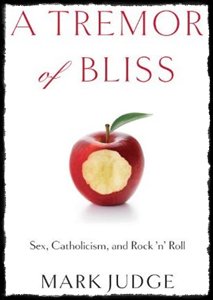 I’m thrilled to see that my buddy Mark G. Judge has a new book out called A Tremor of Bliss: Sex, Catholicism, and Rock ‘n’ Roll.
Mark and I are so opposite politically that we bump into each other coming around the back side. And he’s a fantastic writer plus a witty, wicked smart, courageous companion on the journey.
I haven’t read the new book yet, so can’t give it a proper review. In the meantime, Mark says of the book, “It is interesting theologically and very pro-pop music. I praise Benedict and Madonna, sometimes on the same page!”
Congratulations, Mark!
-
Poem: “In the Cross Maker’s Tent” by Jeff Newberry
In response to British Petroleum’s industrial oil catastrophe in the Gulf of Mexico, I went looking for poetry. I found a great collection over at Poets for Living Waters. Here’s a poem by Jeff Newberry, a Gulf native.
“Recently, I visited my hometown, Port St. Joe, Florida, a former mill town and fishing village on the Gulf Coast, some 35 miles east of Panama City,” writes Jeff. “I took a long walk one morning down by St. Joseph’s Bay, and looking out over the still green water, I saw where the shallows dropped off into the deeper water of the bay. It was clear demarcation: visible sand then darkness. I found the contrast both beautiful and ominous. Only later did I realize that my thinking about art comes from having grown up by the Gulf of Mexico. For me, art is like St. Joesph’s Bay. You can see it, measure it, understand it – up to a point. Beyond that point is mystery, a place both exciting and dangerous, a place where you lose yourself and become a part of the art itself.”
In the Cross Maker’s Tent
Port St. Joe Seafood FestivalThe old woman carved crosses from driftwood,
Displayed them on lattice board, ran balsa
Hands over one as she spoke: I find the piecesEach morning, washed up from the bay. Some days,
Webs of seaweed tangle them, but I find the best
Pieces this way: hidden. I wanted to buy a carving,Pictured her hands turning the wood, palms like wave-
Polished sea glass. Did she use a lathe? Did she plane
Or shave the wood? How often did she slip & sliceSkin from her palm? Outside, the festival continued:
People drifted by the tent, a steady rhythm of voices,
Like waves stealing sand. October wind rattledThe tattered canvas. Bruised clouds churned low
Over St. Joseph’s Bay. A sudden strobe of lightning.
She gestured west, swirled the air with one lined palm.Indian summer. Rain’s coming she said. Storms, hail.
It’s the heat mixing with the coming cold. I chose
A gray cross with periwinkle inlays, felt the honed-Down ridges, imagined her finding it after a sleepless
Night, carving it as the sea lay still, a sheet of glass.Read more of Jeff’s work here.
-
Rand Paul and Other Sad Examples of Dehumanizing Empire
Sometimes everyday life is just a little too coarse, a little too violent. Rand Paul’s ignorant undermining of the Civil Rights Act makes me feel terribly sad. The guys who whip through stop signs in their $40,000 Lexuses stun me with their arrogance, smallness, and stunted sense of generosity. The fact that the families of the 11 oil roustabouts killed in the BP rig explosion had no bodies to bury (see a moving NPR report here) makes me irrationally angry. I want BP and Transocean and Halliburton executives to have to look on the bodies of the men they killed.

"Bleeding World" by Salvador Dali And yet, I’m trying to hold all this in biblical context. These are all examples of the excesses of Empire. This is the absurdity or vanity or meaninglessness that Qoheleth addresses at the opening of Ecclesiastes. “Vanity of vanities, says Qoheleth, vanity of vanities! All things are vanity!” (1:2).
One of the products of Empire in the bible is a constant dehumanizing pressure on the people that leads to a “culture of despair.”
“Anguish reigns, the spirit is crushed, life is diminished and paralyzed. All of us, in some way, for different reasons, have felt this sensation of closed horizons. For this situation, even though it seems incredible, the book of Ecclesiastes has something to say,” writes Mexican liberation theologian Elsa Tamez.
(For more on this, read Tamez’s brilliant interpretation of Ecclesiastes called When the Horizons Close.)
The opposite of the “monoculture” demanded by Empire is the Pentecost movement that blows uncontrollably, creating a generative “togetherness” out of dizzying diversity. It’s this violent Wind of God that blows down the idols of Empire and restores the unique “tongues of the people.” The Spirit undoes the Empire’s “cash English” (see Acts 2) and restores the parlance of poetry.
Into this context comes Benedictine Joan Chittister’s reflection from her new book Uncommon Gratitude: Alleluia For All That Is .
Unity is more than solidarity and more than uniformity. Unity, ironically, is a commitment to becoming one people who speak in a thousand voices. Rather than one message repeated by a thousand voices, unity is one message shaped by a thousand minds.
In times of great social change, as now, in times when the very foundations of life are in threat of collapsing, as now — when the very nature of life and death, of spirit and matter, of mind and body, of technology and people — are in question, the temptation is to avoid the ambiguities of the future by requiring the institutionalization of the past. Then churches tell people what they can think and governments tell people what they can’t do, the courts make law and the military makes weapons. Then everything is made to look united again, but nothing really is.
The kind of unity that is born out of differences and becomes the glue of a group has four characteristics: it frees, it enables, it supports, and it listens. A group that is genuinely unified is a group that has freed every member to be themselves. In fact, the truly united group knows that every idea, every voice, counts in the process of idea formation.
Without the collection of ideas, no consensus is possible. Then the group is reduced to the kind of compliance that wilts in the noonday sun.
Then we begin to hear: “Well, I never thought it was a good idea in the first place.” Then we know that even at the height of its power, underneath it all the group lacked heart.
For the freedom to ask questions without reprisal in the face of contrary concepts, sing alleluia. To seek unity means that enabling people to speak without fear and without hesitation must become the cornerstone of discussion. Ideas must be sought out. Answers must be elicited. Hesitations must be defined. Cautions must be honored before unity in diversity is possible. But when it comes, sing alleluia because then all the talents of the population are wholeheartedly engaged in the enterprise.
For a people to know unity they must also know the support that comes when people who speak another truth are as respected for that perception as they would have been for agreeing with the majority in the first place. I can only give myself to a group that not only tolerates my differences but seeks them out. That way, when a decision is finally forged out of the fire of differences, there is no doubt that it carries within it all the passion the group has to give.
Finally, unity depends on listening, not only to begin it but also to sustain it. No decisions are made once and forever. No unity can be perpetual if it revolves around a changing center. No good thing can be guaranteed to stay good throughout time. It is so easy to make an idol out of a time, a place, a decision, a group that once was united but now, in the light of another, newer day, is not.
Then it is time to begin again. Then the unity must be tested and reshaped. It is a very holy process, the search for unity. It is an alleluia moment made for eternity but welded and rewelded by time.
I’m hungry for that renewal of Spirit that leads to authentic human freedom. I need to be in that “holy process.” I’m clinging to the tail-end of the Alleluia and praying for a high wind.
-
Subscribe
Subscribed
Have a WordPress.com account? Log in now.

