-
Teresa of Avila: Is Prayer Just ‘Spending Time with God’?
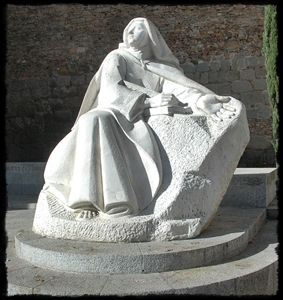
Sculpture of Teresa in Avila, Spain. I was drinking my coffee this morning at the local coffee shop while reading the daily lectionary. Along with Matthew 13–where the disciples beg Jesus to let them peek at the answers at the back of the book (“Explain to us the parable of the weeds in the field.”)–there was this confounding quote from Teresa of Avila. Five hundred years later and she’s still able to make me set down my coffee in surprise!
“Prayer is not just spending time with God. It is partly that–but if it ends there, it is fruitless. No, prayer is dynamic. Authentic prayer changes us–unmasks us–strips us–indicates where growth is needed. Authentic prayer never leads to complacency, but needles us–makes us uneasy at times. It leads us to true self-knowledge, to true humility.”–Teresa of Avila
For a delightful short video series on the life of Teresa of Avila, check out Sister Donna on YouTube.
-
True ‘Family Values’ Means Loving Your Gay Kids, Say Latino Catholics

Migdalia Santiago: "My daughter is lesbian. I learned this when she was 13. I am Catholic." The Christian Right has maintained a strong anti-gay plank in their “family values” platform. However, many Christians believe that true “family values” are rooted in the family as a model of Christian community.
Christian families are kinship groups where the basics of Christian virtues and life are taught to the young and exemplified by the elders — including sacrificial love, deep prayer and study, charity and justice within and beyond the family, and a bottomless well of mercy and forgiveness.
Latinos are known for holding the family at the core of culture and values. The Public Religion Research Institute’s July 21, 2010, report on Religion and Same-Sex Marriage in California indicates how “family values” are defined among Latino Catholics and Protestants in California when it comes to gays, gay marriage, and justice.
Here’s what the statistics show:
*57% of Latino Catholics would vote for the legalization of same-sex marriage compared to 22% of Latino Protestants
*Latino Catholics “say they trust the parents of gay and lesbian children more than their own clergy as a source of information about homosexuality.”
*According to the Pew Forum, an estimated 31% of California’s population is Catholic. And of that between 40-50% is Latino.
Joe Palacios, adjunct professor of sociology at Georgetown University, reflects on this trend in On Faith:
Family First: Latino Catholics orient their social lives around the family and extended family even in the context of high Latino single-parent households (estimated 33% of all U.S. Latino households; 36% of all Latino Children in California live in single-parent households). Family solidarity is strong and even though children may not follow “traditional family values” as projected by the church and the U.S. society, parents want to keep their children within the family. It is not surprising that Catholics in general and Latino Catholics in particular, as the Public Religion Research study shows, see that parents learn about gay issues from their children. Their moral and ethical judgments are primarily made through this social reality rather than abstract pronouncements from their church leaders.
Catholic Communal versus Protestant Individual Faith: Catholicism is a communal faith that highlights the life cycle process through the sacraments of baptism, Eucharist, confirmation, and marriage. Families experience their moral lives through communal participation in the sacraments, as well as the Latino community’s cultural observances of Our Lady of Guadalupe, Posadas, Dia de los Muertos, etc. Protestant Latinos, on the other hand, have a faith that is individually driven through faith conversion (“accepting Jesus Christ as my Lord and Savior”) that often separates a person from the Catholic sacramental life cycle process and the social fabric of the Catholic-based cultural celebrations. Fundamentalist Protestantism sees such Catholic cultural practices as contrary to a pure Christian faith. The study illustrates this communal-individual faith difference by noting that Latino Protestants (37%) lean toward a style of religious social engagement prioritizing “personal morality and faith” over a Catholic (59%) orientation that prioritizes “justice and action.”
Latino Catholic Tolerance versus Protestant Fundamentalist Judgment: Catholics allow complexity and ambiguity in moral decision-making since Catholicism is neither fundamentalist nor literalist regarding the Bible. Rather, Catholics can weigh factors such as the Bible, church teaching, and social reality affecting decision-making. Latino Catholics in the United States live in this social context that allows the free exercise of conscience rather than enforced scriptural fundamentalism or bishops’ and pastors’ exhortations in making decisions regarding homosexuality and gay rights– as is often exercised in Protestant fundamentalist and evangelical denominations and now by increasingly doctrinaire Catholic bishops. Further, as noted in the study, Catholic priests rarely mention homosexuality or gay issues in sermons except when forced to by the bishops as happened during the Prop 8 campaign.
Read Palacios’ whole column here. Read the whole Public Religion Research Institute report with more valuable data on religious views correlated to gay/lesbian issues. Including this:
A significant number of Californians who initially say they support civil unions but not same-sex marriage say they would support same-sex marriage if the law addresses either of two basic concerns about religious marriages:
*With a religious liberty reassurance that the law would guarantee that no congregation would be forced to conduct same-sex marriages against its beliefs, support for same-sex marriage increases 12 points, from initial support of 42% to a solid majority at 54%.
*With a civil marriage reassurance that the law would only provide for ‘civil marriages like you get at city hall,’ support increases 19 points, from 42% to about 6-in-10 (61%).
Also read Why Would More Latino Catholics Be For Same-Sex Marriage Than Protestants? by Candace Chellew-Hodge
And for an excellent discussion on the Bible and gay marriage, see earlier post The Good Book and Gay Marriage.
-
Joan Chittister: To Be A Moral Force in the World

Sr. Joan's recent lecture in Boston was cut short due to a false fire alarm. The invitation to be a “perfect fool” is at least an invitation to perfection.
As brother Paul says, “For the message of the cross is foolishness to those who are perishing, but to us who are being saved it is the power of God.” Speaking up for justice within the incomprehensible love of God is part of the process of salvation, the journey of becoming “children of God.”
Sr. Joan reminds me of my responsibility to the process of my salvation, the ongoing practice of following Christ. She says:
There are three obstacles to our personal development that would make us a moral force in the world.
First, fear of loss of status has done more to chill character than history will ever know. We do not curry favor with kings by pointing out that the emperor has no clothes. We do not gain promotions by countering the beloved viewpoints of the chair of the board or the bishop of the diocese. We do not figure in the neighborhood barbecues if we embarrass the Pentagon employees in the gathering by a public commitment to demilitarization. It is hard time, this choice of destiny between public conscience and social acceptability. Then we tell ourselves that nothing is to be gained by upsetting people. And sure enough, nothing is.
Second, personal comfort is a factor, too, in the decision to let other people bear responsibility for the tenor of our times. It takes a great deal of effort to turn my attention beyond the confines of where I work and where I live and what my children do. It lies in registering interest in something beyond my small, small world and perhaps taking part in group discussions or lectures. It requires turning my mind to substance beyond sitcoms and the sports channel and the local weekly. It means not allowing myself to go brain-dead before the age of forty. But these things that cost comfort are exactly the things that will, ultimately, make life better for my work and my children.
Third, fear of criticism is no small part, surely, of this unwillingness to be born into the world for which I have been born. To differ from the mainstream of humanity, to take a position that is not popular tests the tenor of the best debaters, the strongest thinkers, the most skilled of speakers. To do that at the family table or in the office takes the utmost in courage, the ultimate in love, the keenest communication skills. And who of us have them?
The process of human discourse is a risky one. Other people speak more clearly or convincingly than we do. Other people have better academic backgrounds than we do. Other people have authority and robes and buttons and titles that we do not now and ever will have, and to confront those things takes nerve of a special gauge. I may lose. I may make a perfect fool out of myself. But everybody has to be perfect about something. What else can be more worth it than giving the gift of the perfect question in a world uncomfortable with the answers but too frightened or too complacent or too ambitious to raise these doubts again? — Sr. Joan Chittister, OSB
-
Arizona Adopts ‘Jimenez Crow’ Laws: Direct and Indirect Civil Disobedience

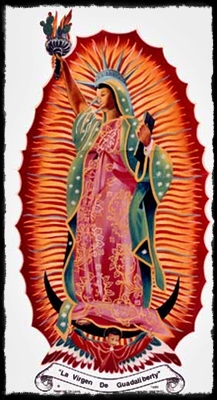
by NEPHTALI DELEON Next week, Arizona’s Senate Bill 1070 will go into effect.
This bill, among other things, requires local law enforcement to check an individual’s immigration status if there is “reasonable suspicion” that said individual is undocumented. Another provision of SB 1070 requires immigrants to carry papers denoting citizenship at all times while in the state.
The U.S. Department of Justice has filed a suit against Arizona, citing the bill as discriminatory. (For more on the law and comprehensive immigration reform, please see Sojourners’ great campaign Christians for Comprehensive Immigration Reform.)
As the action heats up in Arizona, we’ve got a “teachable moment” about what nonviolent direct action looks like when taken directly against an unjust law — as opposed to symbolic civil disobedience that often breaks a smaller law to highlight the injustice of a larger situation.
Will Travers’ article A Rare Opportunity for Direct Civil Disobedience in Arizona provides an excellent outline for this conversation. Will’s a scholar of nonviolence with a degree from the University of Michigan. He works with the NYC-based band/nonprofit, Lokashakti, promoting peace and social justice through collective nonviolent action. Here’s an excerpt:
… Not since the end of the draft in 1973 has there been a law in the United States that seems to render itself so well to direct civil disobedience. Arizona SB 1070 requires non-citizens to keep registration documents on them at all times and forces police officers to inquire about immigration status during any kind of arrest or routine stop if they encounter “reasonable suspicion” that the person might be in the country illegally. In addition, the new law gives police leeway to arrest someone solely on the basis of there being probable cause that they may be undocumented, at which point they’re to be turned over directly to Immigration and Customs Enforcement (ICE).
This basically boils down to the police in Arizona having new license to stop anyone looking remotely Hispanic — for no other reason than that they look remotely Hispanic — demand papers from them, and take them into custody if satisfactory documents are not immediately produced. Predictably this has led some people, such as Roman Catholic Archbishop Roger Mahony, to draw parallels to the lives of those in Europe forced to live under the Nazi regime. Additionally — and this concerns all of us — the new Arizona law makes it a crime to “transport or move,” or “conceal, harbor or shield” undocumented immigrants, reminding me more of something out of the Fugitive Slave Acts from this country’s dark past. Against such blatantly unjust, potentially far-reaching legislation, at least we’re armed with a chance for everyone to participate in its direct disobedience, instead of just abandoning our undocumented brothers and sisters to their fate.
In a relatively short amount of time, Martin Luther King Jr. became somewhat of an expert on unjust laws. In a speech he delivered before the Fellowship of the Concerned in 1961, King defined an unjust law as “a code that the majority inflicts upon the minority, which that minority had no part in enacting or creating, because that minority had no right to vote in many instances.” Although close to 50 years old, this definition holds up in modern-day Arizona quite well. The undocumented minority, having virtually no recourse to its voice being heard, is at the mercy of the majority — in this case that of the Arizona Senate — 60 percent Republican and 100 percent white.
King places upon his definition one condition: that the law the minority is compelled to obey is not binding upon the majority. This indeed rings true again, as one would have a very hard time imagining members of Arizona’s white community consenting to being stopped because of their skin color, questioned by police, and immediately forced to prove their legal status under penalty of detention. On the necessity for civil disobedience when faced with such a law, King writes in his Letter from Birmingham Jail that:
[A]t first glance it may seem rather paradoxical for us consciously to break laws. One may well ask: “How can you advocate breaking some laws and obeying others?” The answer lies in the fact that there are two types of laws: just and unjust. I would be the first to advocate obeying just laws. One has not only a legal but a moral responsibility to obey just laws. Conversely, one has a moral responsibility to disobey unjust laws. I would agree with St. Augustine that “an unjust law is no law at all.”
While it’s difficult for me to speculate as to exactly how this unjust law should best be disobeyed, the inspiring example is already there of the five students and community organizers who staged a sit-in at Senator John McCain’s office in Tucson after the bill’s April signing. Remarkably enough, three of the five were undocumented and knowingly subjected themselves to possible deportation, finally undergoing arrest, then detention by ICE, before thankfully being released the next day. …
Read Will’s whole article here.
Archbishop Roger Mahony, Arizona, civil rights, Department of Justice, Fellowship of the Concerned, Fugitive Slave Acts, human rights, immigration, Immigration and Customs Enforcement, John McCain, Lokashakti, Martin Luther King Jr., nonviolence, reform, Roman Catholic, SB 1070, St. Augustine, University of Michigan, Will Travers -
“CO2 is Green”: More Big Oil Propaganda
Big oil and big coal are worried about the upcoming climate change legislation. They’re especially worried about what it will do to their bottom line. So worried, in fact, they’re willing to set up faux non-profits to try to “educate” us into believing rising levels of CO2 are okay – and that the overwhelming consensus of the world’s scientific community is wrong.
Some might call that a difference of opinion – but really, it’s just propaganda for profit.
 The front group “CO2 is Green” launched an advertising campaign this week with a half-page ad in The Washington Post urging people to pressure their senators to vote against the Senate’s “cap and trade” bill because, the ad says, “The bill is based on the false premise that man-made CO2 is a major cause of climate change.”
Anne Mulkern, who writes for Greenwire, has a great article in the NYT about the fossil fuel industry’s latest foray into wishful thinking:
“CO2 is Green spokesman H. Leighton Steward sits on the board of directors of EOG Resources Inc., an oil and natural gas development company. He also is an honorary director at the industry trade group American Petroleum Institute, according to a biography on EOG’s website. …”
EOG Resources goes farther to describe Mr. Steward, a graduate of Southern Methodist University, as:
“former Chairman of the U.S. Oil and Gas Association and the Natural Gas Supply Association … and currently an author-partner of Sugar Busters, LLC, a provider of seminars, books and products related to helping people follow a healthy and nutritious lifestyle, and Chairman of the non-profit foundations Plants Need CO2 and CO2 Is Green, providers of information related to carbon dioxide’s impact on the global climate and the plant and animal kingdoms.”
Additionally, David Di Martino, a spokesperson for Clean Energy Works, a coalition of about 80 faith and environmental groups who support climate legislation, told Mulkern, “CO2 is Green is bankrolled by Corbin J. Robinson, chief executive of and leading shareholder in Natural Resource Partners, a Houston-based owner of coal resources.”
According to a Mother Jones article from September 2009, “Natural Resource Partners is also a member of the American Coalition for Clean Coal Electricity (ACCCE), the scandal-plagued coal front group currently under investigation for its role in the forged letters sent to members of Congress criticizing the House climate bill.”
Steven Mufson at The Washington Post also wrote about these guys in back in September 2009, saying:
Steward has joined forces with Corbin J. Robertson Jr., chief executive of and leading shareholder in Natural Resource Partners, a Houston-based owner of coal resources that lets other companies mine in return for royalties. Its revenues were $291 million in 2008. They have formed two groups — CO2 Is Green designated for advocacy and Plants Need CO2 for education — with about $1 million. Plants Need CO2 has applied for 501(c)(3) tax status, so that contributions would qualify as charitable donations, said Natural Resource Partners general counsel Wyatt L. Hogan, who also serves on the group’s board.
(If you want to read more on the “populist” uprisings against climate change regulation and who’s bankrolling them, see Greenpeace’s excellent report “Koch Industries Secretly Funding the Climate Denial Machine”.)
So it looks like the oil, coal, and natural gas corporations have developed two new front organizations: “Plants Need CO2” is the 501-c-3 (education) nonprofit and “CO2 is Green” is the 501-c-4 (advocacy) nonprofit.
These two “not-for-profit” organizations are rolling out propaganda advertisements that are bankrolled by oil company profits (“I’m not getting a penny for this,” said Steward, who said he owned oil company stocks but no coal stocks, according to the Washington Post. “It’s just something I thought people should know.”) in order to influence votes in the Senate on climate legislation that will directly impact the financial bottom line of those same oil companies.
There is something wrong with that. Maybe it’s the “lying to people for profit” -angle.
In the interest of using this column to educate rather than obfuscate, however, let’s quickly review the climate change facts as laid out by the world’s best scientists (see The Intergovernmental Panel on Climate Change 2007 report):
1. “Warming of the climate system is unequivocal.” (It’s happening.)
2. “Global atmospheric concentrations of CO2, methane (CH4) and nitrous oxide (N2O) have increased markedly as a result of human activities since 1750.” (It’s happening because of high concentrations of CO2.)
3. “Most of the observed increase in global average temperatures since the mid-20th century is very likely due to the observed increase in anthropogenic [human-induced] greenhouse gas concentrations.” (It’s happening mostly because of CO2 waste produced by us, not trees.)
4. “Anthropogenic warming could lead to some impacts that are abrupt or irreversible.” (It’s happening and if we don’t do something we are really, uh, up a galaxy without a planet.)
5. “A wide array of adaptation options is available, but more extensive adaptation than is currently occurring is required to reduce vulnerability to climate change.” (It’s happening and we could do something to slow it down, but our most effective legislative options are being eaten away by the greed of the energy companies.)
Let me be clear. I’m sure that Mr. Steward and Mr. Robinson feel morally justified in what they are doing. I’m sure that they deeply believe that they are correct in informing the public to their way of thinking. But that is why we have ethical codes, particularly business ethics, to safeguard the societal common good from the egoistic self-interest of the corporate few.
If energy, oil, and coal companies – and the people who run them – want to critique climate change legislation, then let them do it openly – not from behind a curtain of green smoke. I suggest they fund a new ad for The Washington Post:
“Climate change is not our problem — satisfying our stockholders is. Won’t you vote ‘no’ on climate change legislation? Because when Papa’s happy, everybody’s happy.” This ad is brought to you and paid for by Big Oil and Sons.
Rose Marie Berger, an associate editor at Sojourners, blogs at www.rosemarieberger.com. She’s the author of Who Killed Donte Manning? The Story of an American Neighborhood available at store.sojo.net.
Links:
Senate’s climate change legislation (Kerry-Lieberman bill)
Ads Backed By Fossil-Fuel Interests Argue “CO2 is Green by Anne Mulkern
Greenwire
C02 is Green
Ad in The Washington Post
EOG Resources
Plants Need CO2
Clean Energy Works
New Front Group: CO2 is Green by Kate Sheppard, Mother Jones
American Coalition for Clean Coal Electricity (motto: “Clean Coal USA”)
New Groups Revive the Debate Over Causes of Climate Change by Steve Mufson
Koch Industries Secretly Funding the Climate Denial Machine, Greenpeace
The Intergovernmental Panel on Climate Change 2007 reportAmerican Coalition for Clean Coal Electricity, American Petroleum, Anne Mulkern, anthropogenic, cap and trade, Clean Energy Works, climate denial, Co2 is Green, Corbin J. Robinson, David Di Martino, EOG Resources, greenhouse gas concentrations, Greenpeace, Greenwire, H. Leighton Steward, Intergovernmental Panel on Climate Change, koch industries, methane, Mother Jones, Natural Gas Supply Association, Natural Resource Partners, New York Times, nitrous oxide, Plants Need CO2, Southern Methodist University, Steven Mufson, SugarBusters, U.S. Oil and Gas Association, Washington Post, Wyatt L. Hogan -
Tokyo Drips With Sweet Honey

I’m fascinated with honey bees. I’m thrilled by the recent rise in urban beekeeping and glad to see that Washington, D.C’s, local beekeeping laws are finally becoming more amenable to this venerable tradition.
One of the earliest extensive treatises on beekeeping was written by Virgil in 29 BC (Virgil’s Georgic IV):
Of air-born honey, gift of heaven, I now
Take up the tale….
The others shine forth and flash with lightning-gleam,
Their backs all blazoned with bright drops of gold
Symmetric: this the likelier breed; from these,
When heaven brings round the season, thou shalt strain
Sweet honey, nor yet so sweet as passing clear,
And mellowing on the tongue the wine-god’s fire.


 And the bee as Christian symbol was well-known in Europe. The honey bee has historically been a symbol of Christ’s attributes due to its honey and sting. The honey symbolizes gentleness and charity, and sting symbolizes justice and the cross. Bees are also a symbol of the resurrection. The three winter months when bees hibernate reminds Christians of the three days Christ spent in the tomb before rising.
The organization of life in the bees community, with perfectly delineated relationships and its dependence upon and service to the queen bee, also came to reflect an ideal of Christian virtues. Additionally, bees and beehives symbolize eloquence, and are represented with the three known holy orators called doctores melliflui (scholars sweet as honey): St. Ambrosius, St. Bernard of Clariveaux, and St. John Chrysostom. (See more on ancient Christian symbols.)
There’s also St. Gobnait of County Cork in Ireland who is the patron saint of bees. There’s even a contemporary Christian mission group in Uganda called Beekeepers for Christ.
 Now, beekeeping is also taking wing in urban Japan! Here’s an excerpt from a recent article:
Eleven stories above the heart of the Tokyo concrete jungle — with its beehive office partitions and swarms of suit-clad worker-bees — enthusiasts have stacked up beehives dripping with golden honey.
“Let’s enjoy the harvest, but be careful you don’t have an accident,” urban beekeeper-in-chief Kazuo Takayasu tells his fellow volunteers from behind the protective fine-mesh net covering his face.
Clad in white body suits, the crew gets to work, squeezing out the glistening syrup using a simple centrifugal machine they crank by hand as a cloud of bees breaks free from the honeycombs. …
The honey is largely organic, he said, because pesticide use has been banned in Tokyo city parks and gardens including the Imperial Palace, about one mile away, where the bees collect much of their nectar. …
-
“Darth Vader! Only You Could Be So Bold.”
Hi. My name is Rose. And I’m a Star Wars junkie.
As my grade school friends will recall, I saw the original Star Wars approximately 24 times when it was released in the spring of 1977. Nearly all of them were at the Century Theaters at the corner of Arden Way and Cal Expo in Sacramento–huge screens, plush bouncy seats, and the theater had just installed speakers compatible with SurroundSound. I had every line memorized.
I still get chills at the rise of John Williams’ opening score and recall the breath-takingly long Imperial battle cruiser glowering low over my head. The theater walls actually rumbled!
So while the new docuflick The People vs George Lucas may do nothing more than reveal what happens when a culture has no roots, I do understand their hunger for mythos.
Along with all that, the great folks over at Improv Everywhere (“We Cause Scenes”) staged a reenactment of the first Princess Leia/Darth Vader scene from the original Star Wars on a New York City subway car. “The white walls and sliding doors on the train reminded us of the rebel ship from the movie, and we thought it would be fun to see how people would react to a surprise appearance by the iconic characters.” (I love it that Princess Leia is reading “Galactic Rebellion for Dummies.”) Just for fun, here’s the video clip:
-
Gulf Apocalypse: Don’t Watch This Video
Conservationist John L. Wathen aka “Hurricane Creek Creekkeeper” has been producing powerful videos of the BP oil catastrophe. He first went up with SouthWings pilots in early May. Now he’s released another video from June 21 that shows the Gulf Apocalpyse, including dolphins and whales dying in the open water. The day after this video appeared on Keith Olbermann’s show, the Coast Guard enacted new rules that prohibit media from getting close to the slick by boat or air.
“We saw this pod of dolphins obviously struggling just to breathe. Then we found this guy: a sperm whale swimming in the oil had just breached. Along his back we could see red patches of crude as if he’d been basted for broiling. Then we saw this pod of dolphins, some already dead, some in their death throes. It seemed they were raising their heads looking at the fires, wondering why is my world burning down around me, why would humans do this for me.”–John L. Wathen
“And God said, Let the waters bring forth abundantly the moving creature that hath life, and fowl [that] may fly above the earth in the open firmament of heaven. And God created great whales, and every living creature that moveth, which the waters brought forth abundantly, after their kind, and every winged fowl after his kind: and God saw that [it was] good. And God blessed them, saying, Be fruitful, and multiply, and fill the waters in the seas, and let fowl multiply in the earth. And the evening and the morning were the fifth day.”–Genesis 1:20-23
It seems like I should draw some kind of helpful conclusion at this point; a summation. But, as Walter Brueggemann says of the prophet Ezekial, “Ministry has to do with grieving silence after the warning is unheeded.”
Rose Marie Berger, an associate editor at Sojourners, blogs at www.rosemarieberger.com. She’s the author of Who Killed Donte Manning? The Story of an American Neighborhood available at store.sojo.net.
-
Prayer is Infiltrating Christian Youth Groups
 A group in Eureka, Montana, called Lighthouse Trails, recently warned people against me, Jim Wallis, and Sojourners because of our association with Henri Nouwen, Thomas Merton, and contemplative Christian spirituality.
The folks at Lighthouse Trails describes their mission thusly: “In the year 2000, we learned that a mantra-style meditation coupled with a mystical spirituality had been introduced to the evangelical, Christian church and was infiltrating youth groups, churches, seminaries, and Bible studies at an alarming rate. Thus, in the spring of 2002, we began Lighthouse Trails Publishing with the hope of exposing this dangerous and pervasive mystical paradigm.”
 At the same time I was reading the reports from Lighthouse Trails, I was also re-reading parts of Merton’s book Life and Holiness in which he lays out a few basic ideas in Christian spirituality.
Henri Nouwen writes in the book’s introduction, “It is not a book about doctrines or dogmas, but about the life of Christ. … In its great simplicity, this is a radical book. It calls for total dedication and a total commitment [to Christ].”
Here is an excerpt:
“Prayer is then the first and most important step. All through the life of faith one must resort constantly to prayer, because faith is not simply a gift which we receive once for all in our first act of belief. Every new development of faith, every new increment of supernatural light, even though we may earnestly working to acquire it, remains a pure gift of God.”–Thomas Merton, Life and Holiness by Thomas Merton (Image, 1963, p. 81)
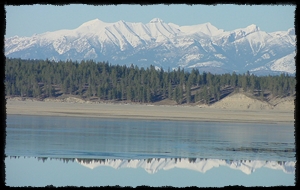 I don’t have anything in particular to say about Lighthouse Trails, except they are located in what must be the most beautiful place in the world at the northwest tip of Glacier National Park.
I understand their concern about Christian mysticism. Christian mystics are those who have a direct spiritual experience of God through Jesus. (See John 10:30 on union with God.) It may be a one-time experience that informs one’s faith or it may be an ongoing experience that radically affects one’s faith journey. It is not about belief or catechisms or rational assent to dogma. It is about a total transformation in Christ — about being “born again.” And this is inherently uncontrollable by religious authorities or dogmatists.
Christian mystics have a long history of being a threat to institutional religions and dogmatic believers. Conversely, the danger to Christian mystics is that they may put too much authority in their personal experience of God, rather than submitting their experiences to the wider wisdom of the Christian community.
This is the paradox that Merton, Nouwen, and even I, know well. As a result, we try to live attentively and, as Merton wrote, “resort constantly to prayer,” asking always for Christ to have mercy upon us.
-
Are the Walls of the Vatican Just Too Thick?

Diether Endicher/Associated Press Laurie Goodstein, the NYT’s religion reporter extraordinaire, along with David M. Halbfinger and Rachel Donadio published an excellent overview of the Catholic Churches response to the sexual abuse scandal, Church Office Failed to Act on Abuse Scandal, in yesterday’s paper.
For me, one of the saddest items in the story is simply the title of the confidential apostolic letter written by Pope John Paul II instructing that all cases of sexual abuse by priests were thenceforth to be handled by the Congregation for the Doctrine of the Faith, Cardinal Ratzinger’s office. The letter’s title: “Sacramentorum Sanctitatis Tutela,” Latin for “Safeguarding the Sanctity of the Sacraments.”
When the walls of the Vatican have become so thick that the one wearing the Shoes of the Fisherman and carrying Peter’s key prioritizes the sanctity of ritual over the sanctity of a child then the ritual has not only become meaningless, but blasphemy.
The apostolic letter should have been public and preached from every pulpit and parapet. It should have been titled “Safeguarding the Sanctity of Our Children.” It should have ordered an immediate opening of all files related to possible criminal activities by employees of the Catholic church (including all priests and deacons) to secular authorities for a proper prosecution. It should have called every bishop, archbishop, and cardinal to Rome for a meeting and hearing from victims of sexual abuse by a religious leader – and professional training by psychologists skilled in the nature of pedophilia, gender-related abuse, sexual abuse, and the insidiousness of domination as it relates to emotional and psychological abuse. It should have called for a time period of regular public repentance by Catholic church leaders, plus ongoing investigation to determine whether previous abuse cases were being dealt with in a timely manner and whether new cases were drastically decreasing.
It is, of course, “unfair” to cast aspersions on such a complicated case and process — especially in hindsight. However, I hope the more times we say what we SHOULD have done, will help prepare us for what we WILL do in the future.
Read Goodstein’s article here and there are some excerpts below:
…in May 2001, John Paul issued a confidential apostolic letter instructing that all cases of sexual abuse by priests were thenceforth to be handled by Cardinal Ratzinger’s office. The letter was called “Sacramentorum Sanctitatis Tutela,” Latin for “Safeguarding the Sanctity of the Sacraments.”
In an accompanying cover letter, Cardinal Ratzinger, who is said to have been heavily involved in drafting the main document, wrote that the 1922 and 1962 instructions that gave his office authority over sexual abuse by priests cases were “in force until now.”
The upshot of that phrase, experts say, is that Catholic bishops around the world, who had been so confused for so long about what to do about molestation cases, could and should have simply directed them to the Congregation for the Doctrine of the Faith all along.
Bishops and canon law experts said in interviews that they could only speculate as to why the future pope had not made this clear many years earlier.
“It makes no sense to me that they were sitting on this document,” said the Rev. John P. Beal, a canon law professor at the Catholic University of America. “Why didn’t they just say, ‘Here are the norms. If you need a copy we’ll send them to you?’ ”
Nicholas P. Cafardi, a Catholic expert in canon law who is dean emeritus and professor of law at Duquesne University School of Law, said, “When it came to handling child sexual abuse by priests, our legal system fell apart.”
… Mr. Cafardi, who is also the author of “Before Dallas: The U.S. Bishops’ Response to Clergy Sexual Abuse of Children,” argued that another effect of the 2001 apostolic letter was to impose a 10-year statute of limitations on pedophilia cases where, under a careful reading of canon law, none had previously applied.
“When you think how much pain could’ve been prevented, if we only had a clear understanding of our own law,” he said. “It really is a terrible irony. This did not have to happen.”
Though the apostolic letter was praised for bringing clarity to the subject, it also reaffirmed a requirement that such cases be handled with the utmost confidentiality, under the “pontifical secret” — drawing criticism from many who argued that the church remained unwilling to report abusers to civil law enforcement. ….
After the new procedures were adopted, Cardinal Ratzinger’s office became more responsive to requests to discipline priests, said bishops who sought help from his office. But when the sexual abuse scandal erupted again, in Boston in 2002, it immediately became clear to American bishops that the new procedures were inadequate.
Meeting in Dallas in the summer of 2002, the American bishops adopted a stronger set of canonical norms requiring bishops to report all criminal allegations to the secular authorities, and to permanently remove from ministry priests facing even one credible accusation of abuse. They also sought from the Vatican a streamlined way to discipline priests that would not require a drawn-out canonical trial.
… Other reforms enacted by American bishops included requiring background checks for church personnel working with children, improved screening of seminarians, training in recognizing abuse, annual compliance audits in each diocese and lay review boards to advise bishops on how to deal with abuse cases.
Those measures seem to be having an impact. Last year, according to the United States Conference of Catholic Bishops, 513 people made allegations of sexual abuse against 346 priests or other church officials, roughly a third fewer cases than in 2008.
Yet the Vatican did not proactively apply those policies to other countries, and it is only now grappling with abuse problems elsewhere. Reports have surfaced of bishops in Chile, Brazil, India and Italy who quietly kept accused priests in ministry without informing local parishioners or prosecutors.
Benedict, now five years into his papacy, has yet to make clear if he intends to demand of bishops throughout the world — and of his own Curia — that all priests who committed abuse and bishops who abetted it must be punished. Benedict, now five years into his papacy, has yet to make clear if he intends to demand of bishops throughout the world — and of his own Curia — that all priests who committed abuse and bishops who abetted it must be punished.
As the crisis has mushroomed internationally this year, some cardinals in the Vatican have continued to blame the news media and label the criticism anti-Catholic persecution. Benedict himself has veered from defensiveness to contrition, saying in March that the faithful should not be intimidated by “the petty gossip of dominant opinion” — and then in May telling reporters that “the greatest persecution of the church does not come from the enemies outside, but is born from the sin in the church.”
The Vatican, moreover, has never made it mandatory for bishops around the world to report molesters to the civil authorities, or to alert parishes and communities where the abusive priests worked — information that often propels more victims to step forward. (Vatican officials caution that a reporting requirement could be dangerous in dictatorships and countries where the church is already subject to persecution.)
It was only in April that the Vatican posted “guidelines” on its Web site saying that church officials should comply with civil laws on reporting abuse. But those are recommendations, not requirements.
Today, a debate is roiling the Vatican, pitting those who see the American zero-tolerance norms as problematic because they lack due process for accused priests, against those who want to change canon law to make it easier to penalize and dismiss priests.
Where Benedict lies on this spectrum, even after nearly three decades of handling abuse cases, is still an open question.
Read the whole article here.
abuse, Curia, David M. Halbfinger, Diether Endicher, John P. Beal, Laurie Goodstein, Nicholas P. Cafardi, Pope Benedict XVI, Pope John Paul II, Rachel Donadio, Ratzinger, Sacramentorum Sanctitatis Tutela, Safeguarding the Sanctity of the Sacraments, scandal, sex, United States Conference of Catholic Bishops, Vatican
-
Subscribe
Subscribed
Have a WordPress.com account? Log in now.

