-
MAP: “Sunday Without Women” (Sept. 26) Map of Catholic Women’s Boycott
Are you joining the “Sunday Without Women” on September 26? If you want to be added to the world-wide map, then leave me a comment below with the name and address of the Catholic Church you will not be attending. (Or, if you are google-map savvy, do it yourself here.)
View an updated version of “A Sunday Without Women” Sept. 26, 2010 in a larger map.What’s it all about? Jennifer Sleeman, an 80-year-old Catholic convert from Clonakilty in Cork, Ireland, is calling on Catholic women to “join your sisters on Sunday, September 26th. On that one day, boycott Mass. Stay at home and pray for change. We are the majority. We may have been protesting individually but unremarked on, but together we have strength and our absence, the empty pews, will be noticed.”
Men are also welcome to participate in the boycott, she said. “It’s not just about Mná na h-Éireann [Women of Ireland]. But it’s for them, because they are frustrated.” This invitation is now being spread to the faithful women of the Catholic church across the world.
Read more here.
-
Irish Woman Calls on Catholics to Boycott Mass on Sept. 26 For Greater Inclusion of Women
 Jennifer Sleeman, an 80-year-old Catholic convert from Clonakilty in Cork, Ireland, is calling on Catholic women to “join your sisters on Sunday, September 26th. On that one day, boycott Mass. Stay at home and pray for change. We are the majority. We may have been protesting individually but unremarked on, but together we have strength and our absence, the empty pews, will be noticed.”
Men are also welcome to participate in the boycott, she said. “It’s not just about Mná na h-Éireann [Women of Ireland]. But it’s for them, because they are frustrated.” This invitation is now being spread to the faithful women of the Catholic church across the world.
(If you want to learn about the map of women boycotting on Sunday, Sept. 26, then go here.)
I love the fact that she uses the Gaelic phrase Mná na h-Éireann. It’s a phrase that carries great cultural weight referencing the critical role of women in the Irish liberation struggle.
Sleemen notes: “I am not a cradle Catholic. I chose to join as an adult [54 years ago] helped by meeting a wonderful priest … but I now wonder did I do the right thing? … Somehow I have grown up but the church has not.”
Here’s an excerpt from the news article:
“Whatever change you long for, recognition, ordination, the end of celibacy, which is another means of keeping women out, join with your sisters and let the hierarchy know by your absence that the days of an exclusively male-dominated church are over.”
Of the sexual abuse scandals within the Catholic Church, she said: “I find I belong to an organization that seems caught in a time warp, run by old celibate men divorced from the realities of life, with a lonely priesthood struggling with the burden of celibacy where rules and regulations have more weight than the original message of community and love.”
She said: “Some of the grandchildren go through the rites of sacraments, but seldom, if ever, visit a church afterwards. Some of my children are actively looking for a meaningful spiritual life, but they do not find it in the Catholic Church — I must except my eldest son who is a monk in Glenstal Abbey, another place that helps me keep some shreds of faith.”
You can read the whole article here. Or the article in the Irish Times here. There were two comments posted on the article that I particularly liked:
Well, hats off to Granny. It’s true women are treated as second class citizens. More women should support Jennifer & boycott Sunday Mass for a few weeks. Maybe it will wake up the Vatican to start doing the right thing instead of giving lip service. Come on Ladies show the church your not just a bunch of dumb sheep. The church seems to forget God created Women also. Ladies – hit them in the pocketbook. that’s where it will hurt!! Time to weed the chaff from the wheat.
Why not go back to the HEDGEROW MASS, when we had to endure anti-Catholicism by the Brits.
I think “hedgerow Masses” are a great idea! This is the equivalent of the house-church movement in the United States or the base community movement in Latin America and SE Asia. Are there priests who are willing to serve these communities? My guess is that there are.
-
Joan Chittister: ‘Mercy Is What God Does for Us’
Sr. Joan Chittister and the folks at Benetvision have just released a new book on forgiveness. As we seem to live in a culture that promotes “mercilessness,” rather than a “quality of mercy [that] is not strained” (as Shakespeare put it), this book is a good one to use with small groups and for summer meditation. (Also listen to the podcast with Sr. Joan below.)
 Mercy is what God does for us. Mercy discounts the economic sense of love and faith and care for a person and lives out of a divine sense of love instead. Mercy gives a human being who does not “deserve” love, love. And why? Because, the Scriptures answer, God knows of what we are made.
The fact is that we are all made of the same thing: clay, the dust of the earth, the frail, fragile, shapeless thing from which we come and to which we will all return some day. We are all capable of the same things. Our only hope is that when we are all sitting somewhere bereft, exposed, outcast, humiliated and rejected by the rest of society, someone, somewhere will “reach out a hand and lift us up.”
Mercy is the trait of those who realize their own weakness enough to be kind to those who are struggling with theirs. It is, as well, the measure of the God-life in us.
Beware those who show no mercy. They are dangerous people because they have either not faced themselves or are lying to themselves about what they find there. “We are all sinners,” we say, and then smile the words away. But the essayist Montaigne was clear about it: “There is no one so good,” he wrote, “who, were they to submit all their thoughts and actions to the laws, would not deserve hanging ten times in life.”
It is our very weaknesses that enable us to understand the power, the necessity of mercy.
The Sufi mystic Mishkat al-Masabaih reminds us, when we are overwhelmed by our own inadequacies, our own diversions from the straight paths of life, that the mercy of God is always greater than the sin of being too humanly human. He writes: She who approaches near to Me one span, I will approach near to her one cubit; and she who approaches near to Me one cubit, I will approach near to her one fathom; and whoever approaches Me walking, I will come to her running; and she who meets Me with sins equivalent to the whole world, I will greet her with forgiveness equal to it.”
The mercy we show to others is what assures us that we do not need to worry about being perfect ourselves. All we really need to do is to make the effort to be the best we can be, knowing we will often fail. Then, the mercy of others, the mercy of God is certain for us, as well. “The only thing we can offer to God of value,” St. Catherine of Siena said, “is to give our love to people as unworthy of it as we are of God’s love.” –Sr. Joan Chittister, OSB
Excerpt from God’s Tender Mercy: Reflections on Forgiveness by Joan Chittister
Listen to a podcast with Sr. Joan on forgiveness and the conversation about the controversy about the Cordoba Center at Ground Zero in New York.
-
Anglican Bishop Mark Ryland: ‘Workaholism is Not a Christian Virtue’
 The Anglican Bishop of Shrewsbury, UK, has warned against growing workaholism, and has commended relaxation and hospitality instead. In his regular diocesan update, Bishop Mark Ryland lays out the necessity for sabbath, rest, and renewal.
By way of information: The U.S. does not have “national holidays” like they do in the European Union – in the sense of days on which all employees in receive a day free from work and all business is halted. The U.S. federal holidays are technically apply only to federal employees. States and local jurisdictions decide how they will follow them. And private businesses don’t have to follow them at all. Ryland writes:
I wonder if we British don’t really value rest and relaxation? We seem to make a virtue out of unceasing work; we boast about how busy we are, as if the hectic pace of our lives is proof that we are important and significant. We feel guilty when we’re not working and we’re suspicious of anyone who lifts their nose from the grindstone for too long. In France, the whole country basically shuts down for the month of August and everyone heads for the beach or the mountains. While the number of public holidays in Britain is eight; on the continent it’s ten or eleven. Despite working more hours, it is debatable whether our country is any more productive. Indeed, Britain has one of the highest records for workdays lost due to sickness in Europe.
In our fast paced world, tales of emotional exhaustion and spiritual bankruptcy are not uncommon and stress is a recognised illness. People feel stretched and overloaded – indeed it is expected of them! I noticed a recent advert on TV that promised to keep you looking fresh, even after sixteen hours. It seemed to be applauding those ‘tough people’ who worked sixteen hour days. Crazy!
We were not, however, designed to be forever on the go. Fast paced lifestyles and little sleep rob us not only of energy but also of relationships. This seems to be a particular danger in the Church where it is all too easy for work and ministry to become the other woman or man in a marriage. We rob ourselves, however, when we desire autonomy or when we imagine we are indispensable, declaring that we can manage alone, that we don’t need anyone or anything else to help us. As Charles de Gaulle once said: ‘the graveyards are full of indispensable men’.
Jesus may have worked long hours teaching and healing but he knew that he needed to draw aside, to step out of the rush and away from the demands laid upon him. He knew of his need to find peace and to reconnect with his Father, gaining spiritual energy and sustenance in solitude. Exhaustion is a fact of life. The prophet Isaiah reminds us that even young people grow tired and become weary. He tells us that the remedy for weariness is rest, waiting on God, waiting to be filled with his strength. So if the prophets recognised the need for spiritual refuelling and Jesus prioritised time alone with his father, how much more do we need it?
We need to relearn this… I need to relearn this! More than that the world needs us God’s people – his Church – to model a healthy rhythm of work and rest for we live in a world that is a long way out of balance. In our society, young and old seek oblivion in alcohol; anti-depressants are amongst the most prescribed medications. People are yearning for real rest as the lie of consumerisms’ ability to satisfy in any meaningful way is being exposed. This deep recession gives us an opportunity and a choice. It could mean that we go on blindly working harder and harder to obtain the things we have grown used to possessing; or it could mean a time to take stock and count our blessings for what we enjoy – what Archbishop David Hope called an opportunity to model a lifestyle of ‘enoughness’.
If you’re like me, it will be an evening fishing on the river; if you’re like the Archdeacon of Salop, it will be playing with your model railway in the attic: a walk in the park; reading a good book; playing games with your children and grand-children, listening to the radio, visiting neighbours and friends – there are so many simple and inexpensive ways to discover re-creation.
As a creator of community, the church is called to model the true worth of human beings as men and women made in the image of God. Making room for the marginalised and the newcomer, providing opportunities for people to meet, relax, play together and strengthen friendships, is a wonderful way to help people belong and feel cherished. In these simple acts we proclaim good news to our neighbours: ‘you have great worth, regardless of how much or how little you accomplish. You have value because God is your Father and, in Christ, you are loved as his very own.’ –Bishop Mark Ryland
-
Clarification of Thought: New Gay Marriage Ruling in California

Chief U.S. District Judge Vaughn R. Walker (AP Photo)
This week, in the nation’s first federal trial on same-sex marriage, Judge Vaughn R. Walker ruled that California’s Proposition 8 that banned same-sex marriage violates the U.S. Constitution’s 14th Amendment guarantees of due process and equal protection (Judge Strikes California’s Ban on Same-Sex Marriage, Proposition 8).Judge Walker’s ruling is very important for further study. I found his legal brief to be extremely cogent. Whether you are “for” or “against” gay marriage, it is worth the read to gain deeper understanding in what the state’s interest is in marriage – and how that interest has changed over time.
If you are involved in faith-based political organizing, I would also highly recommend reading the brief. There were more than 1700 religious organizations allied in support of Proposition 8 and the judge makes very clear that their arguments were insufficient when it came to the law. There is much in the case that’s instructive on what is the proper role of religion in society and what is not. It explores the narrow area where church meets state.
If you want to know why gay people want to get “married,” rather than just getting “domestic partnerships” or “civil unions,” the testimonies of the witnesses are very compelling.
If you think that “loving the sinner and hating sin” has no negative repercussions, then read the section on how religion is a leading indicator in hate crimes against gays and suicide by gays.
Below I’m including a series of excerpts that I found worthy of further study. As many continue to weigh, test, study, and form our consciences on this issue, reading this ruling will aid in what deeper clarification of thought. (You can read the original ruling here or scroll to the very bottom.) Let me know what you think.
Religious Beliefs and the State
“The state’s interest in an enactment must of course be secular in nature. The state does not have an interest in enforcing private moral or religious beliefs without an accompanying secular purpose.” – U.S. District Chief Judge Vaughn Walker, on unconstitutionality of California’s Proposition 8 (4 August 2010)State’s Interest in Marriage
“The court posed to proponent’s counsel the assumption that “the state’s interest in marriage is procreative” and inquired how permitting same-sex marriage impairs or adversely affects that interest. [Doc. 228 at 21.] Counsel replied that the inquiry was “not the legally relevant question,” [ID]but when pressed for an answer, counsel replied: “Your honor, my answer is: I don’t know. I don’t know.” [ID at 23.]14th Amendment, California, civil unions, Constitution, discrimination, domestic partnerships, equality, exclusion, faith-based organizing, gay marriage, hate crimes, Judge Vaughn R. Walker, Katami, law, marriage, Michael Lamb, morality, opposite-sex, Perry, prejudice, Proposition 8, religion, religious freedom, same-sex, state, Stier, Zarrillo -
Urban Theology: Neighborhood as Sacred Text
 “Rose Marie Berger combines her gifts as a poet and storyteller with an incisive critique of the powers of violence and domination present within the imperial city of Washington, D.C. Drawing on her powerful poetic sensibilities she weaves together stories of Washington, D.C., as a divided capital and the biblical critique of cities as centers of imperial power and ritual sacrifice.
Her story Who Killed Donte Manning: The Story of an American Neighborhood is grounded in a powerful narrative of the events surrounding the deadly shooting of nine-year-old Donte Manning in her Columbia Heights neighborhood. Berger weaves the threads of violence surrounding Donte’s death with those of other youth in her neighborhood located two and a half miles from the White House and those of indigenous farmers in rural Colombia who grow the coca fueling the global drug trade. Intertwined with her short vignettes of city life in the imperial capital runs a biblical narrative that breathes sacred meaning into the profanity of urban life from ancient times to the present.
The stories Berger weaves together with biblical reflections are a powerful example of what it means to “read” the city, to interpret the urban context through both a sociological and a biblical framework. Through her story-telling, she ties each of her readers to Donte, his mother, but also to the farmers in Colombia so that—all of a sudden—she has woven a fine global tapestry for us. The shortness and compactness of the book makes it an effective illustrative tool in the classroom.”—Helene Slessarev-Jamir, author of The Betrayal of the Urban Poor
Who Killed Donte Manning? The Story of an American Neighborhood by Rose Marie Berger (122 pages, with study guide) is available at http://amzn.to/d9bTpv or Sojourners (http://store.sojo.net/product_p/bk_wkdm.htm) or by clicking on the cover above.
-
On the Outskirts of the Enlightenment: Prophets, Power, and Post-Modernism
 Why is this issue of the end of modernism and the beginning of post-modernism of interest to Christians? I’m working my way through an academic paper by Jesuit priest Hugues Deletraz on Post-Modernism Opens New Perspectives for Evangelization (see earlier post ‘Modernism has reached its limits‘) to understand what are the marks of this shift and how it helps us understand changes in institutional Christianity today.
While reading Deletraz’ paper, I also picked up Hopeful Imagination by Walter Brueggemann. I love Walter’s deep Bible study and contemporary wisdom drawn from the ancient sources. (I have the honor and pleasure of working right now as his editor at Sojourners while he’s writing Living the Word, our monthly lectionary reflections, for us.)

by Banksy In Hopeful Imagination, Walter compares and contrasts the eras of the biblical prophets around the time of the destruction of the Temple in 587 BCE with our current shift from modernism to post-modernism. His premise is that the loss of the authority of the priestly dynasty and the temple in Jerusalem is analogous to the loss of certainty, centralized authority, legitimacy, and dominance in our own times. Here’s what he says:
“A variety of scholars are calling attention to the prospect that Enlightenment modes of power and Enlightenment modes of knowledge are at the end of their effective rule among us. All of us are children of the Enlightenment. That cultural reality of the last 250 years has brought us enormous gifts of human reason, human freedom, and human possibility. None of us would want to undo those gifts, but they are gifts not without cost. The reality of the Enlightenment has also resulted in the concentration of power in monopolistic ways which have been uncriticized. Moreover, it has generated dominating models of knowledge which have been thought to be objective rather than dominating.
The evidence grows that the long-standing concentration of power and knowledge which constitutes our human world is under heavy assault and in great jeopardy. God’s work at transforming our world is apparent in the rise of Third World nations, the emergence of Islam as a vigorous political force, and the visibility of a variety of liberation movements. In the midst of such realities, we discover the ineffectiveness of old modes of power. American military and economic power is of course considerable, but it is not everywhere decisive. The limit of such power is matched by the limit of Enlightenment modes of knowledge, for we are coming to see that such “scientific” knowledge no longer carries authority everywhere. There is increasing suspicion of such knowledge because it has long been in the service of domination. Such knowledge arranges reality in ways that are not disinterested. Technique becomes a mode of control, and that mode is no longer easily or universally addressed.
Trust in these conventional modes of power and knowledge is matched by a growing uneasiness when those modes are critiqued or rejected.”–Walter Brueggemann (Hopeful Imagination, p. 5-6)
The question that runs through the communities addressed by the biblical prophets — particularly Jeremiah, Ezekiel, and second Isaiah — during the paradigm shift brought on by the destruction of the Temple and the forced emigration of the Hebrews is this: Are the promises of God strong enough to deal with the current collapse of our “known world”?
It’s a question we are still asking.
-
Hugues Deletraz: ‘Modernism Has Reached Its Limits’
I’m working my way through an academic paper by Jesuit priest Hugues Deletraz on Post-Modernism Opens New Perspectives for Evangelization. Deletraz spent many years serving in Tanzania and was director of the Social Justice Secretariat for the Jesuits in Rome.

A Public Protest and Memorial on the Gulf Coast I think I’ll post a few random excerpts as I grapple with the material. Here’s one that I’ve been reading alongside news of BP’s “engineered environmental catastrophe” in the Gulf of Mexico:
One must admit that modernism has today reached its limits. It is the case, for example, in the economic field, dominated by the neo-liberal paradigm of globalization. Intensive use of natural resources has two limitations: the resources get exhausted, and the environment is unable to absorb the amount of pollution produced. Sometimes, these two limitations cross, as in the case of oil, with its reserves being depleted, while the production of greenhouse gas is not tenable anymore.
Not only is the global economy under stress, but the economic development of emerging countries forces developed countries to reduce their living standard. However, such an evolutionary turn is not part of the scheme of modern economy which, moved by the ideology of infinite progress, is forced to grow. In other words, the neo-liberal workings of the economy and the Anglo-Saxon understanding of globalization have no future.
The recent financial crisis and its economic and social consequences due to a speculation that takes money without creating value calls for reforms more fundamental than a better regulation of financial markets. It calls for reforms that aim at a post-modern redefinition of the standing and the role of the economy in the lives of societies. — Hugues Deletraz (Post-Modernism Opens New Perspectives for Evangelization)
I have found Deletraz’s description of the decline of modernity and the rise of post-modernity as it relates to global politics and Christianity to be very helpful in interpreting the “signs of the times.” His framework of inviting the church to move from the Tree of Knowledge toward the Tree of Life is beautiful.
-
Christian Peacemaker Art Gish Dies at 70
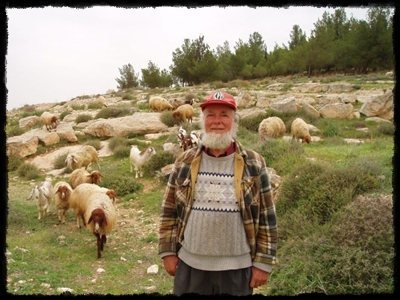
Christian Peacemaker Art Gish with flock in Hebron. As news spreads of the tragic death of Art Gish, world-renowned Christian peacemaker, in a farming accident near Athens, Ohio, more memories and reflections are pouring in. (See yesterday’s post for more.)
“He has been an inspiration to me for more than 36 years.”–Dale in Melbourne, Australia
“Have spent hours, days with him and I have never heard a harsh personal word towards anyone only love and deep concern. Now I have heard him seriously criticize the violent policies and actions of governments and individuals supporting those governments but never personal attacks on anyone.”–Kathleen
The Athens News ran a story on Art in their later edition that gives more details on his death and life:
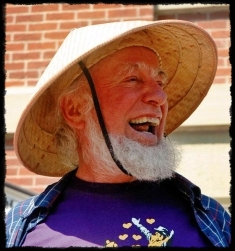 Athens County Sheriff Pat Kelly reported that Gish was disking a field on a tractor at his Amesville area farm around 9:30 a.m., when he apparently drove too close to the sloped edge, flipped the tractor over and was trapped underneath. The vehicle caught fire, and Gish perished in the blaze, Kelly said. The Amesville Fire Department and SEOEMS responded, as well as the sheriff’s department.
The Mennonite Publishing Network, which distributes two of Gish’s books about his work in the Middle East, said he had been active in peace and social justice work for the past 50 years, beginning with his work as a conscientious objector with Brethren Volunteer Service in Europe from 1958-60.
He also worked in the Civil Rights Movement in the 1960s, and had been actively involved in opposing U.S. wars abroad since his youth. He had worked with Christian Peacemaker Teams in the Middle East since 1995.
Both Gish, 70, and his wife, Peggy, of 13206 Dutch Creek Road, have been well-known figures in Athens’ progressive community. Peggy Gish, who is currently in Iraq, also made repeated trips to the Middle East to work with Christian Peacemaker Teams there.
On a regular basis, one or both of the Gishes could be found with a few other people standing on Court Street outside the Athens County Courthouse, holding signs calling for peace, in a weekly lunch hour vigil.
He also was a regular fixture at the Athens Farmers Market, where he sold organic produce and other goods from his farm.
Over the years, Gish submitted dozens of letters to the editor to The Athens NEWS and other local newspapers on peace and justice issues, as well as religion and morality. He repeatedly placed first in the reader-nominated Athens NEWS Best of Athens awards, as “Best Leading Citizen.”
Gish gained worldwide attention in 2003, when the Associated Press distributed a photo of him defying an Israeli tank, to try to block it from destroying a Palestinian market in Hebron.
Read the whole Athens News story here. To learn more about Art, read his books:
Beyond the Rat Race
Living in Christian Community
Hebron Journal: Stories of Nonviolent Peacemaking
At-Tuwani Journal: Hope and Nonviolent Action in a Palestinian Village -
World-Renowned Peacemaker, Art Gish, Dies in Tractor Accident
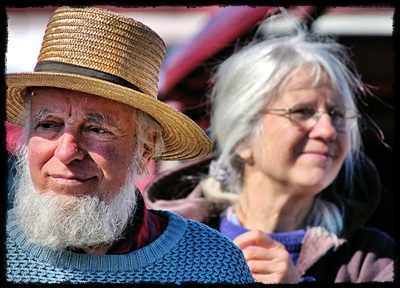
Art and Peggy Gish by Dinty W. Moore Art and Peggy Gish (above) are career peace, civil rights and human rights activists who embody the motto of their primary affiliation, Christian Peacemaker Teams: “Getting in the way.”
Art died this morning in a tractor accident on the organic farm where he and Peggy live near Athens, Ohio. He was 70. (See Athens County peace activist killed in farming accident.)
Art Gish has been part of Christian Peacemaker Teams in Hebron since 1995, getting in the way of Israeli military and settler violence against Palestinian civilians. Peggy was in Iraq as peace advocate and witness before, during and following the invasion of Iraq.

Art Gish stares down Israeli tank. Both of them have been mentors to generations of Christian pacifists and peace activists – as well as bringing a deep love and peaceableness to places of violent injustice around the world, including Hebron and Iraq.
The last time I saw Art was when I was leading a nonviolence training in preparation for risking arrest at the White House as part of the Christian Peace Witness for Iraq on March 16, 2007. To lead a nonviolence training with Art Gish in the room was humbling. And talking to him afterward was a deep spiritual blessing.
Art is loved by many and will be mourned by more. I hold him up to the Light. He is an witness to the model of an honorable man who literally lived “‘neath his vine and fig tree in peace and unafraid” while always standing with those whose vines and fig trees were uprooted by men with guns and for whom peace and safety were fleeting ideals
“Well done, good and faithful servant.” Thank you, brother.

Art Gish on his organic farm in Athens, Ohio. To read books about and by Art and Peggy Gish, check out these:
Iraq: A Journey of Hope and Peace by Peggy Faw Gish
As Resident Aliens: Christian Peacemaker Teams in the West Bank, by CPTer Kathleen Kern
and find more at Christian Peacemaker Teams.
-
Subscribe
Subscribed
Have a WordPress.com account? Log in now.

