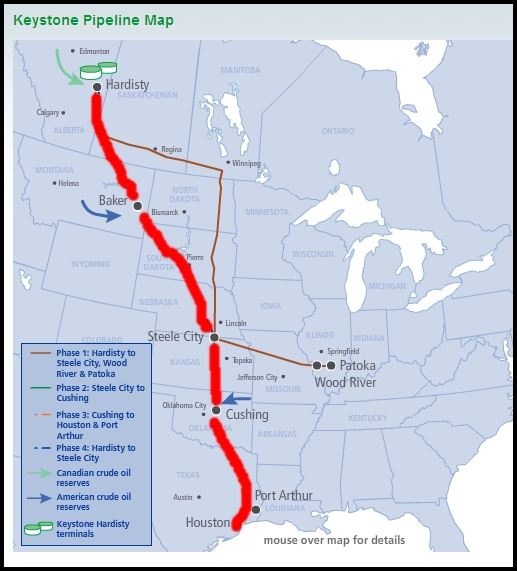
President Barack Obama will decide as early as September whether to light a fuse to the largest carbon bomb in North America. That bomb is the massive tar sands field in Canada’s Alberta province. And the fuse is the 1,700-mile long Keystone XL Pipeline that would transport this dirtiest of petroleum fuels all the way to Texas refineries.
I am writing you now because the Keystone XL Pipeline is a climate and pollution horror beyond description. From August 20th to September 3rd, thousands of Americans – including Bill McKibben, Danny Glover, and NASA’s Dr. James Hansen, and myself – will be at the White House, day after day, demanding Obama reject this tar sands pipeline.
While pro-oil lobbies will undoubtedly tell President Obama that America needs the jobs, there are thousands of Americans who are saying “No more dirty work! Give us clean, green jobs for a healthy planet and healthy families.”
Given the high stakes, many protestors will engage in peaceful civil disobedience, day after day to make their voices heard. Already the attention this event is getting will likely make it the biggest act of civil disobedience in the climate movement’s history.
I’m going to be there, and I hope you will join me – this action, and this issue needs your voice. This action will be going on for two weeks, but you only need to be there for one day – so pick a day between Aug. 20 and Sept. 3 that you can make it to DC, and let the world know just what you think of the tar sands. Click here to sign up.
If you would like to participate with the “Religious Contingent” affinity group on AUGUST 29, then sign up at the Tar Sands Action site AND ALSO send an email to Tim Kumfer (telltheworddc@gmail.com).
If built, the Keystone XL Pipeline would lock America into a future of planet-warming energy dependency. Indeed, Dr. Hansen – America’s top climate scientist – has said that full exploitation of Canada’s tar sands would be “game over” for efforts to solve climate change.
In 2009, Catholic Bishop Luc Bouchard of Alberta, Canada, wrote in a prophetic pastoral letter warning of the moral danger of this pipeline.
“When there is uncertainty as to whether a development project seriously endangers the environment, a pre-cautionary principle utilizing prudence and caution should guide the decision making process which itself must be administratively transparent. Therefore, massive projects that clearly endanger the environment must be approached in a deliberate, open, and consultative manner.”
President Obama alone – without input from Congress – has the power to approve or reject the Keystone XL Pipeline.
He will decide as soon as September whether to honor his campaign pledge to create a clean-energy economy, or to lock us in as a nation that cooks and distills filthy tar sands for much of our energy. Building this pipeline will be an economic and moral setback for clean-energy sources of all types. This is a line in the sand. The tar sands!
Here’s the link to sign up again: http://www.tarsandsaction.org/sign-up. Let me know if you have any questions, thoughts or concerns – I hope you’ll join us. This is just too important to stay home.
Painter Lucien Freud, grandson of Sigmund, died last week. I haven’t been familiar with his work — though when I saw his portrait of Queen Elizabeth I remembered seeing it before. My friend artist Brett Busang wrote an insightful tribute to Freud over at Painting is Dead and So Can I. Below is an excerpt:
Over the next fifty years, [Lucien Freud] amassed a body of work like no other – aoeuvre that fed on his reclusive energy, which addressed the conundrums and comforts of solitude. Some might say he accumulated a freak’s gallery of people and personalities. And, to an extent, they’re right. His people are often scary-looking. Who sits in a chair like that? Somebody Freud summoned to his studio and said: “Don’t move!” Unlike Diane Arbus, who wanted to photograph freaks, Freud took a pop eye or withered flesh and distilled their humanity. He wasn’t afraid of what he might discover inside of a person as he or she sat and waited. Or drifted off to sleep. Or daydreamed audibly.
He managed to get at the soul’s captivity inside of a body that has grown out of proportion and become a smothering presence. He presumed to suggest that people need each other in spite of how difficult relationships can be. He looked deeply within, but was also able to create a dazzling color-scape that was not gratuitously postmodern. The bumps, bruises, and sores of the flesh have, in Freud, a formal counterpart. He pushes the paint into wavy channels that dive into the hollows and perch defiantly on the raised areas, which has a tactile presence even in reproduction.
Freud’s female nudes are glorious, fleshy. This is what incarnation looks like. Below is a poem by John Updike titled “Lucien Freud.” It pushes the way Freud viewed the body — gross and mysterious.
Lucien Freud
by John Updike
Yes, the body is a hideous thing,
the feet and genitals especially,
the human face not far behind. Blue veins
make snakes on the backs of hands, and mar
the marbled glassy massiveness of thighs.
Such clotted weight’s worth seeing after centuries
(Pygmalion to Canova) of the nude
as spirit’s outer form, a white flame: Psyche.
How wonderfully St. Gaudens’ slim Diana
stands balanced on one foot, in air, moon-cool,
forever! But no, flesh drags us down,
its mottled earth the painter’s avid ground,
earth innocently ugly, sound asleep,
poor nakedness, sunk angel, sack of phlegm.
Read Brett Busang’s full post.
See more of Lucien Freud’s work.
More than 150 Roman Catholic priests in the United States have signed a statement in support of a fellow cleric Roy Bourgeois, who faces dismissal for participating in a ceremony ordaining a woman as a Catholic priest, in defiance of church teaching.
More than 300 priests and deacons in Austria – representing 15% of Catholic clerics in that country – last month issued a “Call to Disobedience,” which stunned their bishops with a seven-point pledge that includes actively promoting priesthood for women and married men, and reciting a public prayer for “church reform” in every Mass.
And in Australia, the National Council of Priests recently released a ringing defense of William Morris, the bishop of Toowoomba, who had issued a pastoral letter saying that, facing a severe priest shortage, he would ordain women and married men “if Rome would allow it.”
In the 22 July 2011 New York Times, Laurie Goodstein writes:
While these disparate acts hardly amount to a clerical uprising and are unlikely to result in change, church scholars note that for the first time in years, groups of priests in several countries are standing with those who are challenging the church to rethink the all-male celibate priesthood.
The Vatican has declared that the issue of women’s ordination is not open for discussion. But priests are on the front line of the clergy shortage — stretched thin and serving multiple parishes — and in part, this is what is driving some of them to speak.
A press release from Call to Action spells the whole situation out more clearly. In an unprecedented move, 157 Catholic priests have signed on to a letter in support of their fellow embattled priest, Fr. Roy Bourgeois, who has been told to recant his support for women’s ordination or be removed from the priesthood. The letter that supports Roy’s priesthood and his right to conscience was delivered, Friday, July 22nd, to Fr. Edward Dougherty, Superior General of the Maryknoll Fathers and Brothers in Maryknoll, NY.
“We can no longer remain silent while priests and even bishops are removed from their posts simply because they choose to speak their truth,” said Fr. Fred Daley, a spokesperson of the effort and a priest of the Syracuse Diocese. “Together, we are standing up for our brother priest, Roy, and for all clergy who have felt afraid to speak up on matters of conscience. “We hope that our support as ordained priests in good standing will help give Fr. Dougherty the support he needs to make a decision that is fair and just.”
This stance of priests from the United States follows a series of recent actions where priests collectively have taken a stand for justice in the Church. Last year, priests in Ireland formed a union aimed at organizing the 6,500 priests there in response to the clergy abuse crisis.
A interreligious contingent has chosen Aug. 29 as our arrest day. Jews, Muslims, Christians, and others will train together on Aug. 28 and then worship and risk arrest together on Aug 29.
This is part of a two-week campaign (Aug 20-Sept 3) in which leading environmentalists including Wendell Berry, Naomi Klein, and Bill McKibben will join a peaceful campaign of civil disobedience to block the approval of a dirty oil pipeline that will cross the United States. As one Canadian wrote, “This [pipeline] will make the Great Wall of China look like Tom Sawyer’s picket fence.”
I would love for YOU (yes, YOU!) to join us.
So far, 1,000 people have said they’ll risk arrest. Personally, I’d like to see 1,000 people each day for all 15 days.
Sign up to participate at tarsandsaction.org AND drop me (rbergersol at gmail) or Tim Kumfer (telltheworddc at gmail) a note to join the religious contingent.
Joan Chittister, OSBThank you to Barbara Tamialis who sent me Benedictine sister Joan Chittister’s address to the American Catholic Council in Detroit in June. Below is a section on taking hope in Vatican II and living more fully into the new world it opens for Catholics and others around the world.
After speaking recently with two younger Catholic women who questioned whether they were “really” Catholic because they had a lot of questions about Vatican pronouncements and didn’t always trust the institution, I confirmed for them, “Yep. You definitely are *really* Catholics — and American Catholics at that!” This exchange made me realize again how important it is for voices like Joan Chittister’s to be heard and internalized by Catholics everywhere.
Below is an excerpt from Chittister’s address:
How we see a situation depends on what we’re looking for. The fact is that you and I live in a good event, bad event time, when one age is dying and a new one is coming to life. We are, this in-between generation, the seeds that will not see the flower. The only question is whether or not in our time we will see reality as reason to despair or as the very foundation for hope. Whether we will see the seeds we, too, are planting as simply the beginnings of a new future, planted in hard ground, yes, and slow growing, yes, but to be tended and believed in so that their harvest time can surely come. …
The question is: How do we know the good from the bad? How do we know what is really meant to be done now and here by those of us who love the church and desire its new blooming so that now, as in the past, slaveries may end and prejudices may be palliated and the people may be saved and the church may finally become church and the model of Jesus may become more important than the model of a medieval system now abandoned by humanity everywhere, except by us?
The fact is that we have already been given the blueprint for good over bad. They call it Vatican II. We have already seen it bring new life to old wineskins. And at the same time we can now see it silently, surely, surreptitiously being eroded in many places, in many ways. If you’re any kind of church-watcher at all you know that, for Catholics, life’s been good/not good now for a long time.
The decision to take the church out of the 16th century — out of the character and quality of Trent — into the vision and character of Vatican II was good. At the council of Trent in the 16th century, the church’s response to calls for reform was to lay new laws and new regimentation on the backs of the people rather than bring reform to the policies at the center of the system itself.
The brave decision of the bishops of the world in our time to bring the church into the 20th century in Vatican II — 400 years after the fact and more necessary than ever — was good. But the response this time, too, is being delayed by a few.
It is being denied by those in the system who fear loss of privilege and power for themselves more than they value spiritual gain for the many. In the name of reforming the reforms there is a move abroad now to define who are the ins — the clerical, the hierarchical, the male — and who are the outs again — the laity, the women, the gays.
Yet the fact is that great good has happened in our time. In our time we learned that the church is the people of God — not simply a gathering of hierarchs around an even higher hierarch. Instead, we learned from a church alive with Vatican II that the church is indeed the people of God and we are it!
If I were a Roman Catholic bishop I would not be disturbed that Catholic women were throwing themselves on the steps of the cathedral wanting to minister in the church, begging to minister in the church. I would be disturbed that they had to go to Protestant seminaries for the theological and pastoral preparation to do it.
Vatican II gives us all the right to give God’s gifts to God’s work, and to God’s church. Among the great religious orders and congregations of the church, after all, the ideas for Benedictines, Benedict; Franciscans, Francis; Jesuits, Ignatius Loyola; Sisters of Mercy, Mother Catherine McAuley; Sisters of Charity, Mother Elizabeth Seton; Sisters of Loreto, Mary Ward; the ideas for teaching ministry, education of girls, nursing the sick, not to mention peace and nonviolence through Dorothy Day and Peter Maurin — all came from laity. …
At church on Sunday, Fr. Mike said he’d just completed a 30-day online spiritual retreat. I wanted to find out more, so started poking around on the Spirituality and Practice web site.
In addition to film and book lists for deepening one’s spiritual life, there is also a “Spiritual Literacy” section. Under the topic, Spiritual Literacy in Wartime the authors’ write:
• We know that it is imperative that we disarm our own hearts so that the natural anger and hatred we feel for those who might harm us does not overwhelm us. Daily we face the daunting challenge of loving our enemies. To reinforce our intention to forgive strangers, we begin by forgiving those close to us who have hurt us.
• Intercessory prayer has always been one of our central practices. We have a prayer list that we attend to every day; we make sure that world leaders — and dictators and terrorists — are included.
• The more we notice our culture’s tendency to focus upon differences that divide, the more we cling to the spiritual traditions of hospitality and openness. We are educating ourselves about other cultures.
“Non-violence is perhaps the most exacting of all forms of struggle, not only because it demands first of all that one be ready to suffer evil and even face the threat of death without retaliation, but because it excludes mere transient self-interest, even political, from its considerations.” —Thomas Merton
Artist Brett Busang is spending his summer in Memphis – prowling the streets and painting. His e-pistles read as something holy – feral and complete within themselves.
He’s away from D.C. and in the land of the Chickasaw this summer – in part – because his Mom, who lived there, died in May; she who instructed him in both The Life and The Word of an artist.
Below are a few excerpts from his e-mails:
Memphis is a city of poor people ringed by pockets of privilege. I’m most interested in the poor – who have treated me with kindness and courtesy. Yet as I study the habitat of folk who don’t dream of tomorrow, I wonder what on earth is going to become of us all? A local art maven, upon looking at my portfolio, said I hadn’t told the whole story yet. I wonder whether that’s even a valid criticism – in part because any story is ongoing, but also because one person can only do so much, given his temperament and preferences. I fully acknowledge that I’ve just scratched the surface, but I consider the effort of scratching eminently worthwhile. …
I wrote a much longer essay about being here in Memphis among the poor, who will not only be with us, they will begin – as we sidle up ever closer – to share “trade secrets”. At one time, there was stone soup, made with an actual stone or the sole of a shoe. (Boots furnished a better aroma, but no appreciable elevation in taste.) In the future, our nourishment will center on various forms of temporary empowerment and may involve stealing from the rich; giving comfort to our botton lines, particularly if they’ve withered-up a little; and ministering to the Fallen Mighty, whose numbers will visibly swell.
Such is my apocalyptic version of. . .the following weekend. (I can’t wait for upper-case History. The way things are going, we’ve got to get up to speed right now.)
In May, Krista Tippett interviewed Protestant Old Testament scholar Walter Brueggemann. He explains why he thinks gay and lesbian sexuality “has such adrenaline” in and beyond church communities. He explores the idea that homophobia is a proxy for people’s ill-defined fears about an old world order that’s rapidly disappearing.
“It is an amorphous anxiety that we’re in a free fall as a society. And I think we kind of are in free fall as a society, but I don’t think it has anything to do with gays and lesbians particularly.”
Listen to Walter Brueggemann, author of Prophetic Imagination, read Jeremiah 4 and Isaiah 43 — passages of judgement and hope. He discusses the anxiety of our current age in the context of the prophets and the call of the contemporary church to minister WITHIN the anxiety.
“[The prophets] were rooted in the covenantal traditions of whatever it was from Moses and Sinai and all that. And the other thing is that they are completely uncredeintialed and without pedigree, so they just rise up in the landscape. And the way I put it now, they imagine their contemporary world differently according to that old tradtion. So it’s tradition and imagination.
There’s no way to explain that, so we explain it by the work of the Spirit but I don’t think you have to say that … They are moved, like every good poet is moved, to have to describe the world differently according to the gifts of their insight. Of course in their own time, and every time since, the people who control the power structure do not know what to make of them so they characteristically try to silence them.
What power people always discover is that you can not finally silence poets. They just keep coming at you in threatening and transformative ways.” —Walter Brueggemann, interview with Krista Tippett (May 18, 2011)
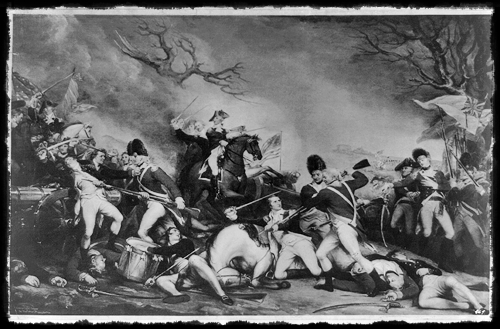
"Battle of Princeton, 1777" by Charles Willson Peale
“Charles Willson Peale knew well the details of the battle at Princeton, since as a militia member in the Pennsylvania regiment, he had found himself in the front line at Princeton at the battle’s climax, with George Washington in command. Although he revisited Trenton and Princeton while he was working on the painting, he already had vivid memories of the site. It is rare for a painter of military history to have been a participant in a battle he later painted.” –from A Revolution in Art
***
John Dickinson: Why do you refer to King George as a tyrant? …
Thomas Jefferson: Homes entered without warrant, citizens arrested without charge, and in many places free assembly itself denied.
Dickinson: No one approves of such things, but these are dangerous times.
Benjamin Franklin: Be careful, Mr. Dickinson. Those who would give up some of their liberty in order to obtain a little temporary safety deserve neither liberty nor safety.
 Dear Beloved Community,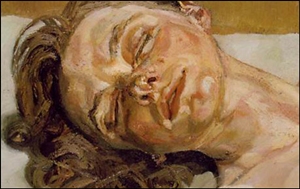


 At church on Sunday, Fr. Mike said he’d just completed a 30-day online spiritual retreat. I wanted to find out more, so started poking around on the Spirituality and Practice web site.