New Hope Catholic Worker Farm and Agronomic University in LaMotte, Iowa, is hosting its second week-long intensive on “Growing Roots: Peter Maurin & Economics” July 17-23, 2011.
It is very much in the tradition of Dorothy Day and Peter Maurin to write about economics. Under the editorship of Dorothy Day, the Catholic Worker criticized an unbridled capitalism which put the majority of money and resources in the hands of a few big corporations and individuals. The Catholic Workers not only disagreed with industrial capitalism on a massive scale, but presented an alternative economics called distributism-a person-centered economics.
As personalists, Catholic Workers believed there had to be a better way than to have the world run by Standard Oil, General Motors and Henry Ford (today we have the global market, giant corporations, sweatshops, maquiladoras).
Peter and Dorothy recommended the works of G. K. Chesterton, Hilaire Belloc and Fr. Vincent McNabb, O.P., on distributism and R. H. Tawney on capitalism, and their ideas were published in the paper. These writers insisted that all people were created in the image and likeness of God, and should not be treated like cogs in a machine or made to work twelve hours a day in back-breaking work as wage slaves (in coal mines, for example), while large corporations and their directors became fabulously wealthy.
Chesterton, theorist of person-centered economics and critic of the excesses of capitalism, shared the views of the Catholic Workers. He knew that the opinions of Henry Ford (who said that most people preferred the mechanical action of the assembly line and were only fitted for it), were against Catholic teaching on the dignity of the human person. Ford made it clear that most people were not smart enough to do anything except repetitious work. As Chesterton put it in The Outline of Sanity, “It will be noted that Mr. Ford does not say that he is only fitted to mind machines.”
Chesterton argued that the Catholic Church taught that every human being was worth saving. He insisted on “respect for the humanity and dignity of ordinary, shabby, ignorant people.” (Margaret Canovan, G. K. Chesterton: Radical Populist, New York: Harcourt Brace Jovanovich, 1977, p. 9).
On “The Invisible Hand” of the Market
Since Adam Smith, the proponents of wealth creation have promised heaven on earth if their ideas were followed: Just believe religiously in the market and allow it absolute freedom, then salvation will come. It is hard to imagine a heaven where one’s creativity and destiny are squandered working on an assembly line or at McDonald’s.
Pope Pius XII went so far as to call the idea that the invisible hand of the market will on its own rather like fate control the world, a “superstition. (Dorothy Day, “Distributism vs. Capitalism,” Catholic Worker, October 1954).
What Are We Talking About When We Say “Capitalism”?
Chesterton knew that when most people spoke of capitalism, they had in mind something quite different than a few very wealthy people controlling everything. To clarify for his readers what he was criticizing, he first described the situation where a few people hold the wealth and all others struggle: “When I say ‘Capitalism,’ I commonly mean something that may be stated thus: ‘That economic condition in which there is a class of capitalists roughly recognizable and relatively small, in whose possession so much of the capital is concentrated as to necessitate a very large majority of the citizens serving those capitalists for a wage.” He emphasized that others had something quite different in mind when they spoke of capitalism: “The word… is used by other people to mean quite other things. Some people seem to mean merely private property. Others suppose that capitalism must mean anything involving the use of capital.
“If capitalism means private property, I am capitalist. If capitalism means capital, everybody is capitalist. But if capitalism means this particular condition of capital, only paid out to the mass in the form of wages, then it does mean something, even if it ought to mean something else.
“The truth is that what we call Capitalism ought to be called Proletarianism. The point of it is not that some people have capital, but that most people only have wages because they do not have capital.”
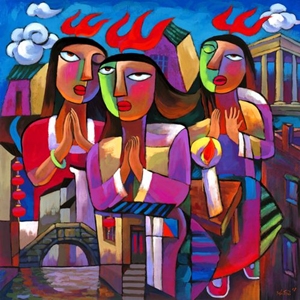
Holy Spirit Coming by He QiA Prayer for Pentecost
from Joan Chittister
The Holy Spirit embodies the life force of the universe, the power of God, the animating energy present in all things and captured by none. On this great feast of Pentecost, the coming of the Spirit of God, I invite you to pray with me:
May the Gifts of the Holy Spirit
bring fire to the earth
so that the presence of God
may be seen
in a new light,
in new places,
in new ways.
May our own hearts
burst into flame
so that no obstacle,
no matter how great,
ever obstructs the message
of the God within each of us.
May we come to trust
the Word of God in our heart,
to speak it with courage,
to follow it faithfully
and to fan it to flame in others.
May the Jesus
who filled women
with his Holy Spirit
fill the world and the church
with new respect
for women’s power and presence.
Give me, Great God,
a sense of the Breath of Spirit
within me as I…
[State the intention
in your own life at this time
for which you are praying.]
Amen.
Mier Wolf, former mayor of Chevy Chase, MD, and a board member of The Writer’s Center (both are in Metro-D.C. area) has started a poetry in prison program at the Montgomery County jail, near Clarksburg, MD. An early presenter was friend and mentor E. Ethelbert Miller (see the video below).
Here’s yet another reason we love NCIS‘ punk-forensic-grrrrl Abby. She’s Methodist.
NCIS is a classic American “police procedural.” The JAG spin-off is now one of America’s most watched dramas. NCIS’ winning formula involves comic elements, ensemble acting, and character-driven plots.
Like the best detective novels or murder mysteries, it assumes a world of high moral standards and in each episode that world is disrupted by crime and the team works to restore the balance of justice.
Integral to the team is goth, tattooed and pierced Forensic Specialist Abigail “Abby” Sciuto, played by Pauley Perrette. Her skillful acting in this delightful, wicked smart, funny, and powerful role has singlehandedly empowered girls to pursue careers in science. It’s even got a name: The Abby Effect.
“Part of ‘The Abby Effect’ has been this incredible role model for young girls,” she says. “I hear from them or their parents and their grandparents all the time. Some of them started watching the show when they were 12 and now they’re going to college. ‘Abby’ has made it a viable opportunity for them. You can go into science and math. That’s amazing. Women were never encouraged to go into hard science or math. Now there have been girls going into science and math because of a television character,” she says.
Perrette has degrees in sociology, psychology and criminal science. She’s also regularly attends Hollywood United Methodist Church. More recently she’s joined the UMC’s Imagine No Malaria campaign.
Check out the short video below to hear Perrette talk about her relationship with God, how she prays, and what her church community means to her. (A shout-out to Julie for sending this video.)
Pauley Perrette is the narrator of a TV special called Killer in the Dark: An Extraordinary Effort to Combat Malaria. The program documents the daily struggle in Africa against malaria and highlights the work of Imagine No Malaria to wipe out the disease. The program is presented by the National Council of Churches under the auspices of the Interfaith Broadcasting Commission and produced by United Methodist Communications.
Rachel Carson, founder of the modern American environmental movement, was born May 27, 1907.
“Those who contemplate the beauty of the earth find reserves of strength that will endure as long as life lasts. There is something infinitely healing in the repeated refrains of nature — the assurance that dawn comes after night, and spring after winter.” –Rachel Carson, American marine biologist and conservationist, author of Silent Spring
I’ve been contemplating writing a book on Carson’s spiritual life — from her Presbyterian upbringing to her deep mysticism. Linda Lear’s excellent biography Rachel Carson: Witness for Nature is a thorough introduction to Carson. She’s an amazing woman. Here’s an excerpt from a column I wrote about her for Sojourners:
Rachel Carson—biologist, writer, conservationist, Presbyterian, and founder of the modern U.S. environmental movement—never lost her sense of wonder and awe in the natural world. She instinctively rooted for life and was ferocious in its defense. She sought out suppressed narratives in nature, such as the silencing of songbirds by industrial pesticides described in her 1962 classic Silent Spring. She cultivated an affectionate ethic for the natural world and the humans who worked most closely with it. Carson was driven by some “memory of paradise,” as playwright Eugene Ionesco put it.
Carson understood that human dignity was protected by social justice and had its own kind of natural beauty. Though Silent Spring focused on songbirds, Carson also flagged the danger pesticides posed to farm workers. Her research, along with immigration policy changes, gave Chicano leaders Dolores Huerta and César Chávez the climate they needed to mobilize for the rights and safety of farm workers, leading to the formation of the United Farm Workers union.
“…for non-violence seeks to ‘win’ not by destroying or even by humiliating the adversary, but by convincing him that there is a higher and more certain common good than can be attained by bombs and blood. Non-violence, ideally speaking, does not try to overcome the adversary by winning over him, but to turn him from an adversary into a collaborator by winning him over.”–Thomas Merton, Faith and Violence: Christian Teaching and Christian Practice (1968)
The assassination of Osama bin Laden may be President Obama’s darkest hour. In clear violation of international law, under the guise of secret treaties with Pakistan, and most likely after having been manipulated by CIA and Pentagon insiders into thinking he was making the best reasonable choice, the winner of the Nobel Peace Prize issued an executive “kill order.”
Bin Laden was indicted on criminal charges related to the bombing of the American embassies in Kenya and Tanzania in 1998, the bombing of the USS Cole in 2000, and plans to attack US defense installations. An indictment is an formal accusation based on probable cause. A verdict is the formal finding of guilt or innocence by a jury after trial. But the difference between just punishment and lawlessness is a trial in a court of law.
The standing order in 1998 was to capture Bin Laden and bring him to trial. At some point, that order changed to an assassination order. When a suspected criminal is murdered rather than brought to trial, it’s called an “extrajudicial killing.” Justice can not be served because the system of justice has been circumvented.
President Obama serves at the pleasure of the American people. How will we reflect on our own responsibility, authority, and culpability in the assassination of Osama bin Laden? How will we hold our government accountable?
Here are a few reflections:
“Osama bin Laden – as we all know – was gravely responsible for promoting division and hatred between peoples, causing the death of countless innocent lives, and of exploiting religions to this end. Faced with the death of a man, a Christian never rejoices, but reflects on the serious responsibility of each and every one of us before God and before man, and hopes and commits himself so that no event be an opportunity for further growth of hatred, but for peace.”–Vatican Press Office Director Fr. Federico Lombardi on the killing of Osama bin Laden
“Here in the Easter season, we may think back to the final days of Lent, when we heard the Passion read on Palm Sunday and Good Friday, and the Church asked us to place ourselves in the role of the chief priests and elders and of the mob that called for Christ’s death. It’s not uncommon, even, to find in Catholic devotional literature meditations in which we compare ourselves with Judas, not in the manner of the Pharisee in the parable of the Publican and Pharisee—’I thank you, Lord, that I am not like this man’—but as a means to recognize the ways in which we ‘all have sinned and fallen short of the glory of God.’
Viewed that way, it hardly needs to be said: When we rejoice in the death of another man, no matter how evil he may have been, our attention is not focused where it needs to be—on our own sinfulness, and our need for God’s grace.–Scott Richert, The Assassination of Osama bin Laden: A Catholic View
And from the Financial Times, an apt critique of America’s deteriorated freedoms:
Mr Obama has abandoned the most outrageous expedients that Mr Bush adopted. By executive order, for instance, he has forbidden waterboarding. But Mr Bush had already adjusted his policies, partly at the Supreme Court’s direction. The framework he left behind is essentially still in place: indefinite detentions, military tribunals, Guantánamo, the right to capture or kill, and the rest. Mr Obama is not just asserting the powers Mr Bush bequeathed, but, as in Abbottabad, is using them.
One could conclude that Mr Obama is an unprincipled tyrant – or that marrying liberal principles and the fight against terrorism is far harder than the president once believed and his critics still insist.
It would be hard to argue (and impossible to persuade the US public) that having located Osama bin Laden the US should have let the law take its course. What would that even mean? But if the fight against terrorism is not a war, the US raid on bin Laden’s compound (to say nothing of the drone strikes in Pakistan that Mr Obama has stepped up so dramatically) had no grounding in international law. These are extrajudicial killings.
Until international law recognises that the fight against terrorism is neither a conventional war nor an ordinary matter of law enforcement, it will continue to be honoured in the breach. US anti-terror law, in the meantime, needs repair in its own right. Stronger Congressional oversight is needed. More transparency is possible than current law provides. And limits on presidential authority should be imposed by law, not volunteered in reversible executive orders.
Most important, Congress needs to put time limits on the post-9/11 powers. Failure to do so in that first sweeping authorisation was a dereliction of duty. Ordinary wars end, and you know when they do. Fighting terrorism is not like that. Emergency powers were justified after 9/11, but allowing them in perpetuity is wrong. They should sunset at two-year intervals and be subject to Congressional renewal.
Poet Antoinette Brim, author of Psalm of the Sunflower, was part of the Willow Books Reading at Split This Rock Poetry Festival: Poems of Provocation & Witness in 2010. Her poem “Let Daylight Come” ran recently in Split This Rock’s Poem of the Week.
Let Daylight Come (Little Rock, circa 2008)
–after Jane Kenyon
Let the moon untangle itself
from the clothesline, as coming daylight
diminishes its lamp to memory.
Let the cicada vow silence
as a woman stirs her grits
and beats her eggs. Let daylight come.
Let school children shuffle into yellow
buses. Let the asphalt roll out black
into the distance. Let daylight come.
Let the dew dry to ash on the brow
of a man. Let traffic thunder across
the overpass above his head. Let daylight come.
To his bottle in the ditch, to his cardboard
and crayon, to the cough in his lungs,
let daylight come.
Let it come, as it will, and don’t
be afraid. This, too, is the day
the Lord has made, so let daylight come. –Antoinette Brim
Brim is a Cave Canem Foundation fellow, a recipient of the Walker Foundation Scholarship to the Fine Arts Work Center in Provincetown, and a Pushcart Prize nominee. Her work has appeared in various journals, magazines and anthologies. Used by permission from Split This Rock Poem of the Week. We just ask you to include all of the information in this email, including this request. Contact Split This Rock at 202-787-5210 or info@splitthisrock.org.
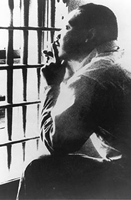
“I must confess that I am not afraid of the word ‘tension.’ I have earnestly opposed violent tension, but there is a type of constructive, nonviolent tension which is necessary for growth. Just as Socrates felt that it was necessary to create a tension in the mind so that individuals could rise from the bondage of myths and half-truths to the unfettered realm of creative analysis and objective appraisal, we must we see the need for nonviolent gadflies to create the kind of tension in society that will help [people] rise from the dark depths of prejudice and racism to the majestic heights of understanding and brotherhood [& sisterhood].” –Martin Luther King Jr.
Just a reminder that King penned this letter in response to an open letter titled “Call for Unity” written by eight white Alabama clergymen who were supporters of the civil rights movement but were opposed to the public protests organized by King and others.
“We recognize the natural impatience of people who feel that their hopes are slow in being realized,” the wrote. “But we are convinced that these demonstrations are unwise and untimely.”
Yesterday in Minneapolis, the Presbyterian Church (U.S.A.) crossed an historic threshold as Presbyterians in the Twin Cities area voted to eliminate all official barriers to the ordination of gay, lesbian, bisexual and transgender people as ministers and lay leaders in their 2.4 million member denomination. With their vote the Twin Cities Presbyterians were the 87th Presbytery (a regional governing body) to vote yes, giving the denomination the majority of votes needed to approve the landmark change.
In light of this historic event and other debates closer to home, I want to repost a 2008 item below.
***************************************
One of my faith heroes and friends, Bill Wylie-Kellermann, a United Methodist serving as pastor at St. Peter’s Episcopal Church in Detroit, recently engaged in a faith-based debate for Newsweek about what Scripture teaches on same-sex marriage. I found it very insightful. His dialogue partner was Barrett Duke from the Southern Baptist Convention’s Ethics & Religious Liberty Commission. Their online discussion was a follow-up to the Newsweek cover story by Lisa Miller, Our Mutual Joy.
It’s this kind of thoughtful interaction that can help people of faith grow together in Christ—while hopefully (in my opinion) moving us toward a Christian faith that asks about the “content of one’s character,” one’s fidelity to God, and how one manifests God’ love both materially and spiritually to the poor and the least of these, rather than sexual customs or mores.
Bill Wylie-Kellerman: I found the cover story by Lisa Miller quite good over all, and stimulating, raising a number of things about which I’d like to talk, beginning with the very nature of marriage in church and society. That is actually a matter of some theological confusion. I love the Bible, and stake my life in the biblical witness, and it is that which calls me to the struggle for full inclusion of gay people and their gifts. I know we disagree.
Barrett Duke: Greetings. I look forward to our conversation. This is a very important topic, not only for the church but also for our culture. I believe Christians must submit to the Bible’s teachings, and I believe the Bible is unequivocal in its teaching that homosexual behavior is sinful. That being the case, it is impossible for me to accept same-sex marriage, which legitimizes a sinful behavior.
I think Lisa Miller’s NEWSWEEK article was atrocious. It was obviously biased in its attitude from the start. It is evident to me that Lisa already had her mind made up and was simply interested in trying to convince her readers that she was right. Of course, she is within her right to do that, but she was hardly honest in her treatment of the Bible in the process. She dismissed it without even giving it opportunity to speak. Her comment, “Religious objections to gay marriage are rooted not in the Bible at all, then, but in custom and tradition …” was offensive and uninformed. My objections to same-sex marriage are very much rooted in the Bible. If NEWSWEEK actually intended to be an honest mediator of this issue, they should have published pro and con articles by respected Bible scholars rather than engage in such blatantly obvious opinion journalism.
Wylie-Kellerman: By laying out a clear argument, public conversations are invited. I also know it was a great breath of air for gay folks to read a theologically literate argument on their behalf. They are so constantly hit over the head with Scripture, to which we must surely come.
Ms. Miller called the mix of civil and religious elements of marriage an often “messy conflation of the two.” I agree. On the one hand, a marriage is a civil contract between two people and the state with certain rights, responsibilities and privileges implied. On the other, it is also often an act of worship between two people before God, surrounded by prayer and support from a worshiping community and with the presence of ongoing pastoral care. It seems to me only over the former that the state should have authority. In the Episcopal Church, for example, marriage is one of the sacraments. In Methodism, it is a service of worship. This means we have the intrusion and participation of the state in a sacramental act of worship. That’s more than messy.
Duke: I’m sure some considered the article a “breath of air,” but they have not been well served. It is not a theologically literate argument. It didn’t even deal with many of the key Bible passages. Reading Ms. Miller’s article, one could get the impression that the New Testament is silent about the subject of homosexuality, which of course it certainly is not. Furthermore, my objections to same-sex marriage are not based solely on the Bible’s teachings. The Bible informs my opinion about this issue, but the question I think we are trying to answer is, what does God have to say about this? It is clear that the Bible condemns homosexual behavior. Since I believe that the Bible is God’s word, and I have good reason for this belief, then it must mean that God condemns homosexual marriage, so the Bible cannot be used to help create an argument for same-sex marriage. Whether one wants to create a nonreligious, i.e., civil, marriage or not, it doesn’t change what is the clear biblical teaching about homosexual behavior.
Wylie-Kellerman: I want to go forward here speaking out of the conversation which I hear going on in Scripture, one pertinent to the full inclusion of gay and lesbian people. The direct sanctions in the Levitical code against male homosexual acts arise during the period of the exile. They are part of the purity code that set boundaries against assimilation into Babylon. Much of those laws concern dietary restrictions. Think Daniel and Meshach and friends and their refusal to consume the imperial diet. The boundaries of the community are being proscribed and protected by the code. As I understand it, the body itself becomes the image of community. So all of the body’s entry and exit points, all orifices are regulated: what goes in as resistance to the empire—like kosher table—has served Judaism’s cultural identity throughout the Diaspora. By the time of Jesus, however, these boundaries had been turned on their sides. The purity code was turned against women, the sick and disabled, and poor people. They were the unclean.
At great personal cost, Jesus set about in his life and ministry to welcome the unclean into his community and to his table. He violated the purity code with his body, even finally on the cross. In the Book of Acts (chapter 10), the Holy Spirit urges Peter in a vision to eat unclean foods, and he says that would be an “abomination.” Precisely so. But the Spirit persists, and he accedes, which really means he is able to welcome and eat with a gentile, Cornelius, otherwise unclean, then on his way to visit. St. Paul spends a lot of his correspondence thinking this through in writing about the law (more than the purity code, but really set in motion by its stricture). For him the issue is whether the “wall of hostility” (Ephesians) would run down the middle of the common table, even the communion table, dividing Jews and gentiles in the Christian community. In the church, the movement is toward fuller and deeper inclusion. It is that which culminates in Paul saying there is neither Greek nor Jew, slave nor free, male nor female for we are all one in Christ. In the context of the American freedom struggle, this was understood by the church (sometimes poorly and certainly belatedly) to imply, there is neither black nor white. Today I hear the summons to say, in Christ, there is neither gay nor straight.

 -grrrrl Abby. She’s Methodist.
 Rachel Carson, founder of the modern American environmental movement, was born May 27, 1907.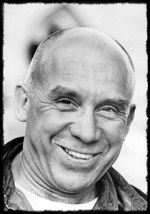
 The assassination of Osama bin Laden may be President Obama’s darkest hour. In clear violation of international law, under the guise of secret treaties with Pakistan, and most likely after having been manipulated by CIA and Pentagon insiders into thinking he was making the best reasonable choice, the winner of the Nobel Peace Prize issued an executive “kill order.”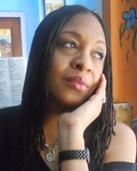
 Excerpt from Letter From Birmingham Jail. Thanks to Julie Polter for highlighting this quote.


