I’ve had some lovely email exchanges with Portland magazine editor Brian Doyle. He’s a thoughtful, thoroughly human writer (see his newest collection Grace Notes). Portland magazine is the wildly popular “alumni magazine” from the Catholic University of Portland (Oregon).
Last week I received a copy of Portland‘s Summer 2011 issue in the mail. Brian’s opening essay speaks volumes about thousands of war survivors in our country and in the countries of our “enemies.”
He writes, “Recently I met a quiet woman who didn’t say much but what she said was wry and pithy and direct, and after a while I asked if I could take notes as she talked, and she said okay, and this is most of what she said.”
My name is Jacqueline. You can call me Jackie. Until recently you could call me Sergeant. I am now retired from the service. I will be twenty-seven years old on Sunday, at fourteen hundred hours. I was a hematology nurse, I am in good health, considering. I have a dog named Gus. I live near the beach. I drink tea. I learned to love tea in Kirkuk. Some days we had tea ten times a day. We found a samovar and learned how to use it. There was a man among us who could play that thing like a guitar. It got so we couldn’t drink anything other than the tea he summoned from that samovar. He vanished one day when his truck was hit by the bandits. Another man took his place. He vanished too. I took his place. After a while I forgot everyone’s names. For a while I called people by their numbers but after a while I didn’t call them anything. That’s when I knew I had war sickness, big time. I never got hit by fire but pretty much everyone I knew did. For a while there I thought it was me, that as soon as I said hello to someone or shook hands or learned their names they were doomed, so I stopped touching people and learning names. You would think wigging out in the middle of a war would be bad but it’s just normal, No one talks about what happens to the people nothing happens to, but something happens to them, and no one talks about it. Probably because we don’t have any words for what happens. Wars kill words, but no one talks about that. …
Actor Mark Ruffalo, who has been an outspoken activist on fracking in his home state of New York and across the country, is lending his support to the Tar Sands Action in Washington, D.C. this August.
“I’ve seen the kind of damage that out-of-control energy development can do to water and to communities near my own home, where fracking for natural gas is causing widespread pollution,” Mark says in the video.
“All these problems are connected—we need to get off fossil fuel.”
As Mark concludes, the Tar Sands Action is a chance for all of us to “put our values into action.” Hope to see you all in DC this August!
Bells on Patmos, Greece (RM Berger)I am a great fan of church bells. From my front stoop I can hear the Howard University Founders Library bells at noon, six, and midnight.
I’ve sat in the garden at the National Cathedral some Sundays and vibrated with the explosive tones of the carillon and hand-rung peal bell practices.
Bells claim a community. Bells give an organizing principle in a chaotic world. Bells tell us we are home. Here’s a quote from Thomas Merton’s journals on the bells at Gethsemani:
“Please help me. what am I going to do? I can’t go on like this. You can see that! Look at the state I am in. what ought I to do? Show me the way.” As if I needed more information or some kind of sign!
…suddenly, as soon as I had made that prayer, I became aware of the wood, the trees, the dark hills, the wet night in my imagination, I started to hear the great bell of Gethsemani ringing in the night…–Thomas Merton
Joan Chittister, OSB“Years ago when I was working with new members in the community, there was always one session in which I asked each of them individually, and in turn, why they went to prayer. The answers were always full of the piety that comes with newness and the theology that comes from books.
“Because,” someone would say, “prayer is what leads us to perfection. That’s why I go to prayer.” I’d shake my head: “No,” I’d say. “That’s not why we go to prayer.”
They’d think a while, then someone else would try. “We go to prayer to immerse ourselves in God.” I’d shake my head: “No,” I’d say. “We are always immersed in God but that’s not why we go to prayer.”
The brows would tighten around the table. “I think we go to prayer to remember God,” someone would say a bit more tentatively. I’d shake my head: “No,” I’d say. “Awareness is certainly a state we seek, but it is not why we go to prayer.”
By this time there were fewer quick answers. Finally, one of the brave ones would say, “then why do we go to prayer?” I’d smile. “We go to prayer around here,” I’d say, “because the bell rings.”
It took a moment or two of stunned silence and then they got it. We go to prayer because the community sweeps us along on the days we are too tired to pray, too distracted to pray, to overburdened to care. Then the community becomes the vehicle of our spiritual lives.
The function of community is to sustain us in our weaknesses, model for us the ultimate of our ideals, carry us to the next level of spiritual growth even when we are unaware that we need it, and give us a strength beyond ourselves with which to attain it.
For this reason I am inviting you to become a member of Monasteries of the Heart. Many of you have been faithful supporters of Benetvision for years and that is evidence enough that you are true seekers, that you care about the spiritual life. It’s for people like you that we initiated this new movement.
There are, of course, hermits in the Benedictine tradition. They are an ancient and honored way of life. But Benedict is clear about their place in life. “After they have been trained in community,” he says, they may be able to progress on their own. The message is as fresh today as it’s ever been. We join communities, we create groups, to get to know ourselves and to get the help we need to enable us to do what we most want to do but cannot possibly, continually, certainly do alone.”–Joan Chittister, OSB
Kenzaburo Oe
Japanese writer Kenzaburo Oe has a lovely essay in The New Yorker (28 March 2011). He reflects on Japan’s harrowing relationship with nuclear radiation — from the U.S. bombing of Hiroshima and Nagasaki and the Bikini Atoll atomic tests to the current nuclear disaster in Fukushima. Here’s an excerpt below:
This disaster unites, in a dramatic way, two phenomena: Japan’s vulnerability to earthquakes and the risk presented by nuclear energy. The first is a reality that this country has had to face since the dawn of time. The second, which may turn out to be even more catastrophic than the earthquake and the tsunami, is the work of man. What did Japan learn from the tragedy of Hiroshima? One of the great figures of contemporary Japanese thought, Shuichi Kato, who died in 2008, speaking of atomic bombs and nuclear reactors, recalled a line from “The Pillow Book,” written a thousand years ago by a woman, Sei Shonagon, in which the author evokes “something that seems very far away but is, in fact, very close.” Nuclear disaster seems a distant hypothesis, improbable; the prospect of it is, however, always with us.
The Japanese should not be thinking of nuclear energy in terms of industrial productivity; they should not draw from the tragedy of Hiroshima a “recipe” for growth. Like earthquakes, tsunamis, and other natural calamities, the experience of Hiroshima should be etched into human memory: it was even more dramatic a catastrophe than those natural disasters precisely because it was man-made. To repeat the error by exhibiting, through the construction of nuclear reactors, the same disrespect for human life is the worst possible betrayal of the memory of Hiroshima’s victims.–Kenzaburo Oe
I’m risking arrest on Aug. 29 as part of a movement to stop a dirty oil pipeline from ripping through the American heartland and our national water aquifer. Friends of the Earth has interviewed folks along the pipeline route who are fighting back.
“Ernie Fellows is a 65-year-old retired rancher living in Mills, Nebraska, a remote community that sits atop the Ogallala Aquifer along the South Dakota border. Fellows has spent his entire adult life raising livestock and tending to the land he inherited from his family. His grandfather bought the ranch in 1937, and when Ernie came of age, he was charged with taking over. “I took that to mean that I need to be a good steward of the land,” Ernie reflects, recounting the years of careful work he put into improving the ranch. However, the fruits of Fellows’ labor are under threat.
TransCanada, a Canadian oil corporation, is planning to route the Keystone XL pipeline through his property. The pipeline would carry the dirtiest oil available to the U.S. from Canada’s tar sands and bring with it the threat of contaminated water supplies and damage to property and nearby livestock. Complications have also arisen with insurance companies and lenders due to the risks the pipeline poses, making it more difficult for landowners to make ends meet.”
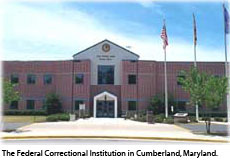
In May 2010, I was honored to serve as resident humanities scholar for an inmate writing program initiated by Hope House DC. I spent a week at two prisons in Maryland facilitating writing workshops on Ernest Gaines’ classic A Lesson Before Dying.
The writing program was all part of a year-long preparation for summer camp behind bars – where the men finally get to spend a week with their kids. For many it’s the only time all year they get to see each other.
Below is great article on Hope House‘s summer camp at the North Branch maximum security prison. Also check out the news video.
CUMBERLAND, MD – A group of kids spent the week at a summer camp behind bars at the North Branch Correctional Institution. They get to spend precious time with their dads, who are inmates.
11-year-old Shawn Harris’s dad is his hero. That’s what he drew in the mural they made together.
“We’re superheros, standing on top of buildings, looking for crime,” explains Shawn.
Kids doing arts and crafts, telling jokes and singing songs. These kids are making typical summer memories with their dads, but this camp isn’t typical, because all of the dads are serving time behind bars.
“It helps me out a lot because I worry about him a lot,” says his dad, Juvon Harris. “A lot of things I want to tell him and show him and teach him.”
It’s a one-week camp organized by the nonprofit Hope House. They bring kids from across the state to visit their parents behind bars. Shawn lives in Baltimore and this is the one time he sees his dad each year.
“He’s grown a lot in size and maturity,” says his father. “Last year he was here, we had to have a big talk. So he stepped up his game in school.”
“I think it’s tough a lot of times at the end of the week,” says North Branch case manager Gary Sindy. “But I think it can only be beneficial and hopefully it works for the future.”
Read The New Jim Crow: Mass Incarceration in the Age of Colorblindness by Michelle Alexander to learn about the effect mass incarceration has upon former inmates who will be discriminated against, legally, for the rest of their lives, denied employment, housing, education, and public benefits. Most provocatively, Alexander reveals how both the move toward colorblindness and affirmative action may blur our vision of injustice: most Americans know and don’t know the truth about mass incarceration.
I don’t remember exactly when I first began to notice the shift of circumstances, the change in attitudes, but I do know that every day the truth of the difference between past and present religious evolutions got more and more clear for me.
What has for long years been considered “dissent” in the churches by those who want more answers than questions, more clerical authority than spiritual investment may not be real dissent at all. People are not challenging Christianity and leaving the Church. They are not arguing against the need for a spiritual life. They are not denying God, Jesus, the Holy Spirit. They are not ridiculing religion and going away. On the contrary. People currently considered “excommunicated” or “suspect” or “heretical” or “smorgasbord” believers are, in many ways, among the most intense Christians of our time. They do more than sing in the choir or raise money for the parish center or fix flowers for the church. They care about it and call it to be its truest self. They question it, not to undermine it, but to strengthen it. They call for new ways of being church together. They do not dismiss the need for the spiritual life. They crave it. What’s more, they look for it in their churches. But they crave more than ritual. They crave meaning. They look for more than salvation. They look for authenticity and the integrity of the faith.
Women, in particular, find themselves with theological questions that will not go away and immerse themselves in the struggle to bring the churches to be what the churches say they are. Men grapple to reconcile what the institution teaches with what the institution does. These men and women do not abandon the spiritual life, however distant their association with the churches that feel so distant from them. If anything, they try harder to provide for themselves the kind of fullness of the spiritual life their churches fail to provide or even deny, for whatever reason. They reach out everywhere to everything that will provide new insights, new awareness of the presence of God.–Joan Chittister, OSB
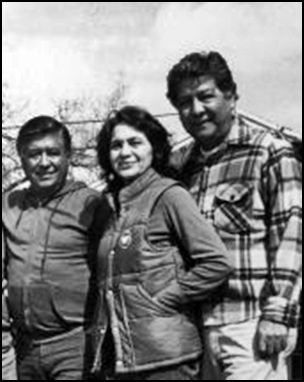
Cesar Chavez, Dolores Huerta, Richard Chavez. Keene, California (1980)
The United Farm Workers, one of the great American democracy movements, lost a brother, leader, friend this week. Richard Chavez, brother of Cesar Chavez, died at age 81 in Bakersfield, California.
If you know nothing else about him, remember that he designed the black Aztec eagle on a red field that became a symbol of Chicano and farm worker justice around the world.
In June 2011, Richard Chavez stood on the steps of the California state capitol to encourage those who were fasting for farm workers rights [Watch the video.]
He said: “It’s been almost 50 years ago that I came and marched on these steps for the very same thing that we are here for today. It was an Easter Sunday and Dolores and I marched. We marched to talk to then-Governor Brown–another Governor Brown, the father of this governor. Fasting is nothing new to our movement. We have been fasting for years and years. (more…)
“I kept my sin secret and my frame
wasted away. Day and night your
hand was heavy upon me.” – Psalm 32
This psalm is a piece of very good psychology about the burdens we carry within us, our unforgiven sins.
When we don’t face our faults, our problems, our weakness, our angers, our sense of inadequacy — worse, when we blame them on others, or deny them, or need to be perfect, or become defensive — we refuse to accept ourselves. Every doctor and psychologist in the country sees the effect of that in their offices every day.
We all have things we need to forgive in ourselves or face in ourselves. We have things we know we ought to ask forgiveness for from someone else, but pride and stubbornness hold us back.
These things become a barrier between us and the community, a hot stone in the pit of the stomach, a block to real happiness. And nothing is going to get better until we face them.
Forgiveness occurs when we don’t need to hold a grudge anymore: when we are strong enough to be independent of whatever, whoever it was that so ruthlessly uncovered the need in us. Forgiveness is not the problem; it’s living till it comes that taxes all the strength we have.
Some people think that forgiveness is incomplete until things are just as they were before. But the truth is that after great hurt, things are never what they were before: they can only be better or nothing at all. Both of which are acceptable states of life.
“Life is an adventure in forgiveness,” Norman Cousins said. You will, in other words, have lots of opportunity to practice. Don’t wait too long to start or life will have gone by before you ever lived it.–Joan Chittister, OSB
 I’ve had some lovely email exchanges with Portland magazine editor Brian Doyle. He’s a thoughtful, thoroughly human writer (see his newest collection Grace Notes). Portland magazine is the wildly popular “alumni magazine” from the Catholic University of Portland (Oregon).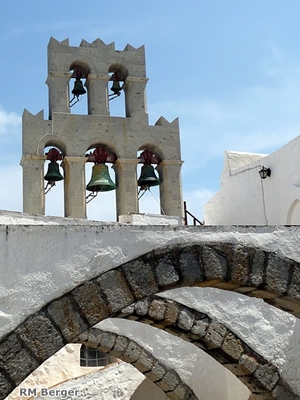

 I’m risking arrest on Aug. 29 as part of a movement to stop a dirty oil pipeline from ripping through the American heartland and our national water aquifer. Friends of the Earth has interviewed folks along the pipeline route who are fighting back.
 In May 2010, I was honored to serve as resident humanities scholar for an inmate writing program initiated by Hope House DC. I spent a week at two prisons in Maryland facilitating writing workshops on Ernest Gaines’ classic A Lesson Before Dying.