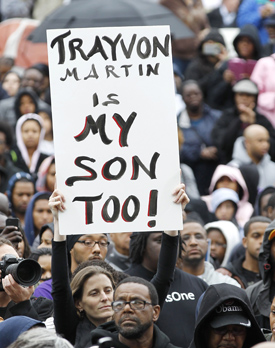
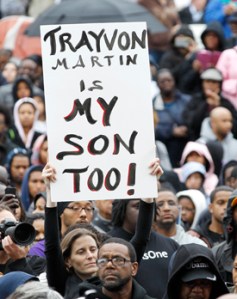
Remembering Trayvon Martin (Haraz N. Ghanbari, AP)The Ballad of Mary’s Son
by LANGSTON HUGHES (1954)
It was in the Spring
The Passover had come.
There was feasting in the streets and joy.
But an awful thing
Happened in the Spring –
Men who knew not what they did
Killed Mary’s Boy.
He was Mary’s Son,
And the Son of God was He –
Sent to bring the whole world joy.
There were some who could not hear,
And some were filled with fear –
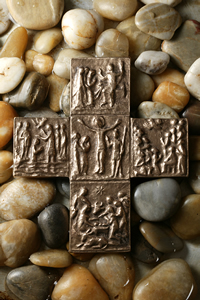
So they built a cross
For Mary’s Boy.
“Christians speak of the “paschal mystery,” the process of loss and renewal that was lived and personified in the death and raising up of Jesus. We can affirm that belief in ritual and song, as we do in the Eucharist. However, until we have lost our foundation and ground, and then experience God upholding us so that we come out even more alive on the other side, the expression “paschal mystery” is little understood and not essentially transformative.
Paschal mystery is a doctrine that we Christians would probably intellectually assent to, but it is not yet the very cornerstone of our life philosophy. That is the difference between belief systems and living faith. We move from one to the other only through encounter, surrender, trust and an inner experience of presence and power.”–Richard Rohr, ofm
From Things Hidden: Scripture as Spirituality by Richard Rohr
Matthew Vines speaks on the theological debate regarding the Bible and the role of gay Christians in the church. Delivered at College Hill United Methodist Church in Wichita, Kansas on March 8, 2012. A one-hour bible study on homosexuality and the Bible. Matthew Vines looks at 6 critical scripture verses. Well worth the time. The transcript is also available.
“In 1 Corinthians 7, Paul writes about marriage and celibacy. He was celibate himself, and he says that he wishes that everyone else could be celibate as well. But, he says, each person has their own gift. For Paul, celibacy is a spiritual gift, and one that he realizes that many Christians don’t have. However, because many of them lack the gift of celibacy, Paul observes that sexual immorality is rampant. And so he prescribes marriage as a kind of remedy or protection against sexual sin for Christians who lack the gift of celibacy. “It is better to marry than to burn with passion,” he says. And today, the vast majority of Christians do not sense either the gift of celibacy or the call to it. This is true for both straight and gay Christians. And so if the remedy against sexual sin for straight Christians is marriage, why should the remedy for gay Christians not be the same?”–Matthew Vines, The Gay Debate
“If you are uncomfortable with the idea of two men or two women in love, if you are dead-set against that idea, then I am asking you to try to see things differently for my sake, even if it makes you uncomfortable. I’m asking you to ask yourself this: How deeply do you care about your family? How deeply do you love your spouse? And how tenaciously would you fight for them if they were ever in danger or in harm’s way? That is how deeply you should care, and that is how tenaciously you should fight, for the very same things for my life, because they matter just as much to me. Gay people should be a treasured part of our families and our communities, and the truly Christian response to them is acceptance, support, and love.”–Matthew Vines, The Gay Debate
The Howard University men that are part of the Howard Students For Justice group created the video above that asks viewers to check their biases about black men.
“Contrary to what America has led many to believe all young black males are not suspicious, we don’t deserve to be harassed, murdered, prosecuted or denied the protections of the justice system all because America thinks we are suspicious,” say one Howard alumni as images of other black male students scroll through the screen.
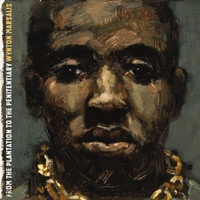
During Lent I have a few music selections that I return to: Miles Davis’ Sketches of Spain, Winton Marsalis’ From the Plantation to the Penitentiary, and Bach’s St. John’s Passion. Each one helps me enter the season of suffering and joy in a unique way–blending the Christendom culture of Old Europe with our own gritty history to form a Via Dolorosa that is distinctly American.
This Holy Week I am remembering Martha Hennessy (Dorothy Day’s granddaughter) who, with others, is fasting in St. Patrick’s Cathedral in New York City. “Blessed are those who hunger and thirst for righteousness sake, for they shall be satisfied” (Matthew 5:6).
John Dear, Catholic peace activist, wrote a touching commentary in the National Catholic Reporter this week reflecting on Judas’ betrayal of Jesus and what happens when we experience betrayal by our Church. Below is an excerpt:
Sometimes I think every follower of the nonviolent Jesus sooner or later experiences betrayal from the church. And perhaps we betray others, too. We do not suffer the great mythic betrayal that Jesus underwent, of course, but we do experience small betrayals. As we watch the breakdown of the institutional church and the expansion of our war-making empire, we might ask ourselves: When have we been betrayed? Who betrayed us and how? How did we respond to the little betrayals we experienced within the church? Have we been as nonviolent as Jesus? More, whom have we betrayed? These are important Lenten questions to ponder.
“Everything that slows us down and forces patience, everything that sets us back into the slow circles of nature, is a help. Gardening is an instrument of grace.”–May Sarton, poet
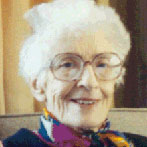
Poet Adrienne Rich (Staff photo Kris Snibbe/Harvard News Office) In 2006, Adrienne Rich published this essay “Legislators of the World” in The Guardian saying, “In our dark times we need poetry more than ever.” At the time she had just been awarded the US National Book Foundation 2006 Medal for Distinguished Contribution to American Letters and released her most recent book School Among the Ruins. Rich died this week at the age of 82. I’m including the full essay below because I think it is so important:
In “The Defence of Poetry” 1821, Shelley claimed that “poets are the unacknowledged legislators of the world”. This has been taken to suggest that simply by virtue of composing verse, poets exert some exemplary moral power – in a vague unthreatening way. In fact, in his earlier political essay, “A Philosophic View of Reform,” Shelley had written that “Poets and philosophers are the unacknowledged” etc. The philosophers he was talking about were revolutionary-minded: Thomas Paine, William Godwin, Voltaire, Mary Wollstonecraft.
And Shelley was, no mistake, out to change the legislation of his time. For him there was no contradiction between poetry, political philosophy, and active confrontation with illegitimate authority. For him, art bore an integral relationship to the “struggle between Revolution and Oppression”. His “West Wind” was the “trumpet of a prophecy”, driving “dead thoughts … like withered leaves, to quicken a new birth”.
I’m both a poet and one of the “everybodies” of my country. I live with manipulated fear, ignorance, cultural confusion and social antagonism huddling together on the faultline of an empire. I hope never to idealise poetry – it has suffered enough from that. Poetry is not a healing lotion, an emotional massage, a kind of linguistic aromatherapy. Neither is it a blueprint, nor an instruction manual, nor a billboard. There is no universal Poetry, anyway, only poetries and poetics, and the streaming, intertwining histories to which they belong. There is room, indeed necessity, for both Neruda and César Valléjo, for Pier Paolo Pasolini and Alfonsina Storni, for both Ezra Pound and Nelly Sachs. Poetries are no more pure and simple than human histories are pure and simple. And there are colonised poetics and resilient poetics, transmissions across frontiers not easily traced. (more…)
I’m taking time to savor the work of Adrienne Rich, one of the greatest American poets of the 20th century who died this week at the age of 82. She articulated what it means to be a woman in a man-made world, giving thousands a dictionary of images and phrases to describe our own experience. And more than any other poet I know, Rich was relentless in pursuing a balance between politics and art without ever sacrificing the essence of either.
On the Role of the Poet:
“We may feel bitterly how little our poems can do in the face of seemingly out-of-control technological power and seemingly limitless corporate greed, yet it has always been true that poetry can break isolation, show us to ourselves when we are outlawed or made invisible, remind us of beauty where no beauty seems possible, remind us of kinship where all is represented as separation.”–Adrienne Rich
On Poetry and the Capitalist Model:
“Poetry has the capacity to remind us of something we are forbidden to see. A forgotten future: a still uncreated site whose moral architecture is founded not on ownership and dispossession, the subjection of women, outcast and tribe, but on the continuous redefining of freedom – that word now held under house arrest by the rhetoric of the ‘free’ market.”–Adrienne Rich
Adrienne Rich’s 1997 letter to Jane Alexander, head of the National Endowment for the Arts:
Dear Jane Alexander, I just spoke with a young man from your office, who informed me that I had been chosen to be one of twelve recipients of the National Medal for the Arts at a ceremony at the White House in the fall. I told him at once that I could not accept such an award from President Clinton or this White House because the very meaning of art, as I understand it, is incompatible with the cynical politics of this administration. I want to clarify to you what I meant by my refusal.
Anyone familiar with my work from the early Sixties on knows that I believe in art’s social presence—as breaker of official silences, as voice for those whose voices are disregarded, and as a human birthright. In my lifetime I have seen the space for the arts opened by movements for social justice, the power of art to break despair. Over the past two decades I have witnessed the increasingly brutal impact of racial and economic injustice in our country.
There is no simple formula for the relationship of art to justice. But I do know that art—in my own case the art of poetry—means nothing if it simply decorates the dinner table of power which holds it hostage. The radical disparities of wealth and power in America are widening at a devastating rate. A President cannot meaningfully honor certain token artists while the people at large are so dishonored. I know you have been engaged in a serious and disheartening struggle to save government funding for the arts, against those whose fear and suspicion of art is nakedly repressive. In the end, I don’t think we can separate art from overall human dignity and hope. My concern for my country is inextricable from my concerns as an artist. I could not participate in a ritual which would feel so hypocritical to me. Sincerely, Adrienne Rich (See July 16, 1997 Democracy Now interview with Rich)
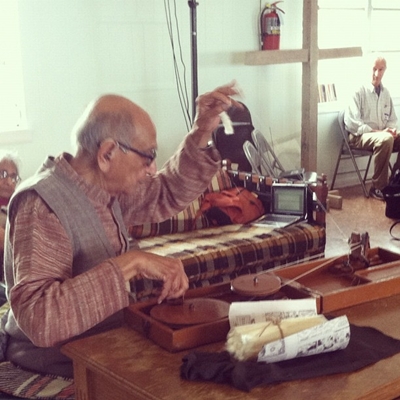
Gandhian biographer Narayan Desai spins cotton for khadi cloth at the beginning of Lenten retreat on nonviolence.
I’ve just come back from three days of retreat with Narayan Desai who is an instrumental leader in the Gandhian movement, anti-nuclear movement, and has written the definitive four-volume biography of Gandhi. I felt like I sat at the feet of the Mahatma –once removed.
“If we look forward to receiving God’s mercy, we can never fail to do good so long as we have the strength. For if we share with the poor, out of love for God, whatever he has given to us, we shall receive according to his promise a hundredfold in eternal happiness. What a fine profit, what a blessed reward! With outstretched arms he begs us to turn toward him, to weep for our sins, and to become the servants of love, first for ourselves, then for our neighbors. Just as water extinguishes a fire, so love wipes away sin.” —St. John of God
 During Lent I have a few music selections that I return to: Miles Davis’ Sketches of Spain, Winton Marsalis’ From the Plantation to the Penitentiary, and Bach’s St. John’s Passion. Each one helps me enter the season of suffering and joy in a unique way–blending the Christendom culture of Old Europe with our own gritty history to form a Via Dolorosa that is distinctly American.