“At 11:02 am, two-thirds of Japan’s Catholics were annihilated; … more Japanese Christians were slaughtered than had been martyred in four centuries of brutal persecution.” – The Holy City Nagasaki
Lest We Forget …
That 67 years ago, on August 6th and 9th, there were 150,000 people, mostly non-combatants, killed instantaneously by 2 nuclear weapons which were dropped on the cities of Hiroshima and Nagasaki in Japan. Additional thousands died of radiation poisoning in subsequent years.
That today the U.S. has 6,800 nuclear warheads with indescribable power of destruction.
That today’s nuclear bombs could end human life on planet Earth.
That today’s nuclear weapons have no rational use but could be used by ideologues, or the insane.
That today’s nuclear power industry is intimately linked with the nuclear weapons industry.
That today it is a fact that $1 TRILLION will be spent globally on nukes in the next decade.
That today, politicians are cutting budgets for health care, education, renewable energies, and other social needs programs but not for nukes.
So, today, we can do something about it for our families and future generations.
We can sign a petition with Global Zero to call on world leaders to cut nukes, not the things we desperately need.
Daniel Berrigan by Rose Marie BergerTen Commandments for the Long Haul
1) Call on Jesus when all else fails. Call on Him when all else succeeds (except that never happens).
2) Don’t be afraid to be afraid or appalled to be appalled. How do you think the trees feel these days, or the whales, or, for that matter, most humans?
3) Keep your soul to yourself. Soul is a possession worth paying for, they’re growing rarer. Learn from monks, they have secrets worth knowing.
4) About practically everything in the world, there’s nothing you can do. This is Socratic wisdom. However, about of few things you can do something. Do it, with a good heart.
5) On a long drive, there’s bound to be a dull stretch or two. Don’t go anywhere with someone who expects you to be interesting all the time. And don’t be hard on your fellow travelers. Try to smile after a coffee stop.
6) Practically no one has the stomach to love you, if you don’t love yourself. They just endure. So do you.
7) About healing: The gospels tell us that this was Jesus’ specialty and he was heard to say: “Take up your couch and walk!”
8) When traveling on an airplane, watch the movie, but don’t use the earphones. Then you’ll be able to see what’s going on, but not understand what’s happening, and so you’ll feel right at home, little different then you do on the ground.
9) Know that sometimes the only writing material you have is your own blood.
10) Start with the impossible. Proceed calmly towards the improbable. No worry, there are at least five exits.
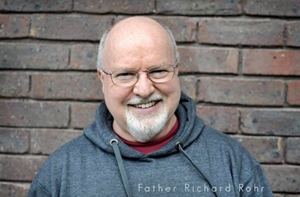
We had an excellent sermon preached at Sojourners last month by Sarabeth Goodwin from the Episcopal Church St. Stephen and the Incarnation. She framed her reflections with stories of sorting through boxes and boxes of paper in her study, trying to decide what to keep and what to let go. It made me realize what a contest with the personal ego this process is! On the flip side, for me, when I’m anguishing about holding on to notes I took at a lecture in 1981, then it is a clear signal of an opportunity to embrace change and release the private ego. Here’s Richard Rohr on a similar topic:
“Once Jesus’ great and good news became a reward-punishment system that only checked into place in the next world instead of a transformational system in this world, Christianity in effect moved away from a religion of letting go and became a religion of holding on. Religion’s very purpose for many people was to protect the status quo of empire, power, war, money, and the private ego. So in many ways, we have not been a force for liberation, peacemaking, or change in the world. One thing for sure is that healthy religion is always telling usto change instead of giving us ammunition to try to change others. Authentic Christianity is a religion of constantly letting go of the false self so the True Self in God can stand revealed—now.”–Richard Rohr, OFM
“Nothing disquiets the soul more than a feeling of being unfinished, adrift, rudderless at the same time. There is something more we’re meant to do in life, we’re sure, but no way, apparently, to dispel the aura of aimlessness in which we have begun to live. I go to work every morning but no amount of money could really make me like it, feel good about being there, able to convince myself that being there is where I’m meant to be.
There is a cosmic sense of frustration about knowing myself to be on the way to somewhere—but in the dark. I do my best at everything I do, however mundane, however humble. I know that cooking hamburgers in a short-order place is a decent thing to do in life. But I can’t believe that is all I’m meant to do in life. There must be more. There simply must be more I’m supposed to be doing than making hamburgers for people who can pay for them.
I avoid class reunions because everybody else there talks big plans about big things, but nothing big has ever happened to me. Nor have I begun yet to realize that there is a distinction between going to work and pursuing my call. So I go through life disappointed with the job but unable to realize that the call, for me, may be far and wide away from any paid occupation anywhere.
I have yet to understand that my call may start after work ends every day. My call may be to organize games for street children, or write to prisoners, or make casseroles for the old woman next door, or learn another language in order to help refugees adapt to the small white town in which I live.
The point is clear: my sense of worth and purpose in life is tied up with the quality of life I provide for others, for the planet, for the human race. Solving equations all day long, or encoding a computer all day long can also be boring, can also seem worthless, unless I’m doing these things in order to be some small part in curing an insidious disease or finding a formula that reduces the world’s dependence on fossil fuels.
It may be something as simple as producing materials that ennoble the human mind rather than pander to it, selling and creating things that enhance life rather than destroy it. And, yes, making hamburgers for those who can pay for them can also be a call, provided that working in this place is what enables me to care consciously for someone else in some other way.
In the end, it is passion and purpose—passion and purpose—that are of the essence of a vocation, a call to do something that makes me a conscious co-creator of the world.”–Joan Chittister, OSB
“The mystical night is not mere night, absence of light. It is a night which is sanctified by the presence of an invisible light (to which our visible, sacramental fire burning in the spring night is only a witness.) The brightness of the eternal light is so great that we cannot see it, and all other lights become darkness by comparison with it.”–Thomas Merton
From The New Man by Thomas Merton (Farrar, Straus, Giroux, 1961, p 247)
Oak Ridge, TN—Early on Saturday morning, July 28, three Catholic plowshares activists performed a disarmament action in response to U.S. government plans to invest $80 billion to sustain and modernize the nuclear weapons complex, which should in fact be phased out.
Calling themselves Transform Now Plowshares, Michael R. Walli (63) left, Sr. Megan Rice (82), and Greg Boertje-Obed (57) right, entered the Y-12 nuclear weapons facility at Oak Ridge, Tennessee, as a prophetic Christian witness to prioritize people over bombs.
They released a faith-based statement citing Isaiah 2 and saying, “A loving and compassionate Creator invites us to take the urgent and decisive steps to transform the U.S. empire, and this facility, into life-giving alternatives which resolve real problems of poverty and environmental degradation for all.”
They also delivered an indictment citing U.S. Constitutional and Treaty Law as well as the Nuremberg Principles: “The ongoing building and maintenance of Oak Ridge Y-12 constitute war crimes that can and should be investigated and prosecuted by judicial authorities at all levels. We are required by International Law to denounce and resist known crimes.” This action is one of a long tradition of Plowshares disarmament actions in the US and around the world which challenge war-making and weapons of mass destruction.
At Y-12, the National Nuclear Security Administration plans to replace facilities for production and dismantlement of enriched uranium components with a new consolidated Uranium Processing Facility (UPF). It is budgeted to cost more than $6.5 billion.
Read the bios and full statements of Michael, Sr. Megan, and Greg here.
The Leadership Conference of Women Religious will gather for its 2012 conference from Aug. 7-11 in St. Louis, MO. As we keep this momentous gathering of women in our prayers, I offer former LCWR president Theresa Kane’s address to Pope John Paul II at the National Shrine of the Immaculate Conception in Washington, DC, on October 7, 1979.
The most relevant part of her speech was:
“As I share this privileged moment with you, Your Holiness, I urge you to be mindful of the intense suffering and pain which is part of the life of many women in these United States. I call upon you to listen with compassion and to hear the call of women who comprise half of humankind.
As women we have heard the powerful messages of our Church addressing the dignity and reverence for all persons. As women we have pondered upon these words. Our contemplation leads us to state that the Church in its struggle to be faithful to its call for reverence and dignity for all persons must respond by providing the possibility of women as persons being included in all ministries of our Church.
I urge you, Your Holiness, to be open to and respond to the voices coming from the women of this country who are desirous of serving in and through the Church as fully participating members.”
It is worth noting that Sr. Kane’s speech received thunderous applause. And “when she finished speaking,” newspapers report, “the gray-haired nun moved to the altar of the magnificent National Shrine of the Immaculate Conception and knelt before the pope. He gently touched her head.” Such is the agonizing and beautiful paradox and mystery of Catholicism.


 “The mystical night is not mere night, absence of light. It is a night which is sanctified by the presence of an invisible light (to which our visible, sacramental fire burning in the spring night is only a witness.) The brightness of the eternal light is so great that we cannot see it, and all other lights become darkness by comparison with it.”–Thomas Merton