-
Video: Monks of the Desert on Today Show
It’s a funny ol’ world. You never know where grace and the monastic moment might appear.
For example, Abbot Philip (who I quote frequently on this blog) and 5 of his brothers from Christ in the Desert Monastery in New Mexico appeared last week on NBC’s Today show!
They sang “Alleluia Lustus Germinabit” off of their new album, “Blessings, Peace, Harmony” by “Monks in the Desert.” Watch the video below:
http://www.msnbc.msn.com/id/32545640
Visit NBCNews.com for breaking news, world news, and news about the economy
The lyrics are taken from the prophet Hosea: “Alleluia. Justus germinabit sicut lilium: et florebit in aeternum ante Dominum. Alleluia” (Alleluia. The just shall spring like the lily: and shall flourish forever before the Lord. Alleluia.)
-
Joan Chittister: A Questioning Heart

In a room where people unanimously maintain a conspiracy of silence, one word of truth sounds like a pistol shot. –Czeslaw Milosz
“The quality of life as we know it has changed radically in our lifetime. When I was a young woman, the world—my world—was an exercise in answers. We had absolute answers for everything: who was going to heaven and who was not. The number of planets and how they went together. The age of the earth and how it developed. But now things have changed. Now, it seems, life is more an exercise in questions than a catalogue of certainties. It is the unending process of an expanding universe and its expanding knowledge with it. Nothing, it seems, is not now open to question.
When we consider yesterday’s answers more important than today’s questions, we fail both the past and the future. In the first place, the past was for its own time; in the second place, it is meant to prepare us to face the future.
Never refuse to ask a question however unwelcome the question may be. In the end, it may be the only thing that saves us from our own ignorance. To keep growing, it is imperative to keep asking the forbidden questions.
When we try to stop thought by stopping people from asking forbidden questions, we only prove the paucity of our answers. What is true will hold up to scrutiny—however much untruth is around us. If an idea be of God—like love and goodness and openness and respect and tolerance and compassion—it will thrive in the most godless environment.”–Joan Chittister, OSB
From Aspects of the Heart by Joan Chittister
-
Franciscans on Moral Discernment in an Election Season
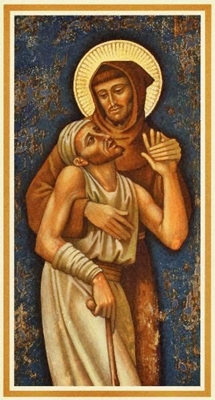 In the middle of this crazy election season, I’ve appreciated the thoughtful leadership of the Franciscans in how to approach difficult decisions.
 The Justice, Peace, and Integrity of Creation Directorate is presenting short pieces to help introduce particularly Franciscan and Catholic approaches to the decision-making process. Here’s an excerpt from their first installment. I urge you to read the whole article:
In the election sphere today, there is often an attempt to link our Catholic faith squarely with one political party. Although most religious leaders assert that our faith is not adequately represented or served by the platform of any particular political group, some, overtly or tacitly, strain to demonstrate how one party is the only morally acceptable choice. Such effort is wasted. The world is a morally complex and ambiguous place, especially when it comes to political decisions.
Taking a wider view as Catholics inspired by the Franciscan path of following Jesus, how can we approach the elections? Is there a political party or candidate for whom it would be morally unacceptable to vote? Does our faith compel us to pull a particular lever in the ballot box? If not, is it all just relativism?
The problem is not the clarity of our moral foundations; these are clear. The challenge comes from the complexity of our globalized world, the pluralistic society that is our nation, and the limitations of our fallen, yet still blessed, human condition. While our faith tradition offers us principles by which to live in a complex world, they don’t translate into a litmus test for choosing between candidates. Rather, our faith invites us to engage in moral reasoning—weighing the pressing issues of our day in the light of our tradition. While this is a process that often yields no categorical answers, it does provide us a method of discernment to guide us through troubling ambiguity as we make our decisions.
Our Franciscan tradition offers us a framework of five interconnected parameters that can guide our discernment: care for creation, consistent ethic of life, preferential option for the poor, peacemaking and the common good. …
Read the rest of “Franciscans are not ‘party animals’” (Part 1).
-
‘Making a Deposit of Faith’: On Catholics and Credit Unions
 I’m very happy to say that U.S. Catholic magazine has published an article I wrote for them on Catholics and credit unions.
It was a great exercise in recalling my own upbringing around money and how much the financial industry has changed, even just in my lifetime.
U.S. Catholic chooses some articles – like mine – to post first online with a reader survey, then they run the survey results along with the article in the print magazine. So right now this article is only available online, but will be in the February 2013 print edition of the magazine.
I hope you’ll take the survey! Here’s an excerpt from my article Make A Deposit of Faith When Finding a Home for Your Money.
One of the first questions to ask when assessing one’s own financial social responsibility is: How quickly does my dollar leave my neighborhood? Or as one community organizer put it: How many of your neighbors’ hands does your money pass through before it leaves your immediate community? Generally speaking, the bigger the financial corporation, the quicker your dollar exits.
Credit unions, as we know them today, originated in Europe in the 1800s as financial self-help cooperatives among small business owners and farmers in particular locales, geared toward providing for and protecting their economic sovereignty. Many of them were started by Catholics and were based on principles of Catholic Social Teaching. For example, both St. Anthony Claret (1807-1870)–founder of the Claretians, who publish this magazine–and Franciszek Stefczyk (1861–1924) worked in rural areas to establish credit unions among poor farmers. Both wanted famers to own their farms and market their own crops, and they understood that one’s financial health was intimately connected with one’s family and local community. Stefczyk’s community organizations were intended to be “schools of character” for enhancing human dignity and stabilizing local communities.
As immigrant Catholics brought credit unions to America, they became organized around seven principles that reflect Catholic teaching: 1) voluntary membership, 2) democratic governance, 3) member control of capital, 4) autonomy and independence, 5) education of members and public in cooperative principles, 6) cooperation between cooperatives, and 7) concern for the local community. Most credit unions today are still built around these principles.
“If love is wise,” wrote Pope Benedict in his 2009 encyclical Charity in Truth, “it can find ways of working in accordance with provident and just expediency, as is illustrated in a significant way by much of the experience of credit unions.” … –Rose Marie Berger
Read the rest of Make A Deposit of Faith When Finding a Home for Your Money.
-
Leslie Fields: Obama Honors Cesar Chavez
Official White House photo by Pete SouzaBy Leslie Fields, Sierra Club
On October 8, on a gorgeous early autumn day in the oak-dappled foothills of California’s Tehachapi Mountains, President Obama formally designated the César E. Chávez National Monument. The designation is the fourth of Obama’s presidency, but the first-ever national monument dedicated to a Latino.
Below, the president with Helen Chávez at her late husband’s gravesite at Nuestra Señora Reina de la Paz (Our Lady Queen of Peace), or La Paz, in the town of Keene, California, site of the new national monument.
Official White House photo by Pete Souza“César Chávez was a true labor and environmental champion whose work helped result in the passage of landmark laws that protect our air, water, land, and—most important—people,” said Sierra Club executive director Michael Brune. “His work helped link people’s health and the environment, and his fight for environmental justice is one that the Sierra Club remains committed to today.” …
Read the rest of Monument to a National Treasure by Leslie Fields.
-
Teresa of Avila: ‘Prayer is Dynamic’
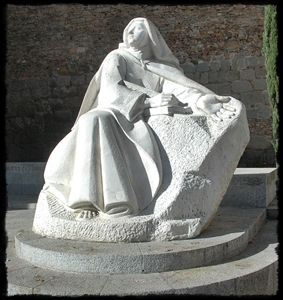
Sculpture of Teresa in Avila, Spain (photo by Jim Forest) October 15 is the feastday of Teresa of Avila, mystic, philosopher, author, reformer, and saint.
In 1970, Pope Paul VI awarded Teresa and Catherine of Siena the distinction Doctors of the Church, making them the first women to be so named.
“Prayer is not just spending time with God … If it ends there, it is fruitless. No, prayer is dynamic. Authentic prayer changes us–unmasks us.”—Teresa of Avila
Benedictine Joan Chittister offers a wonderful reflection on prayer for this feastday:
To wait for God does not mean that there is nothing else for me to do in the spiritual life than pray. Prayer is not a cocoon. We do not simply go into prayer and hope to come out on the other end of the exercise fully grown in the Spirit, perfectly new, totally finished. All dross removed. All rust scoured. The soul burnished. The heart refurbished. The soul bright and radiant. The mind clear and certain.
Not at all. There is too much of us in us to ever disappear. Nor is it meant to. No, the function of prayer is not to obliviate the self. It is to become to the utmost what we are meant to be no matter what situation we are in. Prayer is the process that leads us to become what Jesus models for us to be.
To pray does not mean that we will cease to be ourselves. It simply means that we will come to know clearly what it will take to become more of the Jesus figure we are all meant to be.
We watch Jesus confront the leaders of the day. He calls the priests and Pharisees to cleanse the temple and lift from the backs of the people the laws of the synagogue that burden them. He calls the leaders of the state to stop living off the backs of the poor. And he calls us to do the same.
Being immersed in prayer, really immersed in prayer, sears our souls. It forces us to see how far from our own ideals we stand. It challenges the images of goodness and piety and integrity we project. It confronts us with what it really means to live a good life. It requires courage of us rather than simply piety.
It is in following Jesus down from the mountaintop, along the roads of the world, through the public parts of the city, into the ghettoes of the poor and the halls of government and the chanceries of the churches, saying with John the Baptist, “Repent and sin no more” that prayer gets its hallmark of undisputed credibility.–Joan Chittister, OSB
Excerpted from The Breath of the Soul by Joan Chittister
-
Did the Butler Do It? VatiLeaks
 Paolo Gabriele, the butler/fall guy in the most recent Vatican scandal, was sentenced to 18 months of house arrest on Saturday–and will likely receive a “papal pardon.”
In what plays like an episode of “Zen,” the trial turned up accomplices and other high-ranking Vatican officials who were likely part of the conspiracy, but who were never investigated or called to court.
One interesting tidbit revealed during the trial was that one stolen document was “a letter to the Pope in German, written by Aldegonde Brenninkmeijer, a Dutch Catholic philanthropist who accused the Roman Curia of betraying the legacy of the Second Vatican Council.”
A summary of her letter in Il Chiesa said:
The content of the letter is clear nonetheless. It is a tough act of accusation against the Vatican curia and the Catholic hierarchy in general. The rich Brenninkmeijers denounce the fact that money should play a central role in various offices of the curia, in some European dioceses, and in the patriarchate of Jerusalem. They accuse the pontifical council for the family of using gullible and acritical collaborators instead of employing personages who can and want to act in the sense of “aggiornamento” of Vatican II. They insinuate that in the most restricted circle around the pope, a considerable amount of power has been accumulated in a visible and tangible way, adding that they possess written proof in support of their charges.
The Brenninkmeijers do not accuse anyone by name, except in one case. After maintaining that in Europe there are growing numbers of informed believers who are separating themselves from the hierarchical Church without, according to them, abandoning their faith, and after lamenting the lack of “non-fundamentalist” pastors able to guide the flock according to modern criteria, the two spouses manifest to the pope not only their own discouragement, but that of many laypeople, priests, religious, and bishops over the appointment of the new archbishop of Utrecht, Jacobus Eijk.–Il Chiesa
Robert Micken wrote a great “roundup” essay in The Tablet (excerpt below) outlining the VatiLeaks scandal thus far:
The security breach was considered one of the most serious in modern Vatican history. The papal butler, an Italian layman named Paolo Gabriele, was caught red-handed with thousands of sensitive documents that he either photocopied or stole in original form from Pope Benedict XVI’s apartment and then leaked to an Italian journalist. The reporter, Gianluigi Nuzzi, selected dozens of those stolen papers – many showing instances of financial corruption, mismanagement, factional fighting and careerism involving the priests and bishops that run the Roman Curia – and published them in a best-selling book called Sua Santità (“His Holiness”). …
On 13 August, the dead of summer when all of Italy was beginning the week-long Ferragosto holiday, the Vatican’s chief prosecutor, Nicola Picardi, published the indictment against the former butler. And, lo and behold, for the very first time the Vatican admitted that Gabriele had not acted alone. On the second page of Picardi’s 35-page dossier, which was distributed by the Holy See press office to the handful of journalists still in Rome, it was announced that Claudio Sciarpelletti, a computer technician at the Secretariat of State, had also been arrested. He was imprisoned on 25 May (a day after the butler) and released less than 24 hours later. The indictment said that he, too, would be put on trial for aiding and abetting Mr Gabriele.
This was a dramatic and damning revelation. It has made it difficult to believe that anything the Vatican has claimed about the leaks, the former butler or his trial has been, as the famous phrases goes, the truth, the whole truth and nothing but the truth. …–Robert Mickens, from “Lifting the Lid on Dark Secrets” (The Tablet, 13 Oct 2012)
As we recognize the 50th anniversary of the opening of Vatican II, there is a fight for the heart and soul of that Council going on across Catholicism. The VatiLeaks trial, and what the documents reveal, is just one part of a much larger struggle to defend Vatican II.
-
Abbot Philip: ‘The Most Beautiful Trees in our Canyon’
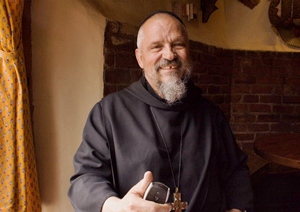
“In the early monastic writings, we find the monks extolling perseverance. Sometimes early writers defined a monk as one who falls every day, but who gets up and keeps on trying. One of the wonderful stories, for me, is of an old monk who encouraged a young monk by telling him that he, the old monk, continued to struggle with his sinfulness even in advanced age.
Years ago an artist pointed out to me that the most beautiful trees in our canyon are not those that are perfectly straight and without blemish, but those that have lived through storms and winds and have lost limbs and been twisted—but still keep growing toward the light.
None of this means to extol failure or sin, but simply to acknowledge that failure and sin are part of our daily human experience. What forms us as spiritual persons is the struggle against failure and sin. We should not become complacent as we age. We do come, I hope, to accept ourselves as women and men who will continue to struggle with failure and sin until we die. Over the years, hearing the confessions of older, mature men and women has brought incredible consolation to me.
There are times in life when we are aware very much of our brokenness, our failures and our sins. We need such awareness so that we are truthful before our Lord. We must not confuse this spiritual aware with depression or natural sadness. If we are depressed or sad, we need help. If we are sinners, we need God. Learning to turn to God is at the heart of the spiritual life. Learning to keep on trying to be faithful is a form of that turning to God, over and over.
At a practical level, this never implies that a Christian or a monk will always manifest complete joy. That might be an ideal. Most of us still struggle and find ourselves at times not able to be completely joyful. Often, however, I see older people who become more and more joyful as they accept themselves and continue in the struggle.”–Abbot Philip, OSB
-
Norm Ornstein: Romney vs. ‘Young Guns’ in 2013
 On the radio show “To The Point,” Norm Ornstein, Congressional scholar at the American Enterprise Institute, a conservative D.C.-based think tank, gave an insightful look into what the “Young Gun” Republicans (Eric Cantor, Kevin McCarthy, and Paul Ryan) have planned for Congress after the election.
Ornstein, with Congressional scholar Thomas Mann, is co-author of It’s Even Worse Than It Looks: How the American Constitutional System Collided with the New Politics of Extremism. Here’s the critical excerpt:
“The decision to use the debt limit as a hostage taking event was cooked up well before the 2010 elections. It was a conscious approach by the ‘young guns,’ as they call themselves–[Eric] Cantor, Kevin McCarthy, and Paul Ryan. It was the first time ever that the debt limit had been used as a hostage for another set of goals. You had a large number of Republicans who ran by pledging they would never vote to increase the debt limit. This was not something that just emerged and then it was a question of who would navigate through it. …
The problem that Romney would face [if elected] would be particularly acute, paradoxically, if the Republicans win the House and the Senate. Because I can tell you from conversations with Republicans in both chambers, but especially in the House, and this was Paul Ryan’s plan long before he became the running mate. They’ve got a plan that if they capture everything their going to put together in January the ‘Mother’ of all reconciliation bills, avoid a filibuster, and it’s going to provide the vision of Ryan’s budget, which is far more conservative than what Mitt Romney suggested in that first debate. They are going to try to pass it through on their votes alone and send it to him and, in effect, dare him to veto it. His ability to withstand what would be very conservative policies coming out of a Republican House and Senate would be very limited.”–Norm Ornstein
Listen to the whole interview on KCRW’s To The Point (Oct. 8, 2012).


-
Subscribe
Subscribed
Have a WordPress.com account? Log in now.

