-
Seamus Heaney: Friends and Miracles
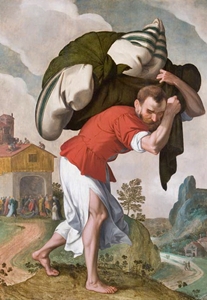
The Healing of the Paralytic (Netherlandish, c. 1560/1590) I’m musing on Mark 2:3-4 (Jesus Heals the Paralytic) and the nature of miracle in any given community.
Note in this painting by a Dutch artist that the friends who have lowered the paralytic to Jesus are still on the roof, while the healed man has left. Are they doing repairs?
Note also the muscle strength in the healed mans legs. Where is he going? Who is he going to tell?
“Not the one who takes up his bed and walks
But the ones who have known him all along—
And carry him in.”
–Seamus Heaney, from “Miracle” (Human Chain: Poems, 2011)
-
Joan Chittister on Passion and Purpose
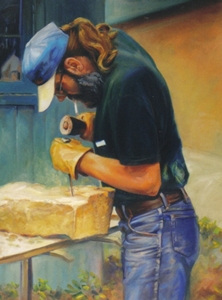
Gerrie Govert’s The Stone Cutter, Indiana “What’s your passion? In the end, it is passion and purpose—passion and purpose—that are of the essence of a vocation, a call to do something that makes me a conscious co-creator of the world.
An old medieval story makes the point best. A traveler came across three stonecutters. “What are you doing?” the traveler asked the first man. “I am making a living,” the man said. “And what are you doing?” the traveler asked the second man. And that man answered, “I am practicing to become the best stonecutter in Europe.” Then the man asked the third laborer. And the third man answered, “I am building a cathedral.”
In my commitment to my vocation, whatever it may be—helping cripples to walk and people to die dignified deaths and children to learn and the world to grow seeds and nations to live in peace—I myself become a holy person, a mystic whose God is alive and present and waiting for us to do what must be done to make creation itself a holy place.
A call demands endurance and persistence, commitment and stability. To be a real call it must be something worth giving my time, my resources, myself to doing. It has nothing to do with success as measured in the number of people served or the numbers of units produced or the number of events attended. It has everything to do with trying. As the Sufi say, “If you are expecting to find an answer to your problem, you have simply not asked a big enough question.” It is out of awareness of our role on earth that we find our place on earth.”–Joan Chittister, OSB
From Following The Path by Joan Chittister
-
Just What Color of Country Are We? Maps of the 2012 Election Results
Mark Newman, from the University of Michigan department of Physics and Center for the Study of Complex Systems, posted an excellent map series reflecting the results of Tuesday’s national election. Here are three results below, but check out the whole series:
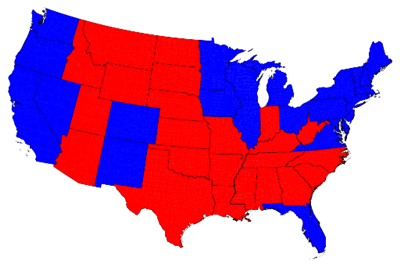
“Above is a standard state map. The states are colored red or blue to indicate whether a majority of their voters voted for the Republican candidate, Mitt Romney, or the Democratic candidate, Barack Obama, respectively. Looking at this map it gives the impression that the Republican won the election handily, since there is rather more red on the map than there is blue. In fact, however, the reverse is true – it was the Democrats who won the election. The explanation for this apparent paradox, as pointed out by many people, is that the map fails to take account of the population distribution. It fails to allow for the fact that the population of the red states is on average significantly lower than that of the blue ones. The blue may be small in area, but they represent a large number of voters, which is what matters in an election,” writes Mark Newman
 Above here is a cartogram of the United States based on population.
“As you can see, the states have been stretched and squashed, some of them substantially, to give them the appropriate sizes, though it’s done in such a way as to preserve the general appearance of the map, so far as that’s possible. On this map there is now clearly more blue than red.
The presidential election, however, is not actually decided on the basis of the number of people who vote for each candidate but on the basis of the electoral college. Under the US electoral system, each state in the union contributes a certain number of electors to the electoral college, who vote according to the majority in their state. (Exceptions are the states of Maine and Nebraska, which use a different formula that allows them to split their electoral votes between candidates.) The candidate receiving a majority of the votes in the electoral college wins the election. The electors are apportioned among the states roughly according to population, as measured by the census, but with a small but deliberate bias in favor of less populous states,” writes Mark Newman.
Below, is the United States using more colors than red and blue, but also allowing them to reflect the mixture of votes, creating the purple areas.
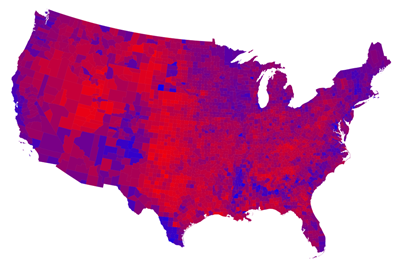
See more of Mark’s maps here.
-
Video: NBC’s ‘New Normal’ Asks Gay Catholics to Fight for their Place in the Body of Christ
NBC’s The New Normal has a great “confessional” scene in the episode called The Godparent Trap.
Gay dads Bryan and David want to choose godparents for their new baby. They want the child to have a good spiritual foundation, but they are having trouble identifying their own spiritual foundation since their churches have rejected them.
Bryan decides to go back to his Catholic church and speaks to the priest in the confessional. This 2 minute clip is titled “Are You a Fighter?”
-
Brazil’s Bishop: ‘Reckless Development is Coming to a Dead End’
 In 2010, Dom Erwin Kräutler, Catholic bishop of Xingu, Brazil, received the Right Livelihood Award for his work for the human and environmental rights of indigenous peoples and his efforts to save the Amazon forest. He has been a leading opponent of the controversial Belo Monte dam in his diocese — and warns of the connection between unchecked “development” and global warming. This excerpt is part of a series celebrating the 50th anniversary of the opening of the Second Vatican Council in US Catholic magazine.
When Pope Paul VI in his 1967 encyclical Populorum Progressio surprised the world with his slogan “Development is the new name for peace,” he wasn’t thinking of the kind of economic growth at all cost that allows a few oligarchies and business people to get filthy rich while intentionally excluding most people and plunging many into poverty. Pope Paul called on all the people of the world to promote development that is based on justice and solidarity.
The definition of development is key. When the free market is seen as the engine of progress and the measure of all things, earth, water, air, and fire will be commodified and subordinated to the rules and powers of the market, multinational companies, and international trade.
But when life in human dignity is the goal and meaning of all development, then development will be geared toward the survival and well-being of all people, including the generations that are coming after us.
The unrelenting pursuit of increasing exports, trade surpluses, and economic growth that exploits the human family and its environment has become a dangerous dead end.
A change in the direction of our thinking and actions is urgent. What is needed is development that is oriented toward the protection and promotion of life and human capacities; toward education, health, security, housing in dignity; and toward environmentally responsible agriculture, stewardship of our water resources, and careful protection of biodiversity.
Averting climate change and saving our planet will require both a change in consciousness and concrete measures that hold all people and countries of the world accountable.–Dom Erwin Kräutler, Catholic bishop of Xingu, Brazil
Read Dom Erwin Kräutler’s whole article here.
-
Catholics, Elections, and the Specter of ‘Intrinsic Evil’
 Often during election season, the phrase “intrinsically evil” gets bandied about to infer that Catholics who don’t vote a right-wing political agenda are somehow going against the teachings of the Church.
A recent NCR editorial takes on these alternative Catholics’ argument; arguments not in line with the teaching of the Church. Here’s an excerpt:
” “Intrinsically evil” — that perennial election year canard that is meant to tell us Catholics how to vote and whom to avoid — has gotten much play this cycle. But it is truly a deception. So-called Catholic voter’s guides that use intrinsic evil as the measuring stick to choose among a half-dozen issues as “nonnegotiables” are partisan distractions and should be ignored.
Catholics who bring with them a conservative political agenda — and who have garnered the support of not a few bishops and other Catholic opinion leaders — generally select these as nonnegotiable issues: abortion, embryonic stem cell research, cloning, gay marriage, and euthanasia. While this makes a tidy list, convenient for pamphlets stuck under car windshield wipers in church parking lots, we will dispute that they are “nonnegotiables,” because they are in fact cherry-picked from long lists of actions that are intrinsically evil by church teaching.
Let’s borrow a list from Pope John Paul II. Quoting Gaudium et Spes, he says that intrinsically evil acts are “any kind of homicide, genocide, abortion, euthanasia and voluntary suicide; whatever violates the integrity of the human person, such as mutilation, physical and mental torture and attempts to coerce the spirit; whatever is offensive to human dignity, such as subhuman living conditions, arbitrary imprisonment, deportation, slavery, prostitution and trafficking in women and children; degrading conditions of work which treat laborers as mere instruments of profit, and not as free responsible persons: all these and the like are a disgrace … and they are a negation of the honor due to the Creator” (Veritatis Splendor, 80).
We might even add climate change to the list. After all, if the right to life is the most basic human right, then human-caused global warming threatening the entire life of the planet must be the ultimate evil.
“Wait, wait,” the perpetrators of the intrinsically-evil canard will protest. “These are evil, but they can’t be treated as all the same. For some of these we must exercise prudential judgment.” Therein lies the deception, because dealing with any evil — and especially determining the best solutions in a plural democracy — will always require prudential judgment. Further complicating matters is that we must make these judgments within the context of specific electoral and legislative processes. …”
Read the whole article.
-
Remembering AIM Activist and Prophet Russell Means
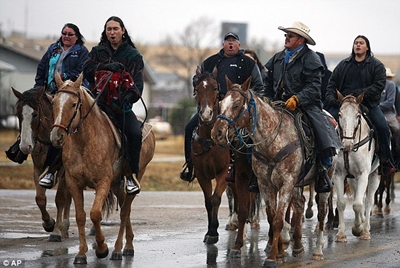
Funeral procession for AIM activist and Spiritual Leader Russell Means Russell Means was an Oglala Sioux activist for the rights of Native American people, a political activist, and a keeper of memories for his people. He was highly confrontational and therefore highly controversial. He became a prominent member of the American Indian Movement (AIM), and helped organize notable events that attracted national and international media coverage.
Means was active in the anti-nuclear movement, prison reform movements, and international issues of indigenous peoples, including working with groups in Central and South America, and with the United Nations for recognition of their rights. He raised the desperate conditions at his native Pine Ridge Indian Reservation to national prominence.
Kiowa Robert Chanante asked Means several years ago how one overcomes anger and hatred when violence is inflicted on a person for seeking justice for Indigenous Peoples. After listening and thinking about it for a bit this is what Means said: “The way I’ve seen it is that every injury I took, every sacrifice I made and every personal cost I paid has been done on behalf of our people and ancestors. So I take these things as a badge of honor and they are things that I am proud of.”
Thank you, fierce warrior and wise elder, Russell Means.
From Russell Means remembered as man of inspiration by Aaron Orlowski, Rapid City Journal:
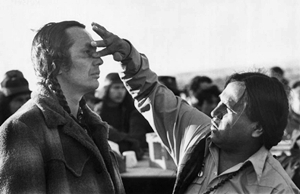
Russell Means, left, gets an application of war paint from Sioux Medicine man Crow Dog in 1973 just prior to a cease fire agreement between federal forces and AIM leaders occupying Wounded Knee. “KYLE, S.D. (AP) – No single individual likely will ever fill Russell Means’ shoes, but his legacy likely will be multiplied many times over by the Native Americans he inspired, his brother said at the Native American activist’s funeral service in Kyle. Means died Monday of throat cancer at the age of 72. On Wednesday, more than 300 people attended the funeral service on the Pine Ridge Indian Reservation.
“He will be replaced by thousands,” said Bill Means, Russell Means’ only surviving brother. “One person is not going to replace him, but through his work, through his family, he will be replaced 1,000 times over.” Those attending the service said Means made them feel proud to be a Native American by encouraging them to take pride in their heritage and challenging them to live it. Means himself never shied away from confrontation. As a young American Indian Movement leader, he spearheaded the 71-day occupation of Wounded Knee, which grabbed the attention of the entire nation.
But Means was never meant to be a warrior, said Chief Leonard Crow Dog, a Lakota medicine man who participated in the Wounded Knee occupation in 1973. Means, he said, was first and foremost a spiritual leader, but the times called for a warrior, and like Crazy Horse, that is what he transformed into. …”
Winona LaDuke (Anishinaabe) who has devoted her life to protecting the lands and life ways of Native communities, wrote about Means:
“In 1972, Oglala Raymond Yellow Thunder was beaten and then stripped naked, paraded in the American Legion in Gordon, Nebraska. He was stuffed in a car trunk, and a few days later died of injuries sustained in his beating. South Dakota and Nebraska were perhaps the most racist states in the country, barring perhaps, Mississippi. But that depends on if you were a Native or a black person. People had to stand up to that. Oglala Lakota elders asked for help and American Indians from the Twin Cities, from urban areas or reservations came. Russell Means came. He was one of many. That was the beginning of the American Indian Movement.
The passing of Oglala Lakota activist Russell Means to the Spirit World marked the end of an era, and hopefully, it marks the beginning of a new one. Means was a leader, and an Ogichidaa, one who stood for the people. He joined with hundreds of other Native people in the occupation of Wounded Knee in 1973, a 71 day occupation, which came to symbolize the renaissance of the dignity of Native people. It was a time when a people said, “This is enough.” The Native occupation of our own lands, was met with the largest military force response of the federal government. (According to Pentagon documents uncovered later, the government deployed 17 armored personnel carriers, 130,000 rounds of M-16 ammunition, 41,000 rounds of M-40 high explosives for grenade launchers as well as helicopters and other aircraft.)
… There are fewer Raymond Yellow Thunders, but there are still Native people being killed for their land in the western hemisphere, particularly on the front lines of hydro-electric dams , mining and oil projects in the Amazon. And, there is still an absolute need for people to be treated with dignity.
Russell Means lived a life proudly as an Oglala man. He lived fully and left us much to be thankful for. We honor him by continuing this work.”–Winona LaDuke (A Hero Moves On)
-
Franciscans Say Voting is a ‘Communal Decision-Making Process’ (Part II)
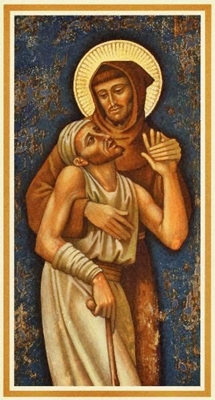 In the middle of this crazy election season, I’ve appreciated the thoughtful leadership of the Franciscans in how to approach difficult decisions.
 The Franciscan Justice, Peace, and Integrity of Creation Directorate is presenting short pieces to help introduce particularly Franciscan and Catholic approaches to the decision-making process. (Click here for the first installment.)
I urge you to read the whole article. Here’s an excerpt from their second installment:
As Franciscans, we see voting as a communal decision-making process that eschews political slogans and mere intellectual abstractions or principles. Instead, it begins with a call to pay close attention to our experience, especially to our relationship with those who are powerless and marginalized. This unique path of discernment goes back to St. Francis of Assisi. Just as St. Francis of Assisi encountered Christ and his love in the embrace of the leper, we as Franciscan-hearted people are invited to embrace the excluded of today and speak for those who are not able to speak for themselves (Proverbs 31:8-9).
Now more than ever, our love for Christ and all the powerless and vulnerable who bear his image impels us to bring their voices to the public square. To do this, it is incumbent upon us to ask critical questions and identify the processes by which so many of our brothers and sisters are being impoverished and excluded. Our desire for integrity and the all-embracing vision of God’s love calls us to transcend the blind spots and biases of any political party with its ideologies.
As we work to this end, we hope that in the silence of our hearts, made more open by compassion, we can behold the beauty of all God’s creation, especially the children who are victims of abortion, the children who live and die in abject poverty, the elderly, the immigrants, the victims of injustice, violence and war, and the homeless, the sick and the unemployed.
Read the rest of Franciscans Are Not ‘Party Animals’ (Part II)
-
Colm O’Gorman: ‘Wilful Blindness Creates Monsters’
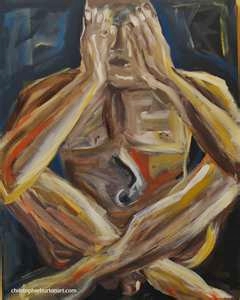 Colm O’Gorman, founder and former director of One in Four, a non-governmental organisation that supports women and men who have experienced sexual abuse, wrote a strong essay in the UK’s The Tablet this week on the Jimmy Savile pedophilia case.
Savile was a popular media personality in the UK for more than 30 years. He was both knighted by the Queen and given a papal knighthood from the Vatican. Savile run and contributed to a number of charities and is estimated to have raised £40 million for charity. After his death a year ago, police began investigating long-standing allegations of child sexual abuse.
The police now describe him as a “predatory sex offender” and are pursuing over 400 separate lines of inquiry based on the testimony of 300 potential victims via fourteen police forces across the UK.
O’Gorman asks why it took so long when everyone knew that Savile was “into little girls.” With powerful people and in powerful institutions it is easy to look the other way when something “unseemly” arises, but people of faith need to keep our fires of righteous anger stoked so we are ready to confront directly those predatory forces that stalk the vulnerable.
Here’s an excerpt from Colm O’Gorman commentary “Silence is Sin”:
“… [P]owerful institutions rarely cast an objectively critical eye inwards. Power rarely subjects itself to honest and open scrutiny, and when it either discovers serious wrongdoing within its own ranks, or indeed is itself guilty of wrongdoing, it often acts to cover up such corruption in an effort to protect its reputation and its authority.
Such wilful blindness creates monsters. The crimes of child abusers … are only possible within a culture of silence and denial. It has often been said that those who sexually abuse children rely upon secrecy, that sexual abuse is possible because it is a secret crime and that its victims are silent and voiceless. Surely, we need to question that view. What the abuse scandals in the Church, and now with Jimmy Savile, reveal is that secrecy is not the enabler of such crimes but rather silence is; the silence of those who shared rumour and gossip but who failed to act to protect desperately vulnerable children and young people.”–Colm O’Gorman, Silence is Sin (The Tablet)
-
Subscribe
Subscribed
Have a WordPress.com account? Log in now.

