-
Bible Wars: Do We Really Know What King Did?

Martin Luther King's bible Blogger Hamden Rice’s 2011 essay Most of You Have No Idea What Martin Luther King Actually Did has become an underground classic that rightly resurfaces around King Day events.
On Monday, President Obama — America’s first Black president — will be sworn in for his second term. He will swear his oath of office on a bible used by President Lincoln and a bible used by Martin Luther King Jr.
Let that sink in.
I like to watch TV and video clips of Obama without the sound. As much as I appreciate his oratory, my experience is that he communicates deeper meanings visually. He sends visual coded messages to signal those watching carefully what’s he sees at the crux of a particular issue, problem, conundrum — what are the essential values he’s holding in tension.
With these two bibles he marries the deepest meaning of America’s democratic struggle. He may be signaling to us that there is a cold civil war raging between the American states that he’s been elected to govern. Like the Republican Lincoln, he is negotiating some very dangerous waters.
He may also be telling us that Martin King’s bible was his power generator. That bible contained the blueprint for African-American freedom from enslavement and fear. Obama knows what that bible is and what it means — even if he’s constrained in how he can act on it.
But King’s bible is our Bible. We can act on it. What did Martin read there that empowered him to do what he actually did?
Hamden Rice writes:
“… I was having this argument with my father about Martin Luther King and how his message was too conservative compared to Malcolm X’s message. My father got really angry at me. It wasn’t that he disliked Malcolm X, but his point was that Malcolm X hadn’t accomplished anything as Dr. King had.
I was kind of sarcastic and asked something like, so what did Martin Luther King accomplish other than giving his “I have a dream speech.”
Before I tell you what my father told me, I want to digress. Because at this point in our amnesiac national existence, my question pretty much reflects the national civic religion view of what Dr. King accomplished. He gave this great speech. Or some people say, “he marched.” I was so angry at Mrs. Clinton during the primaries when she said that Dr. King marched, but it was LBJ who delivered the Civil Rights Act.
At this point, I would like to remind everyone exactly what Martin Luther King did, and it wasn’t that he “marched” or gave a great speech.
My father told me with a sort of cold fury, “Dr. King ended the terror of living in the south. …”
For white Americans, Rice’s summation is the necessary icy plunge needed to shock us out of privileged complacency.
For all Americans Monday’s inaugural events should deliver us a similar icy shock — waking us up to the terrors that U.S. policies –especially foreign policies — are visiting on people today. When we read the Bible–Lincoln’s or King’s–which side are we on? Which side is God on?
Rose Marie Berger, author of Who Killed Donte Manning? (available at store.sojo.net), is a Catholic peace activist and a Sojourners associate editor.
-
Joan Chittister: ‘There Is A Deer In Me’

Deer in the Snow (1911) by Franz Marc “Go light-footed through life. There is a deer in me—made for running, for scampering while the rest of the world around me walks. I am made to find and drink from foreign streams. I am meant to go light-footed through life. So what am I doing in “stability” and “community,” in a lifetime of “Rules” and hierarchy and patriarchy masking as “a woman’s lifestyle”?
But then, on the other hand, how can anyone move freely unless they are rooted in a worldview that is stable and a community that is empowering and a discipline that is strengthening? Disciplined, meaning stretched beyond ourselves to the best of ourselves. Like the well-trained Olympian, like the well-schooled scholar, like the well-formed soul.
It’s easy to bounce through life—going here, trying that, tasting this. What is difficult is trying to figure out what we are supposed to do with what we find, or learn from where we go that will make life even richer. For ourselves, of course. But for the rest of the world, as well.
Don’t be fooled: Deer run, yes, but they never run very far away from the stream at which they drink. The problem with running through life is that it’s possible to outrun our spiritual nourishment. Then we become an empty person in an even emptier place. “The sea is only beautiful,” Patrick Field writes, “if there is a shore.”–Joan Chittister, OSB
From The Art of Life by Joan Chittister (Twenty-Third Publications)
-
Mujeres de la Guerra: Women’s Voices from El Salvador
These are what true women warriors look like. Mujeres de la Guerra, Historias de El Salvador (documentary, book, photography) highlights 28 women leaders in El Salvador telling their stories of participating in the Salvadoran civil war and their continued work for justice and peace today.
Thanks to Bethany Loberg for sending this to me (who continues her work accompanying the justice movement in El Salvador). And to Lyn McCracken and Theodora Simon who are working on this beautiful project holding up women’s stories.
Quotes from some of the women’s interviews:
“My message for all women is that we always have a positive attitude. That we as women, when we want something, we achieve it. And we have to continue fighting, not stay where we are, but figure out how to achieve what we, as women, want. In the world, in our country.” – Reina
“These are real things, these aren’t things from a movie, but things that we have lived. And things that haven’t been easy. Our struggle has been of a lot of sacrifice, of blood, of so many martyrs that have given their lives in this history. We will construct our future together. The problems that we face in our country aren’t just here; the crisis is on the global level. And everywhere, even in the United States, there are people that are organized and fighting against injustice.” – Yolanda
-
Bill McKibben: Climate Change Won’t Wait
 I’ve been pondering climate change issues for awhile: praying, educating folks on what’s happening, shoring up my spiritual foundations by reading things like Hiebert’s The Yawhist’s Lanscape: Nature and Religion in Early Israel, strategizing, and just doing some serious thinking.
On the one hand, “the earth is the Lord’s and the fullness thereof” (Psalm 24:1). I trust completely in the abiding love of God here on earth and in the life to come. What happens is what happens when it comes to breaking God’s fundamental earth covenant and the cycles of human life.
On the other hand, the role of the prophets is to continually make plain to the people where they have broken covenant with God, what they need to do to turn around, and what is promised them when they do.
When it comes to addressing global climate change, both hands are in motion. I need to act with all risk and passion of the prophets and all the joyful confidence of one who strives to walk humbly with God.
On February 17, 2013, God’s people are called again to carry a message to President Obama: Take meaningful action to reverse climate change now.
Below is an excerpt from Bill McKibben’s most recent oped in the LA TImes: Climate Change Won’t Wait:
… With climate change, unless we act fairly soon in response to physics’ timetable, it will be too late.
It’s not at all clear that President Obama understands this.
That’s why his administration is sometimes peeved when they don’t get the credit they think they deserve for tackling the issue in his first term in office. The measure they point to most often is the increase in average mileage for automobiles, which will slowly go into effect over the next decade.
That’s precisely the kind of gradual transformation that people — and politicians — like. But physics isn’t impressed. If we’re to slow the pace of climate change we need to cut emissions globally at a sensational rate, by something like 5% a year.
It’s not Obama’s fault that that’s not happening. He can’t force it to happen, especially with Congress so deeply in debt to the fossil fuel industry. But he should at least be doing absolutely everything he can on his own authority. That might include new Environmental Protection Agency regulations, for example. And he could refuse to grant the permit for the building of the Keystone XL tar sands pipeline. …
…The president must be pressed to do all he can — and more. But there’s another possibility we need to consider: Perhaps he’s simply not up to this task, and we’re going to have to do it for him, as best we can.
Those of us in the growing grass-roots climate movement are moving as fast and hard as we know how (though not, I fear, as fast as physics demands). Thousands of us will descend on Washington on Presidents Day weekend for the largest environmental demonstration in years. And young people from 190 nations will gather in Istanbul, Turkey, in June in an effort to shame the United Nations into action.
We also need you. Maybe if we move fast enough, even this all-too-patient president will get caught up in the draft. But we’re not waiting for him. We can’t.
-
Sane Gun Laws Are a Pro-Life Issue
 Are U.S. Catholics taking the lead in fighting the epidemic of gun violence in our country?
 The editors at National Catholic Reporter have a good column on why pro-life Catholics should be at the forefront of reinstating the assault weapons ban and universal background checks. And these two legislative goals are just the highly effective, legislatively low-hanging fruit.
Here’s an excerpt from Catholics Stand For Peacemaking Wanting, Some Say:
Activists and pastors who work with street violence or teach peacemaking and nonviolence fear the answer to that question is yes. They say the best response to the tragedy of Sandy Hook Elementary School in Newtown, Conn., where on Dec. 14 Adam Lanza, 20, shot and killed 20 first-graders, six teachers, his mother and himself, is a re-commitment to Gospel nonviolence and a grassroots-up movement to change our culture.
“Pro-life Christians who are a major political force in this country should be leading” a movement for saner gun control laws, says John Gehring, Catholic program director for the advocacy group Faith in Public Life.
“If the sanctity of human life in the womb galvanizes evangelical Christians and Catholics to march on Washington, create sophisticated lobbying campaigns and hold members of Congress accountable, there is no excuse for pro-life timidity on this issue,” Gehring wrote in a commentary about gun violence and the pro-life movement on his organization’s website.
“Catholic bishops, who will help mobilize many thousands of pro-life activists … for the annual March for Life in Washington, could also put more lobbying muscle behind gun control efforts,” he wrote.
If the bishops want to be outspoken on gun violence, they would seemingly have support from the pews. A sizeable majority of Catholics, 62 percent, favor stricter gun control laws, according to an August poll conducted by Public Religion Research Institute in partnership with Religion News Service. Fewer than half of white evangelical Protestants, 35 percent, and white mainline Protestants favor stricter gun control laws, the survey found.
-
CITI’s David Deal: This is What Leadership Looks Like
David Deal is the founder and CEO of Community IT Innovators. CITI started in the basement of a house across the alley from me. They’ve been partners and collaborators with Sojourners for many years as Sojourners’ technological needs grew and expanded. As a Mennonite and young tech entrepreneur, David provides a wonderful example of innovative ethical small business leadership. Recently he gave a 14-minute presentation at a D.C.-based TEDx Talk event on servant leadership. Take a few minutes to watch it:
Where do you see servant leadership practiced in organizational structures around you?
What qualities are key to its success?
What elements make a person a servant leader?
Can a business or community organization model servant leadership for the larger community of clients or constituencies?CITI serves people and organizations working for social justice by enabling them to use technology effectively. David has designed CITI as a mission-driven organization that is also a great place to work and a model for sustainable business practices. He also serves on the boards of the Sustainable Business Network of Washington (SBNOW), UrbanEd, Eastern Mennonite University’s Washington Community Scholars Center, Carlos Rosario Public Charter School, and Byte Back. These organizations share the goal of building stronger communities by providing opportunities for service and learning.
Check out these books:
Journey to the East by Herman Hesse
Servant Leadership by Robert K. Greenleaf
Servant Leadership Models for Your Parish by Dan Ebener -
A Christmas Card for You — Merry Christmas!
In lieu of Christmas cards this year, I’m sending you this video. This is my niece. She’s 5. She just started kindergarten this year at St. Thomas More school. I hope her message brings Light and Joy to your hearts — so much so that you set afire all those you meet.
http://www.facebook.com/v/4132849600612
Enjoy the Twelve Days of Christmas with good friends, good cheer, and sharing and receiving among the poor and those in need. Never be afraid to “go tell it on the mountain!”
-
Abbot Philip: ‘No Monastery Dies From Poverty, but from Riches’
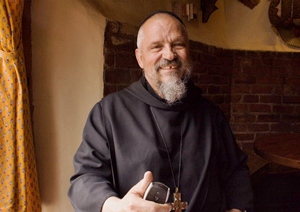 “Brother Christian recently gave me an article on the decline of Buddhism in Thailand as that country grows richer. This is a favorite theme of mine concerning monasticism in the West. It is clear from history that practically no monastery dies from poverty but quite a few have died from riches. This is also a wonderful Christmas theme, because Christ became poor so that we could become rich—on the spiritual level. Christ, who is God, becomes human and takes on our own nature. This is true poverty. …
Why would anyone want to become a monk today? The only reason is to seek God. Seeking God can be done in various ways. One does not need to be a monk to seek God. On the other hand, the monastic life, at least ideally, is established to help the monk focus all of his energy on seeking God.We monks don’t always live that out, but it is what we seek in our ideal world. It does not cut us off from the world in any bad way but it helps us resists being involved in the world in the ways that do not help the inner life. We don’t have to be anxious about anything. This frees our energy up so that we can use it to seek God. Perhaps at times a monk’s energy goes elsewhere, but when the life is orderly, that very order brings back the focus of life to seeking God.
Christ came into the world to save us. We are able to dedicate our lives to following Him, no matter what road we take. We monks want to follow Him in a somewhat radical manner, focusing our daily life and energy on Him. May this also be your gift! Wherever we are, we can seek the Lord and focus our energies on following Him.”–Abbot Philip, Christ in the Desert monastery
-
St. John Chrysostom: ‘For this day the ancient slavery is ended’
 “Come, then, let us observe the Feast. Truly wondrous is the whole chronicle of the Nativity. For this day the ancient slavery is ended, the devil confounded, the demons take to flight, the power of death is broken, paradise is unlocked, the curse is taken away, sin is removed from us, error driven out, truth has been brought back, the speech of kindliness diffused, and spreads on every side, a heavenly way of life has been ¡in planted on the earth, angels communicate with men without fear, and men now hold speech with angels.”–St. John Chrysostom, The Nativity Sermon (385 AD)
 -
Joan Chittister: ‘Jesus has been here before us’

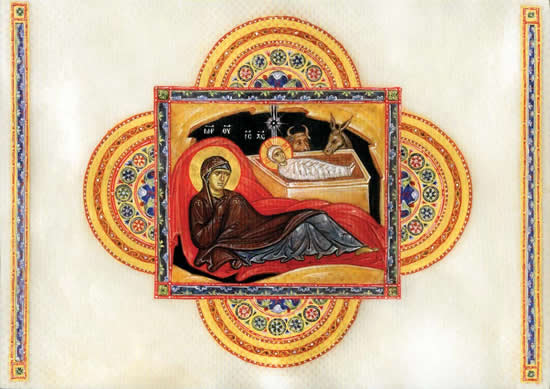
Armenian artist Ermone Zabel Martaian's "The Nativity" “There is a child in each of us waiting to be born again. It is to those looking for life that the figure of the Christ, a child, beckons. Christmas is not for children. It is for those who refuse to give up and grow old, for those to whom life comes newly and with purpose each and every day, for those who can let yesterday go so that life can be full of new possibility always, for those who are agitated with newness whatever their age. Life is for the living, for those in whom Christmas is a feast without finish, a celebration of the constancy of change, a call to begin once more the journey to human joy and holy meaning.
Let the soldiers stomp through life. Let the cold winds blow. Let the birth points of all our lives be drowned in obscurity. Let the days seem mundane and fruitless. The crib in Bethlehem justifies them all. Jesus has been here before us. Bring on the days of our lives. We have a God who has already walked them and found them holy making.”–Joan Chittister, OSB
–from In Search of Belief by Joan Chittister (Liguori)
-
Subscribe
Subscribed
Have a WordPress.com account? Log in now.

