-
Catholics Discuss Ordination of Women: Do I Call Her ‘Father’?
 In December, the National Catholic Reporter wrote an editorial calling for discussion on women’s ordination in the Catholic Church. (The Vatican has forbidden this discussion to be had by anyone in the institutional church or on any church-owned properties. This means no priest can talk about it and no discussion can be had in Catholic schools, universities, or church basements.)
As any teen counselor can tell you, the best way to ensure a conversation spreads like wildfire is to drive it underground.
The National Catholic Reporter (part of the Catholic faithful, not a Vatican-affiliated institution) had such a huge response from readers to their December editorial that NCR followed it with a series of articles on the history of church authority, roles of women, and theology of ordination. (The links to the articles are below.)
I extend an invitation to non-Catholics Christians (pardon the generalization) to read these articles, as well as to Catholics. Much of the content focuses on our common Christian heritage (eg before the Reformation).
Protestants, evangelicals, and Anabaptist tend to cede history before the 1500s to Catholics. Please, don’t do that.
Contemporary Catholics need our Protestant kinfolk to fully claim the early church and the first 1500 years of our common history. (And I dare say, with the rise of “complementarianism,” not a few Protestants need to reclaim their history of women in leadership.)
Here is the NCR series:
“In April 1976 the Pontifical Biblical Commission concluded unanimously: “It does not seem that the New Testament by itself alone will permit us to settle in a clear way and once and for all the problem of the possible accession of women to the presbyterate.” In further deliberation, the commission voted 12-5 in favor of the view that Scripture alone does not exclude the ordination of women, and 12-5 in favor of the view that the church could ordain women to the priesthood without going against Christ’s original intentions.”–Editorial: Ordination of women would correct an injustice (12/3/12)
“The account in Acts of the Apostles 6:1-6 of the apostles choosing seven men to take care of table service is usually considered the origin of the office of deacon, yet no one in the story is called diakonos and the apostles appoint them for the diakonia of the table so that the apostles can devote themselves to the diakonos of prayer and the word. All perform diakonos of different kinds.”–Early women leaders: from heads of house churches to presbyters (NCR, 1/18/13)
“The Council of Paris in 829 made it extremely clear that it was the bishops who were allowing women to minister at the altar. Women certainly did distribute Communion in the 10th, 11th and perhaps the 12th centuries. Texts for these services exist in two manuscripts of this period. All of this changed over roughly a hundred-year period between the end of the 11th century and the beginning of the 13th. For many different cultural reasons, women were gradually excluded from ordination. First, many roles in the church ceased to be considered as ordained — most importantly, abbots and abbesses. Powerful women in religious orders went from being ordained to laity. Second, canon lawyers and then theologians began to debate whether women could be ordained to the priesthood or diaconate.”–The meaning of ordination and how women were gradually excluded by Gary Macy (NCR, 1/16/12)
“The exercise of doctrinal authority throughout much of the first millennium presupposed several basic convictions. First, the doctrine that the bishops taught pertained to public revelation. There was no sense that bishops received some secret knowledge available only to them. Indeed such a view, known as Gnosticism, had been roundly condemned. Second, what the bishops taught was not foreign to the faith of the whole church. In apostolic service to their communities, the bishops received, verified and proclaimed the apostolic faith that all the baptized in their churches prayed and enacted. The apostolic faith consciousness of the whole people of God would eventually be referred to as the sensus fidelium.”–Richard Gaillardetz, Putting the church’s shifts in spheres of authority in historical perspective (NCR, 2/4/13)
-
How I’m Getting Facebook to Pay Nearly $20M to Protect the Internet from Facebook

In February, I got an email with the subject line: Re: LEGAL NOTICE OF SETTLEMENT OF CLASS ACTION. I assumed it was spam. But nope, it’s legit. Facebook users filed a lawsuit against FB charging that the “sponsored stories/ads” were a violation of privacy. Judge Seeborg agreed. The settlement is for $20 million! (That’s a lot of “likes.”)
Okay. Victory won. But–and it’s a big one–users who file a claim can only receive a maximum of $10 from Facebook. And, $10 (or less, depending on the number of claimants, and after court costs and service payments) really isn’t worth the hassle.
Until you read the fine print, which states, and I quote: “If the number of claims made renders it economically infeasible to pay any money to Authorized Claimants, the entire Net Settlement Fund will be distributed to the not-for-profit organizations identified below.”
Those non-profits include: Center for Democracy and Technology, Electronic Frontier Foundation, Campaign for Commercial-Free Childhood, Consumers Federation of America, Consumer Privacy Rights Fund, ConnectSafely.org, WiredSafety.org, and others. Wow!
Here are 7 steps for how I’m getting Facebook to pay nearly $20 million to protect the Internet from Facebook. And you can too. It takes less than 5 minutes.
1. Search your inbox for the subject line: Re: LEGAL NOTICE OF SETTLEMENT OF CLASS ACTION (or by sender: legalnotice ).
2. Scroll down to the bottom of the message and find your nine digit “Class Member Number. Write it down or copy it for later use.
3. You’ll also need your Facebook user name. It’s the last portion of your FB url. My FB url is http://www.facebook.com/rose.berger.90 so my user name is: rose.berger.90. Write it down or copy it for later use.
4. Next, fill out your claim form by 11:59 p.m. Pacific on May 2, 2013. Click here: https://secure.gcginc.com/fbk/claim/default.aspx
5. Enter your name, address, contact email (phone number is optional; contact info is for the purposes of the case only). On the next page enter the email address associated with your FB account, your user name (from number 3 above) and your claim number (from number 2 above).
6. Almost done. The next page asks how you want to be paid–electronically by ACH or by paper check. Scroll down to the bottom and make your choice. (I marked paper check — to make the process as unlikely to happen as possible.)
7. On the last page, scroll down and check the box that says you’ve read and understand what you are doing (so read it and understand what you are doing). Hitting next will serve as your electronic signature.
Voila! A window will pop up at the end with your claim number, control number, and the date and time you submitted it. I just copied this and sent it to myself in an email.
To get $20 million donated to the Internet’s good guys, we need lots and lots of people to fill out their claim forms. Basically, we need everybody who has a claim form to fill it out. Taking 5 minutes to do this will help keep our kids safe on the internet and keep our digital world safe, democratic, and fun! Are you ready? Go to it gladiators of goodness!
(Seriously, how often do you get to donate $20,000,000?)
Rose Marie Berger, author of Who Killed Donte Manning, lives in a really old house in Washington, D.C.
Learn more
Facebook could pay users in class-action Sponsored Stories settlementFacebook Inc (FB) Sent ‘Legal Notice’ To Users Over Sponsored Stories
-
TransCanada: ‘Sorry for the Disruption. We’ll be Playing Gentle Music and Getting Bolt Cutters’
In the category of “You Can’t Make This Stuff Up,” anti-Keystone XL hero Ramsey Sprague chained himself to the sound equipment at a pipeline industry conference in Texas this week. He interrupted the speech of TransCanada’s manager of quality and compliance, Tom Hamilton.Sprague used his bully pulpit to explain the colossal dangers represented by opening up the tar sands and transporting nontraditional bitumen crude to refineries and the world market. When security guards asked him for the keys to his chain lock, he said he didn’t have them.
This situation prompted the exchange that should go down in history (and thanks, once again, to Democracy Now! for covering it):
Official: “Ladies and gentlemen, I’d just like to say I apologize for this disruption. We’ll be playing some gentle music and be getting some bolt cutters, and we will resume as soon as we can. Unfortunately, we can’t remove the speaker without shutting down the whole system. But we will be resuming as soon as possible. Thank you so much, and again we apologize for this.”
Ramsey Sprague: “I really apologize that TransCanada is a terrible actor stealing land from my friends in order to facilitate a toxic tar sands pipeline that is full of holes!”
Come to the National Mall on Feb. 17 to rally for presidential leadership on climate change and against the Keystone XL pipeline.
Read more about Ramsey’s work here.
-
Jan. 31: 65th Anniversary of Gandhi’s Death
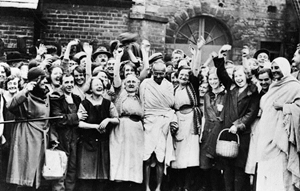
Gandhi with textile workers in England, 1931 Today marks the 65th anniversary of the death of Mohandas K. Gandhi.
There is still so much we don’t know about the man and the political web that targeted him for assassination.
That great soul, however, and the soul-power he released on behalf of truth with justice, continues to inspire and provoke our conscience.
If you haven’t read Jim Douglass’ book on Gandhi, I highly recommend it.
Publishers Weekly Review of Gandhi and the Unspeakable: His Final Experiment with Truth by James W. Douglass
Fifteen years ago, Douglass began investigating the assassinations of John and Robert Kennedy, Martin Luther King Jr., and Malcolm X. His award-winning JFK and the Unspeakable (2008) is now recommended reading for those seriously investigating political assassinations. While researching Kennedy, Douglass learned from Arun Gandhi, grandson of the Indian liberation leader, that his grandfather had been killed by a conspiracy involving powerful nationalist forces within the Indian government—not a lone gunman. This led to Douglass’s rigorously investigating thousands of documents on Gandhi’s 1948 murder. He now provides readers with a slim, elegant volume containing explosive insight into who conspired to assassinate the father of modern nonviolence and why. “Gandhi’s murder, followed by the repression of its truth,” writes Douglass, “forms a paradigm of killing and deceitful cover-up that U.S. citizens would soon have to confront in our own government.” No other contemporary writer is exposing the mechanics of assassination as methodically and bravely as Douglass. But because he is a Catholic independent scholar and activist most well-known for his writings on nonviolence and suffering, this book is more than a fresh look at historical circumstances: it’s spiritual spelunking into the depravity of unchecked political power.
-
Shelley Douglass: ‘The Gospel is Dynamite’
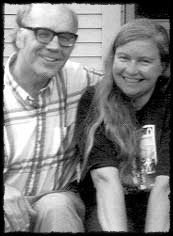 Shelley and her husband author Jim Douglass are elders in the movement for justice and peace. This year they mark 20 years in Birmingham offering radical hospitality in the Catholic Worker tradition.
Below is an excerpt from the seasonal newsletter by Shelley from her location at Mary’s House Catholic Worker in Birmingham, Alabama.
She reflects on a recent Vatican program to improve the Catholic image. It’s known as the “new evangelization.” It’s purpose is to “re-propose the Gospel to those who have experienced a crisis of faith.”
“For months now I’ve been reading articles about the new evangelization. Usually they are proposing wasy to spread the message–through social media, or better texts for theology in Catholic Schools, or more careful adherence to doctrinal purity, or better art and music at liturgies, or any number of ways to make Catholicism more attractive and better understood. Now I love beautiful music, and I’m all for clarity (and brevity) in teaching. I have nothing against twittering and tweeting, although I don’t know how myself. It does make me wonder though: how on earth did Jesus manage to spread his message without all our modern advances in communication? Or how did Dorothy Day and the early Catholic Worker community evangelize before the internet?
Peter Maurin used to say that the message of the Gospel is dynamite, cloaked and hidden by theological language. For him, a new evangelization would be to uncover the social teaching of the church, and put it into practice. For Dorothy and for Peter, evangelization was to begin to live the good news themselves, by practicing the works of mercy in daily life. For Jesus, the good news was simple: the Kingdom of God is at hand! Change your lives, and live as though it were true!”–Shelley Douglass, Mary’s House Catholic Worker (Magnificat, January 2013)
P.S. I’ll be leading the Mary’s House Lenten retreat in Birmingham, Alabama, March 15-17, 2013. Come join us! To find out more information, email Shelley Douglass (shelleymdouglass at gmail dot com).
-
Video: ‘Developing Tar Sands Means Losing Control of the Climate’
“If we fully develop the tar sands, we will certainly lose control of the climate. We will get to a point where we can not walk back from the cliff,” says climate scientist Dr. John Abraham. The Keystone XL pipeline is the lynch pin to developing the tar sands in Alberta.
As many of you know, I’ve been paying attention to the Keystone pipeline development since 2011 when it was under review by the State Department. I joined a group of religious leaders to deliver thousands of petitions to Dr. Kerri-Ann Jones, Assistant Secretary of State for Oceans and International Environmental and Scientific Affairs, asking her to to stop the pipeline. I said to her, “If this decision about the pipeline was made purely based on the climate science, we wouldn’t be here having this discussion.” She didn’t disagree. The exploitation of tar sands will significantly worsen the climate.
Now, new scientific data shows that developing the tar sands (and the pipeline to carry it) is worse than previously known. The video above shows climate scientists countering the notion that the climate impacts of the Keystone XL pipeline are small compared to total U.S. global greenhouse gas emissions. Nathan Lemphers, a Senior Policy Analyst with the Pembina Institute, details how the Keystone XL is a critical ingredient to significant expansion of tar sands. He dispels the myth being promoted by the tar sands oil industry that tar sands development is inevitable with our without Keystone XL. That’s not true. All other routes are similarly being blocked.
Lorne Stockman, Research Director for Oil Change International, announced new research that shows that the emissions from tar sands oil are worse than originally believed. This is because the climate emissions from a byproduct of tar sands, petroleum coke which is made in the refinery process and is used in coal-fired power plants, have not been previously considered. “If Keystone is approved,” says Dr. Danny Harvey, professor at the University of Toronto, “we’re locking in several more decades of fossil fuels and higher levels of carbon dioxide and global warming.”
“Climate change is the story related to Keystone. The drought and heat wave in Texas cost Texans $5.2 billion. Hurricane Sandy cost us $70 billion,” says Dr. John Abraham, climate scientist at the University of St. Thomas. “Some people say it’s too expensive to develop clean energy. I say it’s too expensive not to.”
After the largest climate protests in U.S. history were held in Washington, D.C., in 2011, the fight against the Keystone XL went back to the regions along the pipeline route.
Hundreds have been arrested in their attempts to block the bulldozers. There are farmers engaged in numerous local law suits against TransCanada’s pressure on local governments to use “imminent domain” to force them to give up their property to the corporation. There are First Nations and American Indian communities in treaty battles to keep TransCanada’s massive machinery off their lands.
There are Buddhist nuns walking the pipeline route in prayers for the earth and her people. A 92-year-old Lakota grandmother stood in front and blocked the giant rigs hauling pipe. Twenty-somethings are launching “tree sits” in the construction path. A Baptist church in Nacogdoches, Texas, near the pipeline route, has launched a new young adult and youth ministry specifically for and with Keystone XL activists.
On Feb. 17, the movement will come back to Washington, D.C.
You come too. We need you. Now is the time for all good Americans to come to the aid of their country. And for all good Christians to come to the aid of our world’s most vulnerable.
-
Joan Chittister: ‘Hospitality Is A Lifeline’
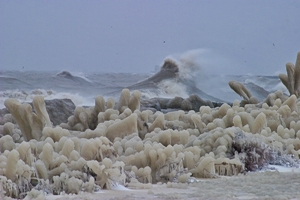
Lake Erie by Hank Plumley “To live the monastic life in a monastery on the edges of a windswept Lake Erie makes something very clear: hospitality is not a matter of gentility or niceness. Here, as it was in biblical desert lands, hospitality is often a factor in physical survival. Too often, if it weren’t for the spirit of hospitality in this area, people would freeze to death in stranded cars or in city parks or in unheated homes.
It is an important lesson for people who live a monastic spirituality. It teaches us that hospitality is a lifeline that is part of the fiber of life. People need physical hospitality, spiritual hospitality, and psychological hospitality always. That’s why hospitality is a basic theme in The Rule of Benedict. That’s why there’s always someone in charge of answering the door at the monastery. Monastic hospitality dictates that there must always be someone there to care for anyone and everyone in need. The cold of February reminds us to open our hearts always. Someone is waiting to get in.
A Danish proverb reads: “If there is room in the heart, there is room in the house.” Who is there in life that you seem able to bear in unlimited quantities? Who is there that you have little room for at all? Try to remember that coldness of heart is always a call to personal growth.”–Joan Chittister, OSB
From A Monastery Almanac by Joan Chittister
-
Guns and Greenhouse Gases: The Lord said ‘Tell the People to Get Going!’
 “Then the LORD said to Moses, “Why are you crying out to me? Tell the people to get moving!”–Exodus 14:15
Sometimes you spend years preparing for change, then when it arrives you are too tired to get moving.
I’m trying not to let this happen to me.
For inexplicable reasons, the horrific shootings at Newtown and Superstorm Sandy have shifted something in the American soul. After all these years of advocating for action, there is finally forward movement on climate change and sane gun regulations. Though I for one am weary and tired, I want to encourage you (and myself) to do what we can to meet this moment.
1. On greenhouse gases and climate change–If you’ve never spoken out about climate change, do it now. Write to your Congressional representatives and ecclesial leaders asking them for strong, clear leadership to reverse of global warming and mitigate its associated social disruptions. President Obama raised it in his inaugural address. There seems to be movement in Washington to address it–finally. While in most cases the best solutions to a problem are those closest to the ground, this is not the case with climate change and climate disruption. It will only be adequately addressed with federal leadership. So we’ve got to push. Tell Barack Obama that you support him to lead in the fight against climate change, beginning with the Keystone XL tar sands pipeline.
2. On sane gun laws–After the shootings at Sandy Hook, Americans rose up to demand two things: universal background checks and a ban on assault weapons. President Obama’s 23 planned executive actions on weaponry is moving us forward on universal background checks.
The second piece, a ban on assault weapons, has now been introduced to Congress by Sen. Dianne Feinstein. I’ve read the whole bill. It’s excellent legislation. It deals directly with many of the loopholes in the previous assault weapons ban that sundowned in 2004. Now it is our job to build support for it. Write to your Congressional representatives (here’s the link to the Brady Campaign support letter) and ecclesial leaders asking them for strong, clear, unequivocal support for Sen. Feinstein’s “Assault Weapons Ban of 2013.”
As we move toward Ash Wednesday and Lent, I hope that part of our commitment can be to take meaningful action in these two areas at least … remembering when the Lord said to Moses “Stop whining to me! Tell the people to get moving!”
Learn More:
Watch the video of the climate change portion of President Obama’s inaugural address.
Learn more about the movement to address global warming with the Forward on Climate campaign.
President Obama Signs 23 Planned Executive Actions on Guns
Summary of the Assault Weapons Ban of 2013
Congressional text of the Assault Weapons Ban of 2013
The Brady Campaign Support Letter for Sen. Feinstein’s Legislation
-
Feb. 17 (It’s a Sunday. It’s a Holiday. It’s the Largest Climate Change Event in U.S. History.)
In the fall of 2011, during two weeks of public demonstrations at the White House in Washington, D.C., 1,252 Americans ended up in jail, the largest and most sustained protest of its kind in decades. They had one purpose: that President Obama reject the Keystone XL pipeline. (See #NOKXL)
Why? Not because they hate oil companies. Not because they don’t want people to have good construction jobs. For one reason only: It will push us off the climate change cliff, from which there is no manageable or inexpensive way back.
During 2012 the fight to stop the Keystone XL went local. Everywhere along its route in both Canada and the U.S., citizens have been praying, blockading, chaining themselves to earth-moving equipment, sitting in trees, fasting. In other words, doing everything they can think of along the route to stop the pipeline. (See Tar Sands Blockade.)
Now it’s 2013. Hurricane Sandy provided a tipping point in the American conscience on just how disruptive climate change is going to be. It’s not just a climate disruption; it’s a climate eruption.
Now is the time to come back to Washington, D.C.
There will be at least 15,000 people on the National Mall on February 17, 2013, to demand that the President take clear and effective leadership to address climate change and start by nixing the Keystone pipeline project. If we take him at his word from his second inaugural address, then he’s willing … if there is enough public pressure.
I invite you to turn that 15,000 into 15,000 + 1. Find out more.
[If you still have questions about whether the Keystone XL pipeline is a worthy target or if opening up bitumen tar reserves in Alberta is any different than any other kind of oil drilling, the read the most recent article from Scientific American “How Much Will Tar Sands Oil Add to Global Warming?”. It’ll set you straight and answer all your questions in detail.]
-
Osagyefo Sekou: Martin King, Science Fiction, and the Future of America
 Rev. Osagyefo Sekou is a fire-brand Pentecostal prophet. His recent essay A Mighty Stream traces Martin King’s life and developing perspective on radical economics within the Christian tradition.
I first met Sekou through the Word and World program. Additionally, he was the founding national coordinator for Clergy and Laity Concerned About Iraq. In response to Hurricane Katrina, Sekou moved to New Orleans for six months and founded the Interfaith Worker Justice Center for New Orleans. He’s the author of Gods, Gays, and Guns: Essays on Religion and Democracy (Campbell and Cannon Press, 2011) and the forthcoming Riot Music: British Hip Hop, Race, and the Politics of Meaning (Hamilton Books, 2012), which explores the London riots.
Sekou’s a third-generation Pentecostal minister and the special assistant to the Bishop of New York Southeastern District of the Church of God in Christ. As we continue to unpack and learn from the tremendous legacy Dr. King left us, here is another perspective in the opening section of Sekou’s essay A Mighty Stream:
“Darling I miss you so much. In fact, much too much for my own good. I never realized that you were such an intimate part of my life,” writes a young graduate student, Martin Luther King Jr. to his love interest, Coretta Scott. They are separated for a few months because King had gone home to Atlanta for the summer after his first year as a PhD student at Boston University School of Theology. King opens the letter by sharing how much he missed her. Honing the oratory that would go on to seize the consciousness of a nation, King laid it on thick. “My life without you is like a year without a spring time, which comes to give illumination and heat to the atmosphere, which has been saturated by the dark cold breeze of winter.”
Turning to “something more intellectual,” King indicated that he finished reading Bellamy’s “fascinating” book. In April 1952, Scott sent King a copy of Edward Bellamy’s socialist novel, Looking Backward 2000-1887. She inscribes the gift with a note expressing her interest in his reaction to “Bellamy’s prediction about our society.” The utopian science fiction novel took place in Boston, where both King and Scott were graduate students. Written in 1888 and set in the year 2000, the novel’s protagonist Julian West awoke from a 130-year slumber to realize that the United States has been transformed into a socialist society. West offered a stunning criticism of the faith practices of the 19th century:
“Moreover, it must not be forgotten that the 19th century was in name Christian, and the fact that the entire industrial and commercial frame of society was the embodiment of the anti-Christian spirit must’ve had some weight, though I admit it was strangely little, with the nominal followers of Jesus Christ.”
Read Sekou’s whole essay here.
and Guns, capitalism, Christian, Church of God in Christ, Clergy and Laity Concerned About Iraq, Coretta Scott, economics, Edward Bellamy, gays, Gods, Hurricane Katrina, Jesus, Julian West, Looking Backward 2000-1887., Martin Luther King, New Orleans, Osagyefo Sekou, Pentecostal, Riot Music, science fiction

-
Subscribe
Subscribed
Have a WordPress.com account? Log in now.

