“Narrator: And all this time I thought the world was round. The world is not round. It has edges we can fall from and faces staring in entirely different directions. And I thought the world was huge, but it is not. It’s in our hands. We can hold it, change it, turn it, shake it. We can solve it, but not by share, luck, or chance. We must be taught the way.
Ananya Roy: Each year, I teach a large class on global poverty at the University of California Berkeley. As is befitting a great public university the students represent a diversity of social class, advantage, and privilege. Some are first generation students. Some are the sons and daughters of working class of global California, others comes from the fortresses of wealth. Yet others belong to that newly precarious social group, the American middle class. …”
The #GlobalPOV Project combines critical social theory, improv art, and digital media to explore innovative ways of thinking about poverty, inequality, and undertaking poverty action.
[Note: Today Pope Francis is elevating a bunch of new cardinals. Here’s a bit of the background.–Rose]
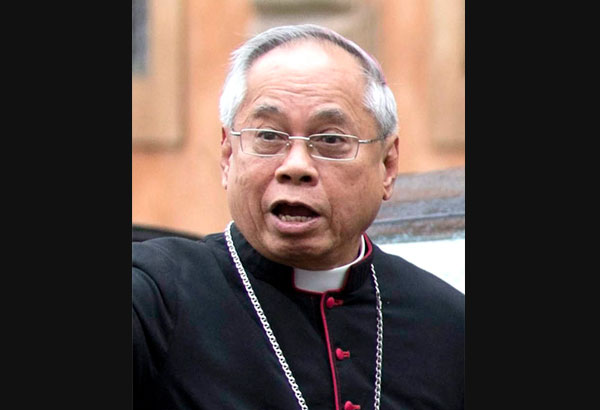
IN MINDANAO, Philippines, a cheer went up: Mayron tayong cardinal! (“We have a cardinal!”) In January, Orlando B. Quevedo, archbishop of Cotabato, was one of 19 new cardinals named by Pope Francis.
Cardinal Quevedo rose from newsboy to archbishop. He’s renowned for his interreligious work and cofounding a Catholic-Muslim peace community in the southern Philippines where there is violent ethnic conflict. Quevedo is a leader in the Federation of Asian Bishops’ Conferences, a body representing more than 100 million Catholics that has courageously pushed forward the values of Vatican II amid traditionalist backlash.
During a papal conclave, when a new pope is chosen, much of the world, Catholic and otherwise, pays close attention to the news ticker from the Vatican. For the selection of new cardinals, not so much. But with Francis, everything bears watching.
Historically, cardinals were called “the princes of the church” because of the power they wielded. Functionally, they serve in the College of Cardinals, which meets with the pope to deal with questions of major importance and elects new popes. Sadly, scoring a red hat has been for some the acme of clerical ambition. The season of cardinal picking can devolve into extravagant indulgence.
But, there’s a new sheriff in town: Pope Francis wants deputies, not darlings.
“The cardinalship does not imply promotion,” the pope wrote in a personal letter to his fresh picks; “it is neither an honor nor a decoration; it is simply a service that requires you to broaden your gaze and open your hearts.”
Until now, the influential college was dominated by the Northern minority, from Europe and North America; only about 25 percent were from the global South. This made sense in 1910, when France and Italy had the highest population of Catholics. Now, Brazil and Mexico top the list—and Catholicism’s growing center is in sub-Saharan Africa, particularly Nigeria and the Democratic Republic of Congo. If not for the church’s historical connection to Rome, the Vatican might relocate to Rio de Janeiro or Lagos!
Ten of the 19 cardinals Francis chose are from the majority world—including three from the poorest countries: Ivory Coast, Burkina Faso, and Haiti. Like Quevedo, they are pastors rather than administrators, “shepherds who have the smell of their sheep.” Francis is putting the poorest at the center, steering the way toward a Southern majority. … Read more.
“Keep in mind these two Catholic principles: #1.) Everyone does everything for mixed motives. The right thing gets done for mixed reasons; just as the wrong thing can get done with good intentions. #2.) Social justice is a this-worldly virtue. Thus, all reform is incremental; more social justice will be required tomorrow.”–Bill Droer, Initiatives (March 2014) from the National Center for the Laity
Abbot Philip lives at Christ in the Desert Monastery in New Mexico (left), but has been on retreat in Hawaii for the last few months:
“As far as I can tell, this will be my last Notebook from Hawaii this year. I am ready to leave later today and return to the mainland. It has been a wonderful time of renewal and restoration for me. One of the aspects of my life here and at Christ in the Desert is to live in incredible beauty.
I remember almost 35 years ago when a Trappist abbot commented to me that it is nearly impossible to lead a deep spiritual life in an ugly place. Monasteries that are founded in ugly places have to change them into beautiful places or they have to relocate. Part of our spiritual life has to include some awareness of our surroundings and an awareness of how those surroundings affect us. This is another aspect of living the incarnation.
Prof. Michelle Gonzalez wrote an awesome article for the January 2014 issue of Sojourners (“if you don’t get it, you don’t get it”).
The title is Breaking the Habits of Machismo. When Pope Francis said we need a new theology of women, I asked Michelle to write an article in response.
We followed up yesterday with Sojourners’ first 50-minute Google Hangout. I moderated and Jim Wallis and Michelle Gonzalez led the discussion. We had about 70 people join us for the live portion and lots more are watching the video. Check it out.
PS. If you are looking for adult Sunday school material, then show this video and lead a discussion about it.
“Melt in your mouth” Pope Francis chocolate replica for Valentine’s Day. OSSERVATORE ROMANO Frank Bruni’s A Pope You Can Eat is a humorous and pointed op-ed on Il Papa Francesco. This is what “big tent” Catholicism looks like.
“THE pope, a porn star and a parrot walk into a bar.
Well, almost. Their point of intersection just a week and a half ago was actually St. Peter’s Square, and “porn star” stretches things: The performer in question was reportedly a former male stripper who had graduated to racy movies and, this being Italy, was once head of his town council. Sounds like prime minister material to me. A chip off the old Silvio.
He brought the bird, named Amore, to meet the pope, meaning Francis, who was taking one of his routine spins among the flock in the popemobile. Amore caught Francis’ eye, perched briefly on one of his fingers and squawked what the crowd was chanting: “Papa!” Those syllables, I’d bet, were a big improvement over other utterances Amore has learned to mimic.
It’s amazing what you miss if you don’t stay on top of Vatican news these days. …”–Frank Bruni
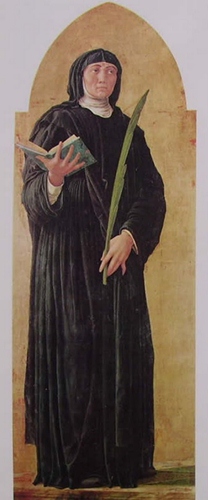
“February 10 is the feast day of Saint Scholastica, the twin sister of Saint Benedict. She’s the patron saint of women’s Benedictine contemplative communities.
Saint Benedict had a sister named Scholastica who also dedicated her life to the pursuit of God. She, too, founded monasteries and became an abbatial figure. The only story we have of Scholastica is told when Benedict was already an abbot of renown. The incident demonstrates clearly that the brother and sister were emotionally close and a spiritual influence on each other till the time of her death.
During one of their annual visits, Scholastica, inspired by the depth of their conversation, asked Benedict to remain overnight in the place where they were meeting in order to continue their talk and reflection on spiritual things. Benedict wouldn’t even think of it. It was getting dark; it was time to get back to the monastery; it was time to get on with the regular routine of the spiritual life. Unable to persuade him with words, Scholastica put her head down on the table in deep prayer. Suddenly, out of nowhere, a great storm brought with it flash floods and Benedict realized that he could not possibly return to the monastery that night. And the Dialogues say, “he complained bitterly.” He said, “God forgive you, sister! What have you done?” Scholastica answered simply, “I asked you for a favor and your refused. I asked my God and I got it.”
The story is a vein worth mining for a lifetime.
• It tells us that law is never greater than love
• It tells us to be intent on pursuing the values of the life, not simply its rules
• It tells us that discipline is necessary in the spiritual life but that religious discipline is not enough, that depth is a process and that depth costs
• It tells us that God lurks in strange places. And waits for us. And puts in our paths just what we need in order to become what we are meant to be
• It reminds us that a woman has as much power in the eyes of God as any man and that we must recognize women, too, as spiritual guides.”–Joan Chittister, OSB
My next Keystone resistance court date is on Valentine’s Day!
The “ERM 54,” as we are called, were arrested last July (photo at left) in the lobby of corporate headquarters of Environmental Resources Management, the company hired by the State Department to conduct the environmental impact statement (EIS) for the Keystone XL pipeline. In addition to providing a very flawed report, the company failed to include key conflict of interest information in its State Department application.
Below is Bill Moyers interviewing Bill McKibben on the most recent State Department report on the Keystone XL pipeline. It’s a good summary of where the Keystone fight, called “the Woolworth’s lunch counter of the climate change movement,” is now and is headed.
From Moyers and Company:
After the State Department issued a long-awaited environmental impact statement on the controversial Keystone XL pipeline last week, environmentalists and those opposed to the 1,179-mile pipeline have intensified their push for the Obama administration to reject the project.
This week, Bill Moyers talks withBill McKibben, an activist who has dedicated his life to saving the planet from environmental collapse, about his hopes that Americans will collectively pressure Obama to stand up to big oil.
“Most people understand that we’re in a serious fix,” McKibben tells Moyers, “There’s nothing you can do as individuals that will really slow down this juggernaut … You can say the same thing about the challenges faced by people in the civil rights or the abolition movement, or the gay rights movement or the women’s movement. In each case, a movement arose; if we can build a movement, then we have a chance.”
Stephen Colbert welcomed Masha Alyokhina, 25, and Nadya Tolokonnikova, 24, the recently freed members of the feminist punk band Pussy Riot, on The Colbert Report this week.
Colbert joked around by playing the role of a Putin defender: “Now Vladimir’s a friend,” he said. “So I’m going to edit out anything bad you say about him.”
To which our heroes replied, “That’s okay. We are making our own tape.”
And on it went. These women are so brave, witty, smart, and committed. They truly stand in the punk tradition. While touring the U.S. they are visiting our prisons. Nothing like going directly to the heart of the matter.
Abbot Philip serves at Christ in the Desert monastery in New Mexico. I’m often encouraged and enriched by his reflections. I’m sometimes deeply challenged by his male perspective and his sense of traditionalism. His reflections below on the nature of obedience — which bring so many issues for me as a woman — are nevertheless insightful and ultimately freeing for me.
“Sometimes people who are not monks find it difficult to understand any value to obedience. When I was a young monk, I had all kinds of questions about obedience and was not sure that I could ever obey wholeheartedly. Yes I always obeyed. When I came up for solemn vows, my abbot told me that the other solemnly professed (the Chapter) was not convinced that I would ever obey anyone. So we talked about obedience. At the end of the talk, the abbot assured me that I did always obey. He also told me, however, that I seemed to have to question things before I obeyed. (more…)


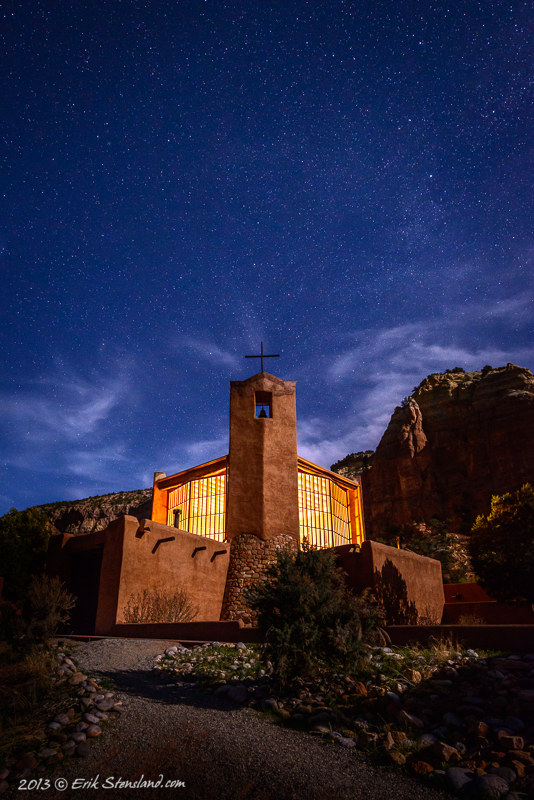 Abbot Philip lives at Christ in the Desert Monastery in New Mexico (left), but has been on retreat in Hawaii for the last few months:
 The title is Breaking the Habits of Machismo. When Pope Francis said we need a new theology of women, I asked Michelle to write an article in response.

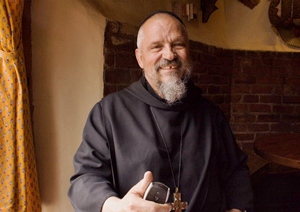 Abbot Philip serves at Christ in the Desert monastery in New Mexico. I’m often encouraged and enriched by his reflections. I’m sometimes deeply challenged by his male perspective and his sense of traditionalism. His reflections below on the nature of obedience — which bring so many issues for me as a woman — are nevertheless insightful and ultimately freeing for me.