-
Video: The Jacqueline Woodson Speech
Jacqueline Woodson wins the 2014 National Book Award Young Adult Literature Winner for Brown Girl Dreaming. The importance of seeing people who look like us mirrored into a larger world and how important it is to talk to our elders before they become ancestors. -
Video: Lakota Sings Defeat of KXL Senate Vote
From Liz Schmitt, Creation Care organizer at Sojourners:
Just in case you missed the news, last night Mary Landrieu’s bill to approve the Keystone XL pipeline came up one vote short of passing. For me, this was a joyous end to an eventful day. My day included meetings with new partners on fossil fuel divestment, then a meeting with other faith leaders at the EPA where we hand delivered Sojourners’ 3500 comments on the Clean Power Plan to EPA Administrator Gina McCarthy, and discussed carbon regulations, [environmental justice] considerations, and an upcoming methane rule in a very candid conversation with her. And then at 6 in the evening, the Senate rejected the pipeline.
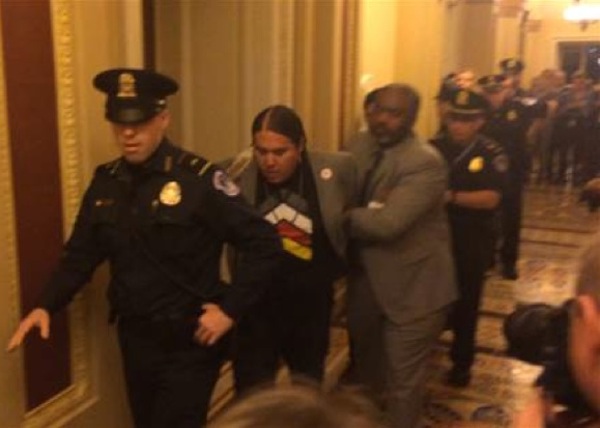
Right after Senator Warren announced the vote results, one of our friends from the Rosebud Sioux nation (which lies in the pipeline’s proposed path) broke out into Dakota/Lakota song from the Senate gallery. My sentiments exactly.
The fight continues, because Mitch McConnell took the floor a few minutes after to assure everyone that Keystone will be one of the first bills introduced in the next Congress. But for now, the pipeline is shelved again.–Liz Schmitt
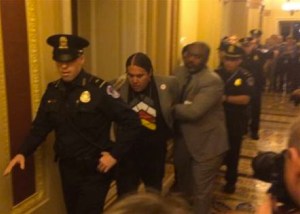 THIS JUST IN: Greg Gray Cloud, cofounder of Wica Agli, member of the Rosebud Sioux Tribe, and a prominent anti-Keystone activist. confirms, “yes that was me who sang the honor song in the [senate] gallery.” Thank you, Greg! Read more here.
 -
Pope Francis: ‘The Holy People of God Living On the Peripheries of History’
 This morning Pope Francis met with the participants in the national assembly of the Italian Confederation of Major Superiors (CISM).
“Charisms [spiritual gifts],” he said, “are not to be conserved like bottles of distilled water, but to be put to the service of history.”
Below is an excerpt from his presentation:
“Faced with the witness of a brother or a sister who truly lives a religious life, people ask themselves, What is there here? What is it that leads this person beyond a worldly horizon? This is the first issue: helping the body of Christ grow by attraction. Without proselytizing: attraction.
The second point is that radicality, in different forms, is required of every Christian, but in the case of religious persons it assumes the form of prophetic witness. The testimony of an evangelical life is what distinguishes the missionary disciple and in particular those who follow the Lord in consecrated life. And prophetic witness coincides with sanctity. True prophecy is never ideological, it does not oppose the institution: it is institution. Prophecy is institutional, it does not follow fashion, but is always a sign of contradiction according to the Gospel, like Jesus was. Jesus, for example, was a sign of contradiction to the religious authorities of His time: to the heads of the Pharisees and the Sadducees, the doctors of the Law, but also to the others, such as the Essenes, Zealots, etc.
“We do not want to fight rearguard battles in defense, but rather to spend ourselves among the people,” to quote the [president of the Italian Major Superiors of Men’s Orders], “certain of the faith that God has always made germinate and grow in His Kingdom.” This is not easy, it is not to be taken for granted; it requires conversion; it requires, first and foremost, prayer and worship; and it means sharing with the holy people of God who live in the peripheries of history. Removing oneself from the center. Every charism, to live and to be fruitful, is required to decentralize, because at the center there is only Jesus Christ. The charism is not to be conserved like a bottle of distilled water, but must instead be made to bear fruit, with courage, placed at the service of current reality, of cultures, of history, as the great missionaries of our institutes teach us.”–Pope Francis, 7 November 2014
-
Rabbi Arthur Waskow’s Midrash for Election Day
 The Torah of our Choosing by Rabbi Arthur Waskow (A midrashic interpretation of Deuteronomy 17: 14-20):
You may set, yes, set over you some to hold office
Who are aware that the Breath of Life is One,
Uniting all, breathing into life all God’s Creation.
You may not give power to those so alienated
As not to feel that you are kin to them.Indeed! — the officials whom you choose
must not multiply the horses of a cavalry,
a standing army to invade other nations and oppress our own;
Your choice must not return the people
to living in a Tight and Narrow Place – that’s slavery!
For the Breath of Life has said to you:
You must not return yourself or others
to ignorance, to poverty, to subservience, or despair –-
all slavery!The ones you choose must not become addicted to sexual obsessions,
Or to taking bribes or favors from the wealthy
For in these ways their hearts will be turned aside
From wisdom and compassion.But it shall be when they sit in the halls and seats of power,
They are to clarify their understanding of Most Sacred Wisdom
And face the caring public; share their vision
in ways that could with honor
face the wisdom of our wisest forebears,
prophets and holy teachers,
and so be worthy of our trust.Their understanding of the Sacred Wisdom
is to remain beside them,
to read it and rewrite it as each day, each dawn,
Brings new knowledge and new insight to our lives —
To make certain that the rulers whom we choose
Will remain steadfast in knowing that all Creation
deserves, demands, our wonder and our healing,
so that their hearts not rise in arrogance above their kinfolk,
all Earth and all her life-forms –
that they not turn-aside from what connects us all.Only in this way can we prolong our days
among all peoples, all life-forms
we and all our children.–Rabbi Arthur WaskowRead more from Rabbi Waskow at The Shalom Report.
-
Video: ‘It’s All About That Bus’ #NunTrouble
Thank God for Catholic sisters! Sing along.
-
Abbot Phillip: ‘Seek Peace and Pursue It or Play Host to Anger’
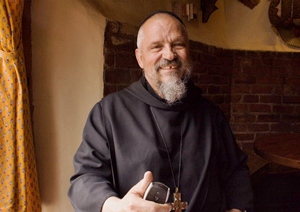
Abbot Phillip Abbot Phillip Lawrence, OSB, at Christ in the Desert Monastery in New Mexico, offers these reflections on the paradoxical struggle for peace:
“The challenge for anyone who wants peace is to create peace within. That is the first challenge. Saint Seraphim of Sarov said in one of his sayings that if we acquire a spirit of peace, and thousands of souls will be saved around us. We don’t have to fight the world or to fight others. The first and really only battle is with ourselves. In much of the spiritual tradition, there is reference to the spiritual struggle, the spiritual battle, etc. That battle is always against ourselves so that we may have peace and love others without judging them.
In my own life I have gone through times when peace has been easy and has been a wonderful gift. At other times, though, I can feel my own reactions which are against peace. That is the point where there is a choice: seek peace and pursue it or play host to my bad feelings and angers and lusts and fears and let them push my life in all directions. Just because I try to choose to seek peace does not make it easy! Instead, part of growing in the spiritual life is learning to embrace such battles and not weary in pursuing peace. Most of us know when we have accepted anger or lust or fear or laziness.
It is when we become aware that we have accepted such realities in our lives that we have the chance to choose against them. Sometimes these realities creep up on us and we are not aware of them. But in that moment that we become aware, we have the choice. If we are engaged in the spiritual battle regularly, we tend to make better choices, even if not always the best choices. So if I were to give advice to anyone about the spiritual life, it would be simple: start now to try to do God’s will! No matter how often you fail, keep on trying. In time good things will begin to happen along with the necessary suffering that trying to do His will entails. … Stay with it! …
So often, when we seek the spiritual life, we are hoping to feel good. An honest spiritual life sometimes has those moments of feeling good. But it also has long stretches of not feeling much and sometimes periods of feeling awful about ourselves, about others and even about God. Be prepared to suffer if you want a deep spiritual life.”–Abbot Philip, Christ in the Desert
Read Abbot Philip’s whole reflection.
-
Populist Pope to Peoples’ Movements: ‘I Unite My Voice With Yours’
 This morning Pope Francis addressed representatives from popular movements for social justice from around the world. I can’t find a raw transcript, but reading the reports below will give you a taste of his salty flavor!
#Favorite Pope Quote: “Solidarity, understood in its most profound sense, is a way of making history.”
#Favorite Pope Quote: “It is not possible to tackle poverty by promoting containment strategies to merely reassure, rendering the poor ‘domesticated,’ harmless and passive.”
#Favorite Pope Quote: “Creation is not our property, that we may exploit as we please; far less so, the property of the few.”
#Favorite Pope Quote: “Christians have something very good, a guide to action, a revolutionary programme, we might say. I strongly recommend that you read it. It’s called the Beatitudes”.
Below are two reports that give significant quotes from Pope Francis’ talk:
(Vatican Radio) Pope Francis met on Tuesday with participants in the World Meeting of Popular Movements which is holding a conference here in Rome to discuss problems facing the poor, the unemployed and those who’ve lost their land. The group chose to hold their three-day conference here because of Pope Francis’ particular attention to the struggles of the poor.
“This meeting of Popular Movements is a sign, a great sign,” Pope Francis told his audience. “You came to be in the presence of God, of the church… [to speak about] a reality that is often silenced. The poor not only suffer from injustice, but they also fight against it.”
-
Video: ‘Start Music, End War’ Say Young Syrians
Young Syrian musicians are performing on the streets of war-torn Damascus to engage passersby, despite the security crackdowns.
When people ask, What can be done against ISIS or in the midst of a civil war? Artists always have an answer. Whether it is Vedran Smailovic with his cello in Sarajevo during the 1992 siege or the Syrian youth flash performers, Meet Us On the Road (seen here), peace finds its way.
With a motto, “Start Music, End War,” the organization Meet Us On The Road (find them on FB), whose members appear unexpectedly on the street with their instruments to recite their “musical” prayers, only to disappear suddenly, sees art as the only way to motivate Syrians to put aside differences and pursue peace.
This is what protest looks like in the middle of war: reclaiming space from violence. This is what church should look like every day. This is the kind of evangelization that undercuts the brutal coercion practiced by ISIS and the others with a habit toward violence.–Rose Berger
Read more here.
-
St. John Neumann: ‘Everyone has a mission’
“Everyone has a mission, has a work. We are not sent into this world for nothing; we are not born at random. God sees every one of us. God creates every soul for a purpose. God needs every one of us. God has an end for each of us; we are all equal in God’s sight. As Christ has his work, we too have ours; as he rejoiced to do his work, we must rejoice in ours also.”–St. John Neumann, first bishop of Philadelphia
-
Rabbi Eliyahu Fink: The Ribbon of Repentence
 There have been three news stories this week focusing on Orthodox Jews. One is a controversial takeover by Orthodox Jews of a school board, another about financial irregularities, and the third about a rabbi who spied on women in the mikveh. (The last story is close to home for me because it’s a synagogue I’ve attended several times for classes.)
Orthodox Rabbi Eliyahu Fink wrote a thoughtful response to these scandals that I find helpful for all who “have fallen short of the glory of God.” All of us need lessons in how to turn our failures and sin into something good for the glory of God.
Here’s an excerpt from Rabbi Fink’s essay A Better Orthodox reaction to the mikveh, East Ramapo scandals:
“One of the greatest gifts of Judaism is teshuvah — literally translated as “return,” and the Jewish word for repentance. Failure is inevitable. We are humans, and humans are flawed creatures who make mistakes. Judaism provides an opportunity to turn our errors into acts of goodness through the process of teshuvah. When we repent, we are actually closer to God than we were before we sinned. It’s as if a ribbon connects us to God. Sin cuts the ribbon into two, disconnecting us from God. True repentance ties the two pieces of ribbon together, reconnecting us. But the process of repairing the ribbon makes the ribbon shorter and reduces the distance between the two ends of the ribbon. Teshuvah reattaches us to God and makes us closer than we were before we sinned.
In any good relationship there will be mistakes that disconnect the two parties. These are opportunities for teshuvah. Whenever a relationship needs to be repaired, if it’s done right, the two parties should be closer after the “return” than they were before the relationship was harmed.
Traditionally, there are three steps to teshuvah: Acknowledgement, regret and reform. These are the three elements necessary to repair any broken relationship or any breach of trust. The Orthodox Jewish community must take these three steps to earn back the trust of Orthodox Jews and the general public.”–Rabbi Eliyahu Fink
Read the whole essay here.



-
Subscribe
Subscribed
Have a WordPress.com account? Log in now.

