-
Manuel Cisneros: ‘All I Need are Rocks’
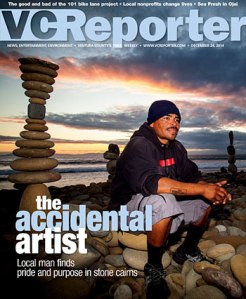 “I just need rocks. It’s all what I need,” says Manuel Cisneros, an artist working and living on the beach in Ventura, Calif., in this 3-minute video. (Read more about Manuel Cisneros in the Ventura Reporter.)
“And I say also unto thee, That thou art no longer Manuel but Pedro, and upon this piedra I will build my church; and the gates of hell shall not prevail against it.” –From Matthew 16:18
(Thank you to Tim Nafzinger for news of Manuel Cisneros.) Everything Happen for a Reason from rossangeles on Vimeo.
-
Eve Tetaz: Bad Citizen or Good Citizen?
 “I am a good citizen as I continue to speak the truth to power and challenge the empire.”–Eve Tetaz after being sentenced on Jan. 29, 2015, to pay a $5,000 fine for entering the Fr. Benning Army base with a photo of 18-year old Mauricio Ortega Valerio, one of the forty-three Mexican students who were disappeared in September 2014, and asking the guard “Where are the missing?” [Read more of Eve Tetaz’s statement.]
The prophet Isaiah says: “Cry out and sing, citizen of Zion, for the Holy One of Israel is among you in greatness” (Isaiah 12:6). Eve Tetaz is exhibiting all the characteristics of a citizen of Zion.
SOA Watch protesters get $5,000 fine, probation for entering Benning
One School of Americas Watch protester was sentenced to five years probation and another was slapped with a maximum $5,000 fine Thursday for trespassing onto Fort Benning during the annual protest in November.
U.S. Magistrate Stephen Hyles sentenced Robert Norman Chantal, 62, of Americus to five years probation after pleading guilty and stating that he wouldn’t enter the post again. Chantal was dressed in a sad clown face during the Nov. 23 protest on Benning Road to close the Western Hemisphere Institute for Security
Cooperation.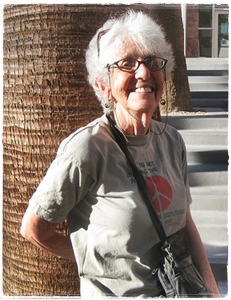 Calling 83-year-old Eve Tetaz a bad citizen, the judge sentenced the longtime activist to pay a $5,000 fine but the woman with a many medical issues avoided prison time. She must pay the fine in 30 days or make arrangements, one of her attorneys said outside District Court.
Chantal and Tetaz of Washington, D.C., were among the 1,336 people who gathered at the Stone Gate for the annual protest to remember the victims of violence in Latin America and call for closing the institute. It was the group’s 25th year at the post since the 1989 massacre in El Salvador was linked to graduates of the School of Americas which operated at the post from 1984 to December 2000. The school’s name was changed to the institute in 2001. …
Read Ben Wright’s whole story.
-
Wendy Clarissa Geiger: Merton & Gandhi – Two Ways of Being Born Again
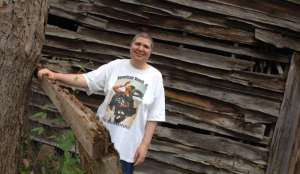
Friend Wendy Clarissa Geiger in Jacksonville, Fl. I’m honored to be on the receiving end of epistles from Quaker Friend Wendy Clarissa Geiger, peacemaker, poet, planter, and purveyor of historical memory, who roots herself on her family farm near Jacksonville, Florida. Here is her note from yesterday:
… Friday, January 30th, 2015, is the anniversary of M.K. Gandhi’s assassination at the age of 78 in New Delhi, India, in 1948. “He became much more than there was time for him to be” is a line Vincent Harding was very fond of quoting regarding Martin Luther King Jr. Although it is from a Robert Hayden poem about Malcolm X, the line could, also, describe Thomas Merton whose 100th birthday is [January 31]. M.K. Gandhi wrote: “God is Truth.”
For some reason, this 100th birthday of Thomas Merton is celebrated with great silent exuberance within me. I delight in its significance for being rather insignificant in the scheme of things as angels pause, trees bow. And, I bow and pause at the enormousness of one life lived so completely written out on paper that I giggle at the truth of Jim Forest’s words about Merton that appeared in a “Fellowship” magazine quoted in PEACE IS THE WAY, edited by Walter Wink: “Merton was a writer. He could not scratch his nose without writing about it.”
And, so, today’s offering about Truth and Beauty brings a chuckle. “The Philosophers” was written by Thomas Merton in 1940-42 and is published on page 145 of IN THE DARK BEFORE DAWN – NEW SELECTED POEMS OF THOMAS MERTON, with preface by Kathleen Norris and edited by Lynn R. Szabo.
“The Philosophers”
by Thomas MertonAs I lay sleeping in the park,
Buried in the earth,
Waiting for the Easter rains
To drench me in their mirth
And crown my seedtime with some sap and growth,Into the tunnels of my ears
Two anaesthetic voices came.
Two mandrakes were discussing life
And Truth and Beauty in the other room.“Body is truth, truth body. Fat is all
We grow on earth, or all we breed to grow.”
Said one mandrake to the other.
Then I heard his brother:
“Beauty is troops, troops beauty. Dead is all
We grow on earth, or all we breed to grow.”As I lay dreaming in the earth,
Enfolded in my future leaves,
My rest was broken by these mandrakes
Bitterly arguing in their frozen graves. -
Jim Perkinson: The Social Movements of Jesus
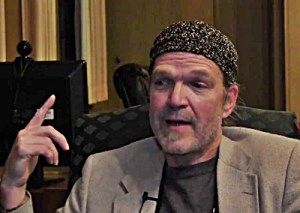 Jim Perkinson is a long-time activist and educator from inner city Detroit, where he has a history of involvement in various community development initiatives and low-income housing projects. He holds a PhD in theology from the University of Chicago and is in demand as a speaker on a wide variety of topics (especially race, class & colonialism). Our friends over at Radical Discipleship interviewed Jim on his 2014 work Messianism Against Christology: Resistance Movements, Folk Arts and Empire.
One could spend all of the season of Lent praying deeply with Jim’s first response:
Radical Discipleship: What’s the difference between “messianism” and “christology?”
Jim Perkinson: Messianism Against Christology: Resistance Movements, Folk Arts and Empire is a work committed to re-thinking the Christian tradition from the point of view of social movements rather than magnified individuals. Jesus was a movement man—as were Moses and Elijah before him, and John the Baptist alongside him. “Messianism” is a word drafted into service as a movement term. Rather than focus on a great individual called “Jesus” comprehended as “the Christ,” the book examines his effort as part of a broader resistance initiative. The social movement launched by John was already in motion when Jesus first opts to begin public action. Baptism under John’s hands meant plunging into a project centered on recovery of living relationship to the lower Jordan watershed. His movement “initiated” one into a new relationship with the land, based on much older traditions and skills of doing so, dating back to Israel’s “birth” as a maroon movement of slaves, walking out of imperial Egypt and being re-schooled for 40 years in the Sinai desert, under Moses. Re-imagined as “messianism,” “christo-logy”—the “logic” of the christos—is then profiled as referring to any initiative of courageous folk, who partially or fully step outside of an imperial domination system to begin recovery of a more just and sustainable way of dwelling in a local ecology or watershed. The focus is not on a “great man” idea of “salvation” (or “being made whole”), but on catching sight of the ways popular resistance can “open up” embodied memory of more indigenous ways of living in symbiotic reciprocity with a particular bioregion. “Salvation” or wholeness here is not aimed at some fraction of the person called a “soul,’ but an entire way of dwelling in a given locale. The emphasis is not on individual traits, but community relations between human beings and on that community’s return to a living relationship to local plants and animals, soils and waters, seasons and cycles. Any movement managing to invoke and partially embody that older ability (which we all shared at some point way back in our evolutionary history as hunter-gatherer peoples) is “read” as partially “incarnating” what we mean by “Christology.” I simply call it “messianism” to emphasize its movement character. …
Read the whole interview.
-
Ched Myers: The Power of Symbolic Action

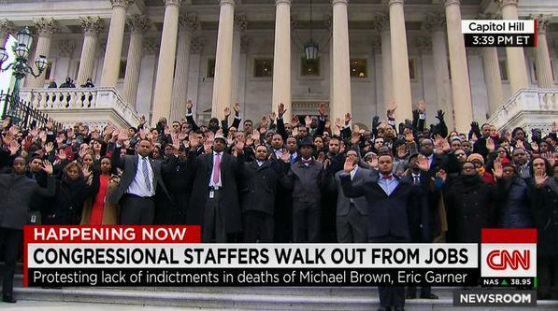
Staffers raise their hands, gesturing “Hands Up, Don’t Shoot.” What acts are you seeing today that symbolize a much greater change?
“In Mark 1:21-28, implied social conflict characterizes Jesus’ first public action, a dramatic exorcism in a Capernaum synagogue. Here we encounter for the first time a “miracle story.” The modern debate over whether or not we can “believe” such stories is not only misplaced, it fails to address the function of this kind of narrative. The possibility of extraordinary manipulations of the physical (or spirit) world was never questioned in antiquity. Nevertheless, the “miracle” lay not there, but in what the act symbolized in terms of the wider scope of Jesus’ mission. Mark goes to great lengths to discourage us from seeing Jesus as a mere popular healer or magician (such were common in ancient society). Not only does Jesus constantly discourage people from fixating upon his acts of healing or exorcism (see 1:44; 3:12; 5:18f, 43; 7:36); he actually exhorts his disciples (and the reader) to look into the deeper meaning of his actions (8:17-21).”
Read Ched Myers entire reflection over at Radical Discipleship.
-
Pope Francis: What Is Your Capacity to Cry?

Lachrymae – tear vials Pope Francis’ press conference on the plane returning from the Philippines was lively as usual. Regarding the Charlie Hebdo murders, he elaborated on the nuances of “freedom of expression” tempered by the virtue of prudence. He also expanded his comments on “responsible parenthood” and what it means for Catholics today. As always, he set the “birth control” issue in the wider context of certain prevailing spirits of the age, in this case Neo-Malthusianism (whaaaa?): population control that is enforced or overly encouraged by governments or corporations.
However, what jumped out to me was his response to a question by La Nacion’s Elisabetta Pique:
Elisabetta Pique (La Nacion): … This was a moving voyage for everyone. We saw people crying the entire time in Tacloban [Philippines site of the Supertyphoon Haiyan], even we journalists cried. Yesterday you said, the world needs to cry. … What was for you the most moving moment, because the mass in Tacloban was such a moment and also yesterday when the little girl started to cry?
Pope Francis: For me the Mass in Tacloban was very moving. Very moving. To see all of God’s people standing still, praying, after this catastrophe, thinking of my sins and those people, it was moving, a very moving moment. In the moment of the mass there, I felt as though I was annihilated (“wiped out”) [devastated], I almost couldn’t speak. …
The other thing is the weeping. One of the things that is lost when there is too much wealth or when values are misunderstood or we have become accustomed to injustice, to this culture of waste, is the capacity to cry.
This is a grace we must ask for. There is a beautiful prayer in the ancient missal, for crying. It went more or less like this: Lord, you who have made it so that Moses with his cane could make water flow from a stone, make it so that from the rock that is my heart, the water of tears may flow.
It’s a beautiful prayer. We Christians must ask for the grace to cry, especially well-to-do Christians. And cry about injustice and cry about sins. Because crying opens you to understand new realities, or new dimensions to realities. This is what the girl said, what I said to her. She was the only one to ask that question to which there is no answer, why do children suffer?
The great Dostoyevsky asked himself this, and he could not answer. Why do children suffer? She, with her weeping, a woman who was weeping. When I say it is important that women be held in higher consideration in the church, it’s not just to give them a function as the secretary of a dicastery, though this could be ok too. No, it’s so that they may tell us how they feel and view reality. Because women view things from a different richness, a larger one.
Another thing I would like to underscore is what I said to the last young man (at the meeting with young people), who truly works well, he gives and gives and gives, he organizes to help the poor. But don’t forget that we too need to be beggars, from them, from the poor. Because the poor evangelize us. If we take the poor away from the Gospel, we cannot understand Jesus’ message. The poor evangelize us. I go to evangelize the poor, yes, but let you be evangelized by them. Because they have values that you do not.”
The prayer Pope Francis refers to is from the Missa ad petendam compunctionem cordis, for begging compunction of the heart, or a Mass for the Gift of Tears (1962 Roman Missal). The prayer says:
Almighty and most merciful God, who, to quench the thirst of your people, drew a fountain of living water out of a rock, draw from our stony hearts tears of compunction, that we may be able to mourn for our sins and win forgiveness for them by your mercy.
But see how he sets this moving and eloquent prayer as a jewel in the crown of justice and compassion!
-
Video: An Open Letter from Typhoon Haiyan Survivors to Pope Francis
This is what a modern epistle looks like–from one community of the Body of Christ to Peter, its Servant Shepherd.
-
James Alison: The Terrible Awe of the Eucharist
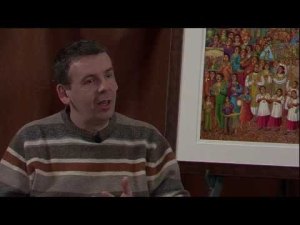
“When we celebrate Mass, the Real Presence to which we are being given access is not some blander version of God, with the love that traverses hostility being kept under wraps only for some special occasions lest it frighten us too much. That would indeed be a taming of God to be “good” for those who are “good”. No, the appropriate awe is due because there is indeed something terrible about a love which traverses our hostility. And does so in such a way that it is very easy for us to be tipped over into righteous rejection of it. The awe does not attribute any violence to God. It begins, however, in awareness that it is indeed a violent and frightening thing to undergo being unhooked from our own, easily knee-jerked, allergic constructions of fake righteousness. It is an awe made available to us over time as a narrative of amazement that “I have been found by the love of one who I treated as my enemy”. And it means that there is no genuine teaching about, or reception of, the Atonement that does not include a rigorous approach to human scandal at what is being proposed and our finding ourselves set free from that scandal.”–James Alison, from Traversing hostility: The sine qua non of any Christian talk about Atonement
-
Radio: The Opening of Guantanamo
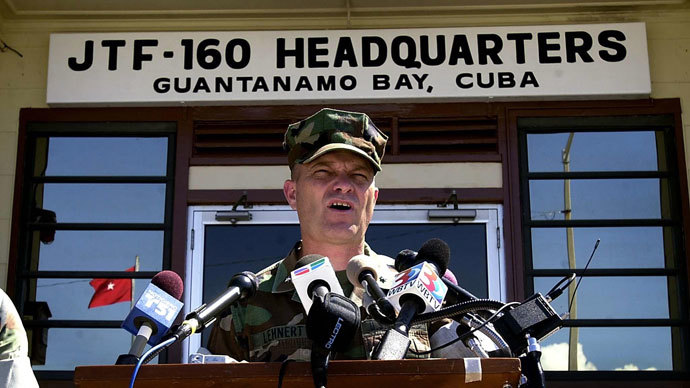
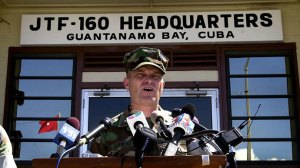 In January 2002, the first prisoners from America’s war on terror arrived at a new hastily-built detention facility at the US naval base at Guantanamo Bay, Cuba. The camp’s first commander, Major General Mike Lehnert, recalls the challenges he faced in opening what would become one of the most notorious prisons in the world. Should he resign in protest or stay as a corrective? One thing he did was make every soldier under his command read The Geneva Conventions.
Listen to this excellent 10-minute interview.
As Maj. General Lehnert explains:
“Of all my initial guidance from superiors, perhaps the most disturbing was the decision by the Administration that the detainees would be afforded none of the protections of the Geneva Conventions. I thought that the Geneva Convention’s stricture to treat detainees humanely until they had been tried by an Article V Tribunal made sense. My personal decision was to run the facility in accordance with the Geneva Convention wherever possible. Although some of the people in the facility could be the ‘worst of the worst,’ that didn’t absolve us from the responsibility to treat them humanely.”
-
@Pontifex: Do we live as children or as slaves?

“The Word of God explains to us, today especially, the meaning of time, to understand that time is not a reality estranged from God simply because He chose to reveal Himself and save us in history. The meaning of time, temporality, is the atmosphere of the epiphany of God, that is the manifestation of God and His concrete love. ‘Time is the messenger of God,’ as St. Peter Favre said. …
Today’s liturgy reminds us of this statement by the apostle John: ‘My children, the hour has come,’ and St. Paul speaking of the ‘fullness of time.’ Therefore, today it shows us how time, which has been ‘touched’ by Christ and by God, received new and surprising meanings. It has become ‘saving time,’ definitive time of saving and grace.
All this leads us to think of the end of life. There was a beginning and there will be an end. With this truth, which is as simple and fundamental as it is neglected and forgotten, the Holy Mother Church teaches us to end the year and our days with an examination of conscience. Through this, we go back to past events; we thank God for every gift we have received and for all the good we could do and, at the same time, we think of our faults and our sins. To say thanks and to ask for forgiveness. This is what we do, even today, at the end of the year. Let us praise the Lord with the Te Deum hymn, and at the same time, let us ask for forgiveness. The attitude of thanksgiving prepares us for humility, to recognise and welcome the gifts of the Lord.
The apostle Paul epitomises, in the reading of today’s Vespers, the fundamental reason for our thanksgiving to God. He has made us their children; He adopted us as children. This undeserved gift fills us with gratitude and wonder! Some might say, “but are we not their children, simply through our being human?” Certainly, because God is Father of every person who is born. But without forgetting that we are far from Him through original sin, that separated us from our Father: our filial relationship is deeply hurt.
That is why God sent his Son to redeem us at the cost of His blood. If there is redemption, that is because there is slavery. We used to be sons and daughters but we became slaves by following the voice of the Evil One. No one else redeems us from that substantial slavery if not Jesus, who became man through the Virgin Mary and died on the cross to free us from the slavery of sin and return us to our lost filial condition.
At the same time, the very gift we thank for is the reason for our examination of conscience, to review our personal and community life, and to ask; what is our way of life like? Do we live as children or as slaves? Do we live as people baptised in Christ, anointed by the Spirit, redeemed, free? Or do we live according to worldly, corrupted logic, doing what the devil makes us believe is in our best interest?



-
Subscribe
Subscribed
Already have a WordPress.com account? Log in now.
 Rose Marie Berger