-
Bree Newsome: Remember This Picture

Bree Newsome removed Confederate flag from S.C. Statehouse and was arrested.
-
Minister-in-Chief: Obama’s Powerful Eulogy in South Carolina
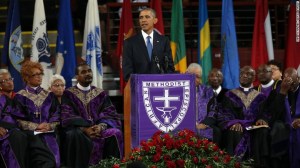 “Reverend Pinckney once said, ‘Across the South, we have a deep appreciation of history — we haven’t always had a deep appreciation of each other’s history.’ (Applause.) What is true in the South is true for America. Clem understood that justice grows out of recognition of ourselves in each other. That my liberty depends on you being free, too. (Applause.) That history can’t be a sword to justify injustice, or a shield against progress, but must be a manual for how to avoid repeating the mistakes of the past — how to break the cycle. A roadway toward a better world. He knew that the path of grace involves an open mind — but, more importantly, an open heart.”–President Obama (Rev. Pinckney’s memorial service, 26 June 2015)
Read President Obama’s historic speech in full.
-
‘Mawidge’ and the Supremes: What you need to know about civil rights and religious liberty
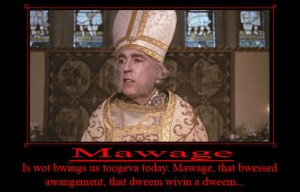
Thank God for The Princess Bride to help us navigate these wedding waters!
Since the landmark civil rights Supreme Court ruling last week on marriage equality, some have raised concern about religious liberty. Will some religious leaders be “forced” to do things they don’t agree with?
The Baptist Joint Committee on Religious Liberty has a good round up on this.
Don’t let far right — whether that’s from within the Catholic bishops conference, certain unaffiliated megachurches, or anyone else stir up doubt and instill fear. The Supreme Court ruling was a civil rights ruling, not a First Amendment ruling.
From BJC’s executive director J. Brent Walker:
When the U.S. Supreme Court agreed to hear the same-sex marriage cases, the justices did not invite briefs on religious liberty. In its writ of certiorari granting review, the Court framed the issues to be whether same-sex marriage is constitutionally required under the Fourteenth Amendment and, if not, whether states under Article IV have to recognize same-sex marriages performed in states where it is legal. It did not frame any First Amendment issues.
But, clearly, church-state relations pervade this subject, and several justices turned to the topic in their questions to counsel and in their debate with each other on the bench.
Three such areas of inquiry about religious liberty are noteworthy:
First, Justice Antonin Scalia asked the petitioners’ attorney, Mary Bonauto, whether ministers and the churches they serve would have to perform and host same-sex weddings if they disagreed with that understanding of marriage. The answer from the attorneys, including Bonauto, and Justice Elena Kagan who chimed in, was an unequivocal “no.”
(more…) -
Jim Wallis: ‘White Privilege Comes From White Supremacy’
Your browser does not support iframes.
Sojourners’ Jim Wallis told Roland Martin, host of NewsOne Now, “White privilege is the benefit of White supremacy.” He added, “No matter where I go, no matter what I say, no matter where I live, no matter who my allies are — no matter how much I fight against racism — I as a White man can never escape White privilege in this country.”
“And Whites don’t want to talk about White privilege, they want to talk about the problems minorities have that we can help with,” said Wallis. He continued, “The problem at the heart of it is Whiteness. Whiteness is an ideology, it’s an idolatry.”
To understand more of what this means, I suggest reading:
How the Irish Became White by Noel Ignatiev
Christians and Racial Justice study guide by Sojourners
-
#Catholic Climate Voices

‘Praised Be To You’: On the Care for our Common Home by Pope Francis
-
Video: The Martyrs of Charleston’s Emanuel AME
Last night nine Christians were massacred while at Bible study at Emanuel AME Church in Charleston, S.C. The dead include Sen. Rev. Clementa Pinckney, senior pastor and state senator, and his sister.
The suspect, Dylann Roof, is 21 years old. He sat for an hour with the pastor and others gathered for Wednesday night Bible study, then open fired. Reportedly, he reloaded as many as five times while church members tried to talk him down. He said he “had to do it.” This was a racialized hate crime.
This video is about the history of this Christian community. This attack, while it may have been the responsibility of one disturbed young white man, is all of our responsibility. This was one young white man who was absorbing the racist fear instilled him him by extremists who use a false faith as a cover for hatred. It is not the case of “one bad apple” and don’t let the media spin it that way.
In the narrative of white supremacy in the U.S., assassination of “Mother Emmanuel” takes on huge spiritual and social significance. At the Sojourners Summit last night I heard civil rights leader C.T. Vivian say, “The violence comes and goes, but the victory is ours, the victory is already won.”
As we look at the bodies of our loved ones, our sisters and brothers, borne forth from the body of their Mother, we say, though our throats are choked with anger and our tears flow in grief: The victory is won.
Here are some key news stories:
For Charleston’s Emanuel A.M.E. Church, shooting is another painful chapter in rich history (Washington Post)Charleston church massacre: The violence white America must answer for
Who Is Denmark Vesey? Charleston Church Founder Was A Slave Rebellion Leader, African-American Hero
-
Key Quotes: Climate Change and the Common Good
 The “ecology encyclical” will be released on Thursday this week. As part of my preparation I’ve been reviewing the material from a number of conferences convened by the Vatican over the last year related to climate change. These conferences have gathered the world’s top scientists, policy makers, and religious leaders to create consensus on the needed next steps in addressing climate change and to create enough social pressure to push obstinate political and business leaders toward conversion of heart and low-carbon sustainable practices and policies.
Here are a few quotes from “Climate Change and the Common Good” presented at the Protect the Earth, Dignify Humanity gathering in April organized by the Pontifical Academy of Sciences, the Pontifical Academy of Social Sciences, Sustainable Development Solutions Network, and Religions for Peace.
A sustainable future based on the continued extraction of coal, oil and gas and their use in the “business-as-usual mode” will not be possible, because it raises the specter of a world that could be significantly warmer than 2°C by the end of this century.–Climate Change and the Common Good (April 2015, The Pontifical Academy of Sciences and the Pontifical Academy of Social Sciences)
There is still time, however, to mitigate unmanageable climate changes and thus to protect humanity and nature. Adequate technological solutions and policy options have been clearly prescribed in numerous reports and need no extended repetition here. Suffice it to note that the most important steps involve the shift from fossil fuels to zero-carbon and low carbon sources and technologies, coupled with a reversal of deforestation, land degradation, and air pollution. In contemplating these needed “deep de-carbonization” transformations, however, we must not ignore the underlying socio-economic factors that are responsible for our current predicament.–Climate Change and the Common Good (April 2015, The Pontifical Academy of Sciences and the Pontifical Academy of Social Sciences)
The Catholic Church, working with the leadership of other religions, could take a decisive role in helping to solve this problem. The Church could accomplish this by mobilizing public opinion and public funds to meet the energy needs of the poorest 3 billion in a way that does not contribute to global warming but would allow them to prepare better for the challenges of unavoidable climate change. The case for prioritizing climate-change mitigation depends crucially on accepting the fact that we have a responsibility not only towards those who are living in poverty today, but also to generations yet unborn. We have to reduce the potentially catastrophic threat that hangs over so many people.–Climate Change and the Common Good (April 2015, The Pontifical Academy of Sciences and the Pontifical Academy of Social Sciences)
Over and above institutional reforms, policy changes and technological innovations for affordable access to zero-carbon energy sources, there is a fundamental need to reorient our attitude toward nature and, thereby, toward ourselves. Finding ways to develop a sustainable relationship with our planet requires not only the engagement of scientists, political leaders and civil societies, but ultimately also a moral revolution. Religious institutions can and should take the lead on bringing about such a new attitude towards Creation.–Climate Change and the Common Good (April 2015, The Pontifical Academy of Sciences and the Pontifical Academy of Social Sciences)
-
Joan Chittister: ‘The Eucharist Dilemma’

The major problem of eucharistic theology in our century is not that people do not understand and value the meaning of Eucharist. The problem is that they do.
The Eucharist, every child learns young, is the sign of Christian community, the very heart of it, in fact. And who would deny the bond, the depth, the electrical force that welds us together in it? Here, we know, is the linkage between us and the Christ, between us and the Gospel, between us and the Tradition that links us to Jesus himself and to the world around us. No, what the Eucharist is meant to be is not what’s in doubt.
What’s in doubt is that the Eucharist is really being allowed to do what it purports to do—to connect us, to unify us, to make us One. The truth is that as much as Eucharist is a sign of community it is also a sign of division. For the sake of some kind of ecclesiastical political fiascos centuries ago between the East and West, we close the table between Orthodox and Uniate—though the faith is the same and the commitments are the same and the vision of life and death are the same.
What’s in doubt, too, is that the division between baptized men and baptized women can possibly witness to what we say is the faith: that men and women are equal; that women are fully human beings; that God’s grace is indivisible; that discipleship is incumbent on us all; that we are all called to follow Christ.
At the end of one presentation after another, women make it a point to continue the discussion with me. “I used to be Catholic,” they begin. “I was a Catholic once,” they say. “I’m a recovering Catholic now,” they announce. It’s a sad litany of disillusionment and abandonment by a Church they once thought promised them fullness of life and then let them know it is their very persons that deny them that.
Call it “holy” communion if you want, they tell me, but it’s not. Not like that. Not under those conditions.
So they go away to where Jesus waits for them, arms open, in someone else’s Christian church. There’s something about it that simply defies the lesson of Mary Magdalene or the Woman at the Well or Mary of Bethany or Mary of Nazareth. They go where every minister of the altar, every bishop, every lawgiver, every homilist, every member of every Synod on the planet is not male. They go where they can see “the image of God” in themselves in another woman. They go where eucharistic theology, which we’re told makes us one, is palpable.–Joan Chittister
From “Eucharist” by Joan Chittister, Spirituality magazine (Volume 18, March-April 2012, No 101. Dominican Publications: Republic of Ireland)
-
#PopeForPlanet: The Meek Are Getting Ready
http://c.brightcove.com/services/viewer/federated_f9?isVid=1&isUI=1
Need I say more?
-
St. Basil: ‘Claiming Ownership of what was for Common Use’
 “I am wronging no one,” you say, “I am merely holding on to what is mine.” What is yours! Who gave it to you so that you could bring it into life with you? Why, you are like a man who pinches a seat at the theater at the expense of latecomers, claiming ownership of what was for common use. That’s what the rich are like; having seized what belongs to all, they claim it as their own on the basis of having got there first. Whereas if everyone took for himself enough to meet his immediate needs and released the rest for those in need of it, there would be no rich and no poor. — St. Basil of Caesarea
From Ownership: Early Christian Teaching by Charles Avila



-
Subscribe
Subscribed
Have a WordPress.com account? Log in now.

