-
14 April: The Power of Nonviolence – Action and Resistance
You are invited to “The Power of Nonviolence – Action and Resistance” webinar on Wednesday, 14 April 2021, from 3:00-4:00 p.m. (EST). This Zoom event is part four of Pax Christi USA’s study circles on the book Advancing Nonviolence and Just Peace in the Church and the World. Register here or watch the watch the livestream on Pax Christi USA’s YouTube page.
In preparation for this session, read Advancing Nonviolence Part III: The Practice and Power of Nonviolence. Panelists will include Rose Marie Berger, senior editor of Sojourners magazine and one of the co-editors of Advancing Nonviolence; Jean Stokan, a member of the Institute Justice Team for the Sisters of Mercy of the Americas; and Scott Wright, director of the Columban Center for Outreach and Advocacy. The panel discussion with Rose, Jean, and Scott will be followed by breakout sessions for small group discussion.

If you purchase Advancing Nonviolence here, you can use PCM15 to receive a 15% discount.
-
Good Friday in Myanmar
[doc id=17713]
With gratitude to the students of Bellerive FCJ Catholic College in Liverpool, UK for this presentation. And with gratitude for the youth and religious leading Myanmar’s Civil Disobedience Movement for dignity and freedom.
-
Good Friday in Myanmar
[doc id=17713]
-
Celebration of Life of Sr. Dianna Ortiz, OSU

Sister Dianna M. Ortiz, OSU (Sept. 2, 1958 – Feb. 19, 2021) Vigil service. Funeral Mass. (More from the Ursuline sisters.)
I knew Sr. Dianna through her advocacy work and through regular gatherings for Mass at the Assisi Community in Washington, D.C., where she lived for 25 years. I came to know her more closely during her fast for justice in the mid-1990s when I wrote an article with Julie Polter for Sojourners out of that experience.
In 2007, poet Joseph Ross and I organized a poetry reading and poetry anthology to accompany an exhibit of paintings by Colombian artist Botero in D.C. We were so grateful to Sr. Dianna for writing the forward to Cut Loose the Body: Anthology of Poems on Torture and Fernando Botero’s Abu Ghraib paintings. She wrote:
“To our feelings of betrayal, fear and isolation, must we also carry the insistent sense of hopelessness our torturers would force up on us? No, we need not. Oh no, we will not. We who have survived this crime against humanity have, indeed, learned to speak for ourselves and to be understood …”
As I reflect on Sr. Dianna’s life and death I keep thinking: Dianna is what resurrection looks like in public. She came out of the belly of death in Guatemala with her scars intact, and she dealt with her wounds every single day. Somehow, she turned her experiences of death into the power of resurrection that saved the lives of thousands of people. And through that slow process of resurrection she came to know a God called Mercy.
Forgive me and us Dianna for all the ways we hurt you and didn’t understand. We in turn “forgive” you for making us uncomfortable when you were bold enough to claim your healing in public. You are our saint of nonviolent witness. Presente!–Rose Marie Berger
https://sojo.net/articles/sr-dianna-ortiz-torture-survivor-and-activist-dies-62
https://sojo.net/magazine/january-february-2003/torture-truth
https://sojo.net/magazine/july-august-1996/deaths-dance-broken -
Joe Nangle: Falling Into the Arms of A Loving God

Sr. Dianna Ortiz, OSU Dianna Ortiz (Sept. 2, 1958 – Feb. 19, 2021) died early this morning on 19 February 2021, after a brief recurrence of cancer. She was a member of the Catholic Ursuline order who lived for 25 years at the Assisi Community in Washington, D.C. She was was 62.
I knew Dianna from her early days to bring justice around her own kidnapping and torture in Guatemala (see Death’s Dance Broken). And celebrated Thanksgiving and Easter Mass with her at Assisi Community whenever I could. She continually clawed her way back into life. Dianna rose with her scars intact as her book The Blindfold’s Eyes: My Journey from Torture to Truth (2004) attests–and went on to conquer death for others, especially through her work on international human rights law and the founding of the Torture Abolition and Survivors Support Network International and more recently with Pax Christi USA. She was tender and astonishingly strong. Dianna is what resurrection looks like. Her Assisi community member, friend, and priest, Joe Nangle writes about Dianna’s last days. I’m so grateful she was not alone. (Read The Washington Post obituary for Dianna Ortiz. And a timeline of Dianna’s life.)–Rose
FROM JOE NANGLE: Falling Into the Arms of a Loving God–Remembering the Last Days of Dianna Ortiz, OSU
To write about the final days of Sister Dianna Ortiz’s life is beyond sad. For those who have not heard, Dianna passed away early this morning after a short illness; my apologies for conveying word of it in such an impersonal way.
Actually, her illness and devastating diagnosis of an inoperable cancer has taken place almost too quickly to comprehend at this moment. Three weeks ago a member of our Assisi Community – of which Dianna has been a part for 25 years – insisted that she go to an emergency room for persistent and increasingly painful stomach pain. In rapid succession, Dianna was hospitalized, discovered to have a serious abdominal blockage and biopsied, revealing the cancer. She was designated for chemotherapy to reduce the tumor but when her symptoms continued to increase, she underwent surgery and the inoperable status of the cancer was discovered. All in less than three weeks!
It is said that our parents’ final legacy is their acceptance of death. Surely this can be said of anyone close to us who walks bravely through the dying process. It is most certainly true in the case of our dear sister – friend – community member – and exemplar. After the initial shock of this rapid series of events, Dianna seemed to call on a deep well of faith, acceptance and resignation as she faced the inevitability of her situation.
(more…) -
Review: Advancing Nonviolence and Just Peace
Andrew Bolton writes in Peace News (UK): “I abandoned Catholicism 50 years ago. Imagine my surprise to learn about a new, fresh wind of hope blowing in the Catholic church called the Catholic Nonviolence Initiative (CNI). The CNI is an astonishing story of visionary, vibrant, and faithful Catholics embracing and promoting a repentant, progressive and fully inclusive form of Christianity. …
Advancing Nonviolence is both inspiring and frustrating.
Let me start with the frustrations. It feels this was a rushed job. It is written for Catholics, but it could have helpfully thought about sympathetic non-Catholic readers because its message can serve and encourage all Christians. Woefully it has no index and not all key assertions are foot noted. It helped me to understand that this is a resource book to support engagement of Catholics in the CNI, recalling Catholics to abandon the just war position for gospel nonviolence as a new default position, and advocating for Just Peace.
Once I got into it, I found it truly inspiring. For instance, I forgot I was holding a Catholic text as I read sections on the Hebrew Bible and the Christian scriptures. Its treatment of the nonviolent Jesus is beautiful and very moving. Theological themes like creation, who is Jesus, Holy Spirit, and the nature of the church are very well done. There is a very good and comprehensive review of peace studies research – creative nonviolence works and leads to much better outcomes!” Read the rest.
-
Remembering Cicely Tyson
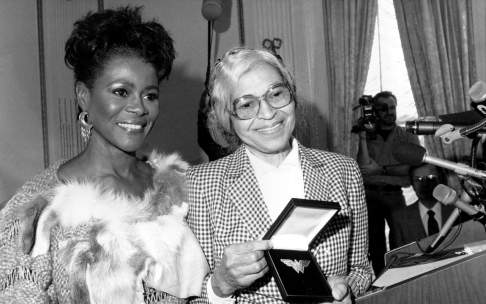
Photograph by SUZANNE VLAMIS https://www.c-span.org/video/?c4942899/user-clip-cicely-tyson-rosa-parks-funeral-dc
I grew up under the leadership and presence of Cicely Tyson as a force in movies and theater. Her roles in Sounder (1972) and The Autobiography of Miss Jane Pitman (1974) particularly shaped my childhood. More recently I marveled at her role as Ophelia Harkness in How To Get Away With Murder with the stunningly brave Viola Davis.
In particular, I remember Ms. Tyson’s speech at the memorial service for Mrs. Rosa Parks in Washington, D.C. (see 8-minute video clip above). Her faith was on full display and she spoke with a voice that channeled the powerful spirit of the “old folks.”
Read more about Cicely Tyson.
-
Video: Defining Nonviolence
To learn more, buy the book: Advancing Nonviolence and Just Peace in the Church and World. This 7-minute video on Christian nonviolence includes interviews with Myla Leguro (Philippines), Archbishop Peter Chong (Fiji), Rania Murra (Palestine), Fr. Emmanuel Katongole (Uganda), Jasmin Nario Galace (Philippines), Fr. Dave Kelly (USA), Sarah Thompson (USA), Jean Baptiste Talla (Cameroon), Christina Leaño (USA), and Pietro Ameglio (Mexico).
-
‘Behold, the Star’
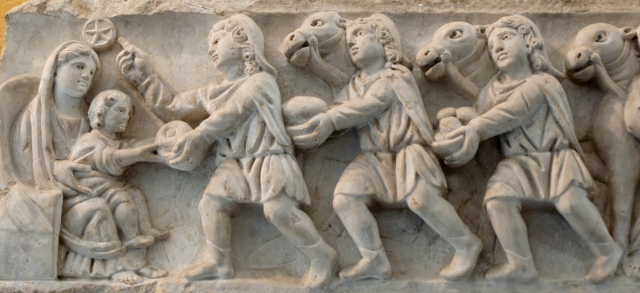
One of the earliest depictions of the Magi, Roman carving, 4th century “THIRD-CENTURY FRESCOES in Roman catacombs hold the earliest depictions of the Adoration of the Magi. In one, three men advance in a line toward a child standing in his mother’s wide-legged stance, showing her authority. Others reveal the Magi extending platters of bread toward the child Jesus. Another illustrates men with camels approaching Mary and Jesus with gifts. The lead gift-bearer extends a disproportionately large right hand to an encircled star overhead. These are the earliest details of the nativity narrative: travelers, bread, camels, a wide-legged woman, a child, a star. Later portrayals add partially visible soldiers.”–Rose Marie Berger, “Epiphany Is a Time for Imaginative Leaps,” Sojourners (Jan 2020)
-
Book Review: Advancing Nonviolence
New book highlights women leaders who advance the practice of nonviolence by pursuing open and sincere dialogue. This article was published in the January-February 2021 issue of Maryknoll NewsNotes by Dan Moriarty.
The Catholic Nonviolence Initiative (CNI), a project of Pax Christi International that began with a conference at the Vatican in 2016, continues its work promoting Catholic understanding of and commitment to Gospel nonviolence with a new book, Advancing Nonviolence and Just Peace in the Church and the World. The fruit of a global, participatory process culminating in a second Vatican conference in 2019, the book includes “biblical, theological, ethical, pastoral and strategic resources, presented to serve as a contribution to Catholic teaching on nonviolence.”
The authors of the new volume – peace practitioners, theologians, and social scientists from 39 countries around the world – describe nonviolence as a spiritual orientation, a way of life, and a practical tool. Presented as “the foundational, universal ethic for building a culture of peace, disarmament and development,” nonviolence has deep roots in scripture and spirituality.
But the CNI also illustrates the practical ways nonviolence is successfully employed to reduce, resist, and transform both direct, physical violence and systemic, institutional violence and injustice.
Women lead in dialogue
Pope Francis and his predecessors have repeatedly called for the faithful to pursue “forgiveness, dialogue, and reconciliation” as alternatives to violent conflict. But to critics, such concepts sound lofty and impractical in the face of real, intractable violence. The CNI offers a concrete counternarrative.
Dialogue may refer to high-level negotiations between political elites – the kind of talks diplomats and mediators have facilitated between warring parties from Northern Ireland to Afghanistan. But other forms of dialogue – at the middle- and grassroots levels, and often led by women – pave the way for such high-level negotiations.
In Mindanao, Philippines, violence between Muslim Moro rebels and the government grabs headlines worldwide. But for local peace activist Myla Leguro with Catholic Relief Services, the picture is more complicated: questions of identity, colonialism, extractivism, human rights, and autonomy are all closely tied to disputes over land.
Leguro developed “the Three B’s,” of dialogue to prepare individuals (“binding” with healing and education) and whole communities (“bonding” by expressing inclusive visions for the future) for negotiations between conflicting groups (“bridging”) to settle land issues. The three-stage process builds skills, trust, and agreements that serve as a basis for addressing wider conflicts. Leguro’s Three B’s have been adopted in conflict zones around the world, including central Africa, where other local leaders have further developed her model.
In northern Kenya, Pax Christi peacebuilder Elizabeth Kanini Kimau facilitated dialogue amid “disorganized, armed, communal violence” between warring pastoralist communities – “a situation vulnerable to political manipulation by armed militias.” Understanding the respect afforded elders, she invited elders from all sides to a neutral location, where they could dialogue safely. The elders recruited warriors to follow suit, and the warriors invited youth. The elders have now established ongoing dialogue to resolve conflicts before they erupt into violence.
While Leguro and Kimau bring a local expertise to peacebuilding, other times third parties from outside a conflict zone play a crucial role.
In Syrian refugee camps in Lebanon, Sara Ionovitz with Operazione Colomba (Operation Dove), describes how ordinary Syrians came up with a plan for the creation of safe zones that allow them to return to their country, but because they were not armed actors in the conflict, they were not included in peace talks.
Operation Dove’s volunteers facilitated conversation between the Syrians and European Union leadership. “We needed schemes of listening that were outside the frames we already knew,” explains Ionovitz. “Mediation is made by dialogue, starting from the ground to the top, to governments. [We are] just the microphone: we go to the Italian government, which possibly talks to the Lebanese or German government or institutions. It’s a popular democratic diplomacy.”
Inside the camps, the presence of the international nonviolence organization was a deterrent to violent attacks on the refugees. Ionovitz and her colleagues were able to reach out to surrounding communities, building “bridges of dialogue between the local Lebanese host population, who are scared and sometimes hostile, and the Syrians themselves.”
Women at the fore
Too often in the Church and in documents on Church teaching, the indispensable, transformative leadership of women is erased and ignored. Advancing Nonviolence offers a refreshing corrective, highlighting the voices and leadership of women throughout.
A book on nonviolence could hardly do otherwise, as study after study demonstrates that sustaining peace is only possible when women are fully included. The integral inclusion of women is one of the many ways the Catholic Nonviolence Initiative is pointing the way forward for the Church and the world.
Advancing Nonviolence and Just Peace in the Church and the World, Berger, R.M., Butigan, K., Coode, J., and Dennis, M. (Eds.) is available in the U.S. from Winchester Book Gallery: http://bit.ly/3ohtBoD —Dan Moriarty, Maryknoll Office of Global Concerns

-
Subscribe
Subscribed
Have a WordPress.com account? Log in now.

