-
+Jean-Marie Muller (1939-2021)+
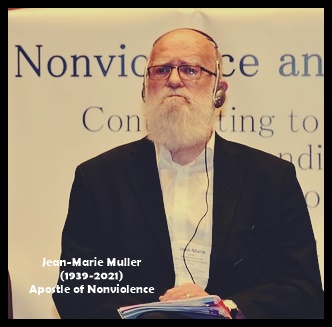
Photo by Rose Marie Berger, Rome, April 2016 Jean-Marie Muller died on December 18, 2021 in Orléans, France. A Christian writer, activist, and philosopher, Muller dedicated his life to promoting nonviolence and making it a method of resistance.
I met Jean-Marie in Rome in 2016 at the landmark gathering on Catholic nonviolence, hosted by the Vatican and Pax Christi International. While I wasn’t familiar with many of his philosophical texts (and he wrote almost exclusively in French), I was familiar with his brave actions as a conscientious objector.
In 1967, while serving as a reserve officer in the French military he turned in his military papers, refused compulsory military service, and applied for conscientious objector status. The French Ministry of Defense declined his request and the case went to trial. Until 1963, France was the only western democracy that did not have legal arrangements for conscientious objectors. The only alternative to military service was five years in prison. (see “Conscientious Objection in France, Britain, and the United States” by Edward R. Cain in Comparative Politics, Jan. 1970.)
During the contentious public debates–heavily influenced by the French colonial adventures in Algeria and Southeast Asia–philosopher Albert Camus pleaded, “Do not leave the CO with the only alternatives of exile or prison.” In 1969, Muller’s case went to trial and gained publicity when the Catholic Bishop of Orlean, Guy-Marie Riobé testified on Muller’s behalf recommending nonviolence as a legitimate defense for Catholics. Riobe said: “One of the central affirmations of Christian hope is that violence is not inevitable, and that, in consequence, history can become nonviolent.” (That same year, Riobé joined with Archbishop Hélder Câmara in public protest against the French weapons sales to Brazil.) Muller was given a three-month suspended prison sentence.
Jean-Marie Muller eventually left teaching to follow in the footsteps of Gandhi and Martin Luther King. In 1973, he took part in a ‘Peace Battalion’, a sea journey to protest against the French nuclear tests in the Pacific, with general Jacques de Bollardière, the priest Jean Toulat, and the ecologist Brice Lalonde. In 1974, together with de Bollardière and other friends, he was the driving force behind the creation of the Mouvement pour une Alternative Non-Violente. In 1984, he became a founding member of the French Research Institute on Nonviolent Conflict Resolution (IRNC).
According to a remembrance in Peace News (Feb-March 2022), “For Jean-Marie Muller, nonviolence was not one moral principle among others, one possible political course amongst many. Nonviolence was, quite literally, what gave meaning to life. In his own words: ‘If violence is destiny, then our life is deprived of all meaning, and our history is absurd. Violence is the negation of the transcendence which gives meaning to our shared human adventure.’” Jean-Marie Muller–presente![]
Learn more about Jean-Marie Muller: Jean-Marie Muller, l’ami de la non-violence (in French) + Jean-Marie Muller: Writer and thinker on nonviolence who influenced Solidarity
-
Janet Gottschalk, MMS: Rest in Power
 “They hate her who reproves in the gate, and they abhor her who speaks the truth. …For I know how many are your transgressions and how great are your sins—you who afflict the righteous, who take a bribe, and turn aside the needy in the gate. … Seek good, and not evil, that you may live … Hate evil, and love good, and establish justice in the gate. … Lt me hear the true music: let justice roll down like waters, and righteousness like an ever-flowing stream.”–Amos 5:11-15, 24
Today we laid to rest my friend Janet Gottschalk. She was 91. It was time. For some reason, that doesn’t make it any easier. Janet was such a good friend to me during her years in Washington, D.C. While I knew of Janet’s work on various Catholic justice committees in DC (she was not one to be overlooked or forgotten!) and as convener of the Alliance for Justice with Susan Thompson, we became friends in 2004 on an extraordinary trip to Venezuela with Maryknoll.
From January 2004 until she moved back to Philadelphia to the MMS motherhouse and then to the Protestant Home in 2015 for more intentional care, we were together nearly every week for meals, Mass, margaritas, Bible study, protests and demonstrations, getting arrested, discussing current events (sometimes from the DC jail holding tank), and various celebrations.
Her participation in the World Conferences on Women, including the 1994 meeting in Beijing, reflected her deep deep solidarity with women on the margins. Her public health classes in Texas on the border–including a pioneering bi-national, bi-lingual community nursing certificate program–opened new generations of students to linking healthcare with social justice. She was a recognized authority and leader in public health around the world. And her students and coworkers never stopped calling on her for her wisdom, expertise, and incisive questions to keep their work grounded in the real experiences of women.
“They hate her who reproves in the gate, and they abhor her who speaks the truth. …For I know how many are your transgressions and how great are your sins—you who afflict the righteous, who take a bribe, and turn aside the needy in the gate. … Seek good, and not evil, that you may live … Hate evil, and love good, and establish justice in the gate. … Lt me hear the true music: let justice roll down like waters, and righteousness like an ever-flowing stream.”–Amos 5:11-15, 24
Today we laid to rest my friend Janet Gottschalk. She was 91. It was time. For some reason, that doesn’t make it any easier. Janet was such a good friend to me during her years in Washington, D.C. While I knew of Janet’s work on various Catholic justice committees in DC (she was not one to be overlooked or forgotten!) and as convener of the Alliance for Justice with Susan Thompson, we became friends in 2004 on an extraordinary trip to Venezuela with Maryknoll.
From January 2004 until she moved back to Philadelphia to the MMS motherhouse and then to the Protestant Home in 2015 for more intentional care, we were together nearly every week for meals, Mass, margaritas, Bible study, protests and demonstrations, getting arrested, discussing current events (sometimes from the DC jail holding tank), and various celebrations.
Her participation in the World Conferences on Women, including the 1994 meeting in Beijing, reflected her deep deep solidarity with women on the margins. Her public health classes in Texas on the border–including a pioneering bi-national, bi-lingual community nursing certificate program–opened new generations of students to linking healthcare with social justice. She was a recognized authority and leader in public health around the world. And her students and coworkers never stopped calling on her for her wisdom, expertise, and incisive questions to keep their work grounded in the real experiences of women.
 Our biggest project together was writing the book Drawn by God: A History of the Medical Mission Sisters from 1961-1991 (published in 2012). In fall of 1967, a small but extraordinary group of women arrived in Rome. Some had suffered through the cataclysmic struggles of World War II on opposing sides. Some were from countries that had only recently thrown off colonial masters. The majority were health professionals from large urban hospitals or rural health clinics. As Medical Mission Sisters, they came to Rome “because the documents of Vatican II touched us deeply and opened us to a whole new way of thinking about ourselves as part of the Christian community, as members of a religious congregation with a mission in the world.” More than 50 years later, Medical Mission Sisters now serve in 20 countries, with leadership growing in Asia and the Global South. These courageous and pioneering women are a shining affirmation that they are, indeed, “drawn by God … to be a healing presence at the heart of a wounded world.” Drawn By God was a labor of love and tremendous work on Janet’s part. She took up the work from Sr. Sara Sommers, who had done remarkable research but was unable to complete the project. Janet took up the work. She was bull-headed and committed to telling the story–even as her eyesight failed and she adapted to using Dragon software for speech to text translation. She literally dictated most of that book! She would use a magnifying light at night to read through the research, then dictate the chapters in the morning. She would then send me the files and I would work on cleaning up the copy. Then we would sit for hours drinking tea and reviewing and making edits. It’s a story that the broader church desperately needs to hear and understand. I’m sorry the book has not received wider circulation. It builds, of course, on the monograph Janet wrote titled She Stepped Out of Her Class: The Life and Times of Agnes McLaren, MD (2003) about the medical doctor who was the inspiration for the founding of the Medical Mission Sisters. Janet was completely dedicated to telling the stories of the bold, brave, brash and bullheaded women of the MMS, whom she loved, struggled with, and laid down her life for–and who did the same for her.
Janet was my friend. One of the great friends of my life. She called me the daughter she would never have. I’m glad her final assignment to Sector Heaven has come through so she can get back to work. We need her brilliance, commitment, unvarnished speech, and skilled organizing at work among the Cloud of Witnesses.–Rose Marie Berger[]
Our biggest project together was writing the book Drawn by God: A History of the Medical Mission Sisters from 1961-1991 (published in 2012). In fall of 1967, a small but extraordinary group of women arrived in Rome. Some had suffered through the cataclysmic struggles of World War II on opposing sides. Some were from countries that had only recently thrown off colonial masters. The majority were health professionals from large urban hospitals or rural health clinics. As Medical Mission Sisters, they came to Rome “because the documents of Vatican II touched us deeply and opened us to a whole new way of thinking about ourselves as part of the Christian community, as members of a religious congregation with a mission in the world.” More than 50 years later, Medical Mission Sisters now serve in 20 countries, with leadership growing in Asia and the Global South. These courageous and pioneering women are a shining affirmation that they are, indeed, “drawn by God … to be a healing presence at the heart of a wounded world.” Drawn By God was a labor of love and tremendous work on Janet’s part. She took up the work from Sr. Sara Sommers, who had done remarkable research but was unable to complete the project. Janet took up the work. She was bull-headed and committed to telling the story–even as her eyesight failed and she adapted to using Dragon software for speech to text translation. She literally dictated most of that book! She would use a magnifying light at night to read through the research, then dictate the chapters in the morning. She would then send me the files and I would work on cleaning up the copy. Then we would sit for hours drinking tea and reviewing and making edits. It’s a story that the broader church desperately needs to hear and understand. I’m sorry the book has not received wider circulation. It builds, of course, on the monograph Janet wrote titled She Stepped Out of Her Class: The Life and Times of Agnes McLaren, MD (2003) about the medical doctor who was the inspiration for the founding of the Medical Mission Sisters. Janet was completely dedicated to telling the stories of the bold, brave, brash and bullheaded women of the MMS, whom she loved, struggled with, and laid down her life for–and who did the same for her.
Janet was my friend. One of the great friends of my life. She called me the daughter she would never have. I’m glad her final assignment to Sector Heaven has come through so she can get back to work. We need her brilliance, commitment, unvarnished speech, and skilled organizing at work among the Cloud of Witnesses.–Rose Marie Berger[]
-
Fourth Week of Advent 2021

Between the last Advent candle and this one, we lost bell hooks, one of our shining stars. We can say, to paraphrase Sojourner Truth, that “bell hooks didn’t die. She went home like a shooting star.”
We’ve been talking this Advent about the Beloved Community – a phrase and practice very dear to the heart of bell hooks. In one of her more recent books, Belonging: A Culture of Place, she offers as a dedication the phrase: “to dancing in a circle of love–to living in beloved community.”
While I read bell hooks books on Black feminist pedagogy early on, it was Belonging: A Culture of Place that brought me back to her writing. When I heard that she’d shared an interview with Wendell Berry about the culture of place in Kentucky, I was intrigued. They are not a pair I would necessarily envision together.
But they are both people of place, people of Kentucky soil, and Appalachian sensibilities. In coming home, both found a deep authentic peace rising out of their respective “beloved communities.”
This fourth week of Advent is dedicated to the angels’ message: “Glory to God in the highest heaven, and peace on earth among those on whom God favor rests!”
This “peace” is not some transactional reward for the chosen, it is instead as Wendell Berry wrote, “the peace of wild things.” The peace of feral angels bring untamed tidings of joy to homeless shepherds.
Wendell Berry writes: When despair for the world grows in me /and I wake in the night at the least sound / in fear of what my life and my children’s lives might be, / … I come into the peace of wild things / who do not tax their lives with forethought / of grief. I come into the presence of still water. / For a time / I rest in the grace of the world, and am free.”
This is the peace that’s on offer to anyone who seeks after God in all the wrong places, who seeks after God on the margins, in the hidden tents and nursing homes and prison cell blocks. Who searches for God’s message in the stars of the night sky and the random encounter with angels living rough.
In the Beloved Community we thirst after this peace. We find it. We lose it. And we help each other find it again.
Our Advent journey is one where we travel back in time, we gather in the present moment, and we live in full expectation of the Coming Child, Immanuel, God-With-Us. The birth of Jesus is an encounter with “the peace of wild things.”
In Belonging, bell hooks offers a description that also describes our four weeks of Advent together. She writes:
“We are born and have our being in a place of memory. We chart our lives by everything we remember from the mundane moment to the majestic. We know ourselves through the art and act of remembering. Memories offer us a world where there is no death, where we are sustained by rituals of regard and recollection. … I pay tribute to the past as a resource that can serve as a foundation for us to revision and renew our commitment to the present, to making a world where all people can live fully and well, and where everyone can belong.”
Here’s “to dancing in a circle of love” Here’s “to living in beloved community.”
Breathe in. Breath out. It’s Advent.
–Rose Marie Berger (delivered as a reflection to Sojourners staff on Dec. 21, 2021, with reading of Matthew 1:18-25 )
-
Third Week of Advent 2021
Scripture: Luke 1: 46-56 (The Magnificat)
Finally, we’ve reached Gaudete Sunday and the week of rejoicing. It takes its name from the first word uttered in the old Latin Mass: Gaudete in Domino semper, itero dico gaudete/Rejoice in the Lord always, again I say rejoice! We light the rose pink candle to mark that we are half way to Christmas, half way on our journey through the bleak mid-winter, through the shadows of fear and uncertainty; halfway to where the our little stars are leading us.
Rabbi Israel Baal Shem Tov, founder of Hasidic Judaism, is credited with returning joy to Judaism. He raised Eastern European Jews up out of the ashes of despair into disciplines for cultivating joy such as ecstatic singing, dancing, and storytelling. One cannot serve God with joy, he said, if one doesn’t daily experience that unbounded spirit of joy within oneself.
Howard Thurman reminds us: “Joy is of many kinds. Sometimes joy comes silently, opening all closed doors and making itself at home in the desolate heart. It has no forerunner, save itself. It brings its own welcome and its own salutation.”
A Beloved Community organizes itself for joy. A theology of joy requires the ability to see beyond the present moment. When the present moment is one of violence and unspeakable injustice, this is very hard to do; and perhaps impossible outside of a community of believers with a narrative history of experiences with God.
A theology of joy is more a perspective than an emotional experience. It is a lived history of God made out of sorrow, suffering, and despair. Dostoevsky described this aspect of joy when he said, “It is not like a child that I believe in Christ and confess him. My hosanna has come forth through the crucible of doubt.”
A Beloved Community holds space for these paradoxical hosannas, this unreasonable joy. It nurtures and cherishes those who have the gift of joy—”Wherever they go, they give birth to joy in others.” A Beloved Community celebrates the ecstatic moments in worship, when as a body we move beyond ourselves. It recognizes joyful awe, a feeling of transcendence that follows a “mountaintop experience” those fleeting moments when we glimpse the face of God in our child, our neighbor, our beloved, or a stranger on the train.
It’s these moments of revelation that produce a joyful response from us. From Mary: “My soul glorifies the Lord and my spirit rejoices in God my Savior” or in my own translation Miryam says “All the lives within me shall be made many in the Lord, the Spirit that breathed over the waters at the beginning now stirs up a mighty fountain within me. Together we leap joyfully into the arms of God.”
Howard Thurman said, “There is a joy that is given.” If you have received it, then “Wherever [you] go, [you] give birth to joy in others. [These ones] are the heavenly troubadours, earth-bound, who spread their music all around and who sing their song without words and without sounds. To be touched by them is to be blessed of God. They give even as they have been given. Their presence is a benediction and a grace. In them, we hear the music and the score. And, in their faces, we sense a glory, which is the very light of heaven.”
Rejoice in the Lord always, again I say rejoice! Breathe in. Breathe out. It’s Advent.
–Rose Marie Berger (delivered as a reflection to Sojourners staff on Dec. 14, 2021, with reading of the Magnificat in Luke 1:46-56)
-
Second Week of Advent 2021
Scripture: Luke 1:39-45 (The Visitation)
Advent is a season in our Christian system of timekeeping when we focus on the “already—not yet” quality of our faith. It’s also a time when our sacred stories measure time by what bodies need, not what empires need.
In the readings from the first week and in these readings, time is measured by women’s bodies in the process of bringing forth life. For some of us, pregnancy examples engage our physical memories; for some of us, it’s metaphorical. Whatever way we experience the pregnancy metaphors, they are in our sacred story to model agape love—a love born of generative self sacrifice, a love that is changeless despite changing circumstances.
At Sojourners in this season we are walking with Adam’s leadership into a practice of “Beloved Community.”
According to Josiah Royce whose work Dr. King studied intensively at Boston University, a Beloved Community must be able to help members form loyalties—or I’d prefer the word “fidelities.” A Beloved Community must be able to help members form loyalties.
Forming loyalties or fidelities, Royce believed, was a result of maturing and allowed for mature decisions on entering into Christ’s self-emptying love and sustaining that deep love and affection in good times and in bad.
Royce believed that as we mature and become more able to form loyalties, we become more able to find devotion to things larger than ourselves. And ultimately we are able to form a “beloved community.”
As fidelities form and mature sacrifices are made, then we begin to glimpse a beloved community forming outside ourselves.
But the beloved community is not something outside of us only.
An external beloved community can only come to mature fruition if we have a beloved community inside ourselves that is also maturing.
Royce said, “the self is a community, for the self is in part its memory, its history.”
In these readings for the second week of Advent, Mary and Elizabeth and Jesus and John are celebrating inner and outer beloved communities.
Mary and Elizabeth are showing their memories and histories in their bodies. Jesus and John are showing their present and futures in their bodies. Thus is the beloved community born within and without. Elizabeth recognizes this as “blessed.” The babies dance in greeting and recognition. The women sing their poetry to one another.
This past week we’ve listened to the Supreme Court debate where life begins, women’s right to bodily integrity and conscience, the role of the state, and exactly when a child becomes autonomous from its mother. We hold the Advent paradox that these “Solomon’s choice” debates are not the final word nor the deepest wisdom.
We also see white men congregating on the National Mall with an agenda that is an existential threat to people of color and anyone else who gets in their way as well as to a democratic way of organizing our society. These are Herod’s dogs snapping and straining their leashes.
The path we walk is full of shadows of death.
Advent is the season of “already—not yet.” The Christ light flickers and calls. Two candles shine for us now. And we say “Blessed is she who has believed that the Lord’s promises to her would be fulfilled!”
To help my inner beloved community mature this Advent, I’ve been trying to spend a little time each day holding my body is stillness and safety and remembering: God loves me unconditionally. Every part of me is beautiful in God’s sight. All my selves—past and future—are God’s beloved community within. All my selves are safe and loved in the arms of God.
Breathe in. Breathe out. It’s Advent.
—Rose Marie Berger (delivered as a reflection to Sojourners staff on Dec. 7, 2021, with reading of the Visitation in Luke 1:39-45)
-
First Week of Advent 2021
Advent is a season in our Christian system of timekeeping when we focus on the “already—not yet” quality of our faith. We make a wreath of greens to remind us of the cycles of the earth, of which we are part, the evergreens whose praise of their creator is unceasing. We set out the four candles so we always know which way we are headed. They are our tiny stars. We follow them through the dark, trying not to lose hold of each others’ hand.
But follow them to what?
At Sojourners in this season we are walking into a practice of “Beloved Community.” And a Beloved Community must be able to carry suffering.
Adrienne Rich, the Jewish-Baptist lesbian feminist radical activist-poet, had this to say about suffering in America in her 1968 poem “The Burning of Paper Instead of Children”:
“Some of the suffering are: it is hard to tell the truth; this is America; I cannot touch you now. In America we have only the present tense. I am in danger. You are in danger. The burning of a book arouses no sensation in me. I know it hurts to burn. There are flames of napalm in Catonsville, Maryland. I know it hurts to burn. The typewriter is overheated, my mouth is burning. I cannot touch you and this is the oppressor’s language.”
“In America we have only the present tense. I am in danger. You are in danger.”
In the past few weeks, we’ve fought like hell to get Julius Jones off death row in Oklahoma. Snatched from the jaws of death, Julius is still alive. But only at the whim of a white governor who stayed the execution two hours before Jones was due to be killed into a “clemency” of “life without parole” for a man likely innocent of his crimes. The “already—and not yet” of Advent.
We’ve also watched three trials play out. In Wisconsin, the question people asked was “Can a white boy travel with an illegal gun and intention to kill people at a Black Lives Matter demonstration, kill them, and get away with it?” That’s not the legal question but it was the moral question. And the answer was “yes.” Adrienne Rich says: “In America we have only the present tense. I am in danger. You are in danger.”
In Virginia, white supremacy organizations were forced into the light by a few brave individuals—including folks we know here at Sojourners. Would they be held accountable for wreaking organized domestic terror on the people of Charlottesville and the nation? The civil court said yes, they would be held accountable, to the tune of $26 million. In a country where hate is well-funded, this verdict strikes a blow.
In Georgia, white supremacist vigilantes, wrapped in the racist impunity of small-town corruption, were found guilty of the murder of Ahmad Arbery by a nearly all-white jury. The conviction hung on the hubristic video taken by one of the plantiffs. This is the “already—and not yet” of Advent.
This is the landscape of our Advent journey. The news the angel brings is always only partial.
The angel of justice sweeps her sword slowly across the field of history.
But we are here. We light our first candle. We reach out in the dark to take our neighbor’s scarred or frightened hand. We form the circle of the Beloved Community. And we walk forward saying “yes” to what God is asking of us.
Breathe in and breathe out. It’s Advent.
–Rose Marie Berger (delivered as a reflection to Sojourners staff on Nov. 30, 2021, with reading of the Annunciation in Luke 1:26-38)
-
How do members of an organization live through major change well? Reflections on Mark 9:30-37
“Today, all of us are living in a Great Transformation. The old is falling away. A new center is emerging. Let us draw one another close and find new ways of building that put Jesus’ foundational people at our center.” Leadership themes in Mark 9.
Please support Catholic Women Preach, who made this opportunity possible. Transcript here.
-
Paul G. Compton (1944-2021)
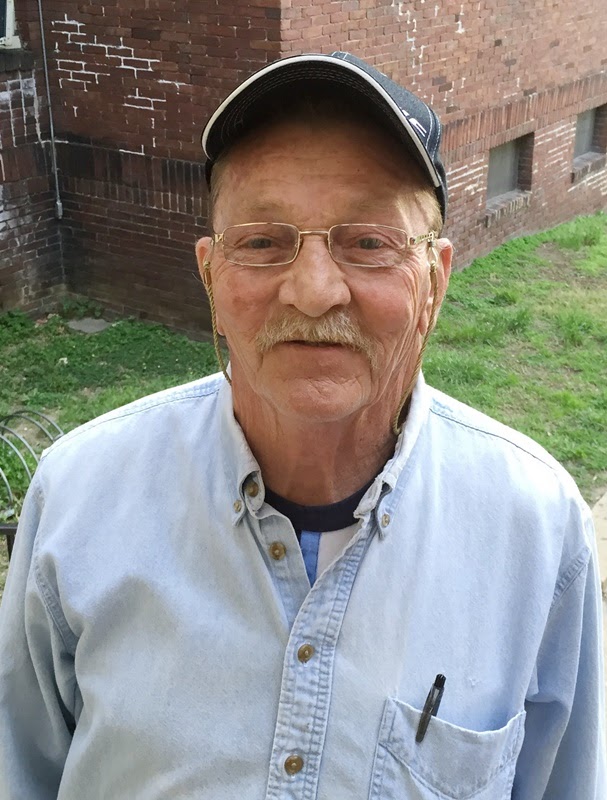
“Mr. Paul” Compton (photo by Heidi Thompson, 2018) Paul Gene Compton, 76, of Washington, D.C., passed away on 7 May 2021 while visiting the Veterans Affairs Medical Center in Washington, D.C. A rosary was held on 10 May 2021 at The Dorchester in Washington, D.C., by various members of the community and women from Sacred Heart Catholic Church. Cremation arrangements were made by Mr. Darryl Salley at Capitol Mortuary in Washington, D.C.
Paul Gene Compton was born in the Riverside section of Morgantown, Monongalia County, W.V., along the Monongahela River and close to the Pennsylvania border in the north-central part of West Virginia to Roy Compton and Xantippe Corley on August 30, 1944.
His parents were both from Philippi (Barbour County), WV, on the Tygart Valley River and married when Roy was 22 and Xantippe was 16. When they got married Roy was living in Paris, WV, and Xantippe in Weaver, WV, an unincorporated coal mining community in Randolph County. They were married by Rev. Joseph Day at the bride’s residence in Weaver, on Nov. 21, 1914.
Paul left school in the 9th grade. He moved up to New Galilee (Beaver County), PA, in “Pensatucky” where he had family in the Beaver River watershed along Jordan Run. He was living and working in that area when his military draft number came up in 1963. At age 19, Paul was drafted into the U.S. Army on Sept. 17, 1963. He was a “Vietnam-era” veteran who, “luckily” as Paul said, was sent to the Pusan Perimeter in Korea as part of the Army’s 5th Battalion, 82nd Artillery, the “Black Dragons.” He served as an expert rifleman in the general infantry Army for two years in Korea. On Aug. 8, 1965, he was given an honorable discharge. He left the Army as Private First Class (E-3). Between 1963 when Paul was drafted and 1973 when the Paris Peace Accords were signed, 65 young men from rural Beaver County, PA were killed in that war. It was not a time that he liked to talk about.
Upon returning stateside, Paul returned to Beaver County, PA, to the New Galilee-Darlington areas to work in the steel mills and factories. Jones and Laughlin, Babcock and Wilcox, and Crucible all had steel mills in Beaver County. The glass factories, such as Flint Glass, Phoenix Glass, and Fry Glass, were also major employers in Beaver County. More than 35,000 Beaver County residents made their living from steel from the 1950s-1970s. That trend reached its plateau in the late 1970s, when more than 60 percent of the total local workforce was tied to the industry. Jones & Laughlin Steel Co. in Aliquippa, American Bridge Co. in Ambridge, Crucible Steel in Midland, and Babcock & Wilcox Steel in Beaver Falls, Koppel and Ambridge made up the majority of those jobs.
When the bottom fell out of big steel in the late 1970s and early 1980s, it hit Beaver County like a cannonball to the stomach. Paul was forced to find work elsewhere and came to Washington, D.C., where he worked a variety of jobs. Paul lived and worked around the Columbia Heights-Adams Morgan area. He lived at Cliffbourne Place NW, then 18th and Calvert NW, and eventually in 1999 Paul moved to 2724 11th Street NW, a small apartment building with 20 other families. Paul worked at the famous Millie & Al’s pizza joint in Adams Morgan. Then, in 2004, started his own business, Compton’s Painting & Plastering, until 2020. He was a known face in the neighborhood with his white van always waving to neighbors as he drove around.
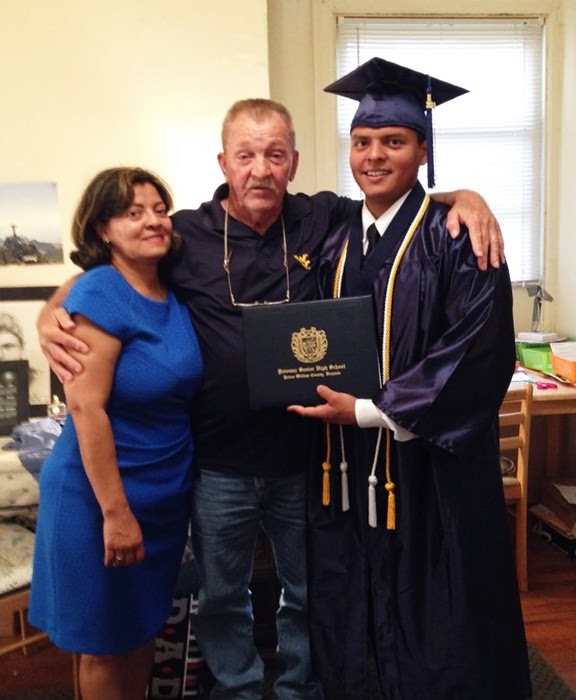
Velbeth, Paul, and Michael In 2003, he met Velbeth Ivan Cruz at 2724 11th Street NW and her son Miguel “Michael” Ivan Aguilera, who was four at the time. As Velbeth says, “In the afternoons, Paul was always at the window of his apartment waiting for the children to come from school to give them sweets. I would pick up Michael at the building where he was watched over while I was at work and Paul and I would talk. On an April afternoon with the air smelling of flowers, Paul asked me about always seeing me alone with my son. I told him yes, Mr. Compton. He said, ‘I’m alone and I’m looking for a wife.’ I smiled and was startled! God was allowing me to have a family again.”
Paul and Velbeth were married on April 17, 2003, in Arlington, Va. When they married, Paul told Velbeth that in the mountains of West Virginia there were bears and they ate people. One day, Paul took Velbeth and Miguel to meet his family in Morgantown, WV. On an afternoon with spectacular weather he drove Velbeth and Mike up to the mountains near the house of Paul’s sister NuNu. Velbeth, fearing getting lost, was thinking about what Paul had told her about the bear. So she took kernels of corn with her. While Paul drove them up a path through the forest, Velbeth threw kernels of corn, in case something happened to them, they could find their way back. This day was Velbeth’s first trip to the mountains. She was scared to death and her young son did not know much about the dangers in the mountains. Both Velbeth and Miguel are very grateful to God for Paul. He was a loving, respectful man. He was always there for them. He always called Velbeth ‘Mami.’
“Señor Paul,” as he was known to many of his neighbors, was an avid sports fan. He loved watching the LSU Tigers play football (“Hold that tiger!”) and was a card-carrying member of the Steelers Nation. He loved watching old Western movies, telling jokes, and playing cards. He loved ice cream! He was “Tio Pablo” to several generations of children at 2724 11th Street NW and a strong member of the 2724 11th Street NW Tenants Association. “Mr. Paul” minced no words when it came to the slumlord who owns that building and he fought every day to get the money he and his neighbors deserved.
He was preceded in death by his parents Roy Compton and Zantippie Corley Compton; his sisters Evelyn “Nunu” Compton Sweetnich (Nunu died at age 95 on Jan. 6, 2020, and was a seamstress for Morgan Shirt Factory for 30 years), Ercelene Compton Newhouse, and Betty Compton Pieri; and his brothers Albert Compton, James “Red” Compton, and Larry Compton.
Paul Gene Compton is survived by his wife Velbeth Ivan Cruz Compton, his son Miguel “Michael” Ivan Aguilera, and extended family around Morgantown, WV, and Darlington, PA, as well as many friends and neighbors in Washington, D.C. who miss him dearly. Now God has called Paul to be at God’s side and Paul will be an Angel in heaven. Rest in peace Paul Compton, you will always be in the heart of your wife and your son Miguel.–Rose Marie Berger
-
‘Advancing Nonviolence’ now available in U.S.

Original book available for purchase in the United States. Click here. NEW! The Advancing Nonviolence STUDY GUIDE is now available here.
The new study guide is developed by the Catholic Nonviolence Initiative education committee and includes video clips, study questions, and other resources. It’s available as a free, downloadable PDF. Perfect for the classroom or adult learning!
Learn more about the original book below.
Advancing Nonviolence and Just Peace in the Church and the World is the fruit of a global, participatory process facilitated from 2017-2018 by the Catholic Nonviolence Initiative (CNI), a project of Pax Christi International, to deepen Catholic understanding of and commitment to Gospel nonviolence.
Edited by: Rose Marie Berger, Ken Butigan, Judy Coode, Marie Dennis
This book includes biblical, theological, ethical, pastoral and strategic resources that might serve as a contribution to Catholic thought on nonviolence.
It details how:
- Nonviolence is a core Gospel value, constitutive of the life of faith.
- Nonviolence is essential to transforming violence and injustice
- Nonviolence is a universal ethic
- Nonviolence is a necessary foundation for culture of peace.
Published by: Pax Christi International
Advancing Nonviolence and Just Peace in the Church and World is now available from a U.S. distributor. Place your order!
-
Video: The Power of Nonviolence – Action and Resistance
Rose Marie Berger, Jean Stokan, and Scott Wright join Pax Christi USA director Johnny Zokovich to discuss “The Power of Nonviolence – Action and Resistance.”
Rose Marie Berger is senior editor of Sojourners magazine and a co-editor of Advancing Nonviolence and Just Peace; Jean Stokan is a member of the Institute Justice Team for the Sisters of Mercy of the Americas and former Pax Christi USA Policy Director; and Scott Wright is director of the Columban Center for Outreach and Advocacy.
This 1:17 hour video is a great primer on active nonviolence today–and includes the 11-minute Pax Christi video on nonviolence that played at the Vatican in December 2020.
-
Subscribe
Subscribed
Have a WordPress.com account? Log in now.

