-
Pope Francis: ‘Please, take back your check, burn it.’
To understand this well: when one is sick one goes to the doctor; when one feels himself a sinner one goes to the Lord. However, if instead of going to the doctor, one goes to a magician, one is not healed. So many times we do not go to the Lord, but prefer to go on mistaken paths, seeking outside of Him justification, justice and peace. God, says the prophet Isaiah, is not pleased with the blood of bulls and lambs (v. 11), especially if the offering is made with hands soiled with the blood of brothers (v. 15). However, I think of some benefactors of the Church who come with an offering – “Take this offering for the Church” – which is the fruit of so many exploited, mistreated, enslaved people with badly paid work! I would say to these people: “Please, take back your check, burn it.” The people of God, namely the Church, does not need dirty money; she needs hearts open to God’s mercy. It is necessary to approach God with purified hands, avoiding evil and doing good and justice. How beautiful is the way the prophet ends: “Wash yourselves clean! Put away your misdeeds from before my eyes; cease doing evil; learn to do good.Make justice your aim: redress the wronged, hear the orphan’s plea, defend the widow” (Isaiah 1:16-17). … —Pope Francis, general audience (March 2, 2016)
-
Watershed Discipleship: A Conversation between Ched Myers, Denise Nadeau and Rose Berger
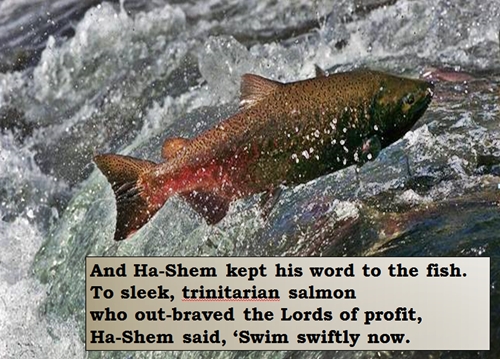
Excerpt from Rose Berger’s poem “Prophecies from the Watershed Conspiracy” “Watershed Discipleship: A Conversation between Ched Myers, Denise Nadeau and Rose Berger” is now available online for $9.50 (recorded March 22, 2016). The purchase price supports the transformational discipleship work at Bartimaeus Cooperative Ministries.
This 1.5 hour webinar celebrated World Water Day with a conversation about various strands of the watershed discipleship vision. Ched recently edited an anthology entitled “Watershed Discipleship: Reinhabiting Bioregional Faith and Practice” (Wipf & Stock, to be published later this year). Denise Nadeau wrote the Foreword to the volume; joining us from Vancouver Island, she talked about the indigenous “Waterwalking” movement. Rose Berger contributed poetry to the volume. Rose shared her poetry and some of the symbolism and meaning behind the beautiful words.
Purchase webinar here.
-
Rose Marie Berger: Easter’s Peculiar Hope

Berta Caceres (1971-2016) The news this month about the assassinations of Bertha Caceres and Nelson Garcia in Honduras and Vincent Machozi in the Democratic Republic of Congo last week are painful reminders of what may be required of us in following Jesus. At least we know we’ll be in the very best of company! I add these names to the church’s litany of saints.
Below is an Easter reflection I wrote several years ago and thought it appropriate now:

Vincent Machozi, DRC (1965-2016) In 2005, on a spring trip to El Salvador, I wasn’t expecting to find Easter. It’s definitely a “Good Friday” kind of country, one that has carried the cross for a long time. However, on Easter morning I found myself heading up a gravel road into the mountains of Morazán near the Honduran border, to the site of the El Mozote massacre.
In December 1981, soldiers of the Salvadoran army’s elite, School of the Americas-trained Atlacatl Battalion surrounded the village of El Mozote and murdered more than 900 men, women, and children. “As far as is known,” wrote Alma Guillermoprieto, who broke the El Mozote story in The Washington Post, “this was the single largest massacre to take place in this hemisphere in modern times.”
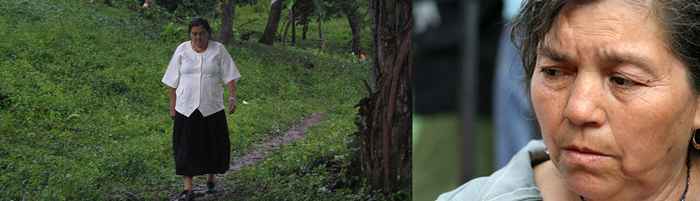
Rufina Amaya (1943-2007) As we drove past the Rio Sapo and into the village, a few children approached the car. They were eager to show us the memorials and take us to the pits where the Argentine Forensic Anthropology Unit had unearthed bodies and bone fragments with strips of cloth still attached. Especially they wanted to show us the plaque placed over the mass grave of 140 children and take us through the rose garden planted in their memory. There is also a rough curved stone wall, not too far from the church, on which the names of the dead are written. It’s watched over by the iron silhouette of a family. (more…)
-
The Great Vigil of Easter
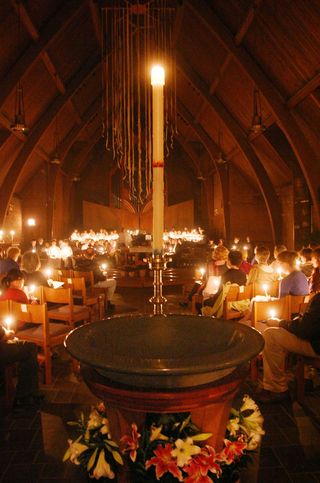 …This is the night of which it is written:
The night shall be as bright as day, dazzling is the night for me,
and full of gladness.
The sanctifying power of this night dispels all wickedness,
washes faults away, restores innocence to the fallen, and joy to mourners,
drives out hatred, fosters concord, and brings down the mighty.
On this, your night of grace, O holy Father,
accept this candle, a solemn offering,
the work of bees and of your servants’ hands,
an evening sacrifice of praise, this gift from your most holy Church.But now we know the praises of this pillar,
which glowing fire ignites for God’s honor,
a fire into many flames divided,
yet never dimmed by sharing of its light,
for it is fed by melting wax,
drawn out by mother bees to build a torch so precious. …–excerpt from Exsultet
-
Thinking about the Cellist of Sarajevo on the Day Radovan Karadzic is Found Guilty of Genocide
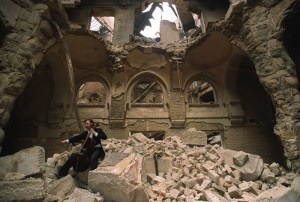
Vedran Smailovic plays cello in the rubble of Sarajevo’s National Library, 1992. This week, after more than 20 years, Radovan Karadzic, the “Bosnian butcher,” has been found guilty of war crimes and genocide by the UN war crimes tribunal. Since Slobodan Milosevic died before his trial, this is the first major conviction of the leaders of the Balkan war and the slaughter of more than 100,000 people in the former Yugoslavia.
I was greatly affected by that war — and traveled twice to the region during that time. Here’s one memory:
Sarajevo Orchestra cellist Vedran Smailovic playing Albinoni’s G minor adagio once a day for 22 days in 1992 outside the bakery where a Serb shell had killed 22 people. It was the most courageous act of art in war that I had ever seen. “My mother is a Muslim and my father is a Muslim,” Mr. Smailovic said, “but I don’t care. I am a Sarajevan, I am a cosmopolitan, I am a pacifist.” Then he added: “I am nothing special, I am a musician, I am part of the town. Like everyone else, I do what I can.”
In 1994 famed cellist Yo-Yo Ma played a newly composed piece by English composer David Wilde at the International Cello Festival in Manchester, England. The piece entitled “The Cellist of Sarajevo” haunted those who were there. Pianist Paul Sullivan described it this way in Readers Digest:
“When he had finished, Ma remained bent over his cello, his bow resting on the strings. No one in the hall moved or made a sound for a long time. It was as though we had just witnessed that horrifying massacre ourselves. Finally, Ma looked out across the audience and stretched out his hand, beckoning someone to the stage. An indescribable electric shock swept over us as we realized who it was…
Smailovic rose from his seat and walked down the aisle as Ma left the stage to meet him. They flung their arms around each other … everyone in the hall erupted into a chaotic, emotional frenzy… We were all stripped down to our starkest, deepest humanity at encountering this man who shook his cello in the face of bombs, death, and ruin, defying them all.”
-
A Cooper’s Hawk in the Wild Kingdom
 “But the hawk and the porcupine shall possess it, the owl and the raven shall dwell in it. He shall stretch the line of confusion over it, and the plummet of chaos over its nobles. They shall name it No Kingdom There, and all its princes shall be nothing.”–Isaiah 34:11-12
This evening we sat on the back porch that faces the alley and watched a Cooper’s hawk disembowel a hefty urban rat while perched on the roof of a neighbor’s rowhouse. It was quite magnificent, even if gory. The hawk’s feathers were backlit by the setting sun. The doves, starlings, and sparrows were all remarkably quiet while this raptor controlled the high ground of the alley.
According to Isaiah, one of the signs of the end of empire is when the kingdom is possessed by the hawk.
-
Maundy Thursday: The Crux of the Matter is Love
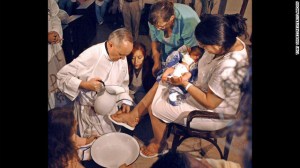 Holy Thursday or Maundy Thursday reminds us that the commandment to love is the crux of our discipleship. Perversely, some in the Catholic hierarchy have chosen Holy Thursday to venerate a male priesthood, male apostolic succession, and clericalism. While Holy Thursday is also clearly about the institution of the Eucharist, it is equally clearly not about male essentialism. The word “maundy” comes from the Latin mandatum, the first word of the phrase “Mandatum novum do vobis ut diligatis invicem sicut dilexi vos” (“A new commandment I give unto you, That you love one another; as I have loved you” John 13:34).
This year, Pope Francis has “changed the rubrics of the Roman Missal” to move us forward toward a more faithful celebration. He has revised the foot-washing ritual on Holy Thursday to indicate that the rite should no longer be limited to men and boys, but also include women and young girls. Those participating in the ceremony should be representative of the entire community.
Below is an excerpt from Rite & Reason: If Jesus can wash his followers feet women can lead the church by Soline Humbert (Irish Times, Mar 22, 2016):
When Jesus washed his disciples’ feet he took on not just a servant’s role but a female servant’s role, for it was mostly women and girls who performed this task: servants for their masters and important guests, wives for their husbands.
Significantly, the only other person in the Gospels who washes feet is a woman, who washes Jesus’s own feet (Luke 7), and in Paul’s letter to Timothy (5:10) it is specified that “the widows must wash the feet of the saints”.When Jesus washed His followers’ feet He subverted not just the master/servant power relationship but also the male/female relationship. Jesus made Himself a servant girl, a female slave, a wife. He transgressed the strict rules delineating gender roles.
When He removed his outer vestment, Jesus stripped Himself of His male privileges of power and superiority. He wrapped a towel around His waist, as females did. No wonder Peter first objected so vehemently!
It is therefore deeply ironic that the official liturgy remains so wedded to a strict sexist, patriarchal division of gender roles as does the theology and organisation of the institutional church. Because of their gender women remain excluded from governance, decision making and all the ordained ministries. …–Soline Humbert
Read Humbert’s whole commentary.
-
Palm Sunday
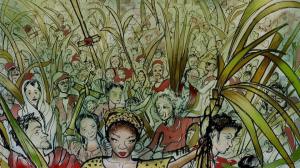
“We need to undomesticated Palm Sunday in our churches. Jesus was staging a kind of counter-demonstration. While Pilate rode into the city on a military stallion, Jesus entered on a borrowed donkey, symbolized sovereignty—but also Zechariah’s promise that Yahweh would one day banish the war horse forever! The procurator claimed the Pax Romana, the Nazarene a ‘Pax Christi.’ Pretty subversive stuff—and our churches have the habit of recreating that ‘demonstration’ in our Palm Sunday liturgies. But to really represent this gospel story in our world, we need to re-contextualize its symbols into our political moment, and re-place our witness back into public space.”–Ched Myers

-
Happy St. Patrick’s Day! From Hardy Drew and the Nancy Boys
Happy St. Patrick’s Day! In 2008, just before the historic U.S. elections, I was in Ireland. The Irish were crazy for “Barack O’Bama,” including the craze that developed around this song by Hardy Drew and the Nancy Boys. (To read more about that Irish drive through Obama’s ancestral home in County Offaly, go here.) So enjoy the original 2008 video of “There’s No One as Irish as Barack O’Bama.” There have been lots of variations since this one.
And here’s a little history on why everyone should be Irish on St. Patrick’s Day:
St. Patrick’s Day had occasionally been a forum for social protest prior to the famine, but strong emotions aroused by the effects of starvation and mass emigration, together with the crystallization of nationalist sentiment, engendered a situation where 17 March became a regular focus for claims about a separatist Irish identity. On St Patrick’s Day, 1846, two ships, the Thatis and the Borneo, harbored in Limerick, illegally hoisted the green flag of Ireland in ‘honor of the national festival.’ The flags were quickly removed on orders of the British war steamer, the Pinto, but not before ‘the feelings of the multittude’ watching and cheering the flag from the harbour wall, ‘were desperately excited.’ This demonstration, while illegal, was ultimately an unimportant affair but it did demonstrate how nationalist feelings could find a voice on 17 March.
During the 1850s, the expression of such sentiments become far more vocal, and, for the British authorities in Ireland, increasingly threatening. This related, largely, to the vexed issue of land ownership in Ireland. In the wake of the famine, the Tenant Right Movement emerged to champion the cause of the tenant and to campaign against high rents, insecure tenure of land and summary eviction. The movement held its key public meetings on St. Patrick’s Day: it was an occasion on which many people were granted a holiday by their employers in honor of the day’s religious significance, so were free to attend. On St Patrick’s Day in 1859 the Tenant Right Movement staged mass meetings in Donhill, County Tipperary and Castlecomber, County Kilkenny, which attracted crowds of some 30,000 and 20,000 people respectively.”– Mike Cronin and Daryl Adair (from The Wearing of the Green: A History of St. Patrick’s Day)
-
God to Rich: Read the Fine Print
 “If you have taken a pledge from the poor,” says God to the rich, “do not say he is your debtor and you are therefore justified in retaining his garment. Remember you are my debtor, your life is in my hand. I return you all your senses and all your faculties after your sleep every day.” —Midrash Tanhuma
-
Subscribe
Subscribed
Have a WordPress.com account? Log in now.

