-
“There Is A Candle” by Rumi
There Is A Candle
by Rumi
 There is a candle in your heart,
ready to be kindled.
There is a void in your soul,
ready to be filled.
You feel it, don’t you?
You feel the separation
from the Beloved.
Invite Him to fill you up,
embrace the fire.
Remind those who tell you otherwise that
Love
comes to you of its own accord,
and the yearning for it
cannot be learned in any school. -
Merton’s Mature Lent
Part of an adult experience of Lent is wrestling with thought’s like Merton’s below:
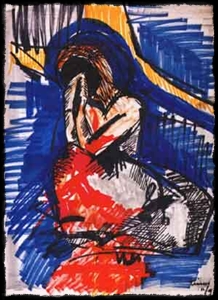
Where is my dignity? Timur I. Poerwowidagdo, Indonesia How many people are there in the world of today who have “lost their faith” along with the vain hopes and illusions of their childhood? What they called “faith” was just one among all the other illusions. They placed all their hope in a certain sense of spiritual peace, of comfort, of interior equilibrium, of self-respect. Then when they began to struggle with the real difficulties and burdens of mature life, when they became aware of their own weakness, they lost their peace, they let go of their precious self-respect, and it became impossible for them to “believe.” That is to say it became impossible for them to comfort themselves, to reassure themselves, with the images and concepts they found reassuring in childhood.
Place no hope in the feeling of assurance, of spiritual comfort. You may well have to get along without this. Place no hope in the inspirational preachers of Christian sunshine, who are able to pick you up and set you back on your feet and make you feel good for three or four days-until you fold up and collapse into despair.–Thomas Merton
-
“The Trees” by Philip Larkin
The Trees
 The trees are coming into leaf
Like something almost being said;
The recent buds relax and spread,
Their greenness is a kind of grief.Is it that they are born again
And we grow old? No, they die too,
Their yearly trick of looking new
Is written down in rings of grain.Yet still the unresting castles thresh
In fullgrown thickness every May.
Last year is dead, they seem to say,
Begin afresh, afresh, afresh.The Collected Poems by Philip Larkin
-
Terry Tempest Williams at Capitol Coal Plant
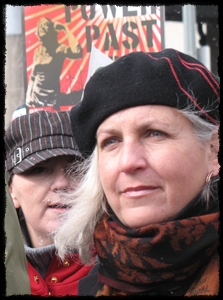 I’ve enjoyed Utah-based essayist Terry Tempest Williams since I read her 1991 book “The Clan of One-Breasted Women” (“I belong to a Clan of One-Breasted Women. My mother, my grandmothers, and six aunts have all had mastectomies. Seven are dead. The two who survive have just completed rounds of chemotherapy and radiation.”) about her family’s experience living as Downwinders from the Nevada Desert Nuclear Test Site.
A few weeks ago, at the Artists for Climate Action event in downtown D.C., I heard her speak. She highlighted some work she’d been doing with creative writing students in collecting oral histories from coal-mining communities in Wyoming. It turned into “an unprecedented experiment in the art of listening,” as Alexandra Fuller described it in her New York Times OpEd piece. You can read the students’ Weather Reports and see photos they took during their community listening project.
Terry’s newest book, Finding Beauty in a Broken World
, is a study of the art of mosaics, which she then applies to examining ecological mosaics in Bryce Canyon and the to the broken land of Rwanda attempting the art of putting what’s broken back together again in a shape that is beautiful.
I saw her at the Chesapeake Climate Action Network demonstration on Monday to close down or convert to solar the Capitol Hill Power plant (which runs on 49 percent coal supplied by Peabody Energy). There was a great line up of Kentucky essayist Wendell Berry, Methodist environmental leader Bill McKibben, head of NASA scientist James Hansen, country music star Kathy Mattea, and Terry Tempest Williams all under the banner “Save Our Mountains.” It was a beautiful sight to see.
-
Women with Attitude
 There’s a great exhibition in D.C. through the end of May called Chicana Art and Experience: Mujeres con Garbo. It’s an exhibition of prints, paintings, posters, and photographs by women who reflect on the experiences and struggles of Mexican Americans.
I love this serigraph (above) by artist Barbara Carrasco of my hero Dolores Huerta. So vibrant and picante! I’ve met Ms. Huerta twice and it was a great honor.
Here’s an excerpt from the curator’s notes:
This exhibit concentrates on works of art that depict the specific concerns of working Chicanas—organizing, immigration, women’s rights, health care, workplace safety, housing, community and cultural identity. The title of the show comes from Juana Alicia’s poster “Women with Attitude/Mujeres con Garbo.” The Spanish word garbo is more complex than the English word “attitude”; it combines assertiveness with grace, elegance and agility—a perfect way to sum up the work in this exhibit.
-
Empower Women, Empower Nations
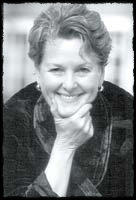 Ambassador Swanee Hunt has a great post on the International Colloquium on Women’s Empowerment, Leadership Development, International Peace and Security held in Monrovia, Liberia, last weekend in honor of International Women’s Day.
I’ve admired Swanee Hunt since I met her in Sarajevo during the war years and saw the work she was doing with Bosnian women war-survivors. I interviewed her for Sojourners in 2004 about the Women Waging Peace project she founded and her book This Was Not Our War.
Here’s an excerpt from her blog post A Historic Gathering in Monrovia:
I thought the most powerful speaker was Governor-General Michaelle Jean of Canada, representing Britain’s Queen Elizabeth II. Haitian by birth, she spoke eloquently of what she has learned “from the incredibly courageous women of Liberia … Female leaders who see every ordeal as an opportunity … who measure their success by what they give, rather than what they take. You exclude women, you fail. You empower women, you empower a nation. Women never forget that life is our most precious asset.”
To read the Democracy Now! interview with world-renowned human rights lawyer and advocate and former president of Ireland Mary Robinson on her perspective from the Monrovia women’s meeting, go here.
-
The Sin of the Male CEO
 The March 7 issue of the British Catholic newspaper The Tablet has an intriguing article by Tina Beatie, Deadlier Sin of the Male, that I recommend reading. Beatie is a professor in Catholic studies at Roehampton University in Bristol.
Apparently the “Pope’s personal theologian” recently endorsed a theory that “men and women sin differently.”
“When you look at vices from the point of view of the difficulties they create,” Msgr Wojciech Giertych, theologian to the papal household, wrote in L’Osservatore Romano, “you find that men experiment in a different way from women.”
Beatie reminds us that this approach has been explored by feminist theologians for at least 50 years since Valerie Saiving published her groundbreaking essay titled The Human Situation: A Feminine View.
Beatie does an excellent job of separating the reality of “gendered sin” from the hierarchy of sin. As you might imagine, the Pope’s theologian not only thinks men and women have different temptations but also that women’s are more dangerous than men’s. (The gall of that guy!)
And as an added twist, Beatie examines the male sin of greed in light of the economic collapse and the fact that “among the leading bankers that have brought the British economy to its knees there are no women.” This is mirrored in the U.S. situation.
Check out Tina Beatie’s article below:
In a recent article in L’Osservatore Romano, the Pope’s personal theologian, Mgr Wojciech Giertych, endorsed a theory by a 95-year-old Jesuit, Fr Roberto Busa, that men and women sin differently. Based on the Seven Deadly Sins, the list of men’s sins includes lust at the top and greed at the bottom, while women’s sins have pride at the top and sloth at the bottom. As usual when the Vatican says anything mildly controversial about sex, the news was greeted with a flurry of media interest. But in fact, it’s not news at all, since feminist theologians have been writing about the gendering of sin for nearly 50 years.
In 1961, Valerie Saiving published an essay in which she appeals for greater awareness of the ways in which concepts of masculinity and femininity shape the ways in which we experience sin. Her article has had a formative influence on much feminist theology, and her theories have been developed and refined by two generations of female scholars. At first glance, Saiving’s theory appears to contradict that of the Vatican. She writes that sins associated with femininity “have a quality which can never be encompassed by such terms as ‘pride’ and ‘will-to-power’.” Rather, women are likely to be guilty of “triviality, distractibility, and diffuseness”; of “inability to respect the boundaries of privacy; sentimentality, gossipy sociability, and mistrust of reason – in short, underdevelopment or negation of the self”. Yet perhaps this is what Mgr Giertych means when he refers to “pride”, since he cites as evidence the example of women Religious in convents, who “are often envious of each other over little things, but when the church bell rings, everyone goes to the chapel to sing vespers.” Monks, on the other hand “aren’t often interested in each other and, therefore, aren’t jealous, but when the church bell rings, few take part in common prayer.” Whatever else these anecdotes reveal, the behaviour of those nuns might suggest envy (which is second on the list of women’s sins), but they seem far more to do with triviality and “gossipy sociability” than with pride.
-
Newsweek Story ‘Our Mutual Joy’ Wins Religion Award
The Newsweek magazine cover story Our Mutual Joy on the Bible and gay marriage that I highlighted on this blog (The Good Book and Gay Marriage) has won a 2009 Wilbur Award from the Religion Communicators Council.
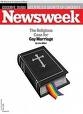 Lisa Miller’s story prompted more than 100,000 e-mail responses and more than 2 million hits on the magazine’s Web site after it was published on Dec. 15. It also won in the magazine category for the prize that recognizes outstanding work in the secular media.
My friend Bill Kellermann was asked to be one of the online commentators for Newsweek on “a faith-based debate on Scripture and what it says about Gay Marriage.” Bill offered a lively and biblically in-depth exchange with Barrett Duke from the Southern Baptist Convention’s Ethics & Religious Liberty Commission. You can read it here.
The Wilbur Award judges said that Miller’s article is a fine example of the purpose of the Wilbur Awards, which is to recognize “excellence in the presentation of religious issues, themes and values.”
-
Atwitter with Prop 8
The California Supreme Court is at this moment debating the Constitutional integrity issues raised by the Prop. 8 ballot initiative.
I find the Twitter version of Constitutional law fascinating – inalienable rights in 140 characters or less:

Justice George asked wasn’t the scope of Prop 8 smaller than the rights given by the court in the in marriage casesJustice Kennard: Assuming this court were to uphold Prop 8, you have the right to go to the people. Wouldn’t you have that right?
Justice Kennard: Is it still your view that gays and lesbians are left with nothing?
Justice Kennard: Would you agree that Prop 8 did not take away … bundle of rights that this court articulated in marriage cases
(At this rate I could get a law degree in 140 minutes!)
I appreciated Logan Laituri’s recent commentary on The Sad State of Dialogue on Civil Unions. As a nation, we need educate ourselves toward a more complex understanding and language around democracy, rights, human dignity, moral authority, and the common good than we currently have. What is too simple dies because it can’t adapt to change.
Here’s an excerpt from Logan’s piece:
Ever since the November elections, I have been unable to turn my attention from the issue of civil unions and same-sex marriage. My interest was piqued when I heard of my own home state of California’s passage of Proposition 8. So when I received an invite by Facebook to a public hearing before Hawaii’s House Judiciary committee to discuss House Bill 444 (HB444), I enthusiastically clicked “will attend.”
Basically, HB444 extends the same rights, benefits, protections, and responsibilities of spouses in a marriage to partners in a civil union. For the most part, I am still undecided about how I feel concerning same-sex marriage, but that may be due to my diminished view of the state’s role in sanctioning marriage in general. It seems to me that renaming a legally recognized intimate relationship to allow the religious-industrial-complex to retain its continued hold on the title “marriage” could be a decent compromise in the eyes of the law. I was (and admittedly may remain) very uninformed on the rationale for supporting or opposing the measure, so I was expecting an invigorating debate.
What I got was something much less. The opponents of the bill relied primarily on a 1998 vote to amend the state’s constitution, which defined marriage as being between a man and woman. Furthermore, at least two opponents stated it was simply against their party’s platform to approve civil unions (way to think for yourselves, folks).
Read the rest of Logan’s post here.
-
Merton on Falling Through the Roof
Thomas Merton was an Trappist monk, mystic, and writer who shaped modern American Catholicism. He lived in Kentucky for most of his life.
In the afternoon I went out to the old horse barn with the Book of Proverbs and indeed the whole Bible, and I was wandering around in the hayloft, where there is a big gap in the roof. One of the rotting floorboards gave way under me and I nearly feel through.
 Afterwards I sat and looked out at the hills and the gray clouds and couldn’t read anything. When the flies got too bad, I wandered across the bare pasture and sat over by the enclosure wall, perched on the edge of a ruined bathtub that has been placed there for the horses to drink out of. A pipe comes through the wall and plenty of water flows into the bathtub from a spring somewhere in the woods, and I couldn’t read there either. I just listened to the clean water flowing and looked at the wreckage of the horsebarn on top of the bare knoll in front of me and remained drugged with happiness and with prayer.–Thomas Merton
Entering the Silence, Journals Volume 1. Jonathan Montaldo, editor (San Francisco: HarperSanFrancisco, 1997, p 363)
-
Subscribe
Subscribed
Have a WordPress.com account? Log in now.

