-
Pirates or The Horn of Africa’s ‘Greenpeace’?
 What’s behind the Somali “pirates”? Are they sea-thieves or rebels against empire? What are we not being told?
More importantly, who’s dumping nuclear and medical waste in Somali waters? I guarantee you, it’s not the Somalis. Is it possible that these “marauders” are the Horn of Africa’s desperate version of Greenpeace?
Read Johann Hari’s article You Are Being Lied To About Pirates.
Here’s an excerpt:
The words of one pirate from that lost age, a young British man called William Scott, should echo into this new age of piracy. Just before he was hanged in Charleston, South Carolina, he said: “What I did was to keep me from perishing. I was forced to go a-pirateing to live.” In 1991, the government of Somalia collapsed. Its nine million people have been teetering on starvation ever since – and the ugliest forces in the Western world have seen this as a great opportunity to steal the country’s food supply and dump our nuclear waste in their seas.
Yes: nuclear waste. As soon as the government was gone, mysterious European ships started appearing off the coast of Somalia, dumping vast barrels into the ocean. The coastal population began to sicken. At first they suffered strange rashes, nausea and malformed babies. Then, after the 2005 tsunami, hundreds of the dumped and leaking barrels washed up on shore. People began to suffer from radiation sickness, and more than 300 died.
Ahmedou Ould-Abdallah, the UN envoy to Somalia, tells me: “Somebody is dumping nuclear material here. There is also lead, and heavy metals such as cadmium and mercury – you name it.” Much of it can be traced back to European hospitals and factories, who seem to be passing it on to the Italian mafia to “dispose” of cheaply. When I asked Mr Ould-Abdallah what European governments were doing about it, he said with a sigh: “Nothing. There has been no clean-up, no compensation, and no prevention.”
Also read Marcus Ridker’s great book Villians of All Nations: Atlantic Pirates in the Golden Age for an historical perspective on pirates as organized rebels against empire.
-
Christian Disestablishmentarianism
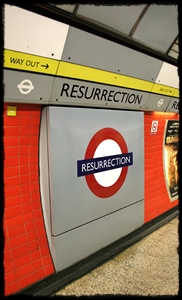
As we move toward Easter, I find it helpful to recall the cosmic anarchy that the resurrection represents. Jesus was blowing apart all systems of domination that deform the basic dignity of the human being — including the threat of death.
When Christians are threatened with death, they understand it as being “threatened with resurrection,” as poet Julia Esquivel put it.
Here’s an excerpt from U.K.-based Jonathan Bartley’s commentary on Easter and Anarchy from Ekklesia:
Easter means freedom rather than control. At least that was the way that it started out.
Some early Christians seem to have celebrated it twice. There was the Passover that took on new meaning for the new Jewish sect following Jesus’ celebration of it with his friends just before his crucifixion. There was also Pascha a commemoration more in tune with the Easter we celebrate today.
But it was anarchic in the political sense too. The Passover called to mind the subversion by the Children of Israel, who defied Pharaoh’s authority and went their own way. Down the centuries Christians have developed various theological motifs to explain what they believe happened when Jesus died. But for the early Christians, the emphasis seems to have been squarely on the Resurrection. This was the moment of liberation at which God demonstrated victory over all evil and oppression – including the empire that put Jesus to death. It was the proof that even the greatest of powers could be overcome.
Easter was also the time when baptisms would happen – that Christians too were ‘raised with Christ’. It was the clearest symbol that the allegiance of early Christians did not lie with the state. This was the point at which a new citizenship of God’s Kingdom was embraced, one which challenged all other forms of citizenship, and most notably that of Rome. It committed them to a set of values and behaviours, and a way of living which was often at odds with the social and political norms of the Empire. Christians called it ‘the Way.’
But in the Fourth century, this presented a problem for the emperor Constantine who was intent on marrying Christianity with the power that had often been its persecutor. The death of Christ was a bit embarrassing. And it wasn’t just that the emperor was running the empire which had put the founder of the faith to death. The way of Christ – loving enemies, forgiving and turning the other check – was particularly ill suited to the business of Government. Baptism threatened allegiance to a state that needed to wage war, imprison and torture.
Bartley, Ekklesia co-director, is author of Faith and Politics After Christendom: The church as a movement for anarchy (Paternoster, 2006) and The Subversive Manifesto: Lifting the lid on God’s political agenda (BRF, 2005). Read the whole piece here.
How would you write your baptismal vows if you knew they threatened allegiance to the State?
-
Time to Close the Borders

-
‘Lay Our Lives Like Palms Before Him’
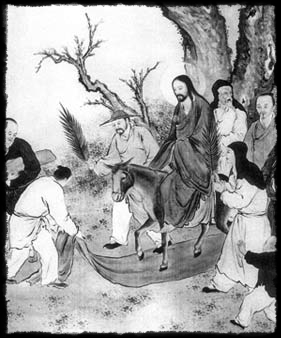
Andrew of Crete was archbishop at the end of the 7th century. Here’s a thought of his for Holy Week:
So let us spread before his feet, not garments or soulless olive branches, which delight the eye for a few hours and then wither; but ourselves, clothed in his grace, or rather, clothed completely in him. We who have been baptized into Christ must ourselves be the garments that we spread before him.–St. Andrew of Crete
-
Avivah Zornberg on Joseph and His Brothers
 Avivah Gottlieb Zornberg is one of my very favorite biblical scholars. She’s got a new book out called The Murmuring Deep: Reflections on the Biblical Unconscious. I studied with Zornberg at the Hebrew College in Boston for a week and it was transformational. It took a few days before the rest of the class realized I wasn’t Jewish and then they were fascinated by why I would be there. Apparently, they were mostly familiar with Christians who wanted to convert them rather than those who wanted to join with them to study scripture.
This section from Zornberg’s essay on Joseph and his Brothers and the trauma that happens in families has resonance for me as I enter Holy Week:
Only by turning towards one’s wound – the wound of reality – only from within that wound – can the event become accessible. ‘Shelterless,’ vulnerable, ‘answerless’, language must ‘pass through the thousand darknesses of death-bringing speech.’ For the testimonial power of language to work, however, a listening Other is required. ‘The history of a trauma …. can only take place through the listening of another.’ For Joseph, does such a healing moment occur?
I suggest that it does occur, but in a fragmentary, suspended manner. The moment of healing is precipitated by Judah, as he breaks through the line of his brothers (‘And Judah came close to him …’ [44:18]) and speaks with passion into Joseph’s ears. This speech, a long, poignant account of the history of the bereaved father, has the ultimate effect of making Joseph break down: ‘And Joseph could no longer restrain himself …’ (45:1) A long silence, the silence of survival, collapses, and Joseph gives his sole testimony to the past: ‘“I am Joseph your brother whom you sold to Egypt.”’ (45:3) These are the only words in which Joseph ever bears witness to that day in the pit. With them, there begins the passage through answerlessness, through the exile of the word.
Read her whole essay here.
-
Rain Water into Wine?
 So … I bought a really nice rain barrel yesterday. Cindy and Kelly from the Rain Barrel Company in Raleigh, North Carolina, dropped it off on their swing through D.C. It’s made from a recycled Greek olive shipping container. It even has little Greek pictures and words on the side.
NOW what do I do?
I’m trying to figure out how to set it up with the rain spout in a location that is still accessible for filling up the water cans to water the front “postage stamp” vegetal patch.
Somehow all this made more sense in the Central Valley of California when it didn’t rain for months on end.
Do you think this is the kind of barrel Jesus stood over when he changed the water into wine? Hmmm.
-
CJR Gives Sojourners Kudos
 There’s a nice mention in the Columbia Journalism Review‘s blog written by Katia Bachko about Sojourners magazine’s April 2009 issue.
Like most great journalism efforts Sojourners editorial staff is a mixture of editors and writers with academic journalism degrees and others with 35 years of experience “just doing the work.” It’s nice when the arbiters of journalistic integrity at least know you exist!
Here’s a clip from CJR’s comment:
Sojourners is a Christian magazine, and, according to its cover, it’s interested in “faith, politics, and culture.” In tone and subject matter, Sojourners often feels like the magazine embodiment of NPR’s Speaking of Faith, only slightly more preachy, and more narrowly Christian.
The magazine is strongest when covering social justice issues, illuminating topics frequently neglected by mainstream outlets.
Read the whole piece here.
-
Church as Training Ground for the ‘Good Life’?
 Many American are starting to ask questions about the “quality” of life as opposed to the “quantity” of stuff. I hope people of faith will step in to this questioning time with the “good news” about lives lived with simple joy, free from undue anxiety, bound by relationships of deep fidelity, and fueled by an economy of grace.
We need to be running classes in this stuff. We need to be leading the trainings – this is what Sunday worship should be about, a training ground for the Good Life in God.
Here’s a quote from Catholic hermit and spiritual writer Thomas Merton:
The life of contemplation in action and purity of heart is, then, a life of great simplicity and inner liberty. One is not seeking anything special or demanding any particular satisfaction. One is content with what is. One does what is to be done, and the more concrete it is, the better. One is not worried about the results of what is done. One is content to have good motives and not be too anxious about making mistakes. In this way one can swim with the living stream of life and remain at every moment in contact with God, in the hiddenness and ordinariness of the present moment with its obvious task.–Thomas Merton
From The Inner Experience: Notes on Contemplation (edited by William H. Shannon, HarperSanFrancisco, 2003)
-
Obamas’ Sharin’ of the Green
Well, it’s happened. The famous line from the musical Hello, Dolly! has come true. “Money is like manure. It’s not worth a thing unless it’s spread about, encouraging young things to grow.”
Not only is President Obama spreading ‘Bama Bucks like night soil on the languorous fields of the American economy, but Mrs. Obama is getting her hands dirty with a little Victory gardening of her own.
The kids from Bancroft elementary school — located in the Mt. Pleasant neighborhood, one over from Columbia Heights — digging and turning up the White House “back 40” (aka the South Lawn). The planting list includes: spinach, broccoli, various lettuces, kale, collard greens, assorted herbs, blueberries, blackberries and raspberries.
For some reason, they are not planting corn. No doubt White House insiders will uncover the reason soon. My guess is that Big Corn exerted some influence here and didn’t want average citizens getting the idea that they could crowd in on AgriBusinesses profit share.
Another interesting tidbit is that the White House garden is also planning to host some bee hives and, as Mrs. Obama said, “grow their own honey.” This is great news! But someone needs to let them know that currently it is illegal to keep bees inside the District. They are considered “livestock” by the District agriculture code. While I’m sure that the White House falls under a federal law, not District law, I’m hoping the hives on the South Lawn will bring a big boost to the renegade bee-keeping revolution that’s been quietly raging in the District over the past few years. Maybe the apiarists can finally come out of the shadows.
Check out the video here:
-
Pope Uses “C”-Word
 There’s been a bit of a tempest about the comments made by Pope Benedict XVI to the press pool on Shepherd One (the Pope Plane) while en route to Cameroon. Apparently, he used the C-word (ahem … “condom”).
That’s a first for a pope. Despite plenty of rulings eschewing birth control and promoting the sanctity of the family, it appears no pope has actually ever said the word publicly before. Wow? What next?
It also appears that the Pope’s comment about “French letters” (so quaint!), was then cleaned up by the papal translators. All this has caused a storm–and rightly so. With the devastating prevalence of AIDS in Africa, religious leaders–especially one as prominent as the Pope–absolutely need to be part of the solution.
The Pope has legitimate moral and theological issues with anything that he thinks is an attack on human dignity and on the culture of the family and the culture of life. I don’t agree with all of them, but they are reasoned. At the same time, he needs to be very careful about overemphasizing ideals that are not possible in the present situation–especially when lives are at stake.
So … what did the Pope actually say? Here’s the original quote–before the papal fixers got a hold of it. The question’s premise was “The Catholic Church’s position on the way to fight against AIDS is often considered unrealistic and ineffective,” and the pope responded:
“I would say the opposite. I think that the reality that is most effective, the most present and the strongest in the fight against AIDS, is precisely that of the Catholic Church, with its programs and its diversity. I think of the Sant’Egidio Community, which does so much visibly and invisibly in the fight against AIDS … and of all the sisters at the service of the sick.
“I would say that one cannot overcome this problem of AIDS only with money — which is important, but if there is no soul, no people who know how to use it, (money) doesn’t help.
“One cannot overcome the problem with the distribution of condoms. On the contrary, they increase the problem.
“The solution can only be a double one: first, a humanization of sexuality, that is, a spiritual human renewal that brings with it a new way of behaving with one another; second, a true friendship even and especially with those who suffer, and a willingness to make personal sacrifices and to be with the suffering. And these are factors that help and that result in real and visible progress.
“Therefore I would say this is our double strength — to renew the human being from the inside, to give him spiritual human strength for proper behavior regarding one’s own body and toward the other person, and the capacity to suffer with the suffering. … I think this is the proper response and the church is doing this, and so it offers a great and important contribution. I thank all those who are doing this.”
-
Subscribe
Subscribed
Have a WordPress.com account? Log in now.

