-
McDonough: ‘If Buildings Were Trees …’
I’ve spent the last few days getting an education on “green-collar jobs” and training programs for jump-starting our economy and our environmental sustainability at the same time. I was on a conference call hosted by Policy Link and Green For All about how to get Obama’s “green dollars” into local communities. More than 800 people dialed in to hear the call. I’m also editing articles for the May issue of Sojourners on the green economy.
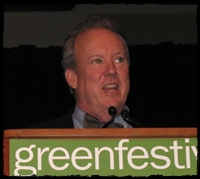 All this reminded me about hearing architect and genius Bill McDonough speak at the Green Festival last fall. (McDonough wrote a great article for Sojourners in May 2005 called Ecology, Ethics, and the Making of Things, drafted from a sermon he gave at St. John the Divine in New York.) I was so intrigued and inspired by his talk that I looked up other presentations he’d given.
The McDonough excerpt below called to mind that strange passage in Mark’s gospel (8:24) when the half-healed blind man says, “I see people as trees, walking.”
What if buildings were alive? What if our homes and workplaces were like trees, living organisms participating productively in their surroundings? Imagine a building, enmeshed in the landscape, that harvests the energy of the sun, sequesters carbon and makes oxygen. Imagine on-site wetlands and botanical gardens recovering nutrients from circulating water. Fresh air, flowering plants, and daylight everywhere. Beauty and comfort for every inhabitant. A roof covered in soil and sedum to absorb the falling rain. Birds nesting and feeding in the building’s verdant footprint. In short, a life-support system in harmony with energy flows, human souls, and other living things. Hardly a machine at all.
This is not science fiction. Buildings like trees, though few in number, already exist. So when we survey the future-the prospects for buildings and cities, settled and unsettled lands-we see a new sensibility emerging, one in which inhabiting a place becomes a mindful, delightful participation in landscape. This perspective is both rigorous and poetic. It is built on design principles inspired by nature’s laws. It is enacted by immersing oneself in the life of a place to discover the most fitting and beautiful materials and forms. It is a design aesthetic that draws equally on the poetics of science and the poetics of space. We hope it is the design strategy of the future.
Read McDonough’s whole article here.
. -
Is Sheol in Preston Hollow, Texas?
Whilst reading in the prophet Isaiah, I popped down to the grocery store to buy orange juice for Sojourners’ Mardi Gras pancake breakfast tomorrow. With the prophet’s searing poetry still curdling inside me, my eyes fell on that this week’s edition of that fish-wrap, scandal rag The Globe trumpeting:
 Just weeks after leaving the White House, depressed and paranoid George Bush is suicidal, insiders fear. In a blockbuster world exclusive, sources tell GLOBE the ex-President is boozing up a storm – and reveal why he is terrified of Barack Obama and his own wife Laura. Don’t miss a single word!
It seems that life in the Bushes’ new home in Preston Hollow, a wealthy Dallas suburb, is not all he expected it would be. It struck me that the prophet Isaiah is much better at explicating the daily headlines than I am and in words much franker and bolder than I usually give myself permission to use. Isaiah 14:6-10 says:
You persecuted the people with unceasing blows of rage and held the nations in your angry grip. Your tyranny was unrestrained. But at last the land is at rest and is quiet. Finally it can sing again! Even the trees of the forest–the cypress trees and the cedars of Lebanon – sing out this joyous song: `Your power is broken! No one will come to cut us down now!’ In the place of the impotent there is excitement over your arrival. World leaders and mighty kings long dead are there to see you. With one voice they all cry out, `Now you are as weak as we are!
In fact, Isaiah describes Yahweh’s specific instructions to Israel to taunt the deposed leader of an empire, saying, “When the Lord has given you rest from your pain and turmoil and the hard service with which you were made to serve, you will take up this taunt against the king of Babylon” (Isaiah 14:3-4).
Theologian Walter Brueggemann, in his explication of Isaiah 1-39, makes the argument for why this taunting is important, saying that when the people are free from their oppression then “one of the important opportunities, in such freedom, is to engage in a mocking song against the tyrant.”
Brueggemann goes on to describe the toppled ruler’s arrival in Sheol:
“Sheol” is not a place of punishment, but it is where the dead are kept in their impotence. As the deposed oppressor arrives in Sheol, now completely removed from authority and utterly impotent—a suitable resident for Sheol—all the others who used to be active authorities and great powers in the earth (now become impotent) present themselves as a welcoming committee for the new arrival in Sheol. They gather around the new arrival and recognize him as one of their own, formerly powerful, now completely powerless.
In high irony, the poet [Isaiah] has them welcome the new member of the powerless to their company—“You are like us”—powerless, no longer a force to be reckoned with. … The speech “rubs it in,” so that this now feeble has-been should be recognized for what he is, completely broken and irrelevant, warranting no attention at all. (Isaiah 1-39 by Walter Brueggemann, 1998, p. 127-128)
 In light of Isaiah’s description, it seems entirely appropriate that Kyle Walters, president of Elliott’s hardware store in Dallas should offer George Bush a job as a store greeter, saying, “Like you, many of our greeters are retired from the corporate world, so we’re sure you’ll have no trouble making new friends.”
How many American retirees have had to do just this in order to make their Social Security checks stretch farther and cover their medical expenses?
And, the LA Times reports, that while the former first lady is working on a book, “the former president has yet to interest a publisher in his memoirs. In fact, several have advised him to wait a few years until his reputation is less, well, in need of a good hardware polishing.”
Of course, having compassion for George W. Bush, the man, the husband, the father, is part of the Christian calling, as is extending him the hand of mercy when he repents of his sins.
But for President Bush who sought the status of emperor and who claimed divine right in his exploits; who tortured strangers in secret prisons; who opened the nation’s treasuries to privateers; who unleashed the dogs of war on civilians for the purpose of working out old vengeances and hoarding resources, I have a few good taunts left in me.
In fact, I imagine that, right now, Sheol may have taken up an address in Preston Hollow, Texas.
-
The Thomas Mass
I just found this photo from the closing liturgy at the 2006 Politics and Spirituality Conference that the Center for Action and Contemplation and Sojourners co-hosted in Pasadena, CA. It was called a “Thomas Mass. ” The con-celebrants were Anita Amstutz, Richard Rohr, and myself. Jim Wallis preached.
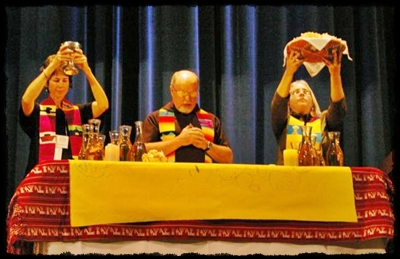
The “Thomas Mass” was first created in Helsinki, Finland in 1988 by a collection of ministers of various denominations, artists, musicians, and civic leaders (hence it is not really a “Mass,” in the official Catholic sense). They wanted to create a prayerful service that would again fill their cathedral, but with seekers, searchers, and believers alike. They recognized that much of Europe had become a continent of skeptics, and so they named the service after St. Thomas “the Doubter.”
After an initial attempt to create an ecumenical and new liturgy, they realized that it basically had the structure of the historic Catholic Mass. It immediately began to spread across Europe. The Thomas Mass avoids the usual denominational turf, arguments, and leadership, while still offering a deeply sacramental structure where disparate groups can gather in a faith-filled way.
It retrieves the historic meaning of the very word “liturgy” as a collective work of the people. One of the strengths of the Thomas Mass is that it emphasizes full participation instead of mere listening or “attendance.” It was a wonderful experience.
-
Linda Pastan’s ‘The Happiest Day’
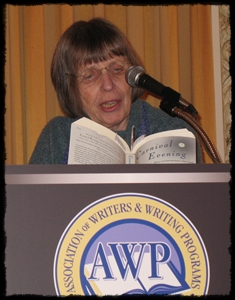
I heard Linda Pastan read her poetry at the AWP conference last week in Chicago. She’s a favorite of mine. She was speaking on the panel called “Women of a Certain Age” with Janet Burroway, Alicia Ostriker, Hilda Raz, and Rosellen Brown. Here’s one of Pastan’s poems from her collection Heroes in Disguise.
The Happiest Day
 It was early May, I think
a moment of lilac or dogwood
when so many promises are made
it hardly matters if a few are broken.
My mother and father still hovered
in the background, part of the scenery
like the houses I had grown up in,
and if they would be torn down later
that was something I knew
but didn’t believe. Our children were asleep
or playing, the youngest as new
as the new smell of the lilacs,
and how could I have guessed
their roots were shallow
and would be easily transplanted.
I didn’t even guess that I was happy.
The small irritations that are like salt
on melon were what I dwelt on,
though in truth they simply
made the fruit taste sweeter.
So we sat on the porch
in the cool morning, sipping
hot coffee. Behind the news of the day–
strikes and small wars, a fire somewhere–
I could see the top of your dark head
and thought not of public conflagrations
but of how it would feel on my bare shoulder.
If someone could stop the camera then…
if someone could only stop the camera
and ask me: are you happy?
perhaps I would have noticed
how the morning shone in the reflected
color of lilac. Yes, I might have said
and offered a steaming cup of coffee.–Linda Pastan
-
Cambodia and the Arc of History
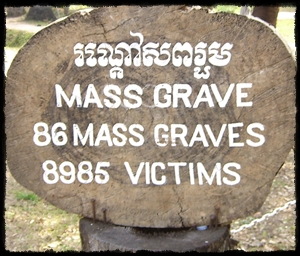
Cambodia from http://www.lukezine.com The first trial of a top Khmer Rouge official starts today, 30 years after the end of the brutal regime that took the lives of as much as a quarter of Cambodia’s population and sent hundreds of thousands onto the seas as refugees.
The first defendant is Kaing Guek Eav, 66, known as Duch, a born-again Christian, who was the commandant of the Tuol Sleng prison and torture house. He sent thousands of people to their deaths in a killing fields.
Below is an excerpt from an excellent essay by François Bizot, one of the only Europeans to survive Pol Pot and also one of Duch’s detainees:
Duch was in charge of the jungle camp, both my jailer and my
prosecutor. I was kept in chains and interrogated daily by him.
Somehow, during the strange dialogue that began between us, he became convinced that I really was just a Frenchman who wanted to study Buddhist texts. Duch undertook to secure my release. My two Khmer assistants did not have the same good fortune: despite Duch’s promise to me, they were executed soon after I left the camp, as so many thousands were in the years to come under his meticulous supervision.I did not see Duch again until 2003, in the military prison in Phnom Penh. Conditions there were rudimentary, but the general feel was not that of a jail. I remember that he had the same look of determination that he had had 32 years earlier, though the smile that he had occasionally flashed when he ruled over my fate was gone.
Read Bizot’s whole essay here.
-
An ‘Occupied Heart’
“Justify my soul, O God, but also from Your fountains fill my will with fire. Shine
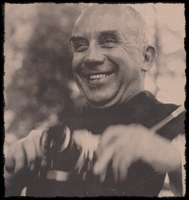 in my mind, although perhaps this means ‘be darkness to my experience,’ but occupy my heart with Your tremendous Life. Let my eyes see nothing in the world but Your glory, and let my hands touch nothing that is not for Your service. Let my tongue taste no bread that does not strengthen me to praise Your great mercy. I will hear Your voice, and I will hear all the harmonies you have created singing your hymns. Sheep’s wool and cotton from the field shall warm me enough that I may live in Your service; I will give the rest to the poor. Let me use all things for one sole reason: to find my joy in giving You glory.” –Thomas Merton
From New Seeds of Contemplation (New Directions Press, 1961, p. 44)
-
Ex-Gitmo Guard: ‘Detainees Were Abused’
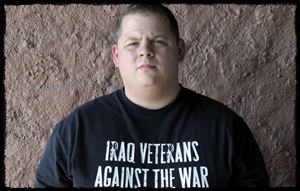
Brandon Neely by Pat Sullivan/Associated Press Thanks to Jim Douglass at the Orthodox Peace Fellowship for pointing out Mike Melia’s article in the Marine Corps Times on abuses at Guantanamo. Melia tells the story of Brandon Neely, who now is a member of Iraq Veterans Against the War.
Now that President Obama has ordered the detention camp shut down, we must begin the work of unpacking what led to the construction of such a camp, what we must do to bring justice to those who were treated illegally, and examine the long-term legacy of Guantanamo. Here’s an excerpt from Melia’s article:
San Juan, Puerto Rico — Army Pvt. Brandon Neely was scared when he took Guantanamo’s first shackled detainees off a bus. Told to expect vicious terrorists, he grabbed a trembling, elderly detainee and ground his face into the cement — the first of a range of humiliations he says he participated in and witnessed as the prison was opening for business.
Neely has now come forward in this final year of the detention
center’s existence, saying he wants to publicly air his feelings of guilt and shame about how some soldiers behaved as the military scrambled to handle the first alleged al-Qaida and Taliban members arriving at the isolated U.S. Navy base.His account, one of the first by a former guard describing abuses at Guantanamo, describes a chaotic time when soldiers lacked clear rules for dealing with detainees who were denied many basic comforts. He says the circumstances changed quickly once monitors from the International Committee of the Red Cross arrived.
Read Mike Melia’s whole article here.
-
Jesus and the ‘Victorian Bushfire Tragedy’
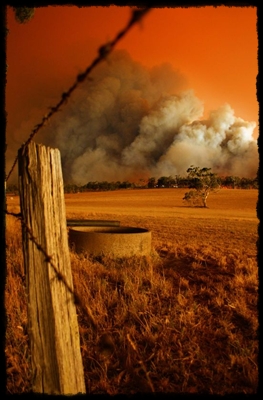
From http://www.abc.net.au/news/photos David MacGregor, a pastor the Uniting Church in Australia, recently posted a wonderful sermon on Jesus touching and healing the leper (Mark 1:40-45). He used a spirituality column I wrote in January 2005 called The Sense of Touch to examine the experience of touch alongside the powerful images of people embracing each other amid the Victorian bushfire tragedy. Please continue you prayers for all those affected by the fires.
David serves at Indooroopilly Uniting Church in Brisbane and serves on the UCA’s National Working Group on Worship. Below is an excerpt from David’s sermon:
When the leper approaches Jesus, he is, in fact, going against the Law. This said that he should have called out to warn Jesus and the disciples that he was unclean and that they should keep away. Instead, in desperation, he comes to Jesus and speaks directly to Him. In his wretched state, he has seen in Jesus someone who could heal him – the question was did Jesus want to heal someone who was ritually unclean – who, some said, was leprous because of some sin?
Jesus, of course, wants to and reaches out and touches him – strictly speaking, making Himself unclean in the process. At once – immediately (how often do we hear that word in Mark’s gospel?! the leprosy leaves the man and he is healed. Jesus reaches out and touches him …
This past week, night after night on our TV screens we’ve watched footage of devastated bushfire victims hugging another victim close, folk – Kevin Rudd included, placing a comforting hand on the shoulder of a bushfire survivor. There’s something about touch.
Read David’s whole sermon here.
-
“JFK and the Unspeakable” by Jim Douglass
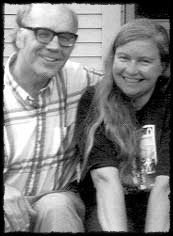 I’ve been honored to know Jim Douglass and Shelley Douglass since their days at the Ground Zero community in Poulsbo, Washington. Now they live in Birmingham, Alabama. Shelley leads their mission at Mary’s House, in the spirit of the Catholic Worker. Jim continues to be one of the foremost Catholic writers, thinkers, theologians, and practitioners of Christian nonviolence.
In Jim’s groundbreaking 2008 book, JFK and the Unspeakable: Why He Died and Why it Matters
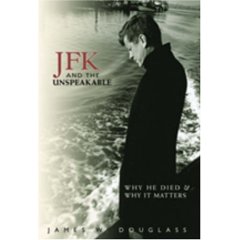 , he probes the role of the principalities and powers in the assassination of John Kennedy, the first Catholic President, and explores why we need to understand our history if we are going to fully understand what is at stake with Barack Obama. Here’s a little bit of what I wrote after visiting with Jim last December:
Kennedy showcased his new vision in June 1963 during a speech at American University in Washington, D.C., by preaching on the absolute necessity for nations to choose peace. “What kind of peace do I mean?” asked Kennedy. “Not a Pax Americana enforced on the world by American weapons of war. Not the peace of the grave or the security of the slave. I am talking about genuine peace, the kind of peace that makes life on earth worth living … .”
It was this speech, Douglass says, that prompted the Unspeakable—in the form of people within the U.S. intelligence and military structure—to act.
FAST-FORWARD TO Jan. 28, 2008, when Ted and Caroline Kennedy stood on the stage at American University to endorse Barack Obama for president. President Kennedy’s 1963 speech formed the historical backdrop. The Kennedys, I think, were sending a message: Barack Obama can pick up the banner for peace dropped by John Kennedy in death.
You can read my whole column about my visit with Jim here–and look for a review of JFK and the Unspeakable by Ed Snyder in the March 2009 issue of Sojourners.
-
Subscribe
Subscribed
Have a WordPress.com account? Log in now.

