-
Back to Basics: “T” is for Torture
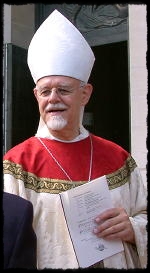 Did the Catholic Church teach so much about abortion that it forgot to teach about torture?
Fifty-one percent of non-Hispanic U.S. Catholics think that torture is “often” or “sometimes” justified, according to the recent Pew study.
Below I’m posting the here the recent commentary by the Hartford, Connecticut-Catholic Bishop Peter A. Rosazza straightening Catholics out on why torture is never justified under any circumstance.
And below that is the section on torture from The Catholic Social Doctrine Compendium.
The use of torture against prisoners in light of 9-11 and our war against terror surfaced several years ago when such abuse of prisoners in Iraq, Guantánamo and Afghanistan came to light. Much of this is documented by former President Jimmy Carter in his book, Our Endangered Values, published in September, 2006. He writes, “Military officials reported that at least 108 prisoners have died in American custody in Iraq, Afghanistan and other secret locations just since 2002 with homicide acknowledged as the cause of death in at least 28 cases.”
A problem in this debate surfaces in statements of those who
say that these techniques had to be used in order to protect our
country. But does the end justify the means?Reacting to this our Catholic Bishops’ Conference wrote
several years ago: “No exceptional circumstances whatsoever, whether a state of war or a threat of war, internal political instability or any other public emergency, may be invoked as a justification of torture and an order from a superior officer or a public authority may not be invoked as justification of torture.”–Catholic Bishop Peter A. RosazzaRead Bishop Peter A. Rosazza’s full editorial here.
Here is Section 404 of The Compendium of the Social Doctrine of the Catholic Church
[404] The activity of offices charged with establishing criminal responsibility, which is always personal in character, must strive to be a meticulous search for truth and must be conducted in full respect for the dignity and rights of the human person; this means guaranteeing the rights of the guilty as well as those of the innocent. The juridical principle by which punishment cannot be inflicted if a crime has not first been proven must be borne in mind.
In carrying out investigations, the regulation against the use of torture, even in the case of serious crimes, must be strictly observed: “Christ’s disciple refuses every recourse to such methods, which nothing could justify and in which the dignity of man is as much debased in his torturer as in the torturer’s victim”. International juridical instruments concerning human rights correctly indicate a prohibition against torture as a principle which cannot be contravened under any circumstances.
Likewise ruled out is “the use of detention for the sole purpose of trying to obtain significant information for the trial”. Moreover, it must be ensured that “trials are conducted swiftly: their excessive length is becoming intolerable for citizens and results in a real injustice”.
Officials of the court are especially called to exercise due discretion in their investigations so as not to violate the rights of the accused to confidentiality and in order not to undermine the principle of the presumption of innocence. Since even judges can make mistakes, it is proper that the law provide for suitable compensation for victims of judicial errors.–Excerpt from The Compendium of the Social Doctrine of the Catholic Church
-
Becoming the Church of Creative Dissent
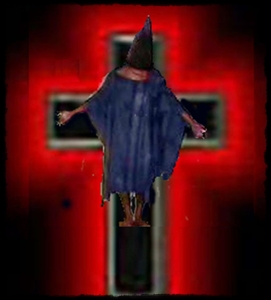 My friend Claire McKeever sent me a brilliant essay on the Church of Dissent. When we fail to live up to the calling and values of this church we end up with statistics like those from the recent Pew study that shows “Christians” in larger numbers support torture.
But we only get a Church of Dissent if dissent, revision, and creativity is what we preach from the pulpit and practice on the streets.
Read Claire’s theological examination of The Torturers’ Manifesto from Sunday’s New York Times.
The Church of Revision, Dissent, Prayer
A Constructive Statement on the Church and Government
by Claire McKeeverThe New York Times reports in the The Torturer’s Manifesto that Jay Bybee, currently a federal judge of the United States, is described as writing “admiringly about a contraption for waterboarding that would lurch a prisoner upright if he stopped breathing while water was poured over his face.” Also from Sunday’s Times, it is reported that bills offering in-state tuition costs to illegal immigrants in New Jersey face strong opposition and that Bill Gates and Warren Buffett, two of the wealthiest people in the world, have now dedicated their combined budgets to the fight against extreme poverty. As Bono notes in this op-ed, both Gates and Buffett are agnostic. Then, Bono ends his piece with, “Not all soul music comes from the church.” All you have to do is peruse the Times and it becomes glaringly obvious that the age-old faith of Christians seems just that—age-old.
What does Christian faith have to say to these issues? What do practices of torture in the United States imply for those of us who profess to follow a God of life? It is the scariest thing for me to sit in a church pew every Sunday morning, surrounded by people who profess to have faith in Christ, yet for this faith to mean nothing when we leave the pew, close the hymnal and take off our Sunday dress. Even more terrifying is for me to witness the voices and bodies of church members, purported faithful followers of Jesus, saying, “I don’t care.” It terrifies me that Bono may be right; that not all soul music comes from the church, and I want to scream in response, “Why?”
Dorothee Soelle reflected that it is the guilt of sin in Christians that creates apathy; yet, through justification and reconciliation in Jesus, we are freed from that guilt. We are able, then, to enter into what Peter Hodgson calls “The Freedom Project,” or what Walter Rauschenbusch called the “Kingdom of God.” Thus, it is when we move from this place of inaction and apathy, when we let go of the guilt that plagues us that this “soul music,” this “freedom project,” this “kingdom of God,” will be sung from the church once again. Christians, bound together as the community of Christ and within and through the Church , can and will affect social and political change, specifically when applied to the United States’ practice of torture. We, as Christians bound together in community, will affect this change by engaging in constant revision, by entering into practices of dissent and by engaging in “narrative and prayer” as forms of protest.
-
Does Wearing a Cross Make You a Torture-Supporter?
 Over at Brian McLaren’s blog he’s been responding to the the recent Pew Forum study, reported by CNN.com, that correlates “White evangelical Protestants with those most likely to say that torture is often or sometimes justified.”
More than six in 10 supported it. People unaffiliated with any religious organization were least likely to back it. Only four in 10 of them did.
Additionally, evangelical pastor Gabe Salguero wrote a great piece in The Washington Post also responding to the data:
Torture is morally reprehensible. Christians, who serve a Christ who was tortured and murdered by a brutal Empire should know this to be true. Torture is not just an affront to the human dignity of the person being tortured but also on the one’s who are dong the torturing. Any society that sanctions torture has lost its moral compass and threatens the ethical integrity of all its people.
What about the Catholics?
The Pew research also shows that 19 percent of non-Hispanic Catholics think that torture “can often be justified.” This is the highest percentage of the religious breakdowns in this category. Nearly half of the Catholic interviewed said that torture “can often be” or “can sometimes be” justified.
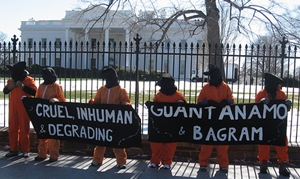
But, on the same day that the report was released, 62 members of Witness Against Torture, started by a group of Catholics, were arrested at the gates of the White House demanding that the Obama administration support a criminal inquiry into torture under the Bush administration and the release of innocent detainees still held at the Guantanamo Bay concentration camp.
Each of those arrested wore the name of a Guantanamo inmate who had been cleared for release or who had died in prison.
“We sent a powerful message to the Obama administration and beyond,” said Witness Against Torture’s Matthew Daloisio, “that the rule of law can be restored only if the law is enforced. President Obama cannot deny indefinitely the mounting evidence of torture under Bush, and must move to hold those who committed, ordered, and justified torture to account.”
This civil disobedience was the culmination of a 100 Days Campaign to shut down Guantanamo.
Send these folks a note of thanks for representing true Christianity at the White House yesterday.
-
Dancing Flash Mob in Antwerp’s Train Station

Last month, more than 200 dancers flash mobbed in Antwerp’s Central Station at 8 a.m. and performed their re-mix of Julie Andrew’s “Do Re Mi” from the Sound of Music.
With just two rehersals, they pulled off this delightful guerilla theater. The stunt was to promote the Dutch TV version of “In Search of Maria,” staged by the Belgian commercial VTM network.
Watch it here and feel the joy!
-
Sojourners Magazine Nominated as Harry Chapin Media Awards Finalist
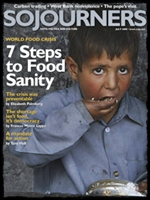 Sojourners magazine’s article World Food Crisis: 7 Steps to Food Sanity (July 2008) has been selected as a Harry Chapin Media Awards finalist!
 The Harry Chapin Media Awards were established in 1982 to reward journalists for their coverage of hunger and poverty-related issues. They are sponsored by World Hunger Year (WHY), founded in 1975 by radio talk show host and present Executive Director Bill Ayres, and the late singer-songwriter Harry Chapin, to fight against hunger and poverty in the United States and around the world.
Our category is “Periodicals” and the finalists are listed below:
“World Food Crisis: 7 Steps to Food Sanity,” Jim Rice and Elizabeth Palmberg (Sojourners); “Hunger Hits Home,” Aliya Sternstein (CQ Weekly); and “The Invisible Workforce,” David Dagan (Central Penn Business Journal).
The winners will be selected on June 18th by an independent panel of judges. Congratulations especially to Zab Palmberg who pulled this issue together under tremendous pressure.
-
Francis of Assisi: Obama’s Saint?
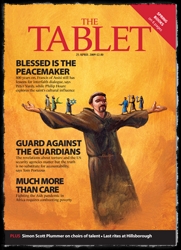 The Franciscan Catholic religious order is celebrating its 800th birthday this year. I grew up around the fantastic women and men who are members of the Sisters of St. Francis of Penance and Christian Charity and the Order of Friars Minor on the West Coast.
The spirits of St. Francis of Assisi and St. Clare have had a profound influence on my faith, ministry, and vision of and for the world.
Check out the current issue of The Tablet, a U.K.-based Catholic magazine, which has a great article by literary critic Philip Hoare examines the influence of Francis on arts and culture–not to mention, President Obama. Here’s an excerpt:
Francis’ message of poverty was a potent antidote to an age obsessed with material advancement at the cost of both human lives and earthly resources. This was nowhere more noticeable than in Gerard Manley Hopkins’ poem “The Wreck of the Deutschland”, published a year after Ruskin’s visit to Assisi. It dwelt upon the fate of five German Franciscan nuns fleeing anti-Catholic laws and who drowned together as their ship sank in a storm off Harwich, the sisters holding hands as their leader called out, “O Christ, come quickly!” In his exquisite verse, Hopkins elided the nuns’ fate with their founder’s, “With the gnarls of the nails in thee, niche of the lance/his/ Lovescape crucified.” In Hopkins’ words, St Francis’ stigmatic body became a landscape of Christ’s love.
Throughout the twentieth century, Francis remained an inspiration to artists and dramatists. In 1922, Laurence Housman, brother of A.E. Housman and a socialist and pacifist, wrote a series of playlets based on the life of St Francis. In 1950, Roberto Rossellini directed the beautifully shot Francesco, giullare di Dio (Francis, God’s Jester). By the 1960s, Francis was recast as a radical, the Che Guevara of the faith. Franco Zeffirelli portrayed him in his 1972 film Brother Sun, Sister Moon, as a proto-hippie in soft focus – complete with a poster displaying the naked saint and a soundtrack by Donovan. In 1989, a tougher Francis was played by the New York-born Catholic Mickey Rourke, in Francesco, a film by Liliana Cavani based on a novel by Hermann Hesse.
Yet even as a new generation embraced Francis’ proto-ecological message, welcoming his recognition as patron saint of the environment, Francis’ words were being invoked to herald an era of materialism. When Margaret Thatcher entered Downing Street on 4 May 1979, she intoned the saint’s prayer: “Where there is discord, may we bring harmony. Where there is error, may we bring truth. Where there is doubt, may we bring faith. And where there is despair, may we bring hope.” Recently, critics of Barack Obama’s tax plans have also quoted Francis at the president: “It is not lawful to take the things of others to give to the poor.” More optimistically, Francis’ embrace of change may be seen in the ambitions of the new leader – who, as a boy, attended the St Francis of Assisi school in Jakarta.
Read the whole article here.
A.E. Houseman, Assisi, Barack Obama, Brother Sun, Charity, Che Guevara, Clare, Donovan, Francesco, Francis, Friars, Gerard Manley Hopkins, Harwich, Herman Hesse, Jakarta, Lawrence Houseman, Liliana Cavani, Margaret Thatcher, Mickey Rourke, Minor, Penance, Philip Hoare, poetry, Roman Catholic, Rossellini, Ruskin, Sister Moon, The Tablet, The Wreck of the Deutschland, Zeffirelli -
Christians and the Moral Right of the Strong
 “Christianity stands or falls with its revolutionary protest against violence, arbitrariness, and pride of power, and with its apologia for the weak. Christianity is rather doing too little in showing these points than too much …
 Christianity has adjusted itself much too easily to the worship of power. It should give more offense, more shock to the world than it is doing.
Christianity should … take a much more definite stand for the weak than to consider the potential moral right of the strong.”—Dietrich Bonhoeffer
Dietrich Bonhoeffer Werke (Vol. 13) London, 1933-1935
-
Discerning God’s Will
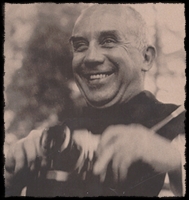 I find this quote from Catholic religious thinker Thomas Merton very challenging. It requires that I reframe my interactions with others through the lens of what the other needs to be “effective” as a human being. It forces me to ask, in each interaction, how can we become “more human” together?
If you want to know what is meant by “God’s will”, this is one way to get a good idea of it. “God’s will” is certainly found in anything that is required of us in order that we may be united with one another in love. … Everything that is demanded of me, in order that I may treat every other person effectively as a human being, “is willed for me by God under the natural law.” … I must learn to share with others their joys, their sufferings, their ideas, their needs, their desires. I must learn to do this not only in the cases of those who are of the same class, the same profession, the same race, the same nation as myself, but when those who suffer belong to other groups, even to groups that are regarded as hostile. If I do this, I obey God. If I refuse to do it, I disobey God. It is not therefore a matter left open to subjective caprice.–Thomas Merton
New Seeds of Contemplation by Thomas Merton (New Directions Press, 1961, p. 76-77)
-
Pirates vs. International Armada
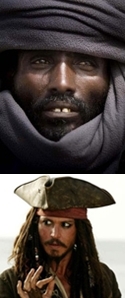
The Somali news outlet WardeerNews is telling a very different story about the “pirates” in the Indian Ocean off the coast of Somalia than what we are hearing in the U.S. news.
There’s no easy answer to dealing with a failed state such as Somalia. The “Somali pirates,” as they are lumped together, are a mix of jihadis, drug dealing gangs, and poor people driven to desperate measures to feed their families. But escalating violence by the international armada is not the right direction, nor will it lead to a lasting solution.
Listening carefully to the complicated factors “on the ground” (or the high seas) and valuing the legitimate grievances present by those on the bottom IS a good direction.
An April 12 op-ed by Muuse Yuusuf writing from Somalia gives context for what’s going on. Here’s an excerpt:
The dumping of toxic and industrial waste in Somalia’s waters is another issue that has not been fully investigated or taken up by the media. However, UN reports indicate that as early as 1990s European companies had been dumping hazardous industrial waste in Somali waters, as this was the cheapest option for them. This is what a UN official has to say about this sensitive issue; “Somalia has been used as a dumping ground for hazardous waste starting about the early 1990s and continuing through the civil war there,” he noted.
“European companies found it to be very cheap to get rid of waste there, costing as little as $2.50 a ton where disposal costs in Europe are something like $250 a ton. And the waste is many different kinds. There is lead. There is heavy metal like cadmium and mercury. There is industrial waste and there is hospital waste, chemical wastes. You name it,” said Mr. Nuttal, a spokes person for the United Nations Environment Programme (UNEP).
The Somali news outlet WardeerNews ran an op-ed piece last December titled Piracy in Somalia: An Act of Terrorism or a Territorial Defense Mechanism?.
Their editorial conclusion:
WardheerNews believes that the real solution lays on-shore. Short of reinstating the Somali nation state would successfully solve either the piracy problem at hand or larger terrorist activities which lately became a main stay in Somalia. The world community must articulate a comprehensive strategy to stop the piracy in Somalia without further violating the territorial integrity of Somalia.
-
Catholic Ohio: Sacraments in the Rust Belt
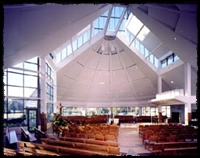 I went to a fantastic Holy Saturday vigil mass at Blessed Sacrament in Warren, Ohio, last week. The architecture of the church is stunning with an glass silo-type spire.
There were 6 or 7 people baptized in the full-immersion font and probably a half dozen more who were confirmed into the church that night. It’s a parish alive with grace, patience, beauty, and (!) teenagers! This is a Catholic community thriving in the spirit of Vatican II.
Unfortunately, many Catholic churches in Ohio are not faring so well, according to a recent CNN story.
Along the Rust Belt and in cities dotting the Northeast and Upper Midwest, Catholic communities are mourning the loss of parishes. It’s a five-year trend of sweeping church closures that most recently hit Cleveland, Ohio. …
What drove the decision to close parishes in Cleveland were population shifts to outlying areas, financial strains that have 42 percent of parishes “operating in the red” and priest shortages, diocese spokesman Robert Tayek explained. The bishop, he said, is trying to find “an equitable solution.”
But the announcement has raised many questions. Among them: What happens to the struggling neighborhoods that have come to rely on outreach and programs offered by some of these inner-city parishes?
“Too many bishops are treating parishes as if they were Starbucks franchises,” said Sister Christine Schenk, a Cleveland-area nun who’s been fighting for nearly two decades to institute change in the church through her organization FutureChurch. “It’s about more than money. It’s about mission to the people,” she said.
-
Subscribe
Subscribed
Have a WordPress.com account? Log in now.

