-
Fishing in Deeper Waters
 Nice to have a note from Dublin psychotherapist Coinneach Shanks on the symbolism of fish. This in response to my Ireland photo (right) of the Tram Chowder in Howth with its “Fish is Life” slogan.
Coinneach blogs at Psychotherapy in Dublin and has some beautiful photos and lovely reflections on the deeper symbolism of our everyday world. Here’s part of his comment on the symbolism of fish:
Fish are water symbols and are as the vendor correctly suggests, symbols of life. Fish and reproduction are well known companions. They make many, many eggs and are considered almost universally as prosperous and fertile. But Howth is a fishing place and the myths of casting the net and hauling fish from the depths are also cross cultural. Peter was the Fisher of Men, catching the souls for conversion and thus saving them from damnation. For psychoanalysts – well, we fish all the time. We are looking for material from the unconscious, which can be compared to the sea. By allowing spontaneous forces to operate, hidden material of great value may be brought to the surface.
Read Coinneach’s whole post here.
-
Personal, Prolific, Provocative: Thomas Merton’s Life in Letters
 I was honored to be asked by Patrick O’Connell, Thomas Merton scholar and editor of the Merton Seasonal journal, to review a new collection of Merton’s personal letters titled Thomas Merton: A Life in Letters, published in 2008 by HarperOne. Below is the review for your reading pleasure.
Personal, Prolific, Provocative
by Rose Marie Berger
Esteemed Merton scholars Christine M. Bochen and William H. Shannon have again brought to bear their years of wisdom and insight into Thomas Merton—the man, monk, merry prankster, mystic, master poet, and writer—in crafting the essential epistolary collection Thomas Merton: A Life in Letters.
Carefully culling from the more than ten thousand letters archived at The Thomas Merton Center, Bochen and Shannon—who edited individually or together the previous five collections of Merton letters—have selected what they consider Merton’s “best letters” from January 2, 1942, when he was a novice at Gethsemani to November 1968, when he wrote his final letter from New Delhi, India.
The breadth and variety of Merton’s correspondents is staggering. Quite simply: He wrote to those who he was interested in learning from and he responded to many who were interested in him and his ideas. The constraints of monastic life and the sometimes ill-fitting gift of stability lent themselves to making out of Merton the prolific letter-writer he became. In this collection, one finds letters to American writer Henry Miller, Pope John XXIII, Nicaraguan journalist Pablo Antonio Cuadra and Nicaraguan president Somoza, American sixth-grader Susan Chapulis, Pakistani Sufi Abdul Aziz, Saturday Evening Post editor John Hunt, Ethel Kennedy, mayor of Hiroshima Shinzo Hamai, ecologist Rachel Carson, novelist James Baldwin, religious scholar Martin E. Marty, Coretta Scott King, beat poet Lawrence Ferlinghetti, feminist theologian Rosemary Radford Ruether, rabbi Abraham Heschel, Zen scholar D.T. Suzuki, and Vietnamese Buddhist monk Thich Nhat Hanh. The art of letter writing was for Merton an expression of intimacy. His letters reveal his affections for individuals, ideas, and express theological and political affection for humanity to be its best self. “I do not hesitate to confess,” wrote Merton to Sister Therese Lentfoehr in 1956, “that letters from my friends have always and will always mean a great deal to me” (vii).
Alexis de Tocqueville, Christine Bochen, Correspondence and American Literature, David Barton, democracy, Elizabeth Hewitt, International Thomas Merton Society, letter writing, Letter Writing as a Social Practice, letters, life, Nigel Hall, Patrick O’Connell, Seasonal, spirituality, Therese Lentfoehr, Thomas Merton, William Shannon -
Ambassadors of Reconciliation
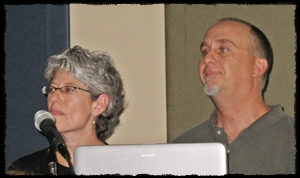 I was delighted to spend time last week with Ched Myers and Elaine Enns from Bartimaeus Cooperative Ministries. They were in Washington, D.C., to speak at the Servant Leadership School about their new book Ambassadors of Reconciliation: New Testament Reflections on Restorative Justice and Peacemaking (Vol. 1), which is available through Orbis Books.
Ched came out of the Christian tradition of peacemaking through prophetic action and protest and Elaine came out of the Christian Mennonite tradition of personal reconciliation and restoration of relationship.
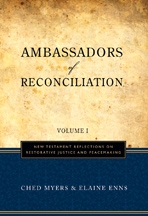 In Ambassadors, they bring together the strength of both to forge a powerful story of Christian faith, courage, humility, and generative power for God’s creative good.
Building on St. Paul’s call on followers of Christ to be “ambassadors of reconciliation,” Ched and Elaine offer a lens for re-reading the entire biblical tradition as a resource for the cause of “restorative justice” and peacemaking.
Ched, the author of Binding the Strong Man and Who Will Roll Away the Stone?, focuses on building biblical literacy, church renewal, and faith-based witness for justice. Elaine has worked for twenty years in the field of restorative justice and conflict transformation.
The second volume, due out in spring 2010, will be a collection of powerful peacemaking and justice stories and interviews the two have collected in their work and travels.
-
Interview: Orthodox John Nankivell on Celtic Christianity
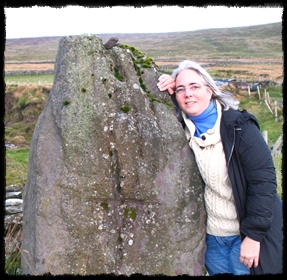
RMB at ancient pilgrim path on Dingle Peninsula, Ireland. There’s an excellent interview over at the online Russian Orthodox magazine Pravoslavie titled Bede’s World: Early Christianity in the British Isles.
It’s Fr. John Nankivell, a Greek Orthodox pastor and author in Britain, giving an indepth look at early Christianity in Ireland, Scotland, Wales, and England.
This is a part of church history that many know little about–but it had a huge impact on how we “do” church in the Western world.
Below is an excerpt, but check out the whole thing if you like this kind of Celtic Christian history.
The Irish influence in seventh-century Northumbria was profound. The relations between Ireland and Britain go back to the earliest use of the seaways between Ulster and Argyll, between Wexford and southwest Wales, but this influence went both ways and we know that the early British (and this includes the area that is now Wales) were quite significant as missionaries, particularly along the coast of Ireland in the fourth and fifth centuries. We don’t have many details about their actual activity, but we do have names from the dedication of churches. The best-known British missionary is St. Patrick, the deacon’s son snatched by pirates from Britain and sold into slavery in fifth-century Ireland, who later returned as a free man intent on winning his pagan masters for Christ. The evidence of early churches named after certain saints links St. Patrick with Ulster and northeast Ireland. We also know of St. Patrick’s connection with Gaul, and interestingly, near St. Germanus’ relics in Auxerre, France, is an early fresco that the local people like to believe is Bishop Germanus blessing St. Patrick. In fact, there are some textual links between the two.
There were also Christians in the south of Ireland from early times. In 431 the Pope sent Bishop Palladius from Gaul to Ireland to organize an already existing church. Church dedications link this mission with Wicklow and with southwest Wales; it’s from Britain that the southern Irish had received their Christianity and learned their Latin.
Having received their faith from Britain, the Irish church became the most flourishing part of western Christendom in the sixth century. People came to Ireland from all over Europe to pray and study in the numerous monasteries, and Irish missionaries carried the faith across Europe, particularly to the Germanic kingdoms that had come into being after the collapse of Roman rule.
The great missionary movement from Ireland began in the sixth century.
The most famous examples of this are the two saints Columbanus and Columba, both named after the dove and noted for their ascetic life, but both men of authority and deep learning. Columbanus’ mission was to the Franks of Gaul and the Lombards of north Italy; Columba’s to the Picts.
One of the reasons St. Columba left Ireland in 563 and founded his monastery on the tiny island of Iona, off Mull, was to be a missionary to the Picts, whom St. Ninian, working from Whithorn (now southwest Scotland) had first preached to in the fourth century. In fact, Columba was going to an existing Irish kingdom, Dalriata, of which Iona was a part. Next to it was a British kingdom, Strathclyde, and north of that was the Pictish Kingdom, both southern and northern Picts. By the mid-seventh century, the Picts were Christian, and as southern Pictland was part of Northumbria for a time, St. Wilfrid served as bishop for Picts in the north of his diocese.
Columba’s Iona became the centre of a major monastic commonwealth stretching from north Ireland, where daughter monasteries were founded at Derry, Durrow, Tiree in the Hebrides, Pictland and Northumbria. In 616, half a century after its foundation, the Northumbrian Prince Oswald came to live at Iona, and by Wilfrid’s time, there was no need to travel to Ireland, as Oswald had invited the Irish Aidan to Northumbria and it was at Aidan’s monastery at Lindisfarne that Wilfrid was first instructed in monasticism.
Besides the followers of Columba, such as Aidan and Cuthbert in Lindisfarne and Northumbria, there were already south Irish missionaries in Britain, such as St. Fursey in East Anglia, who were independent of Iona.
But, East Anglia was also influenced by clergy from Gaul, Northumbria, and Mercia and of course, the British, who are overlooked in all of the literature.
Read the whole article here.
-
Photo: 1K Words
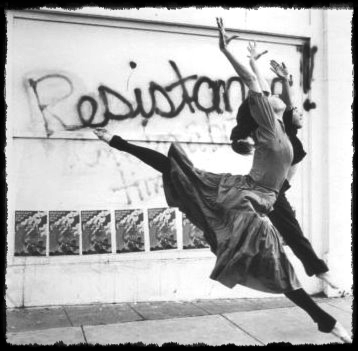
I love this photo. I don’t know who it was taken by, but I’m pretty sure it was taken in Washington, D.C. It’s complex, rich, and packed with energy.
It reminds me of Alice Walker’s novel Possessing the Secret of Joy and the strength shown by the main character Tashi at the end of the story.
-
The Mosque in Morgantown: Finding Our Religion within American Pluralism
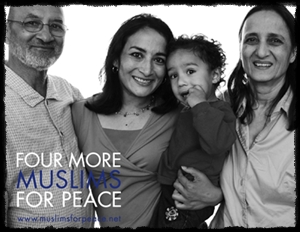
Asra Nomani (center) and family In March, I had lunch with Asra Nomani at Sticky Fingers, the vegan bakery across from the Sojourners office. Nomani, former Wall Street Journal reporter and author of Standing Alone in Mecca: An American Woman’s Struggle for the Soul of Islam, mentioned the culmination of a two-year film project she’d been working on that PBS would be airing as part of the “America at a Crossroads” series. The Mosque in Morgantown premiers Monday, June 15, 2009, at 10 p.m. EST. (Check your local listings.)
I first came across Asra Nomani in 2003. There was a small article in The Washington Post about a woman who was fighting for women’s rights in her mosque in Morgantown, West Virginia. I was intrigued by a Muslim woman — born into an Indian Muslim family and raised in the United States — not only returning to the heart of her religion but doing it in a way that produced the kind of radical call to freedom true faith engenders. I was intrigued that she claimed Sojourner Truth, the ex-slave who adamantly defended the rights of women in the church and in society, as one of her inspirations.
The Mosque in Morgantown is the story of Asra and her mother, Sajida, who in 2003 entered their mosque in Morgantown by the front door and prayed in the same room with men. This was counter to the rising practice in many mosques, in which women are forced to pray behind partitions. In June 2004, five women from around the country joined the Nomanis to pray in Morgantown’s mosque.
Not only did Nomani forcibly integrate the mosque, she “nailed” (taped, actually) her “99 Precepts for Opening Hearts, Minds, and Doors in the Muslim World” and an Islamic Bill of Rights for Women on the mosque door. She stood firmly in the tradition of Martin Luther, who pounded his 95 Theses into the church door in Wittenberg, and Martin Luther King Jr., who posted the demands of the open-housing campaign on then-Chicago Mayor Richard Daley’s office door in 1966.
The Mosque in Morgantown takes the viewer inside a religious community that’s in the midst of a simmering battle between progressives and traditionalists. We see how Nomani’s prophetic tactics of direct action alienate the moderates and horrify the traditionalists. We see the struggle for power that should be familiar to anyone who’s ever served on a parish council or vestry. We see the creative responses that emerge from the community as it is forced to deal with change.
Nomani is driven to fight the “slippery slope” of extremism that she perceives to be taking over the leadership of the mosque her father founded. It’s clear to the viewer that Nomani, who was a close friend of murdered Wall Street Journal reporter Daniel Pearl, must take clear and decisive action against religious extremism in her home community because she’s seen where such extremism can lead.
At the same time, members of her community take great offense at being lumped in with violent extremists just because they take a traditionalist view of their faith. Other community members don’t like her tactics. They prefer a moderate, more measured, course. “The American experience,” says moderate mosque member Ihtishaam Quazi, “works against the idea of a slippery slope that Asra is so afraid of.”
Unfortunately, as we’ve learned from the murder of Dr. George Tiller by religious militant extremist Scott Roeder and the murder at the U.S. Holocaust Memorial Museum by militant religious extremist James W. von Brunn — both of whom claim to be Christians — the “American experience” and the vibrant flame of a pluralistic democracy must be guarded with eternal vigilance.
Watch The Mosque in Morgantown on PBS and find out more here.
This post first appeared on GodsPolitics.com. For more about Asra Nomani, see “Men Only?” by Rose Marie Berger and “Living Out Loud,” by Laurna Strickwerda. To read Nomani’s articles in Sojourners, see “A Faith of Their Own,” “The Islamic Reformation Has Begun,” and “The Struggle for the Soul of Islam.”
-
Video: Sen. Whitehouse on Drilling Down Into the “Torture” Rabbit Hole
Sen. Whitehouse,a leading member of the Senate bi-partisan subcommittee on Intelligence, has read many of the classified reports on U.S. torture – and he is very, very disturbed.
Without compromising classified data, he clearly points to a widespread torture cancer that has spread through the military intelligence apparatus.
Here’s a six minute video (May 22, 2009) of Sen. Sheldon Whitehouse (Dem-R.I.) addressing Robert Litt and Stephen Preston, the two nominees for the position of General Counsel to the Central Intelligence Agency.
-
Why Is “God in the Details”?

Walter J. Ong This quote below from Trappist monk Thomas Merton reminds me of Jesuit writer Walter J. Ong’s fantastic book called Orality and Literacy: The Technologizing of the Word.
One thing Ong talks about is that when a culture moves from oral tradition to written tradition it gains abstraction. Since you are writing down things you’ve already made one level of abstraction from the real. Then when you convey information to someone not in your locale you have to make symbols that might translate to something that they can recognize.
So if you want to write to your friend about the thing with food and medicine that lives outside your house that you call Generous Joe, you have to find some symbol that will carry to your friend who doesn’t know what you are talking about because she’s never been to your house. So you agree upon the abstract, generic word “tree” as a big living thing that provides fruit and has medicinal leaves. But an intimacy has been lost in the shift.
Merton approaches this issue from the point of view of when we treat people as abstractions rather than unique beings.
Persons are known not by the intellect alone, nor by principles alone, but only by love. It is when we love the other, the enemy, that we obtain from God the key to an understanding of who he is and who we are. It is only this realization that can open to us the real nature of our duty, and of right action.
To shut out the person and to refuse to consider him as a person, as another self, we resort to the impersonal “law” and “nature.” That is to say we block off the reality of the other, we cut the intercommunication of our nature and his nature, and we consider only our own nature with its rights, its claims, its demands. In effect, however, we are considering our nature in the concrete and his nature in the abstract. And we justify the evil we do to our brother because he is no longer a brother, he is merely an adversary, an accused, an evil being.
To restore communication, to see our oneness of nature with him, and to respect his personal rights, integrity, his worthiness of love, we have to see ourselves as accused along with him, condemned to death along with him, sinking into the abyss with him, and needing, with him, the ineffable gift of grace and mercy to be saved.–Thomas Merton
From Seeds of Destruction by Thomas Merton (Farrar, Straus and Giroux, 1961).
-
St. Paul the Pacifist: A Christian Response to Torture
 V. Henry T. Nguyen is an Angeleno and a veteran of the U.S. Marine Corps who has “pretty much become a pacifist,” he says. He’s got his doctorate in New Testament and is an adjunct prof at several schools in Southern California. (He blogs at Punctuated Life.)
He’s written a great piece in response to the Pew study on Christians and torture (See Does Wearing a Cross Make You a Torture Supporter?). It was originally posted at Religion Dispatches.
I’m printing the whole thing here because I think it’s an important read.
St. Paul the Pacifist: A Christian Response to Torture
By V. Henry T. NguyenThe recent Pew findings—that churchgoers, especially white evangelical Protestants, are more likely to believe that torture can be justified—have caused many commentators to wonder whether particular forms of Christian theology engender an acceptance of the use of torture.
In a recent article on Religion Dispatches, Sarah Sentilles suggests that Christian theologies and images of Christ’s crucifixion (essentially is an act of torture) have influenced some Christian communities’ understanding of torture as salvific, necessary, and justified. This view of torture is especially fueled by what is known as atonement theology: the view that Jesus’ death provided reparation for humanity’s sins against God.
So what would a Christian theological response against torture look like?
Most Christian theologies are rooted in the writings of Paul, who is particularly celebrated this year by the Catholic church on the bimillenial anniversary of the apostle’s birth; Paul provides the earliest interpretation of the meaning of the crucified Christ. People often forget, or are not aware, that nowhere in the gospels does Jesus himself explain the meaning of his own suffering on the cross. But Paul does.
And I believe that if we were to bring Paul into our current dialogue about whether Christians should support the use of torture, his response would be a resolute “No!”
Acts, Apostles, Christians, conversion, crucifixion, ethics, God, Michael Gorman, New Testament, Nguyen, nonviolence, pacifist, peaceable kingdom, Pew, Punctuated Life, Religion Dispatches, restorative justice, Romans 12, St. Paul, theology, torture, violence, war on terror, white evangelical Protestants -
Abu Ghraib: Don’t Be Afraid of the Truth

Maj. Gen. Taguba Maj. Gen. Antonio Taguba wrote the U.S. Army’s report on the Abu Ghraib torture scandal. He was then forced into retirement.
During that time, he made a startling admission to New Yorker investigative reporter Seymour Hersh. (See Hersh’s article in the June 25, 2007, issue of The New Yorker.) During Taguba’s investigation of Abu Ghraib he saw “a video of a male American soldier in uniform sodomizing a female detainee.” Another photo is said to show a male translator raping a male detainee.
Last week, further photographs depicting sexual assaults on prisoners with objects including a truncheon, wire, and a phosphorescent tube, were confirmed by Maj. Taguba to reporters at The Telegraph.
(Currently there is a smokescreen campaign going on about Taguba identifying photos and videos for The Telegraph. He says he did not verify specific photos and videos that are currently listed as among those the Obama administration wants to suppress. However, he does confirm that he saw photos with these actions depicted. Just that they weren’t the specific photos Obama has been referring to.)
Christians have been on the forefront of resisting the horrors of torture by the U.S. military and its military contractors. Sojourners has covered this faith-based resistance and tried to stay ahead of the story.
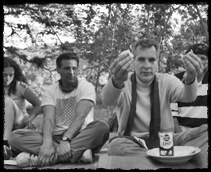
Liturgy outside gates of Guantanamo In March 2006, Sojourners covered the story of 25 Christian peacemakers, members of Witness Against Torture, who went to Cuba and walked 50 miles to the gates of the U.S. Naval Base at Guantánamo to protest the treatment of detainees there. However, “after repeated appeals to the White House and the Guantánamo base commander, we were denied an opportunity to perform a simple work of mercy—to visit the prisoners,” vigil member Art Laffin told Sojourners.
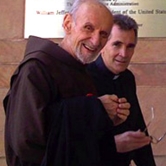
Louis Vitale and Steve Kelly In July 2008, Sojourners published an article by Catholic Franciscan Louis Vitale written from the Imperial County jail where he served a prison sentence for challenging the “terrible frontier” our country has crossed with the use of torture. He served five months for challenging the training of interrogators at the U.S. Army Intelligence Center and School at Fort Huachuca, Arizona.
The night before Vitale was sentenced to prison, he received a phone call. It was from Maj. Gen. Antonio Taguba, who said: “History will honor your actions.”
President Obama has continued to say that it would be detrimental to U.S. security for photos and videos of torture committed by Americans, and in the name of the United States, to be released.
In my opinion, the truth is always detrimental to somebody, but that doesn’t mean you don’t pursue it. “And fear not them which kill the body, but are not able to kill the soul: but rather fear him which is able to destroy both soul and body in hell” (Matthew 10:28).
Sojourners will continue to cover vital stories like these – stories of the people of God acting on faith for justice.–Rose Marie Berger
[This piece first appeared on the Sojourners blog God’s Politics.]
-
Subscribe
Subscribed
Have a WordPress.com account? Log in now.

