-
Holy Health Care! Laying Hands on the Whole System
 Debates on our national system of providing health care are raging in political and corporate offices around the country. Traditionally, however, churches and faith centers have been the sites of healing, health, and wholeness for a community.
In the 1970s, many churches in the U.S. experienced a resurgence of “healing ministries” that accompanied a renewed charismatic movement. Healing services, laying on of hands, anointing with oil, healing prayer, and many other manifestations all spring from the healing ministry of Jesus. It’s what he did: He healed. He taught. He saved.
This “making people whole again” was a way Jesus prepared those he met for receiving the good news into their lives. Karin Granberg-Michaelson wrote in her article The Healing Church:
In considering the healing miracles of Jesus and the profound emphasis he placed on wholeness, we must ask what Jesus wished to communicate through his healing works in people’s lives. That is best answered in the context of more basic assumptions about the meaning of Jesus’ overall ministry in and to the world.
While many churches are deeply faithful to their healing ministry, it sometimes doesn’t make it past the church doors. It doesn’t flow into a social concern for how we as Christians can serve the common good. “If the church is to reclaim its healing ministry, it must ask the question ‘what constitutes wholeness?’” writes Granberg-Michaelson.
Wholeness is not just for the individual or the community of Christians; it is a gift God gives to us and through us for the larger society. It is part and parcel of how we move as a society “toward healing and reconciliation,” as Granberg-Michaelson puts it.
If healing and wholeness (spiritual, physical, and emotional) is a gift that God gives to the church, then it is our responsibility to find ways to share the workings of that gift in service of the common good. Granberg-Michaelson says:
Whole person health care [the treatment of a person as a unity of body, mind, and spirit] is, therefore, the heritage of the church. We must reclaim our function as the primary mediator of healing in society.
One important way that we as Christians can “reclaim our function as the primary mediator of healing in society” is by educating ourselves on the nitty-gritty of the health-care debate and working to craft a system that allows healing to flow throughout our land.
We want to craft a health-care system that honors a fair exchange of money for services, that redistributes our social capital toward the health and healing of all over the long-term, and that allows for philanthropy and generosity of heart by those who can give freely for the betterment of all.
A generous health-care system that reflects a commitment to healing and wholeness for the sake of securing human dignity is a priority. It’s one way Christians can extend our healing ministry toward our national body.
You can read Karin Granberg-Michaelson’s whole article here.
This article first appeared on Sojourners’ God’s Politics blog on 07-21-2009. Rose Marie Berger, an associate editor at Sojourners.
-
Merton on the Importance of a “Living Teacher”
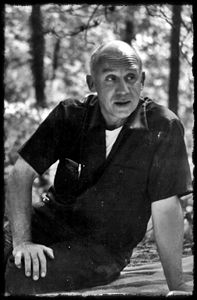 Despite the antiquated male language, Merton’s point in the quote below is well-taken.
The transmission of the Tao of Christ is done best through living teachers.
It reminds me of the old saying: Don’t do what the saints did. Instead, dream the dreams the saints had.
Merely reading books and following the written instructions of past masters is no substitute for direct contact with a living teacher. The Master does not merely lecture or instruct. He has to know and to analyze the inmost thoughts of the disciple. The most important part of direction is the openness with which the disciple manifests to the Spiritual Father not only all his acts but all his thoughts.–Thomas Merton
Contemplation in a World of Action by Thomas Merton (Doubleday and Co., 1973, p. 299)
-
Disarming Reports from the U.K.
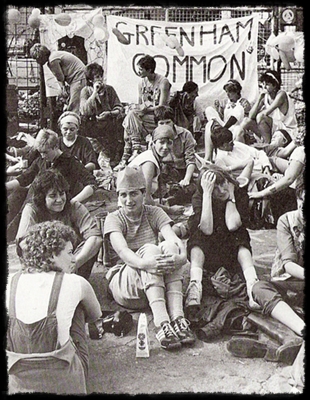 I was pleased to see that the Brits are pushing to scrap nukes and have seen through the deterrence myth. National security issues, they say, are terrorism and climate change. Two things that massive nuclear weapons systems don’t touch.
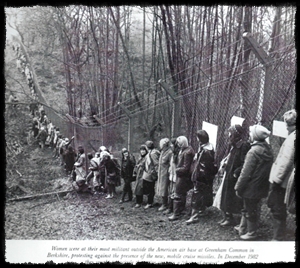
It all called to mind those great photos of the Greenham Common Women’s Peace Camp, which started in 1981 with the Welsh women marching from Cardiff to Greenham Common military base to resist the placement by the U.S. of 96 nuclear Cruise missiles pointed at Russia.
Here’s the Guardian article on the new poll:
Voters want Britain to scrap nuclear weapons altogether rather than replace Trident, according to a July 2009 Guardian/ICM poll. The result marks a sharp turnaround in public opinion amid growing debate about the cost of a new generation of nuclear weapons and the impact of conventional defence cutbacks on the war in Afghanistan.
For decades nuclear disarmament has been seen as a minority issue, with most voters assumed to favour continued investment in an independent British nuclear weapons system. But today’s poll shows that 54% of all voters would prefer to abandon nuclear weapons rather than put money into a new generation of Trident warheads, as the government plans.
Kate Hudson, chair of the U.K.’s Campaign for Nuclear Disarmament, commented that it is “widely accepted that the main security threats that we face are terrorism and climate change. Nuclear weapons have nothing to contribute on these fronts.”
-
On the Seventh Day, God Played
 It’s summer here in the northern climes—and summer means the swimming pool.
Last weekend, I stretched out on a deck chair at the local public pool and spent a few hours in the splash zone. Kids were squealing in delight. Ungainly games of Marco Polo were played with a group of 25 or more. Spontaneous rounds of “keep the beach ball up in the air” formed and faded. Toddlers, in their bright yellow and blue baby floats, grinned, splashed, and waggled their fat little legs.
Play. We all say we love it. But the truth is many of us don’t do it.
Work is getting in the way of our play time. As work hours increase and more people “check in” with work during their days off—or work multiple part-time jobs with no days off—exhaustion levels are up. Americans spend half our “leisure time” collapsed in front of the TV. And, unless we are savvy TV consumers, end up wearier than we started.
The new neuroscience indicates that play is a basic biological process in animals and humans. Along with sex, hunger, and “fight or flight,” play is hardwired in us to keep our neurons adaptable and growing. It’s also the foundation of “civilization”—art, creativity, innovation, literature, music, theater, and complex social relationships.
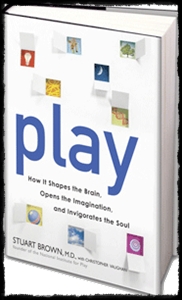 According to Stuart Brown, founder of the National Institute for Play, there are seven properties that identify play: It is done for its own sake, voluntary, has an inherent attraction, and involves freedom from time, diminished self-consciousness, improvisational potential, and the desire to keep doing it.
Brown has studied animal play behavior, developed “play histories” for humans, researched how lack of play may contribute to anti-social behavior, and most important, examined how play fuels brain growth and flexibility across a lifetime.
In his book Play, Brown also notes that good sleep and true play are both essential in brain development, adaptability, and in contributing to a deep experience of joy.
American Christians are particularly bad at playing. The “Protestant work ethic” has left us with a slight religious distaste for fun, frivolousness, silly stuff, and jokes. We have bought the lie that the opposite of play is work. It’s not. The opposite of play is despondency. We have confused playing with Paul’s “childish ways” that, as mature Christians, we are to set aside (1 Corinthians 13:11).
But play is part of our essence created in us by God. On the seventh day, says Genesis 2:2, God “rested,” “blessed,” and “hallowed.” One imaginative interpretation is that on the seventh day God kicked back, opened arms wide, and laughed and laughed, making all things whole and holy.
Perhaps people of faith should become lifelong players. It’s the play that keeps us in sync with the deep and abiding joy in which God created the world. It’s the joy that led David and Miriam to dance and Sarah to burst out laughing. It’s the zany wordplay that saturates the Hebrew texts. Jesus, for one, told great stories—no doubt getting huge laughs poking fun at the religious elite.
“Play is called recreation,” says Brown, “because it makes us new again, it re-creates us and our world.”
Back at the local pool, the 15-minute rest period was ending. Lifeguards remounted their tall chairs. Kids crept closer to the water’s edge. There was a moment of absolutely silent, suspended joy. Whistles shrieked. A hundred kids leaped back into the pool with all the energy of summer lifting them into a massive communal splash.
When was the last time you played hard, laughed until your sides hurt, or lost yourself completely in some frivolous pastime that didn’t involve a video screen?
Play hard. Pray fiercely. Sleep deeply. And go to work with a silly smile on your face.
Rose Marie Berger, a Sojourners associate editor, is a Catholic peace activist and poet. This column first appeared in the August 2009 issue of Sojourners magazine.
-
Executions Worldwide Nearly Doubled in 2008
The number of executions worldwide nearly doubled last year compared with 2007, according to a study released in March by Amnesty International.

Marie Dennis At the same time, Europe and Central Asia have become virtually death penalty-free zones, with only Belarus still maintaining capital punishment. The United States is the only country in the Americas that consistently executes, but the number of executions in 2008 was the lowest since 1995.
In response to these convicting statistics (see Global Death Penalty, Sojourners, July 2009), Marie Dennis, co-president of Pax Christi International, the world’s largest Catholic peace organization, told Sojourners:
I am concerned about the increase in executions because it reflects a loss of respect for the basic dignity of every human life. It represents a failure to believe in the possibility of reform and reconciliation, a failure to recognize the injustice and inadequacies of our justice system, and a misguided belief in the deterrence effect of the death penalty.
I hope people of faith will respond to the increased use of capital punishment around the world by deepening our commitment to the gift of each person’s life. We need to nurture relationships with people who have been victims of violent crime as well as with people who are on death row and probe our own experiences of reconciliation. It is time for all people of faith to advocate for social and racial justice and for an end to the death penalty.
I appreciate Marie’s perspective. I also appreciate that of arch-conservative — and also a Catholic — Richard A. Viguerie who wrote When Governments Kill in the same issue of Sojourners. Using the rigors of Catholic social teaching, both these Catholics come to the same inevitable conclusion—the death penalty is wrong and unacceptable for Christians to support in any way, shape, or form.
The U.S. is slowly retreating from capital punishment — it’s barbaric, ineffective, and very expensive. Christians can use this political and economic moment to light a fire for the end of capital punishment in the United States. It’s time for this country to also be counted among those civilized nations who are considered a “death penalty-free zone.”–by Rose Marie Berger
This article originally appeared on Sojourners’ God’s Politics blog.
-
Catholics and the Credit Crunch
 Edward Hadas is an editor at Breakingviews.com, a London-based financial commentary service and teaches philosophy and Catholic Social Teaching at Maryvale University in the UK. His recently released short little book The Credit Crunch gives an incisive analysis of the current economic crisis through the lens of Catholic Social Teaching in very accessible language. Below is an excerpt from Will Chambers’ review of The Credit Crunch:
The author first of all points out that our financial system has brought great benefits. Then he contrasts the liability of financial systems to repeated crashes against the reliability of air transport, where the techniques for recognising and managing risks in large and complex systems are well understood. He then asks why finance should be so accident prone. First he gives a quick definition of finance, and emphasises the need for trust. He then introduces two “lies”, which when linked to greed are the causes of the breakdowns.
The first lie, oddly called “noble”, is that resources claimed by two parties are regarded by each party as belonging to themselves alone. When I deposit money in a bank I still regard myself as owning it, although it has in most cases been loaned out to a borrower who regards it as for his own use (at least for the time being). Without this lie it would be very hard to borrow money for large projects. Greed causes this lie to give rise to trouble when the lender asks for too much interestor when the borrower exceeds his means to repay.
The other lie, the “ignoble” lie, is that one should strive for the highest possible returns. But beyond a certain level one man’s gains are another man’s losses, and so this form of greed leads to a wealth gap, and also to disappointment for most people, since there must be an upper limit on what one can expect without increasing genuine wealth creation.
-
What Should Prayer Look Like?
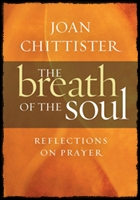 Benedictine sister Joan Chittister has a new book coming out this summer on prayer. She’s really good a setting each person up for success in their spiritual life. Do a few things and do them well. Here’s an excerpt:
Prayer forms are a good thing to cultivate in the spiritual life. They give structure to our prayer life. A prayer form tells us how to sit when we pray. It tells us what to say and how to say it — or better yet, perhaps, what not to say and how not to sit.
Prayer forms are designed to calm us down when we’re too agitated to concentrate. They center us in the midst of the natural distractions and noise of life. In many cases, they even provide the content that a soul that is dry or weary or perturbed simply cannot always provide for itself. They fill the emptiness that sets in when prayer becomes just one more effort I have too little energy to make.
No doubt about it: prayer forms are part of the superstructure of a serious prayer life. But they are not everything. Prayer is about a great deal more than simply the way we pray or even the prayers we pray.
The “everything” of a deep and demanding prayer life is an awareness and acceptance of the self.
No rosary, no icon, no prayer corner can supply the raw material of prayer–which is the self-knowledge that cements the relationship between the self and God.
The temptation with which we must grapple, if we really want to learn to pray, is the temptation to pray as if we were more than we are. More pious, perhaps. More accepting of the will of God, maybe. More ethereal in our concerns. More otherworldly, more a citizen of the next world than a pilgrim in this one. When all we bring to prayer is our holiness, what is the use of being there?
What am I not facing in myself that really needs my prayer if I am ever to grow in the art of prayer and the mandate to become fully human, if I am ever to become more than I am in the spiritual life?
To grow spiritually, then, I cannot hide even from myself. I must pray for self-knowledge, for the searing honesty that, with the grace of God, can bring me to the heart of God. — Sr. Joan Chittister, OSB
From The Breath of the Soul: Reflections on Prayer by Joan Chittister
-
Oliver Stone promos Jim Douglass’ “JFK and the Unspeakable” on Bill Maher

HBO has pulled down most of the YouTube videos of Bill Maher’s June 26 interview with film director Oliver Stone for some kind of copyright reasons. But none the less, Oliver Stone brought Jim Douglass’ ground-breaking book JFK and the Unspeakable: Who Killed Him and Why It Matters on to the show and gave it a great plug! Apparently, Bill Maher had already read it.
See my interview with Jim Douglass about this book and read my column on Jim’s book.
-
Kwok Pui-Lan: From Tiananmen to Tehran

Kwok Pui-lan is Professor of Christian Theology and Spirituality at the Episcopal Divinity School in Cambridge, MA.
She is an Asian feminist theologian that I’ve always been very impressed with. Her writing on the role of the Bible in a non-Bible culture was eye-opening–as well as all of her scripture interpretation from the perspective of the colonialized.
In a recent blog post at Religion Dispatches, she examines the 20th anniversary of the Tiananmen Square revolt with the current uprising in Iran:
On the twentieth anniversary of June 4, Tiananmen Square was relatively quiet and heavily guarded by the police. Hong Kong, as a Special Administrative Region, was the only place in China where a public candlelight vigil could be held. Several Christian groups in Hong Kong have helped organizing these annual vigils and pushed for the vindication of the June 4 demonstrators. The Hong Kong Christian Patriotic Democratic Movement issued a twentieth anniversary prayer, which says:
Righteous and peaceful God,
We pray to you.
The tears of Tiananmen mothers have not dried.
The curse of the wrongful deaths has not been lifted.
We pray that we will have a gentle and humble heart
To hold steadfast to our belief
And not allow distorted history have the last word . . .
Even though the dark night may be long
The light of our hope will be as long. . .Last week as the world watched the demonstration of the Iranian people, images of the Tiananmen crackdown flashed back on many people’s minds. President Barack Obama invoked the words of Dr. Martin Luther King, Jr., “the arc of the moral universe is long, but it bends toward justice.” He continued, “We are bearing witness to the Iranian peoples’ belief in that truth, and we will continue to bear witness.”
Read her whole post here.
Kwok Pui-lan’s the author of Postcolonial Imagination and Feminist Theology, and editor of the major 4-volume reference work Women and Christianity (coming out in October 2009 from Routledge).
-
On Becoming a Human Being
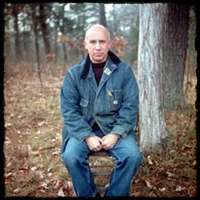 Catholic monk, writer, mystic, and activist Thomas Merton plays with the concept that we become a “member of the human race” over the course of a life time. A concept that has great resonance for me.
It reminds me of John’s gospel (1:12-13): We are given authority to become children of God. (See Wes Howard-Brook’s great treatise on John titled Becoming Children of God: John’s Gospel and Radical Discipleship).
Merton writes:
Coming to the monastery has been, for me, exactly the right kind of withdrawal. It has given me perspective. It has taught me how to live. And now I owe everyone else in the world a share of that life. My first duty is to start, for the first time, to live as a member of the human race which is no more (and no less) ridiculous that I am myself. And my first human act is the recognition of how much I owe everybody else.–Thomas Merton
From Entering the Silence ( Journals, Volume 2) edited by Jonathan Montaldo (HarperSanFrancisco, 1997, p. 451).
-
Subscribe
Subscribed
Have a WordPress.com account? Log in now.

