-
Cesar Vallejo’s “God”
 While proofing a 1989 article in Sojourners by Daniel Berrigan, I came across this poem by Cesar Vallejo. Berrigan referenced it in relation to Isaiah 49.
Vallejo was a Peruvian poet. He was born in 1892 and published his first collection of poems – Los Heraldos Negros – in 1918. This translation of “Dios” is by Robert Bly.
God
by César VallejoI feel that God is traveling
so much in me, with the dusk and the sea.
With him we go along together. It is getting dark.
With him we get dark. All orphans . . .But I feel God. And it even seems
that he sets aside some good color for me.
He is kind and sad, like those that care for the sick;
he whispers with sweet contempt like a lover’s:
his heart must give him great pain.Oh, my God, I’ve only just come to you,
today I love so much in this twilight; today
that in the false balance of some breasts
I weigh and weep for a frail Creation.And you, what do you weep for . . . you, in love
with such an immense and whirling breast. . . .
I consecrate you, God, because you love so much;
because you never smile; because your heart
must all the time give you great pain. -
Prop 8 Decision: Read It Yourself

I tend to be a “primary source” person. I like to read stuff for myself and try to figure it out and what I think about it before I go read everyone else’s opinion on it all.
If you are like that too, then here’s the conclusion of the California Supreme Court decision handed down yesterday on Prop 8, marriage equality, revisions and amendments to the state Constitution, etc:
By contrast, a retroactive application of Proposition 8 is not essential to serve the state’s current interest (as reflected in the adoption of Proposition 8 ) in preserving the traditional definition of marriage by restricting marriage to opposite-sex couples; that interest is honored by applying the measure prospectively and by having the traditional definition of marriage enshrined in the state Constitution where it can be altered only by a majority of California voters. …
In summary, we conclude that Proposition 8 constitutes a permissible constitutional amendment (rather than an impermissible constitutional revision), does not violate the separation of powers doctrine, and is not invalid under the “inalienable rights” theory proffered by the Attorney General. We further conclude that Proposition 8 does not apply retroactively and therefore that the marriages of same-sex couples performed prior to the effective date of Proposition 8 remain valid.
Having determined that none of the constitutional challenges to the adoption of Proposition 8 have merit, we observe that if there is to be a change to the state constitutional rule embodied in that measure, it must “find its expression at the ballot box.”
Read the entire deliberation decision here, including the dissenting views.
-
May 26: Prop 8 and Dred Scott
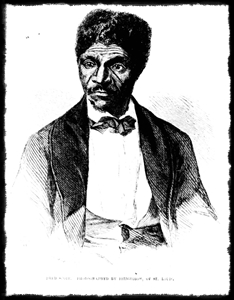 Do you think the California Supreme Court was aware that it was handing down the Prop 8 decision on marriage equality on the anniversary of Dred and Harriet Scott’s manumission?
I hope the odd coincidence of history is predictive and, despite California’s court decision, the U.S. will soon be celebrating the “manumission” to marry for whosoever will.
On March 6, 1857, after an 11-year court battle, the U.S. Supreme Court ruled that Dred Scott, an African-American slave, had “no rights that a white man need respect.”
On May 26, 1857, Taylor Blow, a son of Scott’s original owner, purchased Scott and his family in order to set them free.
Dred Scott was born a slave in Virginia about 1790. He was sold to a doctor who later moved to Illinois and eventually to Missouri with all his property. In 1846, Dred Scott filed a suit in Missouri seeking freedom for himself, his wife, and two daughters. He based his case on the fact that slavery was prohibited in Illinois, and because he had lived there, he had been freed.
Scott’s pursuit of their freedom when on for seven years in various courts, with one higher court after another reversing previous decisions. Throughout the ordeal, the children of Dred Scott’s original owners gave him financial support. Finally, after the Missouri Circuit Court ruled that “once free, always free,” Scott’s case went to the U.S. Supreme Court.
The federal Supreme Court ruled that Scott had no right to sue because blacks were not U.S. citizens. Scott and his family were returned to their owner.
Fifteen months after Scott had been freed by the Blow family, who were Catholic, he died of tuberculosis. When Dred Scott died on September 17, 1858, the Blow family arranged to have him buried in the Catholic Calvary Cemetery of the Archdiocese of St. Louis.
-
What Does the Contemplative Life Require?
 Catholic monk and writer Thomas Merton grew into his contemplative life at Gethsemane monastery in Kentucky. He didn’t enter the monastery as a full-blown contemplative. He learned his calling over time.
As I explore what it means to nurture and cultivate a Christian contemplative life while living in the inner city and working an 8-hour day to the rhythms of the American work force, I find Merton’s list below revealing.
This will give us some idea of the proper preparation that the contemplative life requires. A life that is quiet, lived in the country, in touch with the rhythm of nature and the seasons. A life in which there is manual work, the exercise of arts and skills, not in a spirit of dilettantism, but with genuine reference to the needs of one’s existence. The cultivation of the land, the care of farm animals, gardening. A broad and serious literary culture, music, art, again not in the spirit of Time and Life – (a chatty introduction to Titian, Prexiteles, and Jackson Pollock) – but a genuine and creative appreciation of the way poems, pictures, etc., are made. A life in which there is such a thing as serious conversation, and little or no TV. These things are mentioned not with the insistence that only life in the country can prepare a [person] for contemplation, but to show the type of exercise that is needed.–Thomas Merton
The Inner Experience: Notes on Contemplation, edited by William H. Shannon (HarperSanFrancisco, 2003, p.131).
-
Obama Defends Closing Guantanamo and Cleaning Up Bush-Cheney Mess
 Cleaning up the Bush-Cheney mess will take some time and take careful and responsible work by this new administration. They must be guided by humanitarian principles and the clear separation of powers and protection of citizen’s rights outlined in the Constitution.
If you haven’t preached a sermon on what’s wrong with torture, I suggest you get on it! (Read Back to Basics: T is for Torture to understand why we need to teach from the pulpit that torture is a sin.)
Preach with the lectionary in one hand and President Obama’s national security speech in the other. Consider using Psalm 1, if you’re using the Revised Common Lectionary:
Happy are those who do not follow the advice of the wicked, or take the path that sinners tread, or sit in the seat of scoffers; but their delight is in the law of the LORD, and on his law they meditate day and night.
Or Ephesians 1:20-21, on this Christ who was tortured, if you are using the Ascension readings:
God put this power to work in Christ when he raised him from the dead and seated him at his right hand in the heavenly places, far above all rule and authority and power and dominion, and above every name that is named, not only in this age but also in the age to come.
Following is an exerpt from the text of President Obama’s speech this morning on national security issues, as released by the White House.
We’re currently launching a review of current policies by all those agencies responsible for the classification of documents to determine where reforms are possible, and to assure that the other branches of government will be in a position to review executive branch decisions on these matters. Because in our system of checks and balances, someone must always watch over the watchers — especially when it comes to sensitive administration — information.
Now, along these same lines, my administration is also confronting challenges to what is known as the “state secrets” privilege. This is a doctrine that allows the government to challenge legal cases involving secret programs. It’s been used by many past Presidents — Republican and Democrat — for many decades. And while this principle is absolutely necessary in some circumstances to protect national security, I am concerned that it has been over-used. It is also currently the subject of a wide range of lawsuits. So let me lay out some principles here. We must not protect information merely because it reveals the violation of a law or embarrassment to the government. And that’s why my administration is nearing completion of a thorough review of this practice.
And we plan to embrace several principles for reform. We will apply a stricter legal test to material that can be protected under the state secrets privilege. We will not assert the privilege in court without first following our own formal process, including review by a Justice Department committee and the personal approval of the Attorney General. And each year we will voluntarily report to Congress when we have invoked the privilege and why because, as I said before, there must be proper oversight over our actions.
On all these matters related to the disclosure of sensitive information, I wish I could say that there was some simple formula out there to be had. There is not. These often involve tough calls, involve competing concerns, and they require a surgical approach. But the common thread that runs through all of my decisions is simple: We will safeguard what we must to protect the American people, but we will also ensure the accountability and oversight that is the hallmark of our constitutional system. I will never hide the truth because it’s uncomfortable. I will deal with Congress and the courts as co-equal branches of government. I will tell the American people what I know and don’t know, and when I release something publicly or keep something secret, I will tell you why.
Read his whole speech here.
-
“Gentrification” by Sherman Alexie
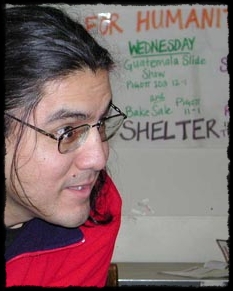 Sherman Alexie is known mostly for his movies – Smoke Signals, The Business of Fancydancing, and 49? – set in Indian Country or just outside.
But he’s also got a new collection of poems out titled Face (Hanging Loose Press, 2009). Here’s one that captures the shifting tides of my own neighborhood of Columbia Heights in D.C.
Gentrification
by Sherman Alexie
Let us remember the wasps
That hibernated in the walls
Of the house next door. Its walls
Bulged with twenty pounds of waspsAnd nest, twenty pounds of black
Knots and buzzing fists. We slept
Unaware that the wasps slept
So near us. We slept in blackComfort, wrapped in our cocoons,
While death’s familiars swarmed
Unto themselves, but could have swarmed
Unto us. Do not trust cocoons.That’s the lesson of this poem.
Or this: Luck is beautiful.
So let us praise our beautiful
White neighbor. Let us write poemsFor she who found that wasp nest
While remodeling the wreck.
But let us remember that wreck
Was, for five decades, the nestFor a black man and his father.
Both men were sick and neglected,
So they knew how to neglect.
But kind death stopped for the fatherAnd cruelly left behind the son,
Whose siblings quickly sold the house
Because it was only a house.
For months, that drunk and displaced sonAppeared on our street like a ghost.
Distraught, he sat in his car and wept
Because nobody else had wept
Enough for his father, whose ghostTook the form of ten thousand wasps.
That’s the lesson of this poem:
Grief is as dangerous and unpredictable
As a twenty-pound nest of wasps.Or this: Houses are not haunted
By the dead. So let us pray
For the living. Let us pray
For the wasps and sons who haunt us.Sherman Alexie’s recent books are Flight (Grove/Atlantic, 2007) and The Absolutely True Diary of a Part-Time Indian, his first young adult novel (Little, Brown, 2007). Radioactive Love Song is due out soon. “Gentrification” is reprinted from The American Poetry Review (March-April 2009).
-
“Detail” by Eamon Grennan
 I went to hear Irish poet Eamon Grennan last night at the Folger Theater at the Library of Congress. His newest book is Matter of Fact.
It was a wonderful rangy reading that included his favorite poems as well as his own work.
He read the section from Macbeth when Macduff learns that his family is all murdered, “Chaucer” by Longfellow, “The Stolen Boat” by Wordsworth, “Sunday Morning” by Wallace Stevens, and many more.
Grennan concluded with his own poem “Detail.”
Detail
by Eamon GrennanI was watching a robin fly after a finch—the smaller
chirping with excitement, the bigger, its breast blazing, silent
in light-winged earnest chase—when, out of nowhere
over the chimneys and the shivering front gardens,
flashes a sparrowhawk headlong, a light brown burn
scorching the air from which it simply plucks
like a ripe fruit the stopped robin, whose two or three
cheeps of terminal surprise twinkle in the silence
closing over the empty street when the birds have gone
about their business, and I began to understand
how a poem can happen: you have your eye on a small
elusive detail, pursuing its music, when a terrible truth
strikes and your heart cries out, being carried off. -
Cardboard City Catholics
 Thirty-two teens from a west London Catholic parish became homeless for a day as part of their preparation for being “confirmed” (making an adult commitment) in the Catholic Church. I LOVE this as a way of practicing living out the gospel and embodying the social teachings of the Catholic Church.
Some find it easy to dismiss this kind of symbolic action, but I have to say that it’s this kind of experience that shapes and forms the individual conscience. It’s not that this particular action will be effective in ending homelessness (though they did raise £1000 for the local shelter), but it will convert a whole generation of Catholics sensitive to the issues.
Here’s an excerpt from the article:
Annette Brazier, who leads the catachetical programme at Our Lady of Lourdes parish in Acton, explained: “our young people have a real concern for social issues. They often challenge us to look after the environment, speak out for the poor and needy and challenge racism. The project started with a reflection on the gospels and the call to reach out to the marginalized in our society. A number of the sessions focused on social justice and how as Christians we are called to feed the hungry and clothe the naked. The group responded well to the challenge presented to them and after a talk from Ian Breen, the director of the local charity Acton Homeless Concern, they decided to go homeless for a day and to do a sponsored fast during this time.”
One of the local schools, St. Vincent Catholic Primary, offered their grounds on a Saturday and the group of 32 confirmation candidates, plus their catechists gave up their usual comforts and lived on the school grounds for the day.
Many of the young people found bits of cardboard to sit on or make temporary shelters so that they could gain a better understanding of what it must be like to be homeless.
Parish Priest, Fr. John Leahy, said he was really impressed by their efforts. He said: “the group have really thought about those who are marginalised in our society.”
The project, which was called, Cardboard City, raised over £1000 for Acton Homeless Concern.
Read the whole article here.
-
‘We’re all Fishermen Now’
 I love this story below that Obama told at Notre Dame yesterday about Fr. Hesburgh creating “common ground” among members of Eisenhower’s Civil Rights Commission. What held them together was fishing.
The way Obama turns the image at the end is phenomenal and not without some Christian resonance. Lovely.
And years later, President Eisenhower asked Father Ted how on Earth he was able to broker an agreement between men of such different backgrounds and beliefs. And Father Ted simply said that during their first dinner in Wisconsin, they discovered they were all fishermen. (Laughter.) And so he quickly readied a boat for a twilight trip out on the lake. They fished, and they talked, and they changed the course of history.
I will not pretend that the challenges we face will be easy, or that the answers will come quickly, or that all our differences and divisions will fade happily away — because life is not that simple. It never has been.
But as you leave here today, remember the lessons of Cardinal Bernardin, of Father Hesburgh, of movements for change both large and small. Remember that each of us, endowed with the dignity possessed by all children of God, has the grace to recognize ourselves in one another; to understand that we all seek the same love of family, the same fulfillment of a life well lived. Remember that in the end, in some way we are all fishermen.
Read the full transcript here.
-
Subscribe
Subscribed
Have a WordPress.com account? Log in now.

