-
Shall the Mountains Fall and Hills Turn to Dust?
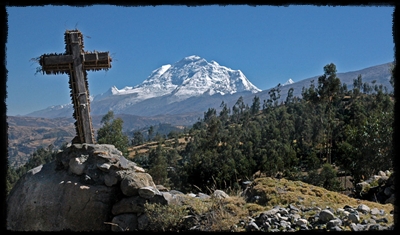
Over at the Maryknoll Office for Global Concerns site, Maryknoll lay missioner Barbara Fraser has a nice reflection for the second Sunday of Advent. Fraser spent many years in Peru.
In the Andes mountains, water is life. Rains fall from November to March, during the growing season. In the dry months, however, people depend on glaciers, which slowly release water, irrigating pastures where animals graze and feeding streams that provide water for drinking and washing. As the glaciers disappear, the pastures dry up, and neighbors begin to fight over access to the remaining pastures and streams. Some cannot continue to make a living from the land. They migrate to cities, where they face hardship and discrimination, because they have little formal education and do not speak Spanish well.
Farmers in the Andes see the world they have known collapsing around them, because of the changing climate. What they feel is probably similar to what the Israelites felt when they were in exile, or what the Jews of John the Baptist’s time felt under foreign occupation. They lived in a time of uncertainty, had little control over events, and did not know if they could promise their children a better future.
Today’s readings reminded them and remind us of God’s faithfulness and the promise of salvation. But the readings also remind us that God calls us to action, to prepare the way for salvation.
Read Barbara Fraser’s whole reflection here.
-
Conflicted on Obama’s Afghanistan Speech?
 I got a note today from my friend Carolyn who said, in response to Obama’s Afghanistan speech: ” I am so conflicted about what US foreign/war policy should be? By comparison health insurance is easy and clear! ”
I’ve been thinking about Obama’s speech for the last few days. It’s taken me a few days to sort out some of my perspective on it – and it’s a perspective that keeps shifting.
For context, I root myself in the tradition of Catholic pacifism. I’m opposed to war and violence. Whenever we pick up the stick, it represents moral failure and a loss of human dignity. Now, that’s all nice and good except when people do really bad things. Then what? So I also have tried to develop a “pragmatic pacifism” (along the lines of the Justpeacemaking Theory) that is complex enough to address the real world.
From my point of view, Obama’s extension of the military model in Afghanistan is a mistake. An understandable mistake, but a mistake nonetheless.
I understand Carolyn’s “conflictedness” over our Afghanistan foreign policy. On the one hand Obama’s speech was SO MUCH BETTER than anything we ever heard from President Bush that it’s hard to not just be relieved.
Obama says things that are important. He puts them in historical context. He addresses various sides of the argument. He addressed this speech to the one’s who are going to have to carry out the mission and suffer the consequences (cadets at West Point). He was very intentional about repositioning of the U.S. vis a vis global alliances. He moved away from the U.S. vs al Qaida into al Qaida vs the world. All of this stuff is good.
BUT, Obama has inherited an imperial regime and he can’t “un”-imperialize it over night. Also, I’m not totally convinced that anyone who runs for U.S. president wants to un-imperialize us. So Obama’s foreign policy decision is what I’d call “imperialism-lite” — increased troops along with increased aid/diplomacy in a regional approach with a withdrawal timeline. It’s hard to get excited about this approach either pro or con.
I think what’s important to remember is that none of this effectively disrupts members of al Qaida. That’s done effectively through Interpol, the FBI, the UN subcommittee on Al Qaida and the Taliban (and the U.S. still hasn’t paid our UN dues) and other tools aimed at disrupting international criminal networks.
Nothing disrupts the idea of al Qaida except an intensive new narrative and long-term relationships at the local level, like they are doing effectively in the southern Phillipines with the Moro Islamic Liberation Front.
So that’s my initial response. I’d be interested in hearing from others.
-
Operation Noah Reports from Copenhagen
Daily film videos from the UN climate summit starting on Copenhagen next week are part of a December plan of action to make sure that the voice of faith is heard at this “make or break” time in our history. These will be on the new ON website at: http://www.operationnoah.org.
Watch the 3-minute introductory video below.
Operation Noah, the ecumenical community which campaigns exclusively on climate change, is working with a US web-based organization, Odyssey Networks, to bring you the voices of religious wisdom as monks, nuns, rabbis and holy men and women converge on the Danish capital.
“It’s quite an ambition,” said ON’s Mark Dowd, who will be fronting many of the reports. “We’re following everyone from the Archbishop of Canterbury, to youngsters from the Christian-Muslim forum, Benedictine and Franciscan nuns, Hindu gurus, Buddhist monks and American evangelicals.”
Using the full range of new media potential, there are plans for daily video diaries, blogs and film reports which will feature, for example, the huge religious gatherings on the weekend of December 12th and 13th.
“I am sure that much of Copenhagen will de dominated by the politicians and policymakers with endless talks of carbon trading, cap and trade and mitigation measures,” said Mark Dowd. “That’s all well and good, but we need to stand back and give the faith voice a platform. Creation is a gift and unless we include some sense of the sacred in our reflections, we are not going to get back on course to living in greater balance and harmony with the natural world.”
-
Sayeth Isaiah: Share Your Food With the Hungry
 More than 36 million people use the inconspicuous plastic cards issued by the government for “food stamps” to buy staples like milk, bread, and cheese. I see the cards all the time at the grocery store I use in Columbia Heights, D.C. Food stamp usage has increased by 22 percent in D.C. since 2007 and 36 percent of the District’s kids are on food stamps.
According to the New York Times, “virtually all have incomes near or below the federal poverty line, but their eclectic ranks testify to the range of people struggling with basic needs. They include single mothers and married couples, the newly jobless and the chronically poor, longtime recipients of welfare checks and workers whose reduced hours or slender wages leave pantries bare.”
The food stamp program is one way that through social institutions we answer God’s plea in Isaiah 58 to share our food with the hungry poor. Government programs should not perpetuate poverty, but they should provide a path of human dignity for those who are powerless in the culture.
Catholic social teaching reminds us: How we organize our society — in economics and politics, in law and policy — directly affects human dignity and the capacity of individuals to grow in community. The obligation to “love our neighbor” has an individual dimension, but it also requires a broader social commitment. Everyone has a responsibility to contribute to the good of the whole society, to the common good.
Check out the interactive map of “food stamp” usage around the country. Who’s hungry where YOU live? What does it mean?
“Is not this the kind of fasting I have chosen: to loose the chains of injustice and untie the cords of the yoke, to set the oppressed free and break every yoke? Is it not to share your food with the hungry and to provide the poor wanderer with shelter—when you see the naked, to clothe him, and not to turn away from your own flesh and blood? Then your light will break forth like the dawn, and your healing will quickly appear; then your righteousnessa will go before you, and the glory of the Lord will be your rear guard.”–Isaiah 58:6-8
-
Video: Stop Gambling on Hunger
Remember when gas was over $4 a gallon? Remember the global food crisis that resulted in dozens of food riots around the world and plunged over 100 million people around the world into hunger? These crises where not caused by shortages of oil or food. Instead they were caused by massive bets made on Wall Street.
Sojourners best analyst on the “moral economy” Elizabeth Palmberg worked with David Kane and others are the Maryknoll Office of Global Concerns to produce this 7-minute video on food security and commodities gambling. Watch and learn!
Clearly, this seven minute video is a simplification of a complex issue, but it sums up the history behind and key problems brought on by the deregulation of commodity futures markets. You can learn more and take action here.
-
World AIDS Day: “Beyond the Begging Bowl”
Mercedes Sayagues over at Gender Masala posted a nice reflection for World AIDS Day. Mercedes is a Uruguayan journalist and editor with life-long membership in the global women’s movement. She lives in South Africa.
Prayer for Today: May the tree of life shed its leaves on us for the healing of the peoples (Revelation 22:2).
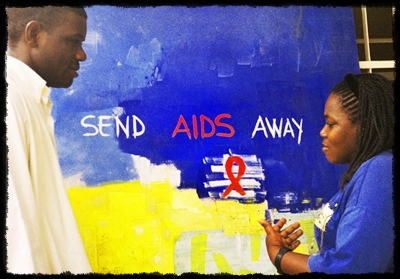
Mercedes Sayagues writes:
Marie Mendene (right in photo above) is an extraordinary activist from Cameroon and one of the first African women to say publicly that she lives with HIV, in the 1990s, when AIDS was a disease of shame and blame.
This is one of my favourite photos about AIDS in Africa. I took it at Sunshine, her NGO in Douala, in 2003, before antiretroviral treatment became widely available. Only a few Cameroonians in cities could get the life-saving pills.
The day I took the photo, Marie had queued for seven hours and received only half of her monthly ARV pills. She was understandably upset about the poor logistics and delivery of medicines. AIDS magnified all the inadequacies of health systems.
That was then. Today, nearly three million people in Africa are on ARV treatment. This seemed like a dream then, but activists were campaigning hard to make it come true.
Marie had a clear vision of activism. “We should go beyond the begging bowl and the appeal to compassion, beyond the stage of being used to do prevention and awareness, and become part of real-decision making around AIDS,” she told me. Marie is to the right in the picture, with a fellow activist.–Mercedes Sayagues
-
Noticing What Is Absent
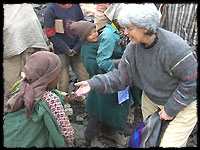
Sr. Janet Hockman in Nepal The Maryknoll Office of Global Concerns has some nice Advent reflections written by their missioners around the world.
Here’s an excerpt written by Sr. Janet Hockman who currently serves in Kathmandu, Nepal.
As Advent begins, Jeremiah sets a stance for us – SEE! BEHOLD! Look and be attentive … It takes time, it means intent. Who of us also remembers to notice what is missing, what is absent as well as what is before us? Noticing something missing is an awareness of things known, things dreamed of, or hoped for, or promised.
Jeremiah names for us things so longed for: fulfilled promises, honesty, integrity, being saved, and dwelling in confidence. These things are of God. They are not new; they have been God-promised and hoped for throughout all of history.
For Nepal, as a country, they were expected from de-throned royalty, awaited in a new Prime Minister, and intended to be written into a first constitution. The absences leave the state of insecurity and continued wondering about the possibility of peace.
Read the whole post at 11-29-09-1st-Sunday-Advent.
-
Joan Chittister: What is Advent About?
 “A friend recently gave me a textile wall-hanging from Peru that makes clear that the process of finding God in the small things of life is as profound as it is simple. A pastoral scene of palm trees and rural lean-tos has been hand-stitched by peasant women, quilt-style, across the top of a felt banner. Under it is a calendar of thirty small pockets, each of them filled with something we can’t see. Every day until Christmas, we are invited to find the part of the scene that has been pocketed for that day and attach it to the scene above, one piece of hand woven cloth adhering to the other as we go.
Some of the pieces are of benign and beautiful things; some are not. There are bumblebees and angels, wild animals and dry straw, a branch-laden peasant man and a weary-looking woman. But there at the end of the days, as common as all the rest of the items in the scene, is the manger, the sign of the One who knows what life is like for us, who has mixed His own with ours. Now, we can see, all our expectations have been worth it.
Advent is about learning to wait. It is about not having to know exactly what is coming tomorrow, only that whatever it is, it is of the essence of sanctification for us. Every piece of it, some hard, some uplifting, is sign of the work of God alive in us. We are becoming as we go. We learn in Advent to stay in the present, knowing that only the present well-lived can possibly lead us to the fullness of life.
Advent relieves us of our commitment to the frenetic in a fast-paced world. It slows us down. It makes us think. It makes us look beyond today to the “great tomorrow” of life. Without Advent, moved only by the race to nowhere that exhausts the world around us, we could be so frantic with trying to consume and control this life that we fail to develop within ourselves a taste for the spirit that does not die and will not slip through our fingers like melted snow.
It is while waiting for the coming of the reign of God, Advent after Advent, that we come to realize that its coming depends on us. What we do will either hasten or slow, sharpen or dim our own commitment to do our part to bring it.
Waiting — that cold, dry period of life when nothing seems to be enough and something else beckons within us — is the grace that Advent comes to bring. It stands before us, within us, pointing to the star for which the wise ones from the East are only icons of ourselves.
We all want something more. Advent asks the question, what is it for which you are spending your life? What is the star you are following now? And where is that star in its present radiance in your life leading you? Is it a place that is really comprehensive enough to equal the breadth of the human soul?”
by Joan Chittister, OSB
From The Liturgical Year by Joan Chittister (Thomas Nelson)
-
Advent Reflections Offered Here
 During Advent, I’ll be posting some short Advent reflections, with the idea of sharing together our Advent journey.
If you want to get them sent directly to your e-mail box, then add your e-mail address to the “Follow Me” box or set up an RSS feed.
Gather your evergreens. Go buy (or make) purple and pink candles. Get wire to make your wreath and a few simple purple and pink ribbons to weave together the greens. Clear a space on the kitchen table or anyplace where your household gathers. Write down a short Bible passage on an index card – something from the Prophet Isaiah would be great – and keep it near the wreath.
Now that we’ve cleared a space for prayer and quiet celebration at home, we can begin clearing the same kind of space in our heart. It’s time to get ready!
-
“We Astronomers” by Rebecca Elson
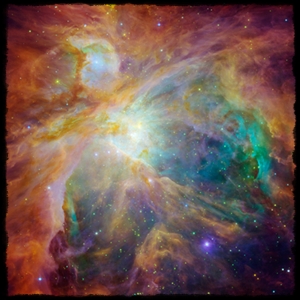
Orion Nebula from Hubble We Astronomers
by Rebecca ElsonWe astronomers are nomads,
Merchants, circus people,
All the earth our tent.
We are industrious.
We breed enthusiasms,
Honour our responsibility to awe.But the universe has moved a long way off.
Sometimes, I confess,
Starlight seems too sharp,And like the moon
I bend my face to the ground,
To the small patch where each foot falls,Before it falls,
And I forget to ask questions,
And only count things.From A Responsibility to Awe by Rebecca Elson (Oxford Poets, 2001)
-
Subscribe
Subscribed
Have a WordPress.com account? Log in now.

