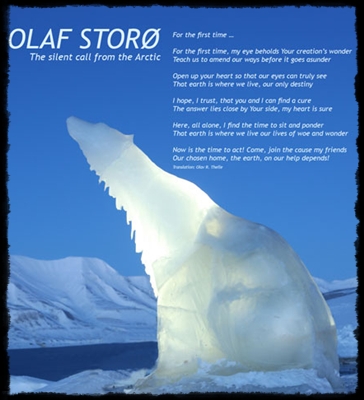
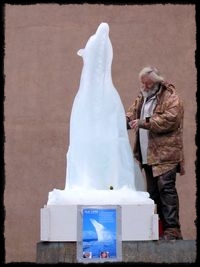
Norwegian artist Olaf Storø has taken to making ice sculptures of polar bears as a symbol of his desire for climate justice.
He’s taken one of these sculptures to Copenhagen and placed it on the steps of the Church of Our Lady, Copenhagen’s Lutheran cathedral.
“The frozen bear will be a silent cry from the Arctic,” said Storø.
The ice bear was blessed at a 13 December worship service called “an ecumenical celebration for creation” in the cathedral, which marked the midpoint of United Nations-organized talks in the Danish capital to reach agreement on limiting emissions responsible for causing climate change.
“It is easy for people to understand climate change when they see a 500 kilogram bear slowly melt and disappear,” the artist said.
Instead of Nero fiddling while Rome burns, Storø’s sculpture shows how world leaders, particularly in the U.S. and China, are fiddling while the earth’s protective systems melt.
The 4-minute extended version of the moment last spring when 13,500 people sang “Hey Jude” together in London’s Trafalgar Square. Everyone involved arrived thinking they could be dancing – no-one had any idea how the event would unfold. (I see John Lennon up there smiling!)
Even though this was a T-Mobile sponsored “sing along,” I think it’s an example of using technology to build community and having technology give something back to culture, rather than just sapping the life out of it.
“And any time you feel the pain, hey, Jude, refrain … Don’t carry the world upon your shoulders … Well, don’t you know that it’s a fool who plays it cool by making his world a little colder …”
On Saturday night, I attended the Washington Revels Christmas extravaganza down at George Washington University in D.C. The Revels were founded in 1971 by musician, educator and author John Langstaff to celebrate the seasons in performance through the power of traditional song, dance, storytelling and ritual from cultures around the world. I think they are in 10 U.S. cities. When I was a child, my family went to see the Revels’ Victorian Christmas in San Francisco a few times. I never forgot it!
If you’ve never been, a Revels production brings a volunteer chorus of children and adults and professional actors, musicians, designers, and directors into community. At each performance, this community invites the audience to join it. The audience always accepts the invitation, to make noises, to sing carols, to join hands with strangers and dance. Audience participation is the hallmark of Revels.
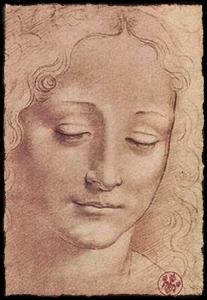
The D.C. Christmas Revels this year focused on the theme of an Italian Renaissance Christmas and the lead character was none other than Leonardo DaVinci! It was a wonderful program that got all 600 guests singing “Dona Nobis Pacem” and dancing in the aisles to “The Lord of the Dance.” This particular performance mixed a celebration of the Winter Solstice with traditional Christmas carols and the peculiar magic that was the Italian Renaissance. (You can see the wonderful performance program here.)
During the performance, “Leonardo” recited this 500-year-old excerpt from a letter written by Franciscan Giovanni Giocando on Christmas Eve. I thought it was beautiful. I hope you enjoy it also.
“I salute you. I am your friend, and my love for you goes deep. There is nothing I can give you which you have not. But there is much, very much, that, while I cannot give it, you can take. No heaven can come to us unless our hearts find rest in it today. Take heaven! No peace lies in the future which is not hidden in this present little instant. Take peace! The gloom of the world is but a shadow. Behind it, yet within our reach, is joy. There is radiance and glory in darkness, could we but see. And to see, we have only to look. I beseech you to look! Life is so generous a giver. But we, judging its gifts by their covering, cast them away as ugly or heavy or hard. Remove the covering, and you will find beneath it a living splendor, woven of love by wisdom, with power. Welcome it, grasp it, and you touch the angel’s hand that brings it to you.
Everything we call a trial, a sorrow or a duty, believe me, that angel’s hand is there. The gift is there and the wonder of an overshadowing presence. Your joys, too, be not content with them as joys. They, too, conceal diviner gifts. Life is so full of meaning and purpose, so full of beauty beneath its covering, that you will find earth but cloaks your heaven. Courage then to claim it; that is all! But courage you have, and the knowledge that we are pilgrims together, wending through unknown country home. And so, at this time, I greet you, not quite as the world sends greetings, but with profound esteem and with the prayer that for you, now and forever, the day breaks and shadows flee away.”–Fra Giovanni Giocando (“A Letter to the Most Illustrious the Contessina Allagia degli Aldobrandeschi, Written Christmas Eve Anno Domini 1513”)
The longing of Advent came early for many of us this year. Amid economic recession, war and strife around the globe and in our communities, we desire Christ’s coming.
We remember loved ones missing from around our tables this Christmas. We mourn ongoing conflict and oppression in so many places. We feel the sting of lost jobs, income and savings in our families and churches, and among our neighbors.
We need the renewed hope of Christmas morning to break into our tiredness and despair.
The prophet Isaiah spoke to a weary people in exile, and speaks to us today, exiles in a strange land. Isaiah promises, “Every valley shall be lifted up, and every mountain and hill be made low; the uneven ground shall become level, and the rough places a plain. Then the glory of the Lord shall be revealed, and all people shall see it together” (40:4-5a).
It is difficult to imagine such transformation when we look around us. President Obama’s decision to send more troops to Afghanistan dashes hopes, at least for several years, of an end to the U.S. military campaign there.
The announcement also is a setback for those who expected substantial change in U.S. foreign policy, and a focus of economic resources on human needs in our country and abroad.
Yet Christ was born into such a world of woe, to a poor family in an occupied land. He was lain, newborn, in the lowliest of places, with a murderous tyrant seeking his death.
Despite such strife, we can picture the hope of Mary and Joseph as they held the infant and imagined how the angel Gabriel’s promises would come to pass.
Today, I cut a few Christmas trees for the house, and a big one for the novitiate. It was not quite raining, but cloudy and cold. Walked home alone by the lake near Bardstown road. The loblolly pines planted during my 1955 crisis are doing well. The whole property is dotted with trees I have planted in hours of anguish. The ones I planted in hours of consolation have not succeeded.–Thomas Merton
“Every ordinary thing in your life is a word of God’s love: your home, your work, the food you eat, the friends you delight in, the clothes your wear, the air you breathe, the flowers under your feet are the courtesy of God’s heart flung down on you! All these things say one thing only: ‘See how I love you.’ As you keep watch this Advent, be mindful of the Holy One within who keeps vigil over you, even listening to your heartbeat.”—Caryll Houselander, woodcarver and mystic
“The wilderness and the dry land shall be glad, the desert shall rejoice and blossom; like the crocus it shall blossom abundantly, and rejoice with joy and singing”.—Isaiah 35:1-2
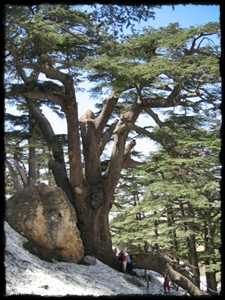
Cedar of Lebanon
Isaiah is weaving a vision that indicts the military might of the kings of Tyre, Babylon, Egypt, Edom. In earlier chapters, Isaiah gives a sharp-tongued eulogy on the death of that clear-cutting king Nebuchadnezzar: “The pines themselves and the cedars of Lebanon exult over you. Since you have been laid low, they say, no man comes to fell us” (14:8).
What are these songs that the earth sings? What is the role of singing amongst those who are oppressed? In slavery and servitude the world over singing is a sign of lament and resistance. So if earth is singing for joy then these must be “resistance songs.”
As theologian Ched Myers says, “Empire has always been at war with nature.” “Resource wars” are nothing new. But when empires are brought low, as Isaiah predicts will occur when God’s word is fulfilled, then the very earth will sing its victory song over the oppressor.
Do you live an honorable life with regards to the earth? Will your Christmas gifts celebrate creation?
Ad……vent. A d v e n t (slowly breathe in on the “Ad” part and out on the “vent” part)…There! You prayed today. Keep it up!
With gratitude to Pax Christi USA where some of these reflections first appeared in print..
It was a great chance to exchange emails with two of the great Merton scholars and editors of Merton’s letters Bill Shannon and Christine Bochen. I was particularly interested in looking at the “American-ness” of Merton’s correspondence. Aside from the theological or spiritual content, I wondered how Merton’s letters fit in the genre of American literature.
Below is an excerpt from my review:
While it is necessary to place the letters in this collection in the context of Merton’s own life and in the context of Merton’s overall legacy, it is also important to examine Merton’s letter-writing art in the context of 20th-century American literature.
Literary sociologists David Barton and Nigel Hall argue in Letter Writing as a Social Practice that letter writing is a genre unto itself and deserves to be studied as enthusiastically as poetry or the novel. Additionally, they posit that “many contemporary genres have their origins in letters” (Barton and Hall, 4). The new research into letter writing raises several questions regarding Thomas Merton, who was, as Shannon and Bochen put it, “one of the most prolific and provocative letter writers of the twentieth century” (vii).
How will Merton be critiqued as a letter-writer per se? William Shannon said in the same personal e-mail that “Merton was an amazingly good letter-writer.” How will critics analyze Merton’s letter-writing genius as compared to his innovation and skill as a poet or his daring analysis as an essayist? British novelist, satirist, and literary critic Evelyn Waugh, who prepared the manuscript of Merton’s The Seven Storey Mountain for a British audience, so much admired Merton’s skill that he advised Merton to “put books aside and write serious letters and to make an art of it” (ix). Of course, Merton didn’t set book-writing aside, but he did continue over his life to perfect his letter-writing craft.
More importantly, are Merton’s letters derivative of his political essays, theological and monastic treatises, autobiographical writings, poetry, and intellectual critiques or, as Barton and Hall prompt, do all these genres have their genesis in Merton’s letters instead? Often the personal correspondence of a well-known personality are collected and published in order to provide enthusiasts with an “inside look” at the “personal” life that would otherwise be hidden. The publication of personal letters can have a tinge of voyeurism. I would argue that it is in Merton’s letters that we find the foundations of his published works. The letters show him testing ideas, crafting opinions, grounding his analysis, playing with images and phrasing, sorting and sifting the essential components of his life story. From this perspective, Merton’s letters (and journals) are the seedbed for his completed works in other genres, rather than the frosting on his “real” work.
Equally important in recognizing Merton’s brilliance in the genre of letter-writing is understanding the “American-ness” of Merton’s correspondence project. Elizabeth Hewitt, author of Correspondence and American Literature, 1770-1865 (Cambridge University Press, 2004), points out that in 1831 Alexis de Tocqueville remarked that the marvel of American political ideology was the seeming ability to strike a balance between individual liberty and a celebration of democratic principles (4). “Letters emphasize the singularity of a particular letter-writer,” writes Hewitt, “even as they strive to position the recipient in an idealized relationship with the writer. They emphasize solidarity and individualism at once,” and thus reconcile a balance of power that is fundamentally American.”
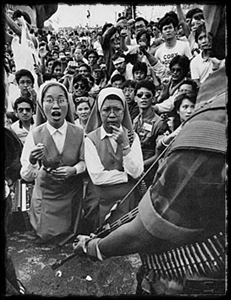
Catholic sisters in Phillippines, 1986The International Center on Nonviolent Conflict (Yes! There is such a place.) has posted a very helpful reading list of books, articles, Web sites, and speeches dealing with contemporary experiments in nonviolence.
This is a great resource for building up your local library’s “history of nonviolence” section.
BOOKS
Peter Ackerman and Jack DuVall – A Force More Powerful: A Century of Nonviolent Conflict (Hardback: New York: St. Martin’s Press, 2000; Paperback: New York, Palgrave-Macmillan, 2001)
Peter Ackerman and Christopher Kruegler – Strategic Nonviolent Conflict: The Dynamics of People Power in the Twentieth Century (Westport, CT: Praeger, 1993)
Gene Sharp – The Politics of Nonviolent Action, Part I, Power and Struggle (Boston, MA: Porter Sargent Publishers, 1973)
Gene Sharp – Waging Nonviolent Struggle: 20th Century Practice and 21st Century Potential (Boston, MA: Porter Sargent Publishers, 2004)
ARTICLES
Reason Online – The East Turned Upside Down: Carnival and Conspiracy in Ukraine – Jack DuVall quoted at length (November 30, 2004) http://www.reason.com/news/show/33953.html
Sojourners Magazine – Mullahs, Nukes and the People: Which Way Forward in Iran? Peter Ackerman and Jack DuVall (November, 2004)
Sojourners Magazine – Nonviolence in Najaf? Will we recognize an Islamic peace movement when we see it? Rose Marie Berger (November, 2004)
Get the whole list here. See ICNC’s full list of all resources here.
Thousands of people have attended the funeral of Chilean singer Victor Jara today who has been reburied 36 years after his death in a military coup. Well-wishers scattered flowers as his cortege made its way to a cemetery.
Jara was one of the most prominent victims of the 1973 coup that brought Gen Augusto Pinochet to power. His body was exhumed in June so that a court could clarify the circumstances of his death. It was established that he had been shot more than 30 times.
Jara’s British-born widow Joan, now in her 80s, led the funeral procession as it wound through the streets of the capital, Santiago. The coffin was draped in the singer’s trademark red-and-black woollen poncho.
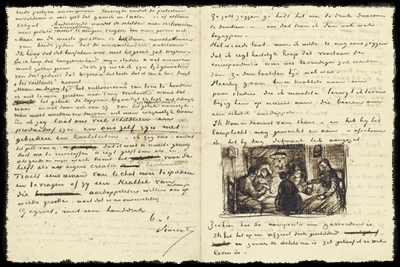
For the first time all the letters of Vincent Van Gogh have been collected and published in a 6-volume set. I’ve been interested in Van Gogh since my parents lived for a year in Nuenen, Netherlands, where Van Gogh painted The Potato Eaters. Below is an excerpt from one of Van Gogh’s letters and an article by Mary Tompkins Lewis from The Wall Street Journal on the new release of letters.
The Potato Eaters
When one eats a crust of black rye bread it’s certainly good to think of the words ‘Tunc justi fulgebunt ut sol in regnum Patris sui’ (Then shall the righteous shine forth as the Sun in the Kingdom of their Father), or also when one very often has muddy boots or wet, dirty clothes. May we all at sometime enter into that kingdom which is not of this world, where they do not marry and are not given in marriage, where the sun shall be no more thy light by day, neither for brightness shall the moon give light unto thee, but the Lord shall be an Everlasting Light, and God our glory, where the sun shall no more go down, neither shall the moon withdraw itself, for the Lord shall be thine Everlasting Light, and the days of mourning shall be ended and God shall wipe away all tears from the eyes.
And so we can be leavened with the leaven of ‘sorrowful, yet always rejoicing’, being what we are through God’s grace, having in the secret recesses of the heart the words ‘I never despair’ because we have faith in God. And then ‘Set your face as a flint’ are really good words in many circumstances, and also ‘be like an iron pillar or like an old oak tree’. It’s also good to love thorns, such as the thorn-hedges around the little English church or the roses in the cemetery, they’re so beautiful these days, yes, if one could make oneself a crown of the thorns of life, not for the people but with which one is seen by God, then one would do well.–Vincent Van Gogh
Over 800 letters written by van Gogh have survived, most of them addressed to his younger brother, Theo, an art dealer and an indefatigable source of support, and 80 others received from friends and family were saved by the artist. But while many of these letters had been published over the years, they hadn’t been approached in their entirety as the illustrious literary monument they are, or with the fullest sense of their import for his art and career. This has now become possible with the publication of all of the artist’s extant correspondence in Vincent van Gogh—The Letters, a richly annotated and illustrated six-volume compendium, and the launch of a related, scholarly and eminently searchable Web edition (www.vangoghletters.org). In tandem and in time, they will undoubtedly reshape the landscape of van Gogh scholarship and the image of the artist long held by the public.
In both versions of the text—the culmination of 15 years of research and edited by Leo Jansen, Hans Luijten and Nienke Bakker—each letter is newly transcribed (the originals are also captured in facsimile on the Web site), painstakingly retranslated without adornment or amendment, and in some cases redated in accordance with new research. A few letters, previously unknown or fragmented, are also added to the lot. They are accompanied by thumbnail reproductions, many in color, of every work of art van Gogh discussed in his incessant musings on painting, including his own. Brief sketches introduce each haunt of his short, peripatetic career, and every person, place or event mentioned even in passing is likewise explained in copious notes. Van Gogh was a voracious reader, and epistolary exhortations to friends to read his favorite authors peppered his writings. His countless literary references, which ranged from Homer to Zola, are also enumerated here in depth. Though no new attempt is made to interpret his work (a massive bibliography invites others to the task), one comes away astonished at the ardor and depth of van Gogh’s immersion into a cultural world we have long thought he knew only from a distance.–Mary Tompkins Lewis
Read Mary Tompkins Lewis’ whole article here. There’s also a lovely online slide show.
 The ice bear was blessed at a 13 December worship service called “an ecumenical celebration for creation” in the cathedral, which marked the midpoint of United Nations-organized talks in the Danish capital to reach agreement on limiting emissions responsible for causing climate change.
 On Saturday night, I attended the Washington Revels Christmas extravaganza down at George Washington University in D.C. The Revels were founded in 1971 by musician, educator and author John Langstaff to celebrate the seasons in performance through the power of traditional song, dance, storytelling and ritual from cultures around the world. I think they are in 10 U.S. cities. When I was a child, my family went to see the Revels’ Victorian Christmas in San Francisco a few times. I never forgot it!
 I was happy to read this lovely Advent meditation from former Sojourners intern Celeste Kennel Shank in The Mennonite Weekly Review.
 Patrick O’Connell over at The Merton Seasonal asked me to review Thomas Merton: A Life in Letters for the Spring 2009 magazine.