-
Pat Mahon: ‘Listen to the Wisdom of the Haitian People’
 Pat Mahon, over at Pax Christi South, has a really nice post on Haiti. He lays out how the complexities of racism, unjust debt systems, and lack of historical memory, play into the suffering that we now see unfolding. But also he reminds us as Christians what our response is.
Here’s an excerpt:
By giving money (This is called charity.) to responsible agencies, we can alleviate the immediate suffering of the people in Haiti; however, it is incumbent upon us to speak up, to advocate and work for the long-range re-creation of Haiti, not in our image and likeness but in the image of the people of Haiti (This is called justice.). Paulo Friere says we need to re-form our consciences. In doing so, we need to listen to wisdom of the Haitian people. They know what is best for them and they need to take the lead in redevelopment with our strategic assistance. We are called as Christians to see that justice is done, see that right relationships are created.
Merton reminds us that we are one with all other people. Rabbi Loewy reminds us of the strong Judeo-Christian tradition. Each of us is “created ‘b’tselem Elohim- in the image of God.” We are not smarter or more industrious—we are just one, created in the image of Abba God.
We have a Christian responsibility to alleviate human misery and suffering in the short term and over the long haul. Justice cries out and rolls down like a mighty stream. Justice creates and renews relationships—our relationship with Abba God, ourselves, one another, and God’s first revelation—creation.
Read the whole post here. Thanks, Pat!
-
Vatican Balks At American Catholic Sisters’ “Failure to Comply”

Benedictine sisters, Minnesota, 1900. As part of the response to the Vatican investigation into American Catholic sisters’ communities, many groups decided to not fill out those pesky and intrusive and demeaning questionnaires. Instead, they sent Sr. Millea, the feminine face of the Vatican’s investigation, copies of their charters of institution–the basic documents that define their mission and organization that have already been approved by the Vatican.
It seems to be a polite, clear, and respectful response to an unasked for intrusion into their lives and ministries.
Apparently, Sr. Millea isn’t too happy with the sisters’ “failure to comply.” (The institution is never happy when it says jump and your response is walk away.) She sent a letter on Jan. 12 regaling the communities with the lovely time she had in Rome over Christmas and requesting that the sisters do what she said and that the Pope agrees with her. I have no doubt that her’s is a futile task.
Here’s an excerpt from the news article in National Catholic Reporter:
The questionnaires, sent last year to the heads of some 325 religious communities, were to have been returned by Nov. 20. A substantial number of the religious communities — some women religious leaders saying the “vast majority” of the communities — refused to comply with an initial Millea request to fill out all the questions on the questionnaire and instead filled out only some or none. A number of religious communities chose, instead, to return to Millea their order’s Vatican approved constitutions.
The decisions by congregation leaders not to comply followed nearly two months last fall of intensive discussions both inside and across religious congregations. They followed consultations with civil and canon lawyers, and come in the wake of what some women religious see as widespread support by laity for their church missions.
Effectively, the acts of noncompliance were mechanisms by U.S. women religious to signal their collective displeasure at what they view as an unnecessary and ill-formed investigation of their religious communities.
Millea’s letter, dated Jan. 12 and placed this week on the official apostolic visitation web site , was the first official acknowledgement of the failure of religious communities to fully comply with the Vatican request for information about the religious communities.
Read the whole article here.
-
Tsutomu Yamaguchi: ‘Only Breast-Feeding Mothers Should Be Allowed to Control Countries That Have Nuclear Weapons’
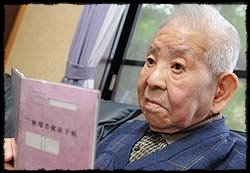
Tsutomu Yamaguchi As weird as it may seem, there were actually 165 people who got blasted twice when the U.S. dropped nuclear bombs in Hiroshima and Nagasaki, Japan, in August, 1945.
A new book by Charles Pellegrino, The Last Train from Hiroshima, tells their remarkable stories. (Dwight Garner gives an excellent review of Pelligrino’s book in the Jan. 19 New York Times)
One of those survivors, Tsutomu Yamaguchi died just a few weeks ago. His obituary and his recollection of his experiences should be read as modern “texts of terror” and studied along side the Prophet Isaiah.
One of Yamaguchi’s conclusions in his long work against nuclear weapons was that the only people who should be allowed to govern countries with nuclear weapons are mothers who are still breast-feeding their babies. An excerpt from his obit is below:
Tsutomu Yamaguchi, the only official survivor of both atomic blasts to hit Japan in World War II, died Monday in Nagasaki, Japan. He was 93. The cause was stomach cancer, his family said.
Mr. Yamaguchi, as a 29-year-old engineer for Mitsubishi Heavy Industries, was in Hiroshima on a business trip when the United States dropped the first atomic bomb on the morning of Aug. 6, 1945. He was getting off a streetcar when the so-called Little Boy device detonated above the city.
Mr. Yamaguchi said he was less than two miles away from ground zero that day. His eardrums were ruptured, and his upper torso was burned by the blast, which destroyed most of the city’s buildings and killed 80,000 people.
Mr. Yamaguchi spent the night in a Hiroshima bomb shelter and returned to Nagasaki, his hometown, the following day, according to interviews he gave over the years. The second bomb, known as Fat Man, was dropped on Nagasaki on Aug. 9, killing 70,000 people.
Mr. Yamaguchi was in his Nagasaki office, telling his boss about the Hiroshima blast, when “suddenly the same white light filled the room,” he said in an interview last March with the British newspaper The Independent.
“I thought the mushroom cloud had followed me from Hiroshima,” he said.
Read Yamaguchi’s whole obituary here. Also read Yamaguchi’s first-person account How I survived Hiroshima–and then Nagasaki by David McNeill.
-
Wallis: It’s Time to Fire Your Bank!
I was glad to see Sojourners‘ Jim Wallis on The Daily Show with Jon Stewart last night! The Sojo folks coined the phrase “It’s time to fire your bank!” and Stewart seemed to really like the concept!
The Daily Show With Jon Stewart Mon – Thurs 11p / 10c Jim Wallis http://media.mtvnservices.com/mgid:cms:item:comedycentral.com:262430 Daily Show
Full EpisodesPolitical Humor Health Care Crisis I like Wallis’ quip referring to father of capitalism Adam Smith from The Theory of Moral Sentiments and also the economic analysis of excessive capitalism from Austrian economist Joseph Schumpeter:
“What happens when ‘the invisible hand’ lets go of the common good? Adam Smith says without a moral framework the market really can’t function properly, and Schumpeter, the Austrian economist, said, ‘When there’s no ethical sensibility, the market ends up devouring every other sector and finally ends up devouring itself.’”
-
Murder Most Vile: The Guantanamo “Suicides”
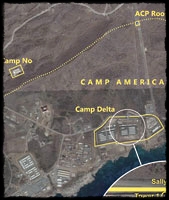 From Jan. 11 – Jan. 22, Witness Against Torture is fasting, vigiling, and occasionally committing civil disobedience in various venues around Washington, D.C., to hold President Obama to his promise to close the extra-judicial prison camp at Guantánamo Bay and investigate torture by U.S. military, U.S. intelligence organizations, and U.S. defense sub-contractors.
In the midst of this, Scott Horton’s mind-blowing expose on the Guantánamo prisoner “suicides” that occurred in 2006 was finally published in the March 2010 issue of Harper’s. Here’s the opening:
The Guantánamo “Suicides”: A Camp Delta sergeant blows the whistle
When President Barack Obama took office last year, he promised to “restore the standards of due process and the core constitutional values that have made this country great.” Toward that end, the president issued an executive order declaring that the extra-constitutional prison camp at Guantánamo Naval Base “shall be closed as soon as practicable, and no later than one year from the date of this order.” Obama has failed to fulfill his promise. Some prisoners there are being charged with crimes, others released, but the date for closing the camp seems to recede steadily into the future. Furthermore, new evidence now emerging may entangle Obama’s young administration with crimes that occurred during the George W. Bush presidency, evidence that suggests the current administration failed to investigate seriously—and may even have continued—a cover-up of the possible homicides of three prisoners at Guantánamo in 2006.(Read the whole story here.)
Horton had barely released his damning account of homicides of prisoners at Camp Delta and the extensive cover up when The Official Response began gearing up in the media.
Colonel Michael Bumgarner, the former Camp America commander who has testified that the deaths of the three prisoners were suicides, commented to Associated Press reporter Pete Yost, “this blatant misrepresentation of the truth infuriates me” (Magazine Raises Questions Over 3 Detainee Deaths.) And the Justice Department is coming down with double-speak too.
But Horton isn’t backing down. For every counter-attack from the military and defense department, he just posts more evidence up at Harper’s. You can watch Horton’s interview with Keith Olbermann here.
I hate to go all 1990s on you, but “This is what democracy looks like.”
-
Mary Ward: Leader, Heretic, Saint
 When I was a senior at Loretto High school, a Catholic girls school run by the IBVM sisters in Sacramento, I was awarded the Mary Ward Leadership medal for “outstanding commitment to social justice.” I was honored by the award. It had never been given before. But I really didn’t know who Mary Ward was. Since then I’ve learned a little more and am oddly comforted by her story.
Mary Ward has just reached the first step toward official church sainthood (she’s “venerable” right now) and there’s a celebration of her at Westminster Cathedral next weekend. The IBVM’s (Ward is their foundress) are celebrating their 400th anniversary. Here’s a little exerpt about her life:
Mary Ward was a Yorkshire woman who, at a time of severe repression of Roman Catholics in England, felt called by God to found a congregation of religious sisters on the model of the Jesuits (Society of Jesus). Her vision was for a non-enclosed order of religious sisters who might serve their faith actively as educators and missionaries across Europe, set free from the restrictions of monastic life as the Jesuits were. In an era when women were considered intellectually and morally incapable of doing good for themselves, let alone for others, Mary soon came into conflict with the Papal authorities.
Having founded a community of sisters in St Omer in Flanders in 1609, Mary was initially allowed to open schools across Europe without restriction and continued to secretly assist persecuted Catholics in Protestant England. Her Order of ‘English Ladies’ considered itself directly answerable to the Pope without other intervening male authority. But when Mary travelled to Rome to seek Papal recognition for her congregation of so-called ‘Jesuitesses’, Pope Urban VIII ruled against her refusal of enclosure and imprisoned her as a heretic.
Despite centuries of struggle in a Church and a world unprepared for Mary Ward’s pioneering vision, her sisters today are fulfilling her dream of apostolic service and opportunities for women all over the world.
Read more about her here.
Mary Ward’s birthday is January 23rd.
Born in 1585, into a family of Yorkshire recusants, outlaw Catholics refusing to conform to the state religion, she was condemned to death in London for her work among underground Catholics. Mary fled to the continent with a group of companions in 1609, believing herself called to start a religious order for women modelled on the mobility and missionary focus of the Jesuits, while remaining independent from them. This contradicted the Council of Trent’s insistence that religious women be strictly enclosed.
In a society and a church unprepared for such emancipation, she taught that ‘there is no such difference between men and women, that women may not do great things’. Dubbed ‘The English Ladies’, Mary Ward and her sisters founded communities and schools across Europe. Mary walked over the Alps to Rome amid the Thirty Years War and outbreaks of plague, to present her new plan to the Pope. Her repeated attempts to persuade him failed, and the fledgling congregation was suppressed as a risk to the moral and intellectual fragility of women. Mary was imprisoned as a ‘heretic, rebel and schismatic’ in 1631. She died in York in 1645 during the English Civil War surrounded by her few remaining companions, who continued to live the dream of an unenclosed apostolic order for women.
It took nearly 300 years to gain final Papal approval of Mary Ward’s plan. Two branches of the order now exist, living under the full constitutions of the Society of Jesus; the Congregation of Jesus and the Institute of the Blessed Virgin Mary, also known as Loreto sisters.
For more information please visit: www.cjengland.org.
-
Sandra Schneiders: Religious Life is Sharing Jesus’ Passion and Resurrection (Part 5 of 5 with Discussion Questions)
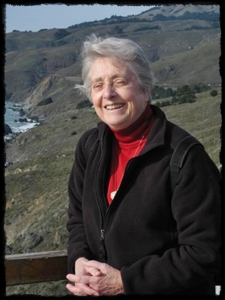 This is part five of a five-part essay by Immaculate Heart of Mary Sr. Sandra Schneiders on the meaning of religious life today. The series is published in the U.S-based National Catholic Reporter. In this part Schneiders, professor of New Testament Studies and Christian Spirituality at the Jesuit School of Theology at Berkeley, offers a conclusion to her essay on prophetic ministry and the nature of true Christian obedience. (See my earlier post on Tom Fox’s interview with Schneiders here, and Part 1, Part 2, Part 3, and Part 4.) The quotes that I highlighted and my set of questions are at the bottom of the post.
Religious Life is Sharing Jesus’ Passion and Resurrection (Part 5 of 5)
We can now see the parallel between the two-level analysis of the execution of Jesus and the two levels of the struggle between U.S. women Religious and the Vatican. At the surface level Jesus was executed to put a stop to his “stirring up the people” which threatened the status quo of the Empire and the Temple. But at the deepest level, although “they knew not what they were doing,” the officials were trying to neutralize the radical revolution Jesus was introducing into their “world.” Jesus was initiating, by his prophetic words and works, a “new creation,” totally at odds with the satanic domination systems in power not only in political and religious institutions but in the human race as a whole. He was inaugurating and inviting people into the Reign of God, into a regime of endless and unconditioned compassion that would overflow into and empower a new form of justice based not on retribution and coercive power but on forgiveness of sins and inclusion in the all-embracing love of God. The Resurrection was God’s “yes” to Jesus’ work and “no” to the murder that tried to stop it.
Since Jesus, the Reign of God is “loose” in this world, working its painful way through the witness of saints and martyrs toward its full eschatological realization. The “powers” of this world are still at work to prevent this realization but, as Jesus said to his disciples on the eve of his death, “Have confidence; I have overcome the world.”
When we get down to the deeper levels of the question with which this essay began, “Why are Religious, of all people, being investigated by the Vatican?” we can discern the same two levels. At the surface level Religious are being threatened because they have been “upsetting the (patriarchal) order” of the Church as institution in which the hierarchy has its position of power. But they are calling into question not only absolute male power over women (which was not invented by and is not restricted to the Church) but also the necessity of understanding the Church itself as essentially an institution based on sacralized power. Religious, by their community life, are aligning themselves with the ecclesiology of the Church as People of God expressed in Lumen Gentium, a discipleship of equals, within which they are both exemplars and facilitators but also in solidarity with those to whom they no longer wish to be “superior” or “elite.” They are gratefully living among their lay sisters and brothers the oneness of the Body of Christ. This ecclesiology is no threat to the community Jesus gathered around him but it is a threat to an understanding of Church as a sacralized empire. It goes back to Jesus, not to Constantine.
But this Body of Christ, which we are, exists not just for the Church itself but for the world which God so loved. It is not a place of privilege or power, a sanctuary of the perfect, but the effective presence of Christ in the world in service of all those for whom Jesus died and rose. This is the vision of the Church in the world that came to marvelous expression in Gaudium et Spes.
The struggle between Religious and the hierarchy is really, at its core, a struggle over the nature of Religious Life itself which is necessarily determined by how one understands the Church in its relation to the world. Is this life a job corps of submissive workers carrying out hierarchically assigned and supervised institutional Church tasks designed to bring all people into the Roman Catholic Church and into subjection to its leadership? Or is Religious Life a charismatically grounded, prophetic life form in the Church called by God to the ever ambiguous task of discerning how the Gospel, the good news of the Reign of God, can be made salvifically operative in the concrete and confusing situations in which believers must live their Christ-life today in witness to all peoples of the infinite loving-kindness of our God?
-
Slide Show: Embassy of Haiti on Sunday
On Sunday, the Embassy of Haiti in Washington, D.C., put out a call for supplies to send to Haiti in the wake of the earthquake. Here’s a short slide show of my visit to the Embassy. For my Prayer for Haiti, go here.
-
Sr. Sandra Schneiders: What Marks a Prophetic Lifestyle? (Part 4 of 5 with Discussion Questions)
This is part four of a five-part essay by Immaculate Heart of Mary Sr. Sandra Schneiders on the meaning of religious life today. The series is published in the U.S-based National Catholic Reporter. In this part Schneiders, professor of New Testament Studies and Christian Spirituality at the Jesuit School of Theology at Berkeley, explores the tasks of those who choose to live a prophetic life. Religious life, says Schneiders, has been called a prophetic life form both in official documents and in spiritual writing almost since its inception. The meaning of this affirmation, however, is often unrealistically romanticized or left so piously vague as to be useless. (See my earlier post on Tom Fox’s interview with Schneiders here, and Part 1, Part 2, and Part 3.) The quotes that I highlighted and my set of questions are at the bottom of the post.Tasks of those who choose the prophetic life style (Part 4 of 5)
Crucial Distinctions
Religious Life has been called a prophetic life form both in official documents and in spiritual writing almost since its inception. The meaning of this affirmation, however, is often unrealistically romanticized or left so piously vague as to be useless. In the current situation [Vatican investigation of American Catholic sisters] in which the nature of ministerial religious life as a prophetic life form in the Church is in public contention it would be helpful for us, as a church in general and as religious in particular, to clarify the meaning of this affirmation.
First, it is the life form, not the individual religious, that is characterized as “prophetic.” Just as entrance into an enclosed monastic community (often called a “contemplative order”) does not make one a contemplative, and there are many genuine contemplatives who do not enter monasteries, so entering religious Life does not make one a prophet and there are many prophetic figures who do not enter religious Life. However, different life forms in the Church offer corporate witness (corporate as in “organic,” not as in “corporation”) to particular dimensions of Christian life in which all the baptized are called to participate. All are called to contemplation, to fidelity and fruitfulness, to prophetic witness. But certain life forms, such as enclosed monastic life, matrimony, or ministerial religious life raise one or another of these dimensions to particular visibility by their corporate living of this charism. So what follows makes no claims that all ministerial religious are prophets or that religious life has any monopoly on the charism of prophecy in the Church.
However, the life form as corporate witness to the charism of prophecy does (or should) explicitly challenge its individual members to the exercise of this charism and empower, support, and promote their fidelity to this charism. The felt call to prophetic ministry and the gifts of spirit, mind, and heart for the exercise of such ministry, therefore, should be factors in discerning a vocation to religious life.
At certain times in its history, religious life has been so caught up in a hyper-institutionalized and over-clericalized understanding of Church and ministry, and of itself in that framework, that many Congregations lost sight of this vocational criterion. They preferred candidates who were compliant and docile. The less experienced and competent, the more girlishly romantic about their calling, that they were at entrance, the better, since they were more easily “formed” for submission. Most congregations today prefer candidates who have a sturdy sense of self developed through education and work experience and sufficient maturity to live and work well outside a “total institution” environment. Such candidates are more likely to grow into a truly prophetic ministerial identity and spirituality.
Second, some can be tempted to label “prophetic” any kind of protest that is extreme, conspicuous, or stubborn, or to claim the title of “prophet” for anyone whose ideas or behavior are questioned by authority, no matter how reasonably. The truly prophetic are typically very reluctant to call themselves prophets. They know well their fear in the face of conflict and the high cost of putting themselves in the line of fire of angry officials. Furthermore, they recognize the need to receive seriously and incorporate responsibly institutional authority’s positions and concerns into any discernment that influences other people, in or outside the Church. Again, discerning between the genuinely prophetic stance and mob fanaticism, between courage and arrogance can be very difficult. It requires prayer, communal consultation, testing, and a humble willingness to consider seriously all reasonable and respectful disagreement with one’s position.
The Inaugural Vision or Prophetic Call
Religious life begins, both corporately and individually, in an experience analogous to the inaugural vision of the Old Testament prophets and of Jesus himself. Although the literary form of the biblical narratives of prophetic calls convey the substance but not necessarily the historical details of these experiences, all these texts indicate that the prophetic vocation is not undertaken on one’s own initiative. Nor is one appointed to it by human beings. The call comes from God, often to one who feels frightened, unworthy, or incompetent. Even Jesus is clearly sobered by the dimensions and evident dangers of the life to which he is called. God’s call to him is powerful and compelling, but Satan’s opposition is both real and dangerous.
Religious orders begin, typically, in the charismatic experience of one or more founders who feel impelled to give themselves to God and God’s work, almost always in response to some historically pressing need. Subsequent members respond to a personal call to join the founders in this divinely-originated enterprise. The ensuing process of mutual discernment for later candidates is designed to test the “fit” between the prospective member, the foundational charism, and the historical shape that the order has taken since its founding.
Religious orders, then, are not the creations of the ecclesiastical institution (although it makes certain regulatory provisions regarding the living of the life, approves rules, and exercises some supervisory or protective functions in regard to approved institutes [L.G. VI, 45]), any more than the Old Testament prophets were appointed by Israel’s kings or priests or Jesus by the Temple officials. In fact, those who functioned as “court prophets,” who “worked for” the king or priests by telling them what they wanted to hear or leading the people to submit to their rulers when God spoke differently through the true prophets or “the signs of the times,” were quintessentially “false prophets.”
Religious Life, then, is a charismatic life form, called into existence by the Holy Spirit, to live corporately the prophetic charism in the Church. It is not a work force gathering recruits for ecclesiastical projects and it does not receive its mission nor the particular ministries of its members from the hierarchy. Congregations, in the exercise of particular ministries within dioceses or parishes, are bound by the applicable local directives and must work collaboratively with the ordained leadership. But this does not put the Congregation or its members “under” the bishop or clergy. This is especially true of “exempt” Congregations which minister across ecclesiastical boundaries.
When members of the hierarchy get panicky about the decline in numbers of religious they reveal a serious misunderstanding of the nature of the life. No Congregation “needs” more members than are actually called to it by God. There is no optimal or minimum size for orders or length of their lifespan. Some orders have never had more than a few dozen members and others have thousands. Some are centuries old and others have had a very brief history. The purpose of the life is not to perpetuate particular Congregations nor to staff Church institutions; it is to live intensely the witness to the Gospel to which the Congregation is called and for as long as it is so called. As long as an order and its members are able to live religious life according to its own founding charism and approved constitutions intrusion by ecclesiastical authority into its internal affairs is not only unwarranted; it is unjustifiable and counter-productive (see e.g., Canon 586).
-
Sr. Sandra Schneiders: What’s Prophetic Ministry (Part 3 of 5 with Discussion Questions)
I got a little behind in this Sandra Schneiders’ series due to the earthquake in Haiti, but now I’m back on track. This is part three of a five-part essay by Immaculate Heart of Mary Sr. Sandra Schneiders on the meaning of religious life today. The series is published in the U.S-based National Catholic Reporter.In this part Schneiders, professor of New Testament Studies and Christian Spirituality at the Jesuit School of Theology at Berkeley, explores Jesus’ life out of which his prophetic ministry flowed. One asks: Is it a realistic model for the life of ministerial religious today? If so, what are the implications of the prophetic character of religious life for the behavior of religious in ministry and in relation to church hierarchy? (See my earlier post on Tom Fox’s interview with Schneiders here, and Part 1, and Part 2.) The quotes that I highlighted and my set of questions are at the bottom of the post.
What Jesus taught us about his prophetic ministry (Part 3 of 5)
The Prophet’s Life
We turn now to Jesus’ life out of which his prophetic ministry flowed. Is it a realistic model for the life of ministerial religious today? If so, what are the implications of the prophetic character of religious life for the behavior of religious in ministry and in relation to the hierarchy?First, Jesus’ prophetic vocation was rooted in and expressive of his mystical life, the intense contemplative prayer life that the Gospels present as the root of his experiential knowledge of God. He not only took part in Jewish vocal prayer and liturgy (e.g., see Lk. 4:16; Mt. 26:17) . He spent long periods — whole nights (Lk. 6:12), hours before dawn (Mk. 1:35), times of decision making (Lk. 6:12-13) and anguish (see Mk. 14:32-42), and, at least once, “40 days” — in prayer to God (see Mk. 1:13 and pars.). Jesus not only knew about God; he knew God intimately. He experienced God as his “Abba” (Mk. 14:36), his loving parent, from whom he drew his own identity, and whose project was his own. In John’s Gospel Jesus speaks of being “one” with God (Jn. 10:30) whose words he speaks and whose works he does (see Jn. 14:10).
The prophet’s direct and immediate experience of God is the root of her or his words and actions. But this activity is often enough critical of or even in opposition to the positions of the legitimate ecclesiastical authorities who are usually presented as, and in fact are, God’s institutional representatives. Jesus’ confrontation with the officials over the woman taken in adultery was not an isolated case. He was frequently in heated conflict with the hierarchy.
We can be tempted to think that such opposition to institutional authority was fine for Jesus in relation to the Jerusalem hierarchy in the first century but not for us in relation to ecclesiastical authority in our own time. Jesus, after all, was God so he knew all the right answers. And the Jerusalem hierarchy was degenerate and filled with evil hypocrites.
To sanitize (and even trivialize) Jesus’ prophetic ministry in this way is to miss the point entirely. Jesus did not claim personal divine authority when he acted prophetically in relation to the religious institution. He claimed to be speaking for God, not as God. And it is important to note that his adversaries were claiming exactly the same thing, that is, to be God’s official representatives to the people which, in fact, they were. They actually had the ecclesiastical authority of office on their side, which Jesus did not because he was not a priest, an elder, a scribe, or any other kind of religious official.
Jesus had prophetic credibility among the people because he “spoke with authority,” precisely not as the scribes, that is, not by virtue of institutional position nor backed up by texts (see Mk. 1:27; Mt. 7:29). He spoke “like no other person ever has” (cf. Jn. 7:45-46). It was not because he was God in thin disguise or because he was credentialed by the religious establishment, but because his truth telling, despite overwhelming personal threat when what he said and did ran counter to what the laws or the officials required, manifested to the people that he was indeed representing the true God. Only later, only after the Resurrection, did they realize that this “prophet, mighty in word and work,” was indeed the Son of God. During his public life, his authority flowed from what he did and said. No one can confer, and no one can “claim,” moral authority. It belongs only to one earns it. Jesus was powerfully, personally authoritative and that is why he was recognized as a prophet.
Furthermore, the religious officials of Jesus’ time were no more wicked, hypocritical, oppressive, immoral, or corrupt than officials of state and Church in other ages. They had the same status among their contemporaries as do our legislators, priests and bishops, presidents and popes. The presumption of legitimacy and competence was theirs by virtue of their office. The officials Jesus confronted were not wearing signs saying embezzler, hypocrite, pedophile, adulterer, pornographer, so that anyone looking at them would know that Jesus was certainly right to call them to account. Jesus was seeing in them, in their teaching and their behavior, what his contemporaries, like so many of us when we deal with people in high places, were conditioned not to see, or were afraid to name. And he bore witness, at risk of his life, to what he saw.
The problem for Jesus’ contemporaries was the same as ours today. How are we to judge between voices competing for our acceptance? How do we recognize the prophet, the one who “speaks for God?” Obviously, as the horror of the Holocaust made clear for all time, it is profoundly immoral to uncritically “follow orders” simply because they come from someone in authority. Jesus warned his contemporaries to beware of the official teachers, of the priests and elders and Pharisees who “sit in the chair of Moses” but are hypocrites (see Mt. 23:1-5), whited sepulchers (see Mt. 23:27), self-serving oppressors of the poor in the name of God.
There were, of course, sincere men among the ecclesiastical officials of Jesus’ time, like Nicodemus (Jn. 3, 7, 19); and the scribe who was “not far from the kingdom of God” (Mk. 12:28-39). But there were many others, like Caiaphas (Jn. 11:49-50 with 18:14), who were “the blind leading the blind” (see Mt. 15:10-14). We face the same challenge today. There are many men of integrity, holiness, and compassion holding office in the Church. But popes can be wrong, even culpably so; bishops can be criminals; priests can be embezzlers or sexual predators. One thing is certain: hierarchical status, office in the Church, is no guarantee that the speaker or his message comes from God. An office holder may be prophetic, or a prophet may hold office, but the two charisms as such do not imply each other. And history suggests that there is virtually always tension, if not opposition, between institutional and prophetic authority.
Besides an intense life of prayer which unites the prophet to God, was extraordinarily “unattached,” not only inwardly, but even in his personal lifestyle. By his own choice, he had no family to provide for or to protect. He owned no personal property that he could lose. He held no official position of power, political or ecclesiastical, that his actions could jeopardize.
Of course, family, property, and power are not necessarily impediments to prophetic freedom. Like St. Thomas More, many people in high places, with much to protect personally, professionally, and politically, have given their lives in witness to the truth. But being without such attachments is a bulwark of prophetic freedom simply because it makes it easier to “hear,” without distortion from one’s own inner voices or outer demands, the voices that are relevant to the issues one must discern. With less “static” from legitimate competing interests the prophet can more easily listen full-time, with all his or her attention, for the truth to which witness is required, the truth that must be done regardless of orders to the contrary. Discernment based on attentive listening, not submission to the will of another, is the essence of prophetic obedience.
Third, a major and non-negotiable criterion of the true prophet is the coherence between the prophet’s message and the prophet’s life. The more insensitive one is to the devastation one’s teaching or legislating causes in the lives of real people, the more willing one is to “stone the sinner” in order to bolster official authority and guard public morality, the more likely it is that, no matter how highly placed, one is a “blind guide,” one of those Jesus described who “tie up heavy burdens, hard to bear, and lay them on the shoulders of others; while they themselves are unwilling to lift a finger to move them” (Mt. 23:4). Rosa Parks and Nelson Mandela were willing to pay the price for their witness for racial justice. Jesus defending the woman taken in adultery was risking his life for hers. Witness to the truth is never comfortable or self-aggrandizing for the true prophet, and the risks are usually high. “Witness” from the favored side of power is dubiously prophetic.
The issue that emerges as central when the prophetic charism conflicts with institutional authority is precisely the one operative in much of the current struggle between the institutional church and religious, namely, obedience. Can we equate obedience to God with doing what we are told by people who hold office? And can we submissively abstain from interpreting the present situation in light of the Gospel and responding to the present needs of real people, because those who hold office require that we do so?
We will return to this topic shortly, but, by way of anticipation, it appears from Jesus’ practice and especially from his life that religious obedience cannot be adequately understood or defined as “blind or absolute submission to official authority,” whether to people, teaching, or laws. No matter how highly placed in the religious institution they might be, human beings do not take God’s place in the life of believers. To pretend otherwise is blasphemy on the part of those who claim to do so and idolatry on the part of those who accord to humans the obedience that belongs to God alone. There is no avoiding the challenge and the obligation of discernment and “blind obedience,” i.e., uncritical submission to power, is neither discernment nor obedience. Nor can it ever be a substitute for either.
Coming to grips, in genuine obedience to God, with the tension between their prophetic vocation and the demands of ecclesiastical authority is at the heart of the current struggle between religious and the Vatican. So we turn now to a focused examination of contemporary ministerial religious life against the background of the understanding of Jesus’ prophetic vocation in which religious are called to share.–Sr. Sandra Schneiders
Read the whole series at the National Catholic Reporter.
DISCUSSION
I think this series by Sr. Schneiders offers an important opportunity for serious conversation among all Christians–not just Catholics–on the quality of our life in Christ and our relationship to our church and our world. Below are some quotes from her article and a few questions of my own.–RMB
* “First, Jesus’ prophetic vocation was rooted in and expressive of his mystical life, the intense contemplative prayer life that the Gospels present as the root of his experiential knowledge of God.”
* “[Prophetic] activity is often enough critical of or even in opposition to the positions of the legitimate ecclesiastical authorities who are usually presented as, and in fact are, God’s institutional representatives.”
* “No one can confer, and no one can “claim,” moral authority. It belongs only to one earns it. Jesus was powerfully, personally authoritative and that is why he was recognized as a prophet.”
*”An office holder may be prophetic, or a prophet may hold office, but the two charisms as such do not imply each other. And history suggests that there is virtually always tension, if not opposition, between institutional and prophetic authority.”
* A second requirement of prophetic identity and mission is a certain freedom from attachments which pressure the person to prefer personal or institutional goods, the maintaining of the status quo within which one’s own position and interests are protected, to God’s interests or the good of those to whom one is sent.”
*”Third, a major and non-negotiable criterion of the true prophet is the coherence between the prophet’s message and the prophet’s life.”
* “Uncritical submission to power is neither discernment nor obedience.”
1. Jesus rooted his life in prayer–privately, in community, and in officially religious settings. In what ways do you allow prayer to root your life in and out of “official” church settings? We can assume that Jesus’ “prayer practices” changed over the course of his life. How have yours changed over time? Do you experience prayer as increasing a sense of intimacy with God?
2. In modern society, we have terrible examples of “prophets” who are told by “the voice of God” to commit terrible anti-social acts. What distinctions does Schneiders mention and might you add that help distinguish prophetic ministry from mental illness (to put it bluntly)?
3. Schneiders says that “Jesus did not claim personal divine authority when he acted prophetically in relation to the religious institution.” Do you agree? Do you think Jesus ever doubted whether he was doing the right thing? What questions do you ask yourself when you are compelled to speak out against an established authority?
4. In some Christian traditions, if a person has a vision for a new ministry, that vision must be “confirmed” by 3 others before it is considered a legitimate ministry of the church. Schneiders implies that Jesus’ prophetic word was “confirmed” because the people heard it as “truth,” as full of “authority.” When have you heard someone speak who you felt immediately had touched on a deep truth that you needed to hear? How did you respond? What actions did you take?
5. Schneiders says prayer, unattachment, and integrity of life and word are hallmarks of prophetic ministry.How are these elements balanced in the life of a prophetic community, not just an individual?
6. Post-Watergate/post-Vietnam era Americans have had experiences that make them very skeptical of authority. The post-9/11 generations often see authority as the only thing protecting them from forces of chaos. How do generational or psychosocial differences influence “prophetic action”? For those in institutional leadership, how do they view “prophetic action”? Can you act prophetically from “within” the system?
-
Subscribe
Subscribed
Have a WordPress.com account? Log in now.

