-
Poetry: ‘For Lucille Clifton’ by Joseph Ross
 I had coffee this morning with my friend Joseph Ross. We were discussing attending poet Lucille Clifton’s memorial service in April and he said he’d written a poem for her.
When Clifton won the prestigious Ruth Lily Poetry Prize in 2007, the judges remarked that “One always feels the looming humaneness around Lucille Clifton’s poems—it is a moral quality that some poets have and some don’t.”
Speaking to Michael S. Glaser during an interview in 2000 for the Antioch Review, Clifton reflected that she continued to write, because “writing is a way of continuing to hope … perhaps for me it is a way of remembering I am not alone.” How would Clifton like to be remembered? Glaser asked. “I would like to be seen as a woman whose roots go back to Africa, who tried to honor being human. My inclination is to try to help.”
Read Joe’s stunning tribute to one of our great American poets below.
For Lucille Clifton, 1936-2010
She insisted on breathing in
the defiant air
of her own survival.She sailed through waters
more angry than blue,
waters that swirledwith the probing hands of others,
touching places where
only words belonged.She found a vision
that saw through sadness
and a voice for calling outto every waiting fear.
Her vision and voice
lifted her from the humid streetinto canyons of night sky
to teach her the given name
of each anonymous anger.And still, she washes us
in a sacred spray of stars,
making us holy.And still, she sails,
carrying us in the carved-out
canoe of her womb,whispering to us
the final message:
that we too can breatheand be both
the blessing and the boat.–by Joseph Ross
Read my earlier post about Lucille Clifton.
-
Support Strong For American Catholic Sisters

Sr. Dolorosa Bundy I was very happy to see that both the Sacramento and Portland-OR Catholic newspapers printed the letter below in support of American Catholic sisters and asking the Vatican to discontinue its investigation.
I was doubly happy that this letter was written by my own parents! In addition to themselves as signatories, 30 others also signed in support.
Any Thought Given to a Year for Women Religious?
To the Catholic Sentinel (Portland, OR):When Pope Benedict proclaimed the year for priests, the Vatican began an investigation of American Catholic Sisters. The investigation lacks collegiality, subsidiarity and transparency, core values of the Vatican II Council. The investigation is an insult to the Sisters and to American Catholic lay people.
American Religious women, in struggling with the needed reforms from Vatican II, offered vision in examining our Catholic Christian roots. They instilled their charisms of faith, vision and courage and empowered us all to be advocates for peace and justice. They became our witnesses of discipleship and faithfulness. They, too, truly deserve our gratitude and support.
The emphasis from Rome, “Praise the Priests, Investigate the Sisters” illustrates the disparity in our church.We have much to be thankful for the good and faithful priests who bring us the Eucharist. They deserve our fullest appreciation.
They are reeling from the sordid actions of a few, about 4.5 percent over the past 50 years, including bishops, who perpetrated and covered up the scandals. Financial settlements have cost dioceses, American Catholics, and their insurance companies $1 billion.
The Sisters and we lay people deserve better. We pray the Pope will cancel the investigation of the American Religious women and proclaim a Year of the Sisters.
John and Barbara Berger
Sacramento, Calif. -
Are You a Capriphile or a Caprichaun?: Sci-Fi, Ethics, and Religion
 “Some commentators have proposed ‘science fiction’ as the last fictional repository for theological speculation,” wrote Margaret Atwood a few years ago. “Heaven, Hell, and aerial transport by means of wings having been more or less abandoned after Milton, outer space was the only remaining neighborhood where beings resembling gods, angels, and demons might still be found.” (Read Margaret Atwood’s literary history of sci fi here.)
Caprica, the new sci fi TV series in the Battlestar Galactica lineage, is the latest brilliant playground of ethics, theology, and social gumbo on the small screen. After watching the first few episodes, I can confirm that I’m definitely a Capriphile or a Caprichaun or a Capricaner or whatever Caprica fans end up calling ourselves. Apparently, I’m not alone.
Over at Religion Dispatches, commentators Diane Winston, Anthea Butler, Salman Hameed, and Henry Jenkins are blogging on each Caprica episode under a series titled Capricology. The mix of commentators is great in itself. Winston holds the Knight Chair in Media and Religion. Butler is an associate professor of religion at the University of Pennsylvania. Halmeed is an astronomer who also writes about Muslims and science. Jenkins is the Provost’s Professor of Communication, Journalism, and Cinematic Arts at USC.
They’re covering the cultural intersection of science and religion as well as the interwoven commentary on the body, artificial intelligence, paganism, original sin, immigration, and race. Here are some excerpts from their posts on Caprica‘s first episode:Whereas most TV dramas are good guys versus bad guys, BSG and Caprica probe the passions that enliven us. The pull of temptation, the cost of obsession, the slog to redemption (yes, yes, and yes) and then the biggest question of all: Do you need to be a carbon-based life form to own and feel these? Teetering between “must-see TV” and bloated soap opera, BSG worked because the melodrama was grounded in the quotidian: model ships, dog tags, and toothbrushes. Now with all the imaginable artifacts that could draw us into Caprica’s odd collision of machines, mobsters, and monotheists, a newspaper—with ball scores, stock prices, and local weather makes it all so mundane, masking (as our own newspapers tend to do) the real stakes behind the stories.–Diane Winston
I was most taken though by the plight of Adama’s daughter, who is brought back from the dead not through an act of self-creation but against her will; who is inserted into an empty world, a purgatory space, which she doesn’t recognize and understand, and is abandoned there, treated as an unnatural abomination, as a monster, by her own father and forgotten by the man who created her. (Shades of Frankenstein, but also some suggestions here of Buffy the Vampire Slayer, the series Jane Espenson worked for before Caprica, where Buffy’s friends bring her back from the dead, like Lazarus, and she finds herself experiencing deep pain and trauma at being ripped from paradise and plunged back into our imperfect world. In fact, Espenson wrote “After Life,” a key episode in the exploration of this theme in Buffy. I hope the series will explore more fully what happens to this girl and how her experiences differ from Zoe’s.)–Henry Jenkins
The real genius of Caprica will be the weekly mind game Ron Moore and his crew are going to play with us about when life begins, and ends. Does life continue after physical “death,” and if life is not in a human body, is it really “human” after all? How does a new religious movement gain followers? What are the moral and ethical implications of a society that has lost its moral center and stokes its fear by creating the ultimate “protection force” that will eventually obliterate its creators? Most importantly, what does it mean to have a body? And how do you use it?–Anthea ButlerA belief in some sort of afterlife is central to many religions and it may have been pivotal in the origins of religions in the first place. How will this play out on Caprica, where the boundaries between what is alive and what is not are already getting quite blurry? Does it shape monotheism or polytheism in a particular direction? In addition to all this, we have the monomania (as Diane calls it) of Daniel Greystone that is leading him to create his own version of life-after-death—and the cost that humans will eventually end up paying 58 years later. As Henry pointed out with a comparison with Buffy, the issue of life after death is a fertile area of exploration for this series, alongside the psyche of suicide bombers.–Salman HameedRead more from Capricology: Television, Tech, and the Sacred.
-
Lucille Clifton: Both ‘Blessing’ and ‘Boat’
 I was laying in my “healing bed” on Saturday when I got the end of a radio news report saying that the “famed poet had died at Johns Hopkins Hospital in Baltimore.” I missed the name. I was praying it wasn’t Lucille Clifton … but I knew that it was. I said my prayers as best I could to send her on her way.
I remember being on retreat with the poet Denise Levertov and she introduced us to a set of “Mary” poems based loosely on Jesus’ mother that I was completely unfamiliar with. The voice in them was astonishing with its crafty strength. They were all by Lucille Clifton. Here’s one of them:
Island Mary
after the all been done and i
one old creature carried on
another creature’s back, i wonder
could i have fought these thing?
surrounded by no son of mine save
old men calling Mother like in the tale
the astrologer tell, i wonder
could i have walk away when voices
singing in my sleep? i one old woman.
always i seem to worrying now for
another young girl asleep
in the plain evening.
what song around her ear?
what star still choosing?I’m grateful to my friend Joseph Ross for his wonderful reflection on Ms. Clifton’s life and work. Here’s an excerpt from Joe’s piece:
She was both the blessing and the boat. She was the book and the light. Lucille Clifton, a remarkable American poet has died. It is time indeed for a moment of silence. Close the books. Dim the lights. Stop walking. Be still in honor of a great life, a great poet.
At the age of 73, Lucille Clifton died today at Johns Hopkins Hospital in Baltimore. Born in Depew, New York, in 1936, she lived in Columbia, Maryland and was a longtime distinguished professor at Saint Mary’s College of Maryland. Lucille Clifton’s poetry won many honors including a Lilly Prize, nominations for the Pulitzer Prize, and the National Book Award in 2001 for “Blessing the Boats,” a book which I proudly say, changed my life.
In my many years of teaching, I have used Lucille Clifton’s poetry to teach creative writing to high school students, graduate students, college students, and prisoners on death row. Her poetry, so simple, yet crafted in stunning ways, could reach everyone. She could take your breath away in twelve lines.
Read Joe’s whole piece here. Read Ms. Clifton’s obituary in the Baltimore Sun.
-
Claire Keegan: Ireland’s Leading Short Story Writer
 I was lucky enough to attend a seminar a few years ago with the amazing Irish short story writer Claire Keegan. While I was studying in Ireland, she gave our group a crash course on “timing” in short story writing. It was the most brilliant and concise teaching I’ve ever received.
When we concluded the day, she left us with a great encouragement. “Meet all kinds of people,” she said. “It really does have a civilizing effect because people will tell you things about yourself from their perspective. It’s an act of love, really.”
Claire, author of the collections Antarctica and Walk the Blue Fields, has a short story in the most recent New Yorker. “Foster” won the Davy Byrnes Irish Writing Award 2009. Read a slice of it below:
Early on a Sunday, after first Mass in Clonegal, my father, instead of taking me home, drives deep into Wexford toward the coast, where my mother’s people came from. It is a hot August day, bright, with patches of shade and greenish sudden light along the road. We pass through the village of Shillelagh, where my father lost our red shorthorn in a game of forty-five, and on past the mart in Carnew, where the man who won her sold her not long afterward. My father throws his hat on the passenger seat, winds down the window, and smokes. I shake the plaits out of my hair and lie flat on the back seat, looking up through the rear window. I wonder what it will be like, this place belonging to the Kinsellas. I see a tall woman standing over me, making me drink milk still hot from the cow. I see another, less likely version of her, in an apron, pouring pancake batter into a frying pan, asking would I like another, the way my mother sometimes does when she is in good humor. The man will be her size. He will take me to town on the tractor and buy me red lemonade and crisps. Or he’ll make me clean out sheds and pick stones and pull ragweed and docks out of the fields. I wonder if they live in an old farmhouse or a new bungalow, whether they will have an outhouse or an indoor bathroom, with a toilet and running water.
An age, it seems, passes before the car slows and turns in to a tarred, narrow lane, then slams over the metal bars of a cattle grid. On either side, thick hedges are trimmed square. At the end of the lane, there’s a white house with trees whose limbs are trailing the ground.
“Da,” I say. “The trees.”
“What about them?”
“They’re sick,” I say.
“They’re weeping willows,” he says, and clears his throat.
Read Foster by Claire Keegan (The New Yorker, 15 February 2010)
-
Video: Malcolm X Park in Winter and Glimpses of the Beloved Community
Landscape artist and resident of D.C.’s Mount Pleasant neighborhood Aaron Leavy pointed me toward this great video of from the Great Blizzard of 2010. This one was filmed at Malcolm X Park (also known as Meridian Hill) last Saturday. Says Aaron, “It’s just delightful. It’s joyous. I just loved it!”
Washington, DC Snow Storm from Es Video! on Vimeo. The video was done by local photographers Nathan Golon and Jordan Ganz.
I’ve written about Malcolm X Park in my forthcoming book Who Killed Donte Manning?: The Myth and Story of an American Neighborhood. Here’s an excerpt describing the park in summer!
Now called Malcolm X Park by locals, Meridian Hill is a meeting place for city folks from all different cultures. Salvadorans, Bosnians, and Haitians don’t share a language, but they all know how to play soccer. And the field is almost always in use. On Sunday afternoon in the center of the park there is a drumming circle. About 40 drummers gather and about 100 onlookers. It’s been going on for at least 35 years. They are often joined by members of a professional Nigerian dance troupe who are overjoyed to dance in a public space rather than on a stage for “entertainment.”
This drum and dance circle is a place where people pray with their bodies. They shout out praise. They cry and comfort one another. There is a woman who stands off to the side holding out burning incense. She blesses those who come to her, sometimes including healing touch. There are little kids and elders; gang-bangers and “suits.” There are Rasta guardians who let newcomers know that marijuana and alcohol should not be brought into the circle. People share their picnics with each other; they feed the birds, and put out bowls of water for dogs. When asked why she came here every week, one woman responded, “I need this on Sundays to carry me through Monday.” To me, this drumming circle, high on the Piedmont Fall Line, looks like John’s City of God.
–Rose Marie Berger (Who Killed Donte Manning? Apprentice House Press, 2010)
-
Thomas Merton: The ‘Prayer of the Heart’

I remember once telling a group of Lutheran bishops that their job–and the job of their churches–was not to raise more Christians but to shape and form true human beings. We had an interesting conversation out of that! Merton’s quote below reminds me that “prayer” at it’ most essential is an impulse of the human heart, not part of an equation of dogmatic exchange.
What is the purpose of meditation in the sense of “the prayer of the heart?” In the “prayer of the heart” we seek first of all the deepest ground of our identity in God. We do not reason about dogmas of faith, or “the mysteries.” We seek rather to gain a direct existential grasp, a personal experience of the deepest truths of life and faith, finding ourselves in God’s truth. …Prayer then means yearning for the simple presence of God, for a personal understanding of [God’s] word, for knowledge of [God’s] will and for capacity to hear and obey him.–Thomas Merton
Contemplative Prayer by Thomas Merton (Image Books, 1996, p.67)
-
Peter Lennox: The Origin of ‘Pecking Order’
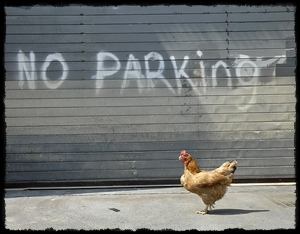 My Dad raised chickens in our suburban Sacramento backyard when I was growing up. Their cluck and brrrr and creak formed a soundtrack outside my bedroom window. Many of our legendary family stories involve a chicken in one way or another.
As urban farming gains in popularity and there are debates in D.C. about whether it’s legal to raise chickens at the White House (How About a White House Chicken Flock?), I found Peter Lennox’s recent article Pecking Order to be funny, wry, informative, and even touching.
In addition, the comments from readers are a great plus. They include many stories on the varying levels of chicken intelligence (“they’re not all the sharpest beaks in the coop”) and one reader concludes she’s much rather spend time with her chickens than most of the management consultants she knows.
Enjoy a quick excerpt below:
Keeping chickens may not be the most efficient way to source eggs, of course, but then it depends on what is being measured. I benefit from eggs, mobile garden ornaments, endless amusement and companionship; I even learn from them. My nine-year-old budding evil-scientist son has learnt that evolution can go down as well as up, and that ground-feeding birds can, over generations, get larger and lose the ability to fly. He also discovered that rigging up a chicken catapult baited with corn can improve individuals’ flying skills, but is not likely to reverse the evolutionary trend and is very likely to get you into trouble. Fair enough: he also learnt to take care of them and understand their preferences and behaviour; he teaches them things, and they patiently go along with it as long as some tasty titbit is part of the deal.
Put that way, keeping chickens is a lot more efficient than driving to the supermarket for eggs of unknown heritage. Ours are great eggs with big golden-orange yolks that sit like perfect hemispheres in the pan. Hardly surprising, as these are gourmand chickens: they eat what we eat (chicken excepted, of course). They like sweetcorn, peas, pasta and rice. They love steak and cooked bacon rind. In the course of evolution, I don’t know where chickens developed a taste for cooked pig. Maybe a freak accident: a bolt of lightning; a forest fire; an unfortunate pig … They also like prawns, salmon, cake and bread, and ironically are rather partial to sage and onion stuffing. They are also fans of strawberries, raspberries, blackberries, gooseberries, carrot tops, cabbage leaves, grass, shoots – especially the ones you’ve just planted. And they turn all this rather efficiently into eggs and excrement.
Read the rest of Peter Lennox’s Pecking Order.
-
Mandela: ‘I Therefore Place the Remaining Years of My Life in Your Hands’
 On the 20th anniversary of Nelson Mandela’s release from prison, I’ve been watching old BBC videos of the news coverage of the original event. It’s inspiring to hear the open-air singing of the hymn Nkosi Sikelel’ iAfrika, which became the anthem of the African National Congress, and to hear Mandela give his first speech after release and give his first interviews to the international media.
I was part of the student movement in the 1980s to force universities to divest from South Africa. Across the U.S., student-led groups eventually forced 55 universities’ Boards of Regents to remove money from companies affiliated with the South African apartheid regime.
I think my first arrest for civil disobedience was on the steps of Sproul Hall at the University of California at Davis in April 1985. There were hundreds of students rallying outside the chancellor’s office–about 25 of us were arrested for sitting down in the doorways and hallways. These were the largest protests the U.C. system had seen since the Vietnam era. Thousands across the campuses were pushing the school to honor the sanctions until South Africa was free. (Similar campaigns are being led now to force schools to divest from Sudan and to not support genocidal regimes.)
I recall my excitement a few years later when I heard Mandela give his first speech. See it below:
Comrades and fellow South Africans, I greet you all in the name of peace, democracy and freedom for all. I stand here before you not as a prophet but as a humble servant of you, the people. Your tireless and heroic sacrifices have made it possible for me to be here today. I therefore place the remaining years of my life in your hands.
On this day of my release, I extend my sincere and warmest gratitude to the millions of my compatriots and those in every corner of the globe who have campaigned tirelessly for my release. I extend special greetings to the people of Cape Town, the city which has been my home for three decades. Your mass marches and other forms of struggle have served as a constant source of strength to all political prisoners.
I salute the African National Congress. It has fulfilled our every expectation In its role as leader of the great march to freedom.
I salute our president, Comrade Oliver Tambo, for leading the ANC even under the most difficult circumstances.
I salute the rank-and-file members of the ANC: You have sacrificed life and limb in the pursuit of the noble cause of our struggle.
I salute combatants of Umkhonto We Sizwe (the ANC’s military wing) who paid the ultimate price for the freedom of all South Africans.
I salute the South African Communist Party for its sterling contribution to the struggle for democracy: You have survived 40 years of unrelenting persecution. The memory of great Communists like Bram Fisher and Moses Mabhida will be cherished for generations to come.
I salute General Secretary Joe Slovo, one of our finest patriots. We are heartened by the fact that the alliance between ourselves and the party remains as strong as it always was.
I salute the United Democratic Front, the National Education Crisis Committee, the South African Youth Congress, the Transvaal and Natal Indian Congresses, and COSATU, and the many other formations of the mass democratic movement.
I also salute the Black Sash and the National Union of South African Students. We note with pride that you have endured as the conscience of white South Africans, even during the darkest days of the history of our struggle. You held the flag of liberty high. The largescale mass mobilization of the past few years is one of the key factors which led to the opening of the final chapter of our struggle.
I extend my greetings to the working class of our country. Your organized strength is the pride of our movement: You remain the most dependable force in the struggle to end exploitation and oppression.
I pay tribute to the many religious communities who carried the campaign for justice forward when the organizations of our people were silenced.
I greet the traditional leaders of our country: Many among you continue to walk in the footsteps of great heroes.
I pay tribute for the endless heroism of youth: You, the young lions, have energized our entire struggle.
I pay tribute to the mothers and wives and sisters of our nation: You are the rock-hard foundation of our struggle. Apartheid has inflicted more pain on you than on anyone else.
On this occasion, we thank the world, we thank the world community for their great contribution to the anti-apartheid struggle. Without your support, our struggle could not have reached this advanced stage.
The sacrifice of the front-line states will be remembered by South Africans forever.
My celebrations will be incomplete without expressing my deep appreciation for the strength that has been given to me during my long and gloomy years in prison by my beloved wife and family. I am convinced that your pain and suffering was far greater than my own.
Before I go any further, I wish to make the point that I intend making only a few preliminary comments at this stage. I will make a more complete statement only after I have had the opportunity to consult with my comrades.
Today, the majority of South Africans, black and white, recognize that apartheid has no future. It has to be ended by our own decisive mass action in order to build peace and security.
The mass campaigns of defiance and other actions of our organizations and people can only culminate in the establishment of democracy.
The apartheid’s destruction on our subcontinent is incalculable. The fabric of family life of millions of my people has been shattered. Millions are homeless and unemployed. Our economy lies in ruins and our people are embroiled in political strife.
Our resort to the armed struggle in 1960 with the formation of the military wing of the ANC (Umkhoto We Sizwe) was a purely defensive action against the violence of apartheid. The factors which necessitated the armed struggle still exist today. We have no option but to continue. We express the hope that a climate conducive to a negotiated settlement would be created soon, so that there may no longer be the need for the armed struggle.
I am a loyal and disciplined member of the African National Congress. I am therefore in full agreement with all of its objectives strategies and tactics.
The need to unite the people of our country is as important a task now as it always has been. No individual leader is able to take all this enormous task on his own. It is our task as leaders to place our views before our organization and to allow the democratic structures to decide on the way forward
On the question of democratic practice, I feel duty-bound to make the point that a leader of the movement is a person who has been democratically elected at a national congress. This is a principle which must be upheld without any exception.
Today, I wish to report to you that my talks with the government have been aimed at normalizing the political situation in the country. We have not yet begun discussing the basic demands of the struggle. I wish to stress that I myself have at no time entered negotiations about the future of our country, except to insist on a meeting between the ANC and the government.
Mr. de Klerk has gone further than any other nationalist president in taking real steps to normalize the situation. However, there are further steps, as outlined in the Harare declaration, that have to be met before negotiations on the basic demands of our people can begin.
I reiterate our call for, inter-alia, the immediate ending of the state of emergency and the freeing of all–and not only some–political prisoners.
Only such a normalized situation, which allows for free political activity, can allow us to consult our people in order to obtain a mandate.
The people need to be consulted on who will negotiate and on the content of such negotiations.
Negotiations cannot take their place above the heads or behind the backs of our people.
It Is our belief that the future of our country can only be determined by a body which is democratically elected on a non-racial basis.
Negotiations on the dismantling of apartheid will have to address the overwhelming demands of our people for a democratic, non-racial and unitary South Africa.
There must be an end to white monopoly on political power and a fundamental restructuring of our political and economic systems to ensure that the inequalities of apartheid are addressed, and our society thoroughly democratized.
It must be added that Mr. de Klerk himself is a man of integrity who is acutely aware of the dangers of a public figure not honoring his undertaking.
But as an organization, we base our policy and our strategy on the harsh reality we are faced with, and this reality is that we are still suffering under the policies of the nationalist government.
Our struggle has reached a decisive moment: We call on our people to seize this moment, so that the process toward democracy Is rapid and uninterrupted.
We have waited too long for our freedom. We can no longer wait. Now is the time to intensify the struggle on all fronts. To relax our efforts now would be a mistake which generations to come will not be able to forgive.
The sight of freedom looming on the horizon should encourage us to redouble our efforts. It Is only through disciplined mass action that our victory can be assured.
We call on our white compatriots to join us in the shaping of a new South Africa. The freedom movement is a political home for you, too.
We call on the international community to continue the campaign to isolate the apartheid regime. To lift sanctions now would run the risk of aborting the process toward the complete eradication of apartheid.
Our march toward freedom is irreversible. We must not allow fear to stand in our way.
Universal suffrage on a common voters roll in a united, democratic and non-racial South Africa is the only way to peace and racial harmony.
In conclusion, I wish to go to my own words during my trial in 1964–they are as true today as they were then:
“I have fought against white domination, and I have fought against black domination. I have cherished the ideal of a democratic and free society in which all persons live together in harmony and with equal opportunity. It is an ideal which I hope to live for and to achieve. But, if need be, it is an ideal for which I am prepared to die.”
-
Merton: ‘Contemplation Would Be Incomplete if Not Shared’

Snowy Road by Thomas Merton The Great Silence of thirty inches of snow in a city that never knows the quiet is a great gift. The cutting cold exposes our city’s social sins, shows us who we’ve allowed to die of exposure under bridges, in cars, in abandoned houses.
The ultimate perfection of the contemplative life is not a heaven of separate individuals, each one viewing his own private intuition of God; it is a sea of Love which flows through the One Body of all the elect, all the angels and saints, and their contemplation would be incomplete if it were not shared, or if it were shared with fewer souls, or with spirits capable of less vision and less joy.–Thomas Merton
From New Seeds of Contemplation. (New York: New Directions Books 1961, p 65)
-
Subscribe
Subscribed
Have a WordPress.com account? Log in now.

