-
Archbishop Tutu: ‘I Would Never Worship a Homophobic God’
 It was refreshing to open up today’s Washington Post and read a commentary by South African elder Desmond Tutu, Anglican archbishop emeritus of Cape Town, South Africa, who won the Nobel Peace Prize in 1984.
Tutu is taking on the politicization of homophobia currently happening in several African countries. But he also speaks as a church leader, a human rights leader, and the father of a daughter (Nontombi Naomi Tutu) very active in the gay rights movement. (In theory, no Roman Catholic bishops will ever have their views on homosexuality shaped by their daughters and their passions.)
Here’s an excerpt from Archbishop Tutu’s commentary:
Hate has no place in the house of God. No one should be excluded from our love, our compassion or our concern because of race or gender, faith or ethnicity — or because of their sexual orientation. Nor should anyone be excluded from health care on any of these grounds. In my country of South Africa, we struggled for years against the evil system of apartheid that divided human beings, children of the same God, by racial classification and then denied many of them fundamental human rights. We knew this was wrong. Thankfully, the world supported us in our struggle for freedom and dignity. … Gay, lesbian, bisexual and transgendered people are part of so many families. They are part of the human family. They are part of God’s family. … Show me where Christ said “Love thy fellow man, except for the gay ones.” Gay people, too, are made in my God’s image. I would never worship a homophobic God.
“But they are sinners,” I can hear the preachers and politicians say. “They are choosing a life of sin for which they must be punished.” My scientist and medical friends have shared with me a reality that so many gay people have confirmed, I now know it in my heart to be true. No one chooses to be gay. Sexual orientation, like skin color, is another feature of our diversity as a human family. Isn’t it amazing that we are all made in God’s image, and yet there is so much diversity among his people? Does God love his dark- or his light-skinned children less? The brave more than the timid? And does any of us know the mind of God so well that we can decide for him who is included, and who is excluded, from the circle of his love?–Archbishop Desmond Tutu
Read Tutu’s whole commentary here.
-
Outlook Good: The Shifting Sands of Young Evangelicals and Climate Change
 The data is in. Kids these days trust the news media as a source for information on global climate change only slightly more than they trust Sarah “I’m-not-one-who-would-attribute-it-to-being-man-made” Palin. So sayeth the researchers at American, Yale, and George Mason universities in a recent study.
Matthew Nisbet, an assistant professor in AU’s School of Communication, writes that “only 33% under the age of 35 trust the news media as a source of information about climate change, a proportion lower than any other age group. This proportion is also only slightly higher than the 27% of those under 35 who trust Sarah Palin on climate change.”
Social intuition has told us that “youth” are and should be more concerned about climate change than older adults. After all, the younger you are the more future you have to lose, right? Well, no. It turns out that the under-35ers are less likely than older adults to believe that global warming is already harming people in the United States and elsewhere in the world and are instead more likely to believe that harm will begin 10, 25, or even 50 years in the future. Just 21% of 18-34 year-olds believe that people around the world are currently experiencing harm due to global warming, relative to 33% of those 35-59 and 29% of those 60 and older.
But here’s a really interesting part of this study–when you add religion into the mix. There was no measurable difference across age when it comes to trusting religious leaders on climate change–except among evangelical Christians. While self-identified evangelicals, who make up roughly 30% of the U.S. population, are more likely to trust religious leaders on global warming than Americans who don’t identify as evangelical, this is especially true of young adults.
Eighty-one percent of the under-35 evangelicals trust religious leaders as an information source on global warming, compared to just 36% of non-evangelical young adults.
In contrast, 51% of evangelicals 60 and older trust religious leaders compared to 41% of non-evangelicals. Notably, 66% of evangelicals trust scientists. And a full 77% of young evangelicals says that they trust scientists as an information source on global warming. President Obama is also a trusted source among a majority (52%) of young evangelicals.
This data highlights the critical role religious leaders play in education around global climate change. It is important that the pulpit be a place that provides accurate and trustworthy information on environmental issues within the context of our Christian narrative and moral tradition.
So, pastors out there, here’s your 3-point sermon:
Earthkeeping. Fruitfulness. Sabbath.
“Serve and Preserve.” “Foster Creativity.” “Regularly Choose Being, Not Doing.”
Genesis 2:15. Ezekiel 34:18. Leviticus 25 and 26.
Find more climate change and creation-care sermons at Creation Care for Pastors. And get your solid climate science in easy spoonfuls at RealClimate. Your youth (and your old ones) are listening.
-
Don’t Hide Your Solar Panels Under a Bushel

Balcony solar water heaters in Zhejiang, China I really want my urban D.C. row house to be as naturally powered as possible. But I’m lacking in both the finances and the DIY skills to make it so. This puts me in the position of a “beach-chair activist” when it comes to solar power. I read all the cool new solar developments with envy and dream of a day I can at least feel the sun in my shower.
I’m also hoping that my Columbia Heights neighborhood will start a solar panel cooperative (like they’ve done in Mount Pleasant, D.C.). And I want the U.S. to catch up at least with Europe in saving the planet. (I have a lot of desires.)
See how China and Europe are quickly expanding inexpensive residential solar hot water heating systems in the excerpt from On Rooftops Worldwide, a Solar Water Heating Revolution by the Earth Policy Institute’s Lester Brown.
The harnessing of solar energy is expanding on every front as concerns about climate change and energy security escalate, as government incentives for harnessing solar energy expand, and as these costs decline while those of fossil fuels rise. One solar technology that is really beginning to take off is the use of solar thermal collectors to convert sunlight into heat that can be used to warm both water and space.
China, for example, is now home to 27 million rooftop solar water heaters. With nearly 4,000 Chinese companies manufacturing these devices, this relatively simple low-cost technology has leapfrogged into villages that do not yet have electricity. For as little as $200, villagers can have a rooftop solar collector installed and take their first hot shower. This technology is sweeping China like wildfire, already approaching market saturation in some communities. Beijing plans to boost the current 114 million square meters of rooftop solar collectors for heating water to 300 million by 2020.
The energy harnessed by these installations in China is equal to the electricity generated by 49 coal-fired power plants. Other developing countries such as India and Brazil may also soon see millions of households turning to this inexpensive water heating technology. This leapfrogging into rural areas without an electricity grid is similar to the way cell phones bypassed the traditional fixed-line grid, providing services to millions of people who would still be on waiting lists if they had relied on traditional phone lines. Once the initial installment cost of rooftop solar water heaters is paid, the hot water is essentially free.
-
Thomas Merton: ‘The Mask of Affability’

Photo by Thomas Merton In silence we face and admit the gap between the depth of our being, which we consistently ignore, and the surface which is untrue to our own reality. We recognize the need to be at home with ourselves in order that we may go out to meet others, not just with a mask of affability, but with real commitment and authentic love. That is the reason for choosing silence. —Thomas Merton
Love & Living, edited by Naomi Burton Stone and Br. Patrick Hart (Harcourt, 1979, p. 41)
-
The Repair Project: A Gandhian Approach to Ending Domestic Violence
 Male violence is not a new thing – but treating men for it (rather than only bandaging up the victims) is taking on a new look. The U.K. and Australia have launched a number of male-oriented violence-reduction programs that use Gandhian theories of nonviolence (ahimsa) to address issues of domestic abuse.
The Ahimsa Project in Plymouth, England, is a new breed of domestic violence projects (others include A Man’s Place in New Zealand and the Men’s Resource Centre in Lismore, Australia) that offer transformational programs in nonviolence rather than “correctional” programs for perpetrators of domestic violence and abuse. The REPAIR (Resolved to Ending Power and Abuse in Relationships) Project in the north of England grew out of the AHIMSA Project.
The current issue of Resurgence magazine has an excellent interview with Peter Rosser on his work with the REPAIR Project and his training in Gandhian nonviolence. Here’s an excerpt:
Why are we in denial about domestic violence which, in the UK, is on the rise? I’m talking with Peter Rosser. He turned his back on the Probation Service, fed up with, (old story), the paperwork, but also the absence of informed supervision, and the apparent inability of the Service to enable change in the violent men who were his clients – even those who wanted desperately to escape their propensity for violence. “So are we living in a violent society?” I ask him. He shakes his head and smiles dryly.
“The Press,” he says, “focuses on President Karzai’s legislation in Afghanistan, which it sees as tantamount to legalising rape in the home, when in Britain, according to The Independent, 300,000 children live with serious domestic violence. We are in denial – and the chief denial is that almost all violence starts at home.”
Ultimately, of course, what is billed as domestic violence is simply another aspect of the violence epidemic in the air that our human society breathes. “And the cause?” I ask. “Back to Cain and Abel?” Peter shrugs. “You tell me. What my experience tells me is that the effect is the cause: violence always furthers and fathers violence, unless some form of ‘repair’ intervenes.”
To look for the source is to become entangled in a loop of cause and effect: fear, alienation from our true nature, absence of belief, values, possible fulfillment. It is a climate of violence which humans currently are born into, and it constitutes in itself an abuse of the human child – abused by the first breath he or she breathes. And the poison of that abuse the child seemingly has no option but to take in, and then no option but to visit it on his or her own children.
Peter left probation to become the manager, facilitator and group worker of an alternative approach to domestic violence and abuse called the Repair Project. The programme is grounded in the work of Paul Wolf-Light [read Wolf-Light’s The Shadow of Iron John] and his Ahimsa project in Plymouth. Peter trained with Wolf-Light for two years, working primarily on himself. Ahimsa is a Gandhian practice, Jain in origin, and is based on four principles of nonviolence. … —by John Moat
Read the rest of the article here.
-
Sheena Iyengar: Health-care Debate and ‘Different Views About Freedom’
 I was listening this afternoon to social psychologist Sheena Iyengar interviewed on the Diane Rehm show. Iyengar, who has a new book out called The Art of Choosing, made a very insightful comment on President Obama’s role as mediator and consensus-builder between Republicans and Democrats in reforming the American health-care system. She said:
The job of the mediator or the leader becomes how do I make sure that I surface all these ideas and take them in a constructive direction and don’t allow this group to disintegrate into a dysfunctional conflict. …
“[The leader’s role is] is to create a truly phenomenal choice that will work. And that’s actually Barack Obama’s challenge right now. If you think about the Republicans and the Democrats in terms of the health care debate. What they are really arguing about at its essence is the different views they have about freedom.
On the one hand, the Democrats are saying the only freedom that’s fair, the only freedom that I value, is one that gives everybody the same outcomes, the same health care. The Republicans are saying the only freedom that’s fair, the only freedom I value, is one that ensures equal opportunity, not equal outcome. So that means that anybody who’s worthy or who has more money or who has better health, whatever the criteria is for greater merit, the people who are more meritorious should get better health care and the people who are less should get less.
Neither position is particularly right or wrong but they are so fundamental to the two parties different views that Barrack Obama has this major challenge on his hands as to how is he going to come up with a health care option that will speak to both models such that people believing in either one of those models will believe in the choice he’s providing.”–Sheena Iyengar
Sheena Iyengar, researcher and S.T. Lee Professor of Business at Columbia University, is the author of The Art of Choosing.
-
‘Las Novias’: Same-Sex Marriage in Mexico City
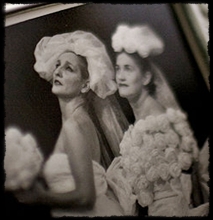
Jesusa Rodríguez and Liliana Felipe I love Mexico. And now I have a reason to love it even more. Tomorrow, Mexico City will be the first in Latin America to put into effect laws legalizing same-sex marriage and adoption. (Mexico City legalized same-sex civil unions back in 2007.) There is, of course, sharp criticism and hand-wringing from my beloved Catholic Church hierarchy and social conservatives — but with a 50 percent approval rate for gay marriage among regular Mexicans (89 percent of whom are Catholic), I’d say that the laity are once again leading the way.
Here’s an excerpt from today’s Washington Post article:
On Thursday, [Mexico City] this sprawling megalopolis will catapult to the front lines of gay rights in Latin America when a city law legalizing same-sex marriage and adoption goes into effect. … Mexican actress Jesusa Rodríguez will marry her partner, Liliana Felipe, after 30 years together. “The important thing is that this law grants equality,” Rodríguez said. Many marriage-minded gay couples are preoccupied by concerns about the security of their loved ones. Reyna Barrera, 70, had a breast removed two months ago, and although she is weak from chemotherapy, she is busy planning her wedding to her partner of 36 years, Sandra Ponce. “This way, she is protected. She will get my pension, our house, everything from the life we built together,” said Barrera, a literature professor at Mexico’s National Autonomous University.
The Legislative Assembly passed the gay marriage act by a broad majority in December, as activists cheered and PAN representatives looked on in dismay. Mayor Marcelo Ebrard, a PRD leader, signed the bill into law — a first in Latin America. … Mexico City legalized same-sex civil unions in 2007; they also are recognized in Colombia, Uruguay, Brazil, Ecuador and Argentina, but advocates for gay rights say only marriage can protect the rights of families in such matters as property and custody. … An opinion poll by El Universal newspaper in November found that 50 percent of Mexico City respondents accepted gay marriage and 38 percent opposed it. Residents ages 18 to 39 were more likely to be supporters.
Read the whole article here.
-
Thomas Merton: Person Before Prophet

“So before we can become prophetic, we have to be authentic human beings, people who can exist outside a structure, who can create their own existence, who have within themselves the resources for affirming their identity and their freedom in any situation in which they find themselves. This means people capable of creating a life for themselves who are not identified with a structure.”–Thomas Merton
The Springs of Contemplation: A Retreat at the Abbey of Gethsemani by Thomas Merton (Ave Maria Press, 1972, p. 109) -
Dorothy Day: ‘Put Away Your Daily Paper’
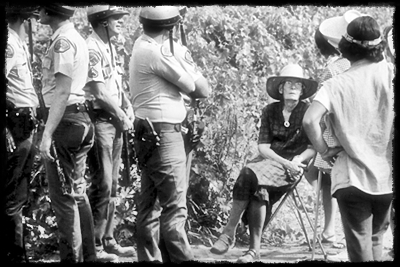
Police flank Dorothy Day, seated at a farm workers picket line in Lamont, California, in 1973. “Turn off your radio. Put away your daily paper. Read one review of events a week and spend some time reading good books. They tell too of days of striving and of strife. They are of other centuries and also of our own. They make us realize that all times are perilous, that men live in a dangerous world, in peril constantly of losing or maiming soul and body. We get some sense of perspective reading such books. Renewed courage and faith and even joy to live.”–Dorothy Day (Journal Entry, 28 September 1940)
The Duty of Delight: The Diaries of Dorothy Day edited by Robert Ellsberg (Marquette University Press, p 62)
-
Subscribe
Subscribed
Have a WordPress.com account? Log in now.

