-
Planes v Volcano: Who Emits the Most CO2?
 While the effects of Iceland’s Eyjafjallajokull volcano have been devastating on Icelanders, I’ve been thinking that shutting down air travel for a week might have some upsides.
The good folks over at Information Is Beautiful created this infographic that shows how carbon dioxide emissions – the fuel driving our global warming engine out of control – actually dropped in the last few weeks, even though Eyjafjallajokull blew tons of more CO2 into the atmosphere.
Why the drop in CO2? Because air travel took an enforced Sabbath. The sabbath is a great concept. Ceasing “doing” and practicing “being” is good for humans, God, and the planet.
Read more about it here.
-
“Who Killed Donte Manning?”: 5 Things You Can Do To Spread the Word
I am really grateful for the warm and generous response to my book Who Killed Donte Manning? The Story of An American Neighborhood. It’s really a pleasure to hear from so many folks. Several people have asked how they can help spread the word. Here are a few suggestions:
1. Purchase WKDM? through Amazon, where I’ve also got an author’s page. I recommend coming first to my Web site (www.rosemarieberger.com) and clicking on the book cover to get to the Amazon purchase page. That way I’ll get a little kickback on the purchases (and help fund this site).
2. Write reviews of Who Killed Donte Manning? on the Amazon page. This will help generate “buzz” online. Just a sentence or two is all that’s needed.
3. Share the post linked here with your friends on Facebook.
4. Send a short note to your e-mail lists telling them about the book. Here’s one note I received.
“I am chomping at the bit to read this! Congrats.”–Ruby Sales, civil rights leader and founder of SpiritHouse
Include this link as the place where folks can buy the book: http://www.amazon.com/gp/product/1934074403?ie=UTF8&tag=rosemarieberg-20&linkCode=as2&camp=1789&creative=9325&creativeASIN=1934074403
5. Who Killed Donte Manning? is really well set-up for a study group (including study guide questions). Consider inviting a group at church or a book group or a neighborhood group to read it together. I’d be glad to answer questions over e-mail or even Skype in for a session.
Send me other ideas on how to get the word out!
-
Thomas Merton: In God’s Silence …
 “But in moments of silence, of meditation, of enlightenment and peace, one learns to live in the atmosphere of solitude even in the midst of crowds. …One opens the inner door of [one’s] heart to the infinite silences of the Spirit, out of whose abysses loves wells up without fail and gives itself to all. In [God’s] silence, the meaning of every sound is finally clear.”–Thomas Merton
Love and Living by Thomas Merton (New York: Harcourt, 1965, p. 21)
-
NOW AVAILABLE! “Who Killed Donte Manning? The Story of an American Neighborhood”
I’m happy to say that my book Who Killed Donte Manning? The Story of an American Neighborhood is finally back from the printer! For those of you who know the Columbia Heights neighborhood of Washington, D.C., I think you’ll enjoy reading about our neighborhood’s history–not to mention Washington, D.C., during the Bush era.
For those who are interested in urban ministry, urban mission, and the Judeo-Christian understanding of cities from the Bible’s Abraham and Sarah to the contemporary era, you’ll definitely find something of interest in Who Killed Donte Manning?
Here’s a snippet from the book’s foreword:
Rose Marie Berger has written a biblical essay on the neighborhood where she lives. I know the neighborhood well, because I live there too. Her provocative discourse is a theological reflection on “place,” which is a long-standing tradition in the Christian faith—a faith that is all about incarnation, the Word becoming flesh in place and time.
The particular “place” where this story begins is in Northwest Washington, D.C., on 13th Street between Euclid and Fairmont, on the sidewalk in front of the notorious Warner Apartments where a third grade boy named Donte Manning was caught in a crossfire of bullets and killed.
In 1993, the new First Lady had come to Washington. Hillary Rodham Clinton had invited a small group of people to her office at the White House to talk about the growing tragedy of youth violence in our cities, a situation of great concern to her. It was the first time I met Hillary Clinton. The meeting had an assortment of civil rights and religious leaders, urban and community activists, and heads of national organizations that cared about children at risk. I was impressed with Clinton’s understanding of the issues, her thoughtfulness and probing questions, and her clear desire to do something that would begin to address the problem.
When the meeting was finished, I came home to my house on 13th Street NW in Columbia Heights … to lots of yellow tape. Of course, I knew what yellow tape meant: Another crime had been committed here and the scene had been cordoned off by police. I learned that during the very hour we were meeting at the White House to discuss the problems of youth homicide, a young kid had been killed across the street from my house—on the sidewalk in front of the Warner Apartments.
I recall wondering at the time how many of the other participants in that meeting came home to yellow tape. It’s not that you know all the answers more easily just because you live there. It’s just that place yields perspective.
It is that biblical insight Rose illustrates in the story Who Killed Donte Manning?, a story that begins with yet another youth homicide on the 2600 block of 13th Street NW in Washington, D.C. Her biblical reflections on her place, and mine, stretch from Genesis to Revelation, and from Washington, D.C., to the coca fields of Colombia in South America. They describe what happens at the center of “empire” and the consequences at empire’s margins, which, in our city and neighborhood, is a journey of only about 2 miles.–Jim Wallis, Foreword, Who Killed Donte Manning? by Rose Marie Berger
civil rights, coca fields, Colombia, Columbia Heights, D.C., Euclid St, Fairmont St, Genesis, George Bush, Hillary Rodham Clinton, incarnation, Jim Wallis, neighborhood, non-fiction, Revelation, sociology, South America, spirituality, theology, urban architecture, urban ministry, urban mission, urban theology, violence, Warner Apartments, Washington, White House, Who Killed Donte Manning? -
Kudos to U.K. Bishops for Tackling Scandal ‘Directly and Unambiguously’

Archbishop Nichols of U.K. washes feet on Holy Thursday. Yesterday, the Catholic Bishops of England and Wales released an exemplary statement on the child abuse scandal. It is being sent out out to all of their parishes this weekend.
I’m not sure what it is in the tone between this statement and the statements issued by the U.S. Catholic bishops, but this one strikes the right chord. Maybe it’s because the U.S. bishops spend all their time defending the Pope, rather than actually taking responsibility.
As far as I can tell, the Pope doesn’t need defending. He’s the most powerful religious leader in the world and no one is going to “dock his pay.” There are, however, thousands of Catholics with the wounds of abuse or the wounds of disillusionment due to the abuse and mishandling that are in need of the respect that comes with transparency and truth.
The bishops of England and Wales have come out more the right side of this thing. Here’s their letter below:
Child abuse in the Catholic Church has been such a focus of public attention recently, that we, the Bishops of England and Wales, wish to address this issue directly and unambiguously.
Catholics are members of a single universal body. These terrible crimes, and the inadequate response by some church leaders, grieve us all.
Our first thoughts are for all who have suffered from the horror of these crimes, which inflict such severe and lasting wounds. They are uppermost in our prayer. The distress we feel at what has happened is nothing in comparison with the suffering of those who have been abused.
The criminal offences committed by some priests and religious are a profound scandal. They bring deep shame to the whole church. But shame is not enough. The abuse of children is a grievous sin against God. Therefore we focus not on shame but on our sorrow for these sins. They are the personal sins of only a very few. But we are bound together in the Body of Christ and, therefore, their sins touch us all.
We express our heartfelt apology and deep sorrow to those who have suffered abuse, those who have felt ignored, disbelieved or betrayed. We ask their pardon, and the pardon of God for these terrible deeds done in our midst. There can be no excuses.
Furthermore, we recognise the failings of some Bishops and Religious leaders in handling these matters. These, too, are aspects of this tragedy which we deeply regret and for which we apologise. The procedures now in place in our countries highlight what should have been done straightaway in the past. Full co-operation with statutory bodies is essential.
Now, we believe, is a time for deep prayer of reparation and atonement. We invite Catholics in England and Wales to make the four Fridays in May 2010 special days of prayer. Even when we are lost for words, we can place ourselves in silent prayer. We invite Catholics on these days to come before the Blessed Sacrament in our parishes to pray to God for healing, forgiveness and a renewed dedication. We pray for all who have suffered abuse; for those who mishandled these matters and added to the suffering of those affected. From this prayer we do not exclude those who have committed these sins of abuse. They have a journey of repentance and atonement to make.
We pray also for Pope Benedict, whose wise and courageous leadership is so important for the Church at this time.
In our dioceses we will continue to make every effort, working with our safeguarding commissions, to identify any further steps we can take, especially concerning the care of those who have suffered abuse, including anyone yet to come forward with their account of their painful and wounded past. We are committed to continuing the work of safeguarding, and are determined to maintain openness and transparency, in close co-operation with the statutory authorities in our countries. We thank the thousands who give generously of their time and effort to the Church’s safeguarding work in our parishes and dioceses.
We commit ourselves afresh to the service of children, young people and the vulnerable in our communities. We have faith and hope in the future. The Catholic Church abounds in people, both laity, religious and clergy, of great dedication, energy and generosity who serve in parishes, schools, youth ventures and the care of elderly people. We also thank them. The Holy Spirit guides us to sorrow and repentance, to a firm determination to better ways, and to a renewal of love and generosity towards all in need.
Read more about the English and Welsh bishops’ statement here.
-
“Praise Ye God, Sun and Moon: Praise God, All Ye Stars of Light”
The Sun Never Says
Even after all this time
The sun never says to the earth,
“You owe Me.”Look what happens with
A love like that
It lights the Whole Sky.
–Hafiz
A full-disk multiwavelength extreme ultraviolet image of the sun taken by SDO on March 30, 2010. False colors trace different gas temperatures. Reds are relatively cool (about 60,000 Kelvin, or 107,540 F); blues and greens are hotter (greater than 1 million Kelvin, or 1,799,540 F). Credit: NASA/Goddard/SDO AIA Team

“We’ve seen solar prominences before—but never quite like this,” says Alan Title, principal investigator of the Atmospheric Imaging Assembly (AIA), the observatory’s main telescope array. Launched on Feb. 11, 2010, the Solar Dynamics Observatory is the most advanced spacecraft ever designed to study the sun. During its five-year mission, it will examine the sun’s magnetic field and also provide a better understanding of the role the sun plays in Earth’s atmospheric chemistry and climate. SDO will provide images with clarity 10 times better than high-definition television and will return more comprehensive science data faster than any other solar observing spacecraft.
-
Mustard Seed Rebellion: Support the Sisters of St. Joseph Against the Religious Authority Guy
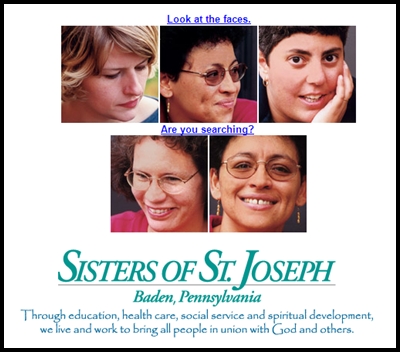
“An environment of dissent from and public opposition to the positions of the [religious guys in authority] does not provide an appropriate seedbed for vocations.”–statement from the diocesan office of Bishop Lawrence Brandt, Diocese of Greensburg, PA
“Woe to you, [religious guys in authority]! For you tithe mint and dill and cumin, and have neglected the weightier provisions of the law: justice and mercy and faithfulness; but these are the things you should have done without neglecting the others. You blind guides, who strain out a gnat and swallow a camel!”–statement from the Nazareth office of Jesus (Matthew 23:23)
So this Catholic Archbishop Brandt told the Sisters of St. Joseph that they can’t run any of their promotional advertisements seeking new vocations in any diocesan paper because they continued to support the passage of the health care reform bill after the U.S. bishops pulled out.
Okay. Whatever. Archbishops can be stupid like the rest of us.
But what do you say we help the Sisters of St. Joseph run a kick-butt vocations campaign, just to show the Archbishop that he’s really not all THAT!
If you live in the Pittsburgh or Western PA area consider promoting the Sisters of St. Joseph for 31 days in May through your own outlets, e-mail lists, parish bulletins, newspapers, whatever. Here’s an e-mail tag line:
A Catholic Sister has a Thousand Faces. Is Yours One? Visit the Sisters of St. Joseph at http://www.stjoseph-baden.org.
Consider sharing the photo above to your Facebook page or sending it out to your networks. Additionally, you might want to send a note to Archbishop Brandt at lgordon@dioceseofgreensberg.org and letting him know that you support the Sisters of St. Joseph of Baden, PA.
Read more about Bishop Nixes Nuns’ Recruitment Drive Over Health Care Spat below:
A Roman Catholic bishop in Pennsylvania has barred local nuns from promoting their order in his diocese because they supported the health care bill Congress passed last month.
The Sisters of St. Joseph of Baden, Pa., “publicly repudiated” the U.S. bishops by supporting the bill, the Diocese of Greensburg said in a statement. Therefore, Bishop Lawrence Brandt has ordered diocesan newspapers, offices, and parishes not to promote the sisters’ upcoming recruiting drive.
The Sisters of St. Joseph, who specialize in health care and social services, was one of nearly 60 Catholic women’s congregations that signed a March 17 letter supporting a version of the health care bill that was denounced by the U.S. bishops.
After minor revisions and a promise from President Obama not to expand federal funding of abortion, that bill became law on March 23.
The sisters are located in the neighboring Diocese of Pittsburgh and wanted to advertise to area Catholics, including in Brandt’s diocese.
Brandt “has a right to disapprove a request from a religious community that wants to host a recruitment event when that community has take a public stance in opposition to the church’s teaching on human life,” the diocese said in a statement dated April 15.
“Furthermore,” the statement continued, “an environment of dissent from and public opposition to the positions of the U.S. Catholic bishops does not provide an appropriate seedbed for vocations.”
Read the whole article here.
-
Taking the “Big Read” to the “Big House”
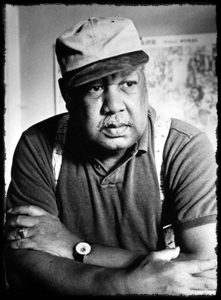
Earnest J. Gaines I’m really honored and excited to be the humanities scholar for Hope House D.C‘s “Big Read” project at two Maryland prisons in early May. The two-day writing workshops–one at a federal prison and one at a state maximum-security prison–will focus on Earnest J. Gaines’ wonderful novel A Lesson Before Dying.
I corresponded with Gaines several years ago for an interview with him published in Sojourners magazine (“A Lesson for Living” by Dale W. Brown) and have always admired his work, particularly The Autobiography Miss Jane Pitman. Workshop participants will work toward writing their own lessons before dying – particularly the lessons they want to pass on to their children. Then they’ll submit their work for publication on a Web site created by Hope House D.C. I hope that through these writing workshops, I can in a small way help “proclaim release to the captives” and hear that liberating shout for myself as well.
Here’s a little more about the “Lessons From Behind Bars” project:
Hope House D.C.’s “Lessons From Behind Bars” project is a humanities-based writing project aimed at providing a cultural and educational snapshot of values, beliefs and behaviors shared by Washington, D.C., prisoners, an increasing segment of our community. As a result of the closing of Lorton Prison in the late 1990s, thousands of Washington, D.C., residents are now incarcerated hundreds of miles away from our city. In the past decade few things have had a greater impact on District families than this.
Many District of Columbia inmates do not have consistent communication with their family members. With limited communication, these inmates do not have an opportunity to share their experiences, not even with family members. The sharing of communication allows us to better understand one another and provides an oral history that can be shared from generation to generation. Consequently, a project of this magnitude is extremely important in order to bring the shared experiences of these inmates back to Washington, D.C. It is imperative that the community have an opportunity to understand the cultural, emotional and social impact the closure of Lorton had on us as well as the role high rates of incarceration has played on our city.
Washington, D.C., leads the nation in rates of incarceration. The act of incarceration and the effects of the isolation create a unique cultural experience for the inmates, their loved ones and the community at-large. The primary purpose of this project is to capture, catalogue and publicly share the experiences, viewpoints and perspectives of this unique and often-overlooked component of our community. Although, prisoners are out-of-sight, their experiences should not be out-of-mind. While, many may frown upon these members of our communities, they are in fact products of our city.
This project will once again bring the voices of our exiled citizens home. To fully understand how the closure of Lorton has affected our city and the fabric of our community, we must continue to hear these voices. Hope House DC plans to participate in the National Endowment for the Arts Big Read project. We will place about 100 copies of the Earnest J. Gaines book “A Lesson Before Dying” in two prisons with high concentrations of District of Columbia inmates.
Hope House DC has worked with fathers in 15 prisons for more than a decade, and has a track record of providing excellent and thoughtful programs for fathers in prison. This project is intended to benefit the residents of Washington, D.C., by spotlighting a civic and social occurrence that has greatly impacted our city over the past thirty years. Since the 1980s, Washington, D.C., has witnessed an increase in rates of incarceration. This has affected thousands of Washington, D.C., residents and families. All of this was exacerbated with the closure of Lorton. This project will bring back to Washington, D.C., the voices and experiences of residents who have been removed from their neighborhoods and communities. This project will impact the city by helping us to understand how incarceration affects each and every one of us.
Find out more about Hope House here.
-
Kristof: A Church Mary Can Love
 When I was in Venezuela in in 2004, the country was 95% Catholic and 60% of the people lived in poverty. Hugo Chavez–for better or worse–was trying to change the poverty statistics. But he was alienated from the Catholic hierarchy (the cardinal had plotted a coup against Chavez) and he was not well-connected to the popular Catholic Church on the ground.
 It was with this “popular church” that I spent most of my time. In one very poor barrio high in the mountains above Caracas, I met Norma who talked to me about there being “two Catholic Churches”: one is the hierarchy and one is the people.
She said: “The bishop in his black cassock and scarlet came once to our barrio and said it was the most horrible place and he hated coming here, but I said this is my life, my reality, can it be so terrible for him? Our question is why are the church hierarchy not coming to be involved with us rather than always expecting that we will be involved with them?”
I remembered Norma’s wisdom when I read Nick Kristof’s wonderful op-ed in the New York Times titled A Church Mary Can Love. I’m reprinting the whole thing here, as a sign of encouragement to all of us downcast and discouraged by the Vatican’s child abuse scandal. Read Kristof’s column below:
I heard a joke the other day about a pious soul who dies, goes to heaven, and gains an audience with the Virgin Mary. The visitor asks Mary why, for all her blessings, she always appears in paintings as a bit sad, a bit wistful: Is everything O.K.? Mary reassures her visitor: “Oh, everything’s great. No problems. It’s just … it’s just that we had always wanted a daughter.”
That story comes to mind as the Vatican wrestles with the consequences of a patriarchal premodern mind-set: scandal, cover-up and the clumsiest self-defense since Watergate. That’s what happens with old boys’ clubs.
It wasn’t inevitable that the Catholic Church would grow so addicted to male domination, celibacy and rigid hierarchies. Jesus himself focused on the needy rather than dogma, and went out of his way to engage women and treat them with respect.
The first-century church was inclusive and democratic, even including a proto-feminist wing and texts. The Gospel of Philip, a Gnostic text from the third century, declares of Mary Magdalene: “She is the one the Savior loved more than all the disciples.” Likewise, the Gospel of Mary (from the early second century) suggests that Jesus entrusted Mary Magdalene to instruct the disciples on his religious teachings.
St. Paul refers in Romans 16 to a first-century woman named Junia as prominent among the early apostles, and to a woman named Phoebe who served as a deacon. The Apostle Junia became a Christian before St. Paul did (chauvinist translators have sometimes rendered her name masculine, with no scholarly basis).
Yet over the ensuing centuries, the church reverted to strong patriarchal attitudes, while also becoming increasingly uncomfortable with sexuality. The shift may have come with the move from house churches, where women were naturally accepted, to more public gatherings.
The upshot is that proto-feminist texts were not included when the Bible was compiled (and were mostly lost until modern times). Tertullian, an early Christian leader, denounced women as “the gateway to the devil,” while a contemporary account reports that the great Origen of Alexandria took his piety a step further and castrated himself.
The Catholic Church still seems stuck today in that patriarchal rut. The same faith that was so pioneering that it had Junia as a female apostle way back in the first century can’t even have a woman as the lowliest parish priest. Female deacons, permitted for centuries, are banned today.
That old boys’ club in the Vatican became as self-absorbed as other old boys’ clubs, like Lehman Brothers, with similar results. And that is the reason the Vatican is floundering today.
But there’s more to the picture than that. In my travels around the world, I encounter two Catholic Churches. One is the rigid all-male Vatican hierarchy that seems out of touch when it bans condoms even among married couples where one partner is H.I.V.-positive. To me at least, this church — obsessed with dogma and rules and distracted from social justice — is a modern echo of the Pharisees whom Jesus criticized.
Yet there’s another Catholic Church as well, one I admire intensely. This is the grass-roots Catholic Church that does far more good in the world than it ever gets credit for. This is the church that supports extraordinary aid organizations like Catholic Relief Services and Caritas, saving lives every day, and that operates superb schools that provide needy children an escalator out of poverty.
This is the church of the nuns and priests in Congo, toiling in obscurity to feed and educate children. This is the church of the Brazilian priest fighting AIDS who told me that if he were pope, he would build a condom factory in the Vatican to save lives.
This is the church of the Maryknoll Sisters in Central America and the Cabrini Sisters in Africa. There’s a stereotype of nuns as stodgy Victorian traditionalists. I learned otherwise while hanging on for my life in a passenger seat as an American nun with a lead foot drove her jeep over ruts and through a creek in Swaziland to visit AIDS orphans. After a number of encounters like that, I’ve come to believe that the very coolest people in the world today may be nuns.
So when you read about the scandals, remember that the Vatican is not the same as the Catholic Church. Ordinary lepers, prostitutes and slum-dwellers may never see a cardinal, but they daily encounter a truly noble Catholic Church in the form of priests, nuns and lay workers toiling to make a difference.
It’s high time for the Vatican to take inspiration from that sublime — even divine — side of the Catholic Church, from those church workers whose magnificence lies not in their vestments, but in their selflessness. They’re enough to make the Virgin Mary smile.
-
Merton: Prayer and ‘Doublemindedness’
 Without courage we can never attain to true simplicity. Cowardice keeps us “double minded” – hesitating between the world and God. …And this hesitation makes true prayer impossible – it never quite dares to ask for anything, or if it asks, it is so uncertain of being heard that in the very act of asking, it surreptitiously seeks by human prudence to construct a make-shift answer.–Thomas Merton
Thoughts in Solitude, by Thomas Merton (New York: Farrar, Strauss, Giroux, 1956, p 24.)
-
Subscribe
Subscribed
Have a WordPress.com account? Log in now.

