-
Martin Smith: ‘The Parts Prose Can’t Reach’
 Episcopal priest Martin L. Smith wrote a lovely piece on poetry and spirituality in the May-June issue of Washington Window (the Episcopal Diocese paper in D.C.) titled Refreshing the Parts Prose Cannot Reach.
Smith is a wonderful spirituality writer, having published such books as A Season for the Spirit, Love Set Free, and The Word is Very Near You. Martin is pastor at St. Columba’s Episcopal Church in northwest D.C.
Below is an excerpt from his article:
Many of us have had the experience of responding to poems so viscerally that we are physically and emotionally shaken as they speak to us. We have a heightened sense that somehow the opposites of life – birth and death, connectedness and brokenness, love and fear – are being held together. We hold our breath on the brink of being suffused with meaning. Words glow on the page and like magnets seem to pull us out of our usual harried state into a place where we recognize our own right to be passionate, to be human beings on a divine quest.
Researchers have made some intriguing discoveries. The typical length of the line in poetry in cultures the world over is virtually identical, taking between 2.5 and 3.5 seconds to pronounce. There is a convincing theory that when words convey meaning to us in this short package, followed by a tiny pause before the next line, it allows the input to pass from one hemisphere of the brain to the other, and so our receptivity is fully opened and our consciousness unified. No wonder human culture and religion has placed such value on metred poetry and song in the sharing of meaning, and in ritual. No wonder that pages and pages of text or hours of speech seldom have a fraction of the effect that a short poem committed to memory can have as it lodges in our consciousness and continues to illuminate and challenge us from within.
I am sure I could write an entire spiritual biography by stringing together the poems that came to me unsought as visiting angels at the right time year after year. About 15 poems of Rilke that I learned 40 years ago shaped my whole way of feeling about God: “we feel round rage and desolation the finally enfolding tenderness.” I look through the pages, worn round the edges from use, where I have copied out the poems. Here’s the Tao Te Ching and Li Po. Here are the poems of David Whyte: “always this fire smolders inside. When it remains unlit, the body fills with dense smoke.” e.e. cummings: “all which isn’t singing is mere talking.” Rumi. Mirabai. Machado. W.H. Auden. Gerard Manley Hopkins. Peguy. None of them deliberately researched. We just come upon the poems when we are ready.
In a beautiful poem, Seamus Heaney remembers the counsel given in confession by a Spanish priest: simply, “Read poems as prayers.” Wise man.
Read Smith’s whole piece here.
-
Vanessa Ortiz: ‘Everything I Learned About Activism, I Learned from Mom’
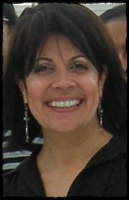
Vanessa Ortiz I came across a fun blog piece titled Everything I learned about activism, I learned from Mom by Vanessa Ortiz. It’s a great testament to the true historical roots of Mother’s Day.
My own Mom took me to United Farm Workers protests in Sacramento in the 1970s, peace demonstrations at the local SAC base and nuclear abolition protests in the 1980s, and showed me what it means to stand up – and show up – for justice. (Thanks, Mom!)
Mothers don’t realize that their daily shows of bravery and seemingly small courageous actions grow another generation of female activists! Yes, we sometimes take the lessons of cooking and cleaning, or studying and reading, or raising great kids, but often we watch with awe as our mothers take on the world. My mother raised five children, she worked as a social worker and a teacher, she kept an immaculate house, she was a community organizer, she was an educator, and she was politically and locally in touch. Today, I can’t even claim half of those achievements.Everything I Learned about Activism, I Learned from Mom | Peace X Peace, May 2010
Peace X Peace, where’s Ortiz’s post was published, is a global network of women with women-focused e-media, fresh analysis, and from-the-frontlines perspectives. We engage, connect, and amplify women’s voices as the most direct and powerful ways to create cultures of peace around the world. I wrote a short piece on the organization for Sojourners magazine back in November 2004 (see Women Building Peace).
-
Faith-Based Organic Farm in Central California Sets Table of Abundance
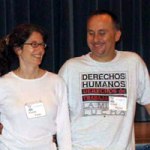 Ched Myers is one of my gospeler mentors. A gospeler is someone who sings the gospel – and Ched and Elaine do that with the way they live their lives. In their recent Bartimaeus Cooperative Ministries‘ newsletter that Ched and Elaine are working with a local faith-based organic farm in the Oxnard Plain in Ventura County, California. It’s called the Abundant Table Farm Project. (I’m posting a couple of the Abundant Table’s inspiring videos below.
I thought the book introduction that Ched wrote for The Biblical Jubilee and the Struggle for Life by Ross and Gloria Kinsler was a nice set up for the Abundant Table story. He wrote:
“We read the gospel as if we had no money,” laments American Jesuit theologian John Haughey, “and we spend our money as if we know nothing of the Gospel.” Indeed, the topic of economics is exceedingly difficult to talk about in most First World churches, more taboo than politics or even sex. Yet no aspect of our individual and corporate lives is more determinative of our welfare. And few subjects are more frequently addressed in our scriptures.
The standard of economic and social justice is woven into the warp and weft of the Bible. Pull this strand and the whole fabric unravels. At the heart of this witness is the call to Sabbath and Jubilee, a tradition we might summarize in three axioms: The world as created by God is abundant, with enough for everyone— provided that human communities restrain their appetites and live within limits …
Here’s a 2-minute video about the Abundant Table Farm Project:
“We are a young intentional community of five interns (sisterfriends) living and working on a 10-acre family farm on the Oxnard Plain. Though we come from far and near, our internship grew out of the campus ministry founded by the Episcopal Church at California State University Channel Islands. To learn more about our organic farm and Community Supported Agriculture program, please visit www.jointhefarm.com.”
Senior producer Jim Melchiorre at Anglican Stories visited The Abundant Table Farmhouse Project, a young adult internship program of the Episcopal Service Corps. Below is his excellent 10-minute video.
Abundant Table Farm, Bartimaeus, Bible, Biblical Jubilee, California, Ched Myers, CSU Channel Islands, Elaine Enns, environmental, Episcopal, Episcopal Service Corps, Faith-based, food, Genesis, Gloria Kinsler, gospel, intentional community, Jim melchiorre, John Haughey, Oak View, Ojai, organic, Oxnard, Ross Kinsler, Sabbath, spirituality -
British Petroleum’s ‘Terrorist’ Attack on America’s Southern Coast
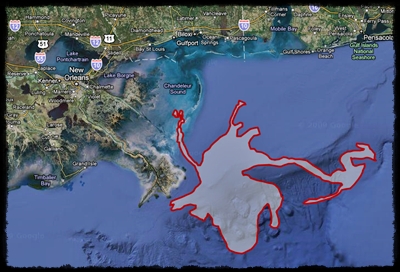
An estimated 5,000 barrels of oil a day are poisoning the Gulf of Mexico and smothering life along the shores since a British Petroleum rig exploded in April. Why should I not react to this as a terrorist attack? Yes, it wasn’t intentionally done by a militant anti-government gang of thugs — instead it was done by unfettered Big Oil business executives who are anti-regulation whose hubris has now led to the biggest environmental attack in this country. An attack that is spreading terror all along America’s southern coast.
Why do I think that if we viewed the Gulf of Mexico as a “water commons” and allowed the small oyster farmers and family-owned fishing businesses to make decisions over the waters that they depend on, we wouldn’t be in this situation.
I’m reminded of the unique solution around oil that Ecuador came up with: Ecuador is paid to leave its oil in the ground. Yes, it’s a crazy upside-down market situation — but the end result is the pristine rain forest is not destroyed by drilling and the indigenous communities have maintained their standard of living.
Here’s an excerpt from an article on mapping the BP oil debacle:
A story in Wednesday’s New York Times described the use in Louisiana of a technology called Ushahidi, which likewise was used after this year’s earthquakes and which is now allowing a group called the Louisiana Bucket Brigade to record data from people who send texts and tweets about everything from out-of-work fishermen to oil-covered animals. The Google tool also is drawing from the Ushahidi data and placing it on the map.
Mapping and crowd-sourcing technologies are proving useful after disasters and in other emergency situations. Most dramatically, the technologies can help rescuers allocate resources to certain locations and quickly find people who can communicate by text or phone, as after the earthquake in Haiti. In other cases, they allow the public to ensure that their concerns are being recorded and give people studying the event a readily accessible set of data from those on the ground.
Reports coming in from the user-generated content near the Gulf of Mexico include information on the closure of oyster beds, odors in the air, and sightings of birds in oily areas. The Louisiana Bucket Brigade anticipates that the reports will increase as the oil moves ashore. Maps of the slick, which have been updated daily this week, show the movement of the oil as winds and currents carry it on the water.
-
Thomas Merton: ‘A Tree Gives Glory to God’
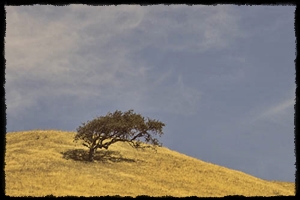
A tree gives glory to God by being a tree. For in being what God means it to be it is obeying [God]. It “consents,” so to speak, to [God’s] creative love. It is expressing an idea which is in God and which is not distinct from the essence of God, and therefore a tree imitates God by being a tree.–Thomas Merton
New Seeds of Contemplation by Thomas Merton (New York: New Directions Books, 1961, p.29)
-
Poetry: ‘If You Leave Your Shoes’ by Joseph Ross
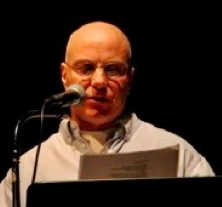 My friend Joe Ross has written a provocative and stunning poem in reaction to the new immigration laws Arizona is about to enact.
Joseph Ross is a poet, working in Washington, D.C., whose poems have been published in many journals and anthologies including Poetic Voices Without Borders 1 and 2, Poet Lore, Beltway Poetry Quarterly, and Full Moon on K Street.
Joe co-edited with me Cut Loose the Body: An Anthology of Poems on Torture and Fernando Botero’s Abu Ghraib for D.C. Poets Against the War. He has given readings in Washington, D.C.’s Miller Cabin Poetry Series and in the Library of Congress’ Poetry-at-Noon Series. He teaches in the College Writing Program at American University in Washington, D.C. I’m grateful to Split This Rock for posting Joe’s poem.
If You Leave Your Shoes
A Response to Arizona’s Law SB 1070
by Joseph RossIf you leave your shoes
on the front porch
when you runto the city pool
for swimming lessons,
you might end upwalking across the sand
of the desert in
scorched feet,bare, like the prophets,
who knew what it was
to burn.If you leave your lover
to run to the market
for bread and pearsyou might return
to find your lover
gone and the bedcovered with knives,
hot and gleaming from
a morning in the sun.If you leave your country
in the wrong hands,
you might return tosee it drowning in blood,
able to spit
but not to speak.Joe Ross appeared on the panel Gay and Lesbian Poetry in the 40th Year Since Stonewall: History, Craft, Equality during Split This Rock Poetry Festival: Poems of Provocation and Witness 2010. Find out more about Split This Rock.
-
Dispatch from Prison: “There, but Not There”
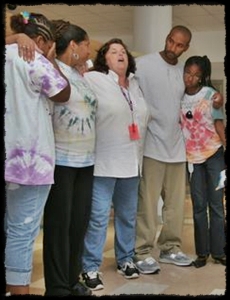
Hope House families with Carol Fennelly (center) The final day of A Lesson Before Dying workshops at the federal prison went really well. I was more relaxed than yesterday and the writing that the guys came in with this morning from yesterday’s assignments was just phenomenal. I was really moved by it and more importantly they “moved” each other with what they’d written.
The homework assignment was based on the opening line of the book we are using (Ernest Gaines’ A Lesson Before Dying), which is: “I was there, but not there.” Some wrote about missing – because they were in jail – the deaths of their parents, friends, or grandparents. A few wrote about missing the births of their children. One wrote about the Southern Freedom Riders who integrated the bus system making it possible for this man to travel where ever he wanted to go — even though he wasn’t there during the time, he “was there” and was grateful for the impact it had in his life. Another wrote about how proud he was when President Obama was elected and how mad he was at himself that he couldn’t go to the inauguration because he was incarcerated. “There, but not there.”
In the afternoon, I asked them write a riff off another line from the book, “My Gray ’46 Ford was parked in front of the house.” It was so wonderful to hear these guys read of litanies to the cars they loved — all the intricate technical detail that some guys carry around in their heads about their favorite cars!
Finally, I asked them to write a letter to one of the characters in Gaines’ A Lesson Before Dying. Someone who they’d like to have dinner with and interview. I thought most of them would write to Jefferson, the guy on death row. But only a few wrote to him. Some wrote to Tante Lou, one of the lead women characters. Others wrote to the minister, interrogating him about his “pie-in-the-sky” theology. A couple wrote to the shopkeeper who was murdered in a robbery at the beginning of the book — some of those letters contained some very personal reflections.
This assignment is a set up for them to work on a 1000-word essay to be completed by the end of the summer that is a letter to their children or family on the topic of their own lessons from life or lessons before dying.
As for me, it was a really excellent experience. I was genuinely honored to meet these guys. And I was impressed by the staff also – especially in the education department. They are tough as nails, but also show a genuine interest in working with the inmates to give them as many skills as possible before they are turned back out. The staff was really grateful for us being there. One person thanked me for giving the guys something that he couldn’t give them herself — a certain knowledge and skill about writing and a safe environment to really build community in vulnerability. I know it must be crazy-making and hard to work inside the prisons for years and years – and also, a few times, rewarding.
Tomorrow we head to the Maryland state prison to offer the same program, though I think the class and dynamics will be entirely different.
Carol Fennelly invited me to participate in this program – funded by the Humanities Council of Washington, D.C. – and made it possible for me to come teach these classes as part of the National Endowment for the Arts “Big Read” program. The book that D.C. has chosen to read and that we are discussing in these workshops is Ernest Gaines’ A Lesson Before Dying, which takes on the question: Knowing we are going to day, how should we live?
Hope House DC was established by Carol Fennelly in 1998 to help keep those D.C. families with someone in prison together and keep incarcerated fathers active in the lives of their kids. Hope House also works to reduce the isolation, stigma, and risk families experience when fathers and husbands are imprisoned and raises public awareness about prison issues and this at-risk population.
After today’s workshop, Carol posted some comments on Facebook about her experience. See below:
Carol Fennelly: Just thinking about the prison writing classes this week. The depth of the conversation that emerged yesterday was so profound. In my old age I have become a cynic, I think. But the genuine probing of self and give and take in that process got to me.
Responder: Proving, yet again, that we should not jump to conclusions or pigeon-hole people and that redemption is, indeed, possible?
Carol Fennelly: Yes. that is true. but we also had great material to spur this conversation, a great facilitator, a first class group of guys ALL of whom had read the book before class, and there was real magic. in stark contrast to the absolute civility in the room, outside on the compound competing gangs got into a fight with several guys locked up as a result. looking back it was almost surreal.
-
Dispatch from Prison: How Strong Is Hope?
 In my daily prayer book, the morning antiphon for today said: “The Lord chose these holy men for their unfeigned love …” The men referred to are Saints Phillip and James, whose feast day it is today. But as I return from a writing workshop at one of Maryland’s federal men’s prisons, the phrase takes on a fresher meaning.
This week I’m the visiting humanities scholar inside the “big house.” There were about 20 men in class today. I think they are all from Washington, D.C. When the federal prison at Lorton, VA, closed in the late 1990s and early 2000s, D.C. federal prisoners were shipped all over the U.S.– sometimes very far from their families.
Hope House DC was established by Carol Fennelly in 1998 to help keep those D.C. families with someone in prison together and keep incarcerated fathers active in the lives of their kids. Hope House also works to reduce the isolation, stigma, and risk families experience when fathers and husbands are imprisoned and raises public awareness about prison issues and this at-risk population.
Carol Fennelly invited me to participate in this program – funded by the Humanities Council of Washington, D.C. – and made it possible for me to come teach these classes as part of the National Endowment for the Arts “Big Read” program. The book that D.C. has chosen to read and that we are discussing in these workshops is Ernest Gaines’ A Lesson Before Dying, which takes on the question: Knowing we are going to day, how should we live?
The guys are discussing the book and writing about their own experiences. I was impressed that every single man had read the book in advance. From the depth of our discussion I think some had read it multiple times. One man quoted sections from memory and cited the page numbers.
We talked about the characters, their motivations, the setting in rural Louisiana in the 1940s. We talked about what makes a character — and whether a character always has to be a person or can it be the landscape or even an experience that looms large in the story line. The men struggled with each other over whether the main character “Jefferson” was a “victim of circumstance” or “did he make a bad choice” that ended with him on death row.
We talked about the preacher that peddles hope on Sunday mornings, but the hope fades by sunset and never leads to changing the systems of oppressions. Just how strong is hope? And how weak is optimism? We discussed how very small acts or things can be used to dismantle an overarching system — the weapons of the weak can take apart dehumanizing systems. But they only work if they force the oppressors and the oppressed to recognize their shared humanity.
At one point our conversation shifted. One man said, “We keep saying that Jefferson was simple or retarded or slow or stupid and that’s why he did those things that ended him up in jail. But WE did the same things! We made the same choices. And WE aren’t stupid or simple or slow.” Then each one began to wrestle with who he was in the story and the choices that he had made and how hard it is to build up enough strength to make new choices when the same old situations arise on the outside.
I won’t say that anyone in the workshop – myself included – is “holy” in a morally righteous sense. But instead “the Lord called these holy men” in the sense that holiness also means moving toward becoming a whole and healed human being. And even in this first day, I can stand as a witness to their “unfeigned love” – especially when they talk about their kids or show pictures of their families. Tomorrow we’ll work on a number of writing exercises and end with a reading from their work and a graduation certificate.
On another note, it turns out that “Casino Jack” Abramoff was also at this facility, on the minimum security side. He’s getting released to a half-way house this month just in time to see Alex Gibney’s newly released documentary about his life called Casino Jack and the United States of Money. Suffice it to say, the range of “bad choices” made by men in Washington, D.C., is wide-ranging.
-
Poetry: ‘The Lioness’ by Stuart Anderson
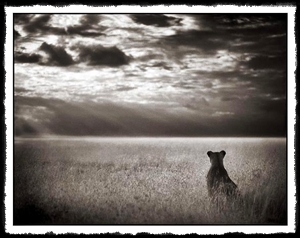
by Nick Brandt The Lioness
By Stuart M. AndersonDay on the savannah is an inheld breath
between the brief, cool pants of dawn and dusk,
a tawny silence aching to be broken
by any sharp sound.
I watch from a small shade.The giraffes browse among the treetops,
within the rustling shadows of their leaves,
in the high communion only they know.The antelope graze on the turf,
in the broad light and rippling distance;
what psalm the grass sings, only they know.The giraffes have their patient gods in the treetops,
and the antelope theirs in the turf;
always and everywhere they are with them,
but the faint scent of mine comes to me
from some far place I do not know,fleeing, and always further.
Once, I was a young hunter, and my worship was swift!
and once –
for one brief, exalted leap –
I had my teeth in the lean flank of heaven,
but I couldn’t bring it down.“The Lioness” by Stuart M. Anderson was chosen this month by Br. Paul Quenon, OCSO, as the first place winner for the Thomas Merton Prize for Poetry of the Sacred. Read other top poems here.
-
Andrew Wilkes: Evangelicals, Race, and GLBT Issues
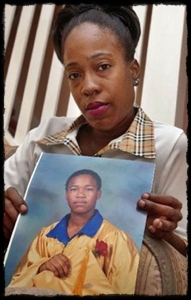
LaTona Gunn holds a 2001 photo of her daughter, Sakia, 15, who was stabbed to death while waiting for the bus after she and her friends told her attacker they were lesbians. I really appreciated Andrew Wilkes excellent post today on Sojourners blog on the evil of indifference when it comes to how dominant sexuality Christians relate to gays and lesbians (Ignoble Indifference: Evangelicals, Race, and GLBT Issues).
Andrew worked with Sojourners as a policy and organizing fellow and added his depth and richness to our ministry life. Now he’s back at Princeton Theological Seminary and getting ready to graduate this spring. Andrew is a noble son of the Black church tradition and it gives me hope that our future is carried by him and his compatriots. Here’s an excerpt:
While progressive evangelicals consider color within and beyond the Emergent Church, let us not ignore the stories of our gay and lesbian brethren as if the two issues are completely separate. The two issues ought not be conflated, and yet they are inextricably intertwined.
Far too often, black and brown youth who are gay and lesbian suffer from an unceasing stream of epithets, threats, and violence in the formative years of life. From the ghastly murder of Sakia Gunn, a fifteen-year-old lesbian, to the skull-fracturing beating of Gregory Love at Morehouse, visceral responses to homosexuality have provoked not only dehumanizing discourse but also destructive deeds. Violence against our gay and lesbian brethren — again, many of whom are black and brown — is immoral, illegal, and incompatible with those who follow the Prince of Peace.
Another sin of civil rights storytelling is that many who invoke Martin King ignore Bayard Rustin. And yet, the emergence of Martin King as a nonviolent prophet is unintelligible without brother Rustin — a brilliant organizer, orator, nonviolent strategist, and also a gay man.
Or when Tonex, perhaps the most gifted gospel artist of the past quarter-century, came out, many of his peers publicly threw him under the pews. The not-so-subtle message was twofold: one cannot be explicitly gay and publicly offer praise to God; and secondly — since everyone and their grandmama knows that there are gay gospel artists — one must suffer in silence before God and Church. This message is unhelpful, tacitly encouraging a culture of shame and clandestine sexuality.
Instead, let progressive evangelicals acknowledge that there are Christian arguments for gay marriage, civil unions, and so forth. One may or may not be convinced, but let us be charitable enough to acknowledge that there are Jesus-loving and justice-seeking believers who have theological reasons to account for their sexuality, an open and affirming church, and so forth.
The stone-cold truth, I suspect, is that more than a few progressive evangelicals are indifferent about GLBT issues. By God’s grace, I ashamedly — and yet gratefully — admit that I am slowly being delivered from this apathy.
“There is an evil which most of us condone and are even guilty of: indifference to evil. We remain neutral, impartial, and not easily moved by the wrongs done unto other people. Indifference to evil is more insidious than evil itself … The prophets’ great contribution to humanity was the discovery of the evil of indifference. One may be decent and sinister, pious and sinful.”–Rabbi Abraham Joshua Heschel, The Insecurity of Freedom, pgs. 110-1
Gracious Triune God of love and justice, deliver us from this ignoble indifference.
Read more on this discussion here. To watch the amazing documentary on the life of Bayard Rustin, see Brother Outsider: The Life of Bayard Rustin. And for more on Sakia Gunn, read here.
-
Subscribe
Subscribed
Have a WordPress.com account? Log in now.

