-
Cody J. Sanders: Why Anti-Gay Bullying is a Theological Issue
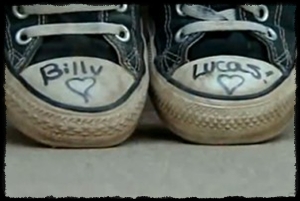
At the memorial vigil for LGBT teen Billy Lucas, after his suicide in September. Cody Sanders has written an excellent op-ed in response to the teen suicides among LGBT kids that have made it into the news: Tyler Clementi (18 ), Seth Walsh (13 ), Raymond Chase (19), Asher Brown (8th grade), Billy Lucas (15).
Sanders is a Baptist minister and Ph.D. student in Pastoral Theology and Counseling at Brite Divinity School in Fort Worth. Sanders was a Fellow in the inaugural class of the Human Rights Campaign Summer Institute for Religious and Theological Study and is a participant in the Beyond Apologetics symposium on sexual identity, pastoral theology, and pastoral practice.
According to researchers, gay teenagers are 2 to 3 times more likely to commit suicide. One significant factor that separates them from their heterosexual peers is victimization or bullying. As Sanders says, we need “more faithful and courageous preaching and teaching in our churches” to educate and address the climate of hate. Here’s an excerpt from Why Anti-Gay Bullying is a Theological Issue:
I cannot count the number of times I have heard well-meaning, good-hearted people respond to this appeal, saying, “Things are a lot better for gay people today than they were several years (or decades) ago. In time, our society (or churches) will come around on this issue.” To these friends and others, I must say, “It’s time.” For Lucas, Brown, Clementi, Walsh, and Chase the time is up. For these teens and the myriad other bisexual, transgender, lesbian and gay youth lost to suicide, the waiting game hasn’t worked so well.
As simply as I can state the matter: The longer we wait to respond, the more young people die.
If this were a hostage situation, we would have dispatched the SWAT team by now. And in many ways, it is. Our children and teenagers are being held hostage by a religious and political rhetoric that strives to maintain the status quo of anti-gay heterosexist normativity. The messages of Focus on the Family and other organizations actively strive to leave the most vulnerable among us exposed to continuous attack. The good news is that we don’t need a SWAT team. We just need quality education on sexuality and gender identity in our schools and more faithful and courageous preaching and teaching in our churches.
Catholic theologian M. Shawn Copeland offers profound words to any individuals and churches seeking to wash their hands of this issue. She states,
“If my sister or brother is not at the table, we are not the flesh of Christ. If my sister’s mark of sexuality must be obscured, if my brother’s mark of race must be disguised, if my sister’s mark of culture must be repressed, then we are not the flesh of Christ. For, it is through and in Christ’s own flesh that the ‘other’ is my sister, is my brother; indeed, the ‘other’ is me…”
If anti-gay bullying is a theological issue, perhaps what is called for is a creative theological response. A theological response that challenges the systematic violence that upholds an oppressive religious and cultural ideology will not be a response through which we can hedge our bets. It will be a full-bodied, whole-hearted giving of ourselves to the repair of the flesh of Christ divided by injustice and systematic exclusion.
Ministers who remain in comfortable silence on sexuality must speak out. Churches that have silently embraced gay and lesbian members for years must publically hang the welcome banner. How long will we continue to limit and qualify our messages of acceptance, inclusion and embrace for the most vulnerable in order to maintain the comfort of those in our communities of faith who are well served by the status quo?
In the current climate, equivocating messages of affirmation are overpowered by the religious rhetoric of hatred. Silence only serves to support the toleration of bullying, violence and exclusion. In the face of what has already become the common occurrence of LGBT teen suicide, how long can we wait to respond?
Read Sanders’ whole article here. For preaching and pastoral resources on these issues, go to HRC: Scripture Resources.
-
Rose Reads at Baltimore Book Festival

Thanks to Gregg Wilhelm (CityLit Project) and Deborah Rudacille and John Barry (New Mercury Readings) for inviting me to read from Who Killed Donte Manning? at the Baltimore Book Fest last Sunday.
I shared the podium with 3 other impressive writers: Howell Baum (Brown in Baltimore: School Desegregation and the Limits of Liberalism), Christopher Corbett (The Poker Bride: The First Chinese in the Wild West), and Christopher White (Skipjack: The Story of America’s Last Sailing Oystermen).
There were about 40 people there in the outdoor tent (thanks Karen, Kevin, Heidi, Emmanuel and Julia for coming out!). We had fun eating kettle corn and watching all the people.
-
Stephen Colbert: Reading Matthew 25 From the Migrant Fields
Comedian Stephen Colbert joined the panel of witnesses at a House hearing on immigrant farm workers. Mr. Colbert has partnered with United Farm Workers and their campaign calling on unemployed Americans to take jobs in the agriculture sector. The UFWs president, Arturo Rodriguez, also testified at the Judiciary Subcommittee on Immigration and Border Security hearing chaired by Rep. Zoe Lofgren (D-CA).
“Stephen Colbert” is a fictional persona of the comedian by the same name. Both are Catholic. In the clip above, Colbert breaks character for a moment to quote from Matthew 25: “Whatsover you do to the least of these …”
-
Bible Geeks 4 St. Jerome, Patron Saint of Librarians
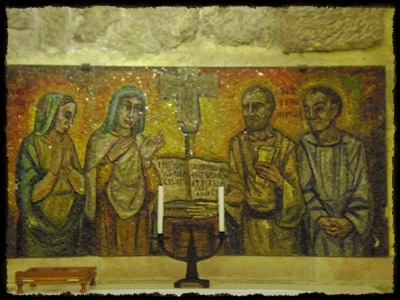
St. Paula and her daughter Eustochium with St. Jerome and Eusebius. (Bethlehem) I consider myself a “Bible geek.” I’ve learned my trade – imperfectly – outside the academy, but in the tradition of most folks throughout history who try to follow the path of the Human One, Jesus. We study the Word. We take it out walking in the world. We let it shape our soul in worship.
If you’re a Bible geek too, then you need to know St. Jerome. Today’s his feast day in the church calendar. He’s also the patron saint of librarians. Take particular note that Jerome began his “finest work” when he was in the company of women he loved.
Monk and doctor of the Church. St Jerome is considered to be one of the greatest Biblical scholars. Born of Christian parents, at Strido in Dalmatia around 348, after being educated at his local school he went to Rome to study rhetoric for eight years. He then set up a community of ascetics in Aquilea. When the community broke up, he travelled east where he met a hermit called Malchis who inspired him to live in a bare cell, dressed in sackcloth and studying the Scriptures.
St Jerome learned Hebrew from a rabbi and then returned to Antioch where he was ordained priest. He travelled to Constantinople and became friends with St Gregory of Nazianzen and St Gregory of Nyssa. He became personal secretary of Pope Damasus and struck up a lifelong friendship with a widow called Paula, her daughter Eustochium and another woman called Marcella.
He began his finest work at this time, revising and translating the Bible into the Latin version which is known as the Vulgate. But when the Pope died, his enemies forced him to leave Rome.
He travelled to Bethlehem with Paula and Eustochium and lived there for 24 years, establishing a monastery and convent and hostel for the countless pilgrims who came to see the birthplace of Christ.
St Jerome was immensely learned and a prolific writer, matched only by St Augustine. His views were often considered controversial. He said: “Plato located the soul of man in the head. Christ located it in the heart”.
He died at Bethlehem in 420 and was buried in the Church of the Nativity next to Paula and Eustochium.
-
St. Francis in Sacramento, Calif., on Sept. 26 Event

St. Francis, Sacramento I’ve been hearing from Catholics in various quarters about how they called attention to and honored the contributions of women in the Catholic church on Sept. 26. Here’s a note that Penny at St. Francis of Assisi Catholic Church in Sacramento, CA, sent to her friends and parish staff who attend the noon Mass:
Dear Friends,
I will not be at noon mass this Sunday, 09/26/10. I am abstaining from mass in solidarity with other Catholic women-the women of Ireland, who are stunned by the pervasiveness of the abuse in Ireland; the women who minister in other parishes throughout the world who are not valued and respected as we are at St Francis; the sisters who are investigated because of their implementation of the gospels and loyalty to Christ above rules; and, the women who hear the call to priesthood and are vilified by the hierarchy and equated with sexual abusers.
I have spent significant time in prayer to discern whether i would participate in this symbolic action. My decision to join in solidarity with these women has nothing to do with my respect and appreciation of … the staff at St Francis. I love each of them for who they are and the gifts they so generously share with us. It is because of the many ways they acknowledge the wisdom and sincerity of the feminine that I feel a strong need to stand strong and straight (because its impossible for me to stand tall) with the oppressed women of the Catholic church.
I will be praying with and for all of you on Sunday. Please remember me in your prayers, also.
Thanks, Penny. I look forward to hearing more reports from the field.
-
St. Lucy’s in Syracuse Reports on Sept. 26 Event
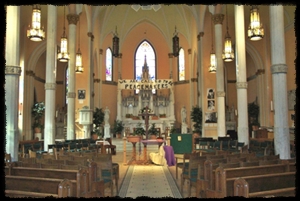
St. Lucy's in Syracuse, NY I’ve been hearing from Catholics in various quarters about how they called attention to and honored the contributions of women in the Catholic church on Sept. 26. Here’s a note from Nancy at St. Lucy’s Catholic Church in Syracuse, NY:
At St. Lucy’s we elected to do it a little differently on the 26th because we have a priest who supports the participation of women & has been preaching about this for a long time. So a big crowd of women & many men do not go to be seated until after Father Jim processed. He turned around at the altar, raised his arms & asked, “Where are all the people? Where are our women?” Then the crowd processed in, with green ribbons tied around our arms (& also Jim’s) to show solidarity with “Our Irish prophet Jennifer.”
One of our organizers, Rachel Guido-DeVries, went to the altar & spoke about what we were doing & why. Women did all the readings at Mass, read the Gospel & gave the homily on the 26th, as well as choosing songs for the Mass about the contribution of women & doing an addition reading by Joan Chittister. This was all done with full support of our pastor & other leaders in our parish. It was especially moving to participate in giving Communion.
I hope many who participated in some way on the 26th will be in Milwaukee for Call to Action in early November & perhaps we can meet up there.
Thanks, Nancy. I look forward to hearing more reports from the field.
-
Thomas Merton: Life and Grace

“…If we are called by God to holiness of life, and if holiness is beyond our natural power to achieve (which it certainly is) then it follows that God himself must give us the light, the strength, and the courage to fulfill the task he requires of us. He will certainly give us the grace we need.” —Thomas Merton
Life and Holiness by Thomas Merton (Image, 1963, p 17)
-
Successful “Sunday Without Women” Raises Issue of Women in the Catholic Church
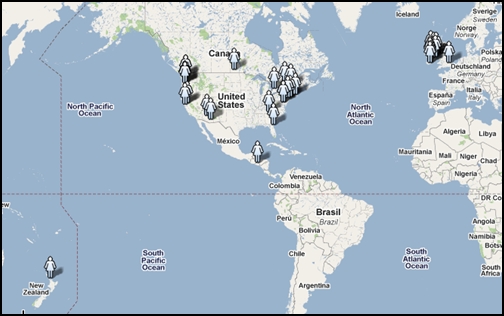
Sept. 26 "A Sunday Without Women" I’ve heard from women and men in Ireland, England, Canada, New Zealand, El Salvador, and across the United States who took time and action today to pray for change in the Catholic Church (go here for the map). If I haven’t heard from you, please drop me a note telling me how you prayed for change today.
Jennifer Sleeman from Clonakilty in West Cork called last August for the Sept. 26 boycott of Mass by women “to let the Vatican and the Irish church know that women are tired of being treated as second-class citizens.” Yesterday, she spoke with the Irish Times:
Of the expected success of the campaign, Sleeman said: “I have no way of measuring it. I loved a letter in The Irish Times where someone said, the boycott will be a failure because so many people will go to church to see how many people didn’t go – I thought that was lovely.
“I actually think the boycott itself now is irrelevant, the message is out there so loud and clear so that whether people go to Mass or not, I don’t think really matters very much now – I don’t think it really matters in terms of numbers.”
She said she was hugely encouraged by the letters and messages of support she had received over the past six weeks or so from as far away as America and Australia and she noted men as well as women had supported her call for change. Ms Sleeman said she was glad to hear that prayer groups supporting her call for greater involvement of women had started in Dublin and Waterford and said she hoped the focus would now shift from her to others who share her views.
“I hope the powers that be in the church have listened and heard because without change, I fear the church will diminish and I think a lot of people feel that way because they’ve just got stuck in a time warp – as Newman said, ‘To live is to change and to be perfect is to have changed often’.”
Irish Radio also did a story on the Mass boycott. Martin Long, Director of the Catholic Communications Office in Dublin said the Church encouraged people not to absent themselves from Mass, no matter what their views. “The celebration of the Mass on Sundays and holy days of obligation is essential to the practice of the Catholic faith as the Sunday Eucharist is a pivotal aspect of the spiritual lives of Catholics.”
Many women attended Mass on Saturday night but absented themselves from their regular Sunday morning Mass. Others, such as Nuala Kernan, a regular Mass-goes in Limerick, made the decision to boycott Mass “not lightly”.
“We have been trying, women in Ireland, to be heard a long time,” Kernan told the RTE. “It’s 40 years since Vatican II and one way or another we have been using every possible opportunity to [be heard]. We wish to contribute; some women ache to contribute, in meaningful ways. ”
She told RTÉ radio the Bishops’ assertion that women were included every day in decisions in the Church did not “match” her experience. “The change has been so token.” She asked why the ordination of women as priests could not be discussed by the Catholic Church adding “the very least” she could do was to support Ms Sleeman’s call.
Thank you to everyone who worked to make this day of change a success. I look forward to hearing from you.
-
National Survivor Advocates Coalition Supports “Sunday Without Women”
 Kristine Ward, chair of the National Survivor Advocates Coalition sent me a statement of support for the Sept. 26 “Sunday Without Women.
 NSAC is a volunteer organization of practicing Catholics and men and women of goodwill working to educate and reform the Church and society about sexual abuse and its consequences. NSAC sent an envoy, Mike Coode, to the United Kingdom to bear witness to the need for justice and reparation for the survivors during Pope Benedict’s U.K. trip and to search for advocates. NSAC envoys have also been sent to Ireland and Germany. Read Ward’s statement below:
The United States-based National Survivor Advocates Coalition (NSAC) supports the Sunday, September 26 Mass boycott in Ireland and calls upon Catholics in the United States and around the world to boycott in solidarity.
NSAC takes this action because the boycott is rooted in a response to the sexual abuse scandal and justice for women.
The coalition does not take this action because we do not understand the value of the Mass or the Sunday obligation. We do.
The Irish boycott was called by Jennifer Sleeman, an 80 year old Irish woman in Clonakilty, Cork, who is the mother of a monk and 54 years a convert to Catholicism. Her call to action came after the release of the Murphy and Ryan reports in Ireland through which horrible revelations of abuse of children came to light along with the protection of abusers by bishops and religious superiors.
NSAC’s founders know that there is aversion by Catholics in the pew to raise their heads above the water line to take any visible actions against priests and bishops even when the cause is just and right.
We don’t understand this aversion but we acknowledge its exists. We also know the weight of it contributes to continued suffering by the survivors and buttresses a hierarchy’s deflection of responsibility. Sexual abuse is a crime. There has never been an hour, a day or a year when it was right for the innocent and vulnerable to be raped and sodomized.
No one should know this better than Bishops, the Pope and the Vatican Curia. Yet it has taken massive news coverage on three continents and investigations by two civil governments to provoke even the weakest of responses from the Church. To add insult to injury the weak response is touted as major reform.
Pope Benedict XVI has more than 20 years of experience in seeing the very reports of sexual abuse that the people of Ireland and the rest of the world have come to know in the news media revelations. His knowledge comes both from being the Archbishop of Munich and heading the Congregation for the Doctrine of the Faith. It is against this backdrop that the boycott is called.
This Sunday presents an opportunity for Catholics in a quiet, private absence from their pew in their Catholic parish to open a slit for the piercing of the darkness. No rabble rousing is needed only silence.
By standing in solidarity with the Irish boycott we hope for its success that in the emptiness Wisdom may enter in.
We encourage our readers, women and men, to re-arrange this week’s usual encounter with the Lord at Mass to leave a visible openness in their usual pew in their usual parish.
Out of the void, God created.
Kristine Ward, NSAC Chair -
Jennifer Sleeman Speaks Out on Sept. 26 Mass Boycott
“Women are no longer happy to be second-class citizens.”–Jennifer Sleeman

Jennifer Sleeman, Cork, Ireland On Tuesday, the Irish Times ran an op-ed by Jennifer Sleeman, the Irish woman who has launched Sept. 26 as the “Sunday Without Women” in support of respectful recognition of women in the Catholic Church. (See my interview with Sleeman.)
Women (and men) around the world (check out the map) are preparing for Sunday.
Marie from Portland, OR, articulated the intent well: “Our goal is equality for women to hold positions of decision-making on all levels in the church. We want dignity and respect for women who work for parishes, schools, and archdiocesan offices. There are many stories of womens’ gifts and skills not being respected and taken seriously.”
Sept. 26 is an opportunity for faithful Catholics and those who care for us and our church to enter into prayerful dialogue about shared authority, the celibate priesthood, church teaching, lived experience, and “the sense of the faithful.” Read Jennifer Sleeman’s commentary below:
I did not have a Catholic childhood and I have been amazed, talking to Irish friends, at how their early experience of religion was one of fear: fear of God and fear of the church. There were rules, and you broke them at your peril. Maybe I was lucky.
I embraced Catholicism in my 20s. My husband was Catholic and I saw he got great comfort from it. Then I met a wonderful priest who gave me instruction and received me into the church.
I lived happily with my decision. However, with the horrifying sexual abuse revelations, cracks began to appear for me, and I started wondering and talking to other people about the church in the reality of the 21st century.
I had often questioned the fact that only men could be ordained. There was also the rule of celibacy. I discovered that many women and men were also concerned and working towards having their voices heard.
It seemed there were organizations and people protesting all over the place, and the idea came to me of a boycott of Mass for one Sunday (September 26th) to draw all these voices together. Let empty pews give the powers-that-be in the church the message that women are no longer happy to be second-class citizens.
The support for the equality of women in the church has been massive: lovely letters and cards, and phone calls have come from Ireland, Australia, the US and Canada, from men and women.
Neighbours and strangers have come up to me in the street to congratulate me and tell me I have “hit a spot”. It is time for the focus to move from me to anyone and everyone who realizes the church needs to change, and what they can do to bring this about.
There are those who support women priests but would not miss Mass. They have other ideas to get the message across.
There have been a few angry letters, and some of them have been more in sorrow – that people would boycott Sunday Mass. I understand. Many of my friends have said they support me – but they could not miss Mass.
Others have come up with different ideas to reveal their dissatisfaction to the hierarchy. I hope they carry these ideas out.
One compelling reason for the ordination of women is the shortage of priests. The average age of priests in Ireland is 65, and as far as I know very few young men are entering the seminaries.
Already there must be tired, lonely and aging men celebrating Masses, attending to weddings, funerals and Baptisms, with no time or energy for visiting their parishioners – or indeed for themselves. There are wonderful priests out there ministering with courage and compassion, some of whom have given me their support. They are heroic, but how long can they last?
There are nuns doing demanding and sometimes difficult work, brilliantly. Why is the church so afraid of women, and especially their ordination? They constitute half the population of the world and at least 60 per cent of Mass-goers. They minister very well in other churches, for example in the Church of Ireland.
I see celibacy as another way of keeping women out. Is the fear that the church might become gentler, more in touch with the reality of family life in the 21st century, a safer haven for the scared? I think the church has changed since children grew up in fear – and I hope it has the courage to change again.
My hope is that empty pews on September 26th will move the hearts and minds of those in charge, that change will happen, and that the church will emerge invigorated by the equality of all.
In the wake of Pope Benedict’s elevation of John Cardinal Newman to the position of “blessed” and as we approach Sunday, it’s worth recalling what Newman was most known for:
Church teaching, he argued cannot be a top-down enterprise, a one-way street. It must be the result of a conspiratio, literally a breathing together of the faithful and the bishops. It is the first responsibility of the episcopacy and papacy, he said, to listen carefully before teaching doctrine (see “Robert McClory’s article).
-
Subscribe
Subscribed
Have a WordPress.com account? Log in now.

