-
Thomas Merton: ‘You Worry About the Birds’
 In the early 1960s, Thomas Merton became increasingly interested in environmental degradation. He was “Brother Forester” for awhile at Gethsemane Monastery in charge of the monastic woods.
During this period he wrote at least one letter to “the mother of modern environmentalism” Rachel Carson. (I’m still on the hunt for any evidence that she ever replied. If you know, let me know.)
Below is a quote from Merton’s journals around the time that he was trying to get a copy of Carson’s book Silent Spring.
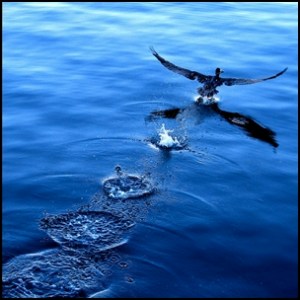
Someone will say: “You worry about birds. Why not worry about people?” I worry about both birds and people. We are in the world and part of it, and we are destroying everything because we are destroying ourselves spiritually, morally, and in every way. It is all part of the same sickness, it all hangs together.–Thomas Merton
The Journals of Thomas Merton, Volume 4 (1960-1963) edited by Victor Kramer (HarperSanFrancisco, 1997, p. 274f)
-
Thomas Merton: Abyss of Solitude
 “However, the truest solitude is not something outside you, not an absence of humans or of sound around you; it is an abyss opening up in the center of your own soul.
And this abyss of interior solitude is a hunger that will never be satisfied with any created thing.” —Thomas Merton
New Seeds of Contemplation by Thomas Merton (New Directions Books 1961, p. 80- 81)
-
St. Martin of Tours: Patron Saint of Conscientious Objectors
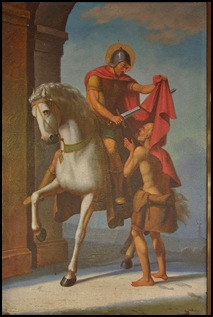
Saint Martin of Tours Cutting His Military Cloak in Half Today, on Armistice Day, 18 American military vets will commit suicide. This weekend, military veterans are gathering in Washington, D.C., for the second Truth Commission on Conscience in War.
“War inflicts terrible, tragic consequences on all touched by it,” says Truth Commission member Herman Keizer (U.S. Army ret.). “Moral conscience should not be one of its casualties.” St. Martin of Tours, pray for us.
St. Martin was born about the year 316 in Sabaria, Upper Pannonia, a province comprising northern Yugoslavia and western Hungary. His father was an officer in the Roman army. While Martin was still a child, his father was transferred to northern Italy. There the boy learned of Christianity, became drawn to it, and became a catechumen.
As the son of a military veteran, at the age of 15 Martin was required to begin service in the army. While young Martin was stationed at Amiens, in Gaul, an incident occurred which tradition and art have rendered famous.
As he rode toward the town one winter day, he noticed near the gates a poor man, thinly clad, shivering with cold, and begging alms. Martin saw that none who passed stopped to help the miserable fellow. He had nothing with him but his military uniform, but, drawing his sword from its scabbard, he cut his great woolen cloak in two pieces, gave one half to the beggar, and wrapped himself in the other.
The following night, Martin had a dream. In his sleep he saw Jesus, surrounded by angels, and dressed in the half of the cloak Martin had given away. A voice interrogated him: Look closely. Do you recognize this cloak?
Martin then heard Jesus say to the angels, “Martin, as yet only a catechumen, has covered me with his own cloak.” After this experience, Martin “flew to be baptized.”
When Martin was about 20, Gaul was attacked. However, his conversion to Jesus made him realize that the military life was not compatible with his faith. He refused military service and was taken off to prison. St. Martin was probably one of the earliest conscientious objectors. He made a protest, refused to fight, and lived through one war in prison.
When he was released from prison, he asked to be ordained a deacon. In 360 he became a monk and was one of the pioneers of western monasticism. In 372 he was made bishop but continued to live in his monk’s cell first at the cathedral in Tours and then at the monastery of Marmoutier. During his long life he established many religious communities and traveled around his diocese by donkey, boat, and on foot, preaching the gospel’s peace and healing. His emblems are a tree, armor, a cloak, and a beggar.
Earlier I wrote about Iraq Veterans Against War’s “Operation Recovery.” Their campaign continues to make an impact. (Motto: Friends Don’t Let Friends Deploy Who Are Wounded Warriors.) Here are a couple of news clips that used my photos:
Veterans Day: IVAW’s Operation Recovery Update
In an effort to raise public awareness about Operation Recovery to stop the deployment of traumatized troops, Iraq Veterans Against the War (IVAW) will be exposing information about the different forms of trauma troops and veterans experience. In the weeks leading up to Veterans Day, IVAW has been giving public presentations to educate the public about the realities of Post Traumatic Stress Disorder (PTSD), Traumatic Brain Injury (TBI), and Military Sexual Trauma (MST), conditions that affect hundreds of thousands of military members and veterans.
Afghanistan & Iraq Vets Call for End to Deployment of Traumatized Troops
Iraq Veterans Against the War (IVAW) in conjunction with other progressive leaning Veterans and Military family groups has been planning Operation Recovery and now IVAW is ready to publicly release details of their campaign.
Read more about veteran suicide rates here: This Veteran’s Day, 18 Will Die By Their Own Hands
-
Joan Chittister: ‘Memory is about what is going on inside of us right now’
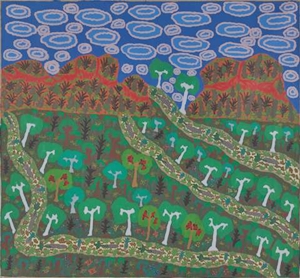
Daisy Napaltjarri Jugadai (b. 1955): An Australian indigenous artist depicts her childhood memory of 5-Mile Creek. “Memory is one of the most powerful functions of the human mind. It is also one of life’s most determining ones. What goes on in memory has a great deal to do with what goes on in us all our lives. Memory is a wild horse, unbridled, riderless, maverick. It takes us often where we would not go, or takes us back over and over again to where we cannot stay, however much we wish we could. So, it leaves us always in one state or the other, one place or the other, leaves us either pining or confused, leaves us in either case in a world unfinished in us.
It is the unfinishedness that is the price we pay for growing always older.
The young hear memory in the voice of their elders and, delighted by these voices from the past or bored by them, too often miss the content behind the content. Memory is not about what went on in the past. It is about what is going on inside of us right this moment. It is never idle. It never lets us alone. It is made up of the stuff of life in the process of becoming the grist of the soul.
There is an energy in memory that is deceiving. The assumption is that since a thing is past, it has no present meaning for us. But nothing could be further from the truth.
Whatever is still in memory is exactly what has most meaning for us. It is the indicator of the unfinished in life. It gives sure sign of what still has emotional significance for us. It refuses to allow us to overlook what must yet be acknowledged if we are ever to be fully honest with ourselves. Most of all, memory and the way we deal with it is the only thing we have that makes us authentic teachers of the young. It tells us what we did that now we miss doing, and it reminds us of what we didn’t do that now we wish we had. And such things live in memory forever.
But memory is not meant to cement us in times past. It is meant to enable us to do better now that which we did not do as well before. It is the greatest teacher of them all. The task is to come to the point where we can trust our memories to guide us out of the past into a better future.
There is nothing in conscious memory that is unimportant. To sit and listen to a person wander through the storied fragments of their lives is to come to know what worries them, what delights them, what love did to them, what rejection dampened in them, and what is left to deal with now if the press of past failures, the loss of past loves are ever to be stitched into a healthy whole in the here and now.” —Sr. Joan Chittister, OSB
From The Gift of Years by Joan Chittister
-
The Rover Rebellion: Dogs Are New Symbol of Iranian Revolt

Muslims have kept dogs for centuries. For example, Salukis, a breed of hunting dog, have historically been valued by the Bedouin. According to a recent news report in The Guardian, the extremist government and religious mullahs in Iran disapprove of dogs as pets. They are “unclean.” So now the pampered pooch become the latest sign of middle-class dissent. All I can say is that there are a million ways to undermine a dictatorship and the Iranians have found another one.
Recently a visitor from Iran assured me that her dog was staying at a five-star spa in Tehran for the duration of her trip. I had no idea she had a dog in the first place, but was struck that she had insisted in telling me such a thing. Over the past few years, dog ownership has become yet another unlikely arena for the social and political dispute within the tumultuous politics of Iran.
… The past 1,400 years or so haven’t been that much fun for dogs in Iran. All that has come to change paradoxically through the very same religion responsible for their plight. Their recent popularity and adulation must have taken Iranian dogs by surprise. Dogs are now as much symbols of safe, middle-class resistance as false eyelashes and green wristbands. Pooches have never had it so good, and rare breeds, especially small lap dogs, change hand for tens, sometimes hundreds of thousands of dollars.
An underground industry of dog beauty parlors thrives, mostly run out of private homes, as do a plethora of canine protection and welfare charities. A legal and substantial kennel industry has developed into what is fancily called “dog spas” where the middle class deposit their dogs when on holiday or, in the case of some of my conflicted relatives, when a devout auntie comes to stay.
The industry booms further every time a firebrand preacher calls for their banning or admonishes dog owners from such platforms like the much loathed national radio and TV. Its been a long time coming, but Iranian dogs are having their day.
Now we can add to the 2002 Great Key Shaking Revolt in Buenos Aires and the 2009 Pant-Wearing Defiance of Women in Sudan. Yes. It’s the Rover Rebellion. Biscuits all ’round.
-
Eric Stoner: Remember Denmark’s Nonviolent Resistance During WWII
Thanks to Eric Stoner over at Waging Nonviolence for his comment on my earlier post Albanian Muslims, Catholics, and Orthodox Saved Jews During WWII. The context Eric sets is important. See below:
As we’ve noted on this site, this is not the only story of Muslims saving Jews during World War II, despite the fact that there are no Arab names among the 20,000 non-Jews recognized at Yad Vashem, the Holocaust Martyrs’ and Heroes’ Remembrance Authority, in Jerusalem. PBS ran a documentary earlier this year called Among the Righteous, that told the previously unknown story of how many Arabs did help Jews in parts of Nazi-occupied Tunisia.
This story from Albania also reminds me of the nonviolent resistance in Denmark and really every other country that I know of where people risked their lives to save Jews during World War II, in that where anti-Semitism was not rampant and people saw Jews as their brothers and sisters, they were often able to avert the Holocaust. The problem is that because anti-Semitism was so widespread throughout Europe, in many places the local populations were either passive or actively cooperated with the Nazis in their effort to exterminate the Jews.
-
“Thou Shalt Not Live for Punishment or Reward”
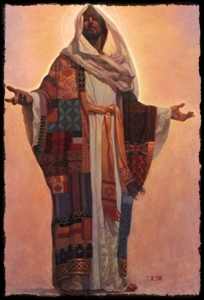
Isa ibn Maryam “Love God and do what you will,” John of the Cross wrote. It’s only when I got old enough, experienced enough and wise enough in the ways of mystics that I knew what John really meant. It’s not what we do that makes us holy. It’s what we love that makes the difference between being simply a spiritual virtuoso and being a saint.
The Sufi understood the paradox very well. They tell a story about Isa ibn Maryam: Jesus, Son of Mary. One day Isa saw a group of people sitting miserably on a wall, moaning out loud and full of fear. “What is your affliction?” he asked. “It is our fear of hell,” the people complained.
Then Isa came upon a second group. They were emaciated and wan and full of anxiety. “What is your affliction?” Isa asked them. “Desire for Paradise has made us like this,” the people cried.
Finally, Isa came upon a third group. They were scarred and bruised, wounded and tired but their faces were radiant with joy. “What has made you like this?” Isa asked. And the people answered, “We have seen the Spirit of Truth. We have seen Reality,” they sighed. “And this has made us oblivious of lesser goals.”
And Isa said, “These are the ones who attain. On the Last Day, they will be in the Presence of God.”
If we live our spiritual lives only in fear of punishment or in hope of reward, rather than in the awareness of the One because of whom all life is worthwhile, we can be religious people but we will never be holy people. Then life is simply a series of tests and trials and scores, not the moment by moment revelation of God who is present in everything that happens to us, in everything we do.
Sanctity is about how we view life. It is not about spiritual exercises designed to evaluate our spiritual athleticism or a kind of spiritual bribery designed to win us spiritual prizes we do not deserve.
Coming to know the sacred — the energy of air, the possibility in children, the beauty of regret, the value of life — is what makes us holy. –Joan Chittister
From Becoming Fully Human by Joan Chittister
-
Albanian Muslims, Catholics, and Orthodox Saved Jews During WWII

"For 6 months in 1943, we sheltered the Solomon family."–Ali Kazazi When I teach, discuss, or train people in Christian nonviolence, there is always one common critique: What about the Nazis? Nonviolence wouldn’t work with them.
The truth is that there are thousands of stories that exemplify how creative nonviolent resistance was employed by civilians during WWII. Photographer Norman Gershman has uncovered another one.
When post-World War II Europe found itself devastated by the loss of its Jewish population, Albania was the only country to boast a larger number of Jewish people than it had housed prior to the Holocaust. More than 2,000 Jews from Albania, Greece, Austria and Italy were hidden in the homes of Albanian Muslim families throughout the war. Between 1943-1945, it is estimated that the people of Greater Albania saved between two and three thousand lives.
In 2003, photographer Norman Gershman embarked on a project to find and photograph Albanian Muslim families who had sheltered and saved Jews – both Albanian nationals and refugees from neighboring countries – during World War II.
Gershman said it wasn’t just Muslim families who shielded Jews from the Nazis, but also Orthodox and Catholic families. All of them were motivated by an Albanian code of honor called “besa,” a concept that can be translated into “keeping the promise,” Gershman says. The Albanian villagers were motivated to risk their lives by the simple concept of helping one’s neighbor. “We chose to focus on the Muslims because, who ever heard of Muslims saving Jews?” Gershman said in a telephone interview from Israel, where he is at work on his next project. (Project explores Muslims who saved Jews)
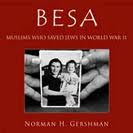 By 2004, after two photographic journeys to Albania and Kosovo, Gershman had discovered roughly 150 Muslim families who had taken part in the rescue of the Jews due to their belief in Besa, or honor, an ancient code which requires Albanians to endanger their own lives if necessary to save the life of anyone seeking asylum. An Albanian proverb says, “Our home is our guest’s house, then our house, but above all it is God’s House.”
Before the war, Gershman estimates from his research, only about 200 Jews lived in Albania, a country that is about 70 percent Muslim. During the years of occupation, 10 times as many Jews streamed into Albania to escape persecution from Poland, Yugoslavia, Czechoslovakia, Greece and Italy. Gershman says it was the only country in Europe where the Jewish population grew by the end of the war. (Project explores Muslims who saved Jews)
Besa is, to this day, the highest moral law of the region, superseding religious differences, blood feuds and tribal traditions. Gershman’s portraits serve as historical documentation of the Albanian Resistance.
The exhibit of 30 photographs includes one of Lime Balla, born in 1910, who told Gershman that a group of 17 Jews came from the capital city of Tirana to her village of Gjergi in 1943 during the holy month of Ramadan. “We divided them amongst the villagers,” Balla said, according to Gershman. “We were poor. We had no dining table, but we didn’t allow them to pay for food or shelter. We grew vegetables for all to eat. For 15 months, we dressed them as farmers like us. Even the local police knew.” (Project explores Muslims who saved Jews)
Gershman’s research eventually led to an exhibit of his photographs, Besa: A Code to Live By and a book, Besa: Muslims Who Saved Jews in World War II. The Besa exhibit has also traveled extensively worldwide, and recently was on display at the Knesset in Jerusalem.
-
Nonviolence and Family Values During Genocide
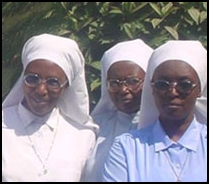 In extreme situations, there are always stories of people of faith who act with extraordinary courage. For the movement of nonviolence and the continuation of the faith, we need to learn about these stories, examine them, and tell them in our churches, to our communities, and in our families.
The story of how the Catholic Benebikira Sisters in Rwanda saved children and rebuilt families during the genocide is one such story. Thank you to Kathleen Sullivan at NCR for her article:
It was during the 1994 Rwandan genocide, which witnessed the murders of an estimated 800,000, that the Benebikira Sisters, at great risk to themselves, sheltered hundreds of orphans and others who sought refuge in their convents.
At the Benebikira motherhouse in the village of Save, the militia stormed the convent and demanded that the sisters, members of an order native to Rwanda, separate themselves by ethnic groups. The sisters refused — essentially signing their death warrants. The militia then looted all their food, cut the water lines, and told the sisters they would return to kill them.
At other convents, 20 sisters were killed when they stood up to militia. At their convent in Butare, the sisters hid 22 children and teens whose parents had been slaughtered by the Hutus, but soldiers found the children and carted them off to a certain death.
Benebikira Sr. M. Juvenal Mukamurama, who would later serve as mother general of the order from 1996 to 2008, was at the convent in Butare in 1994. In a recent interview she recalled the horrific day that the soldiers came.
“It was very sad,” Mukamurama said somberly. “They had orders [to take the children]. What danger can a 5-year-old child be?”
When the genocide ended, the sisters found themselves caring for some 350 orphans — most traumatized after witnessing the brutal murders of their parents. The sisters ran an orphanage, but they felt something was missing. The children “had food and clothing,” said Mukamurama, “but it was no life for them. Family is very important in our country. They needed a family. So we decided to build community houses and make families.”
The Benebikiras then built 39 houses and grouped the orphans into “families” of six to eight children. The sisters, who oversaw the network of community homes, found that the orphans found new life in these newly-formed family units.
-
World Series Wisdom: “Ball and Strikes” by e. ethelbert miller
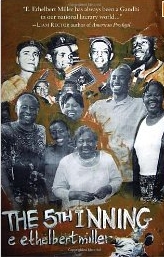 Balls and strikes.
I’m finally learning
how to pitch
And not simply throw.A major adjustment
That one might
Call wisdom…– E. Ethelbert Miller
From The Fifth Inning

-
Subscribe
Subscribed
Have a WordPress.com account? Log in now.