-
Minnie Bruce Pratt: When I Say ‘Steal,’ Who Do You Think Of?

Photo by Leslie Feinberg I became familiar with the poet Minnie Bruce Pratt when I was in high school and read “Motionless On The Dark Side Of The Light,” in the No More Masks: An Anthology of 20th Century American Women Poets.
Pratt was born in Selma, Alabama, in 1946. She graduated from Bibb County High School when it was under segregation, and entered the University of Alabama in Tuscaloosa, a year after George Wallace “stood in the schoolhouse door” in an attempt to stop desegregation.
She says that she received her real education “into the great liberation struggles of the 20th century through grass-roots organizing with women in the army-base town of Fayetteville, North Carolina, and through teaching at historically Black universities.” Since coming into women’s liberation, and coming out as a lesbian in 1975 in Fayetteville, North Carolina, Pratt has been active in organizing that intersects women’s and gender issues, LGBT issues, anti-racism work, and critiques of empire. Currently, she is a professor of Women’s & Gender Studies and Writing & Rhetoric at Syracuse University, where she also serves as faculty for a developing Lesbian/Gay/Bisexual/ Transgender Studies Program.
I came across a lecture she gave in 2004 and wanted to share an excerpt here. The first time I read it, I was struck by the oddness of it pushing up against the gospel readings from Matthew 6 and Luke 12. It has the whiff of Advent about it.
“Every week Miz Nell Weaver had us memorize a Bible verse, one for each letter of the alphabet. This was in the fourth grade, Centreville, Alabama, 1956. One by one, on Fridays, our name would be called and we would go into the only privacy there was, the cloakroom at the back of the classroom, and there in the narrow space jumbled with coats and book bags, we would stand in front of her and open our mouths and recite. “I” was In the beginning, of course. And “L” was Lay not up treasure on earth where moth and rust doth corrupt and where thieves break through and steal. Lay up treasure in heaven, where moth and rust doth not corrupt and thieves do not break through and steal. (Where your treasure is, there will your heart be also.)
Who did I think was stealing? What was the endangered treasure, that which would rot away and be lost? Why was I being taught that any security I might ever have would be after I was dead?
-
Bedouin Desert Tricks and Exodus 17
 Ched Myers is the best “Bible animator” I know. Here’s a short reflection from him on Exodus 17 that combines attentive listening to the text and deep earth wisdom.
Exodus 17:8-13 is a venerable old tale, if not a nonviolent one. Freshly liberated by YHWH (with an assist from nature) from Pharaoh’s imperial straightjacket, Moses and his refugee community have commenced their wilderness sojourn. They are having to re-learn primal lessons of subsistence gathering and dependence upon God’s creation (the “bread and water miracles” of Ex. 16-17 are old Bedouin tricks). Amidst this comes the very first resistance to their journey, as they are attacked by Amalekites, a contemporaneous nomadic tribe of raiders that was presumably far more adept at desert skirmishing than the Israelites. So commences the first of what will be innumerable battles with various inhospitable groups in the course of Israel’s liberation struggle.–Ched Myers
See more of Ched’s work at www.chedmyers.org.
-
Christian Support for Repealing DADT Is a Double-Edged Sword
 Most Americans – including Christians – now support equal rights for gays and lesbians serving in the US military.
 A new poll by the Pew Research Center indicates that 58 percent of Americans support equal rights for gays and lesbians in the armed forces. Large majorities of Democrats (70%) and independents (62%) favor allowing gays to serve openly. Republicans are divided (40% favor, 44% oppose).
But let’s look at the religious breakdown too:
62 percent of white mainline Protestants support equal rights for gays in the military
52 percent of black Protestants support equal rights
66 percent of Catholics favor allowing gays and lesbians to serve openlyLet me be clear, I’m very glad to have Christians moving toward a strong stance in support of equal rights for gays and lesbians in all sectors of society. This is a positive step forward for the society at large and Christians should be part of it.
The Pentagon report released yesterday finds significant support for repealing DADT among the the younger “blue collar warriors,” while a vocal minority of top brass will be uncomfortable with the shift. And don’t get me wrong, I want the churches to continue to support fair and equal treatment for gays and lesbians.
However, there are other sticky questions I want to raise.
Are the Christians that want a repeal of Don’t Ask, Don’t Tell also supporting gays and lesbians within their own churches? Do they advocate for LGBT justice and liberation? Do they invest in and promote gay and lesbian leadership and open their congregations to new, liberating ways of reading scripture in the context of the LGBT life experience?
Secondly, are the Christians that want a repeal of Don’t Ask, Don’t Tell also calling into question military service in a era when the U.S. has the second largest standing army in the world (behind China) and has troops stationed on all 6 inhabited continents?
I can support equal rights for gays in the military – but there’s the bigger question: As a Christian should I be supporting military participation at all? And how do Christians critique the prevailing “Empire consciousness” and offer instead our “prophetic imagination” or “alternative consciousness,” as theologian Walter Brueggemann calls it, on issues of war and peace?
If Christians are supporting the repeal of Don’t Ask, Don’t Tell, then are they also advocating strong teaching in their churches on the Christian pacifist tradition or the rigorous moral “just war” process that any Christian – gay or straight – must go through before participating in any given war?
When Jesus says “Blessed are the peacemakers, for they shall be called children of God,” what does he mean? Or when he says, “Love your enemies, do good to those who hate you, bless those who curse you, pray for those who mistreat you”? Or “To the person who strikes you on one cheek, offer the other one as well, and from the person who takes your cloak, do not withhold even your tunic”?
Early generations of Christians refused to participate in war (though those who did were counseled and sometimes asked not to seek communion for a period of time, but were not cut off from community). Soldiers who subsequently converted to Christianity often left military service, viewing it as incompatible with their new life.
Why? Largely because of idolatry. Military service forced them to put the gods of nationalism ahead of the God of Jesus Christ. Military service also fostered hatred for an enemy, an attitude viewed as antithetical to Christ’s teachings. “Love of enemies is the principal precept of the Christian,” said the Tunisian theologian Tertullian in the first century. Until the time of Constantine no Christian writing allowed for Christians to participate in war. Military valor was not a virtue. True victory was won through love.
In a democracy that enshrines civil rights and “justice for all,” it is right and good for Americans to support the repeal of Don’t Ask, Don’t Tell and promote LGBT civil rights in the society at large.
Christians, however, have another set of values to examine. For traditionalists it may be whether you can be gay and Christian. For progressives, it’s whether you can be Christian and ‘Army Strong.’
Rose Marie Berger, author of Who Killed Donte Manning?, is a Catholic peace activist and regular writer on faith and justice. -
The “Green” Issue of Birth Control?
 Much has been said about Pope Benedict’s comments regarding selective condom use as a possible minor first step in taking personal responsibility for one’s actions. Below is a very thoughtful Letter to the Editor of the Washington Post from a member of a local Catholic parish:
The clarifications of Pope Benedict XVI’s comment on condoms [“Theologians debate meaning of pope’s condom remark,” news story, Nov. 24] are suggestive, given the oft-stated concern of this “green pope” for the environment.
Incongruously, he remains in denial about the reality of global overpopulation, even while accepting the scientific evidence of human-caused climate change.
But the view ascribed to him by his spokesman – of the moral imperative of “taking into consideration the risk of the life of another” and “avoiding passing a grave risk onto another” – applies as much to the ravaged world that we are leaving to posterity as it does to the AIDS epidemic.
Might not a sophisticated thinker such as Benedict eventually come to see that the ecological harm done by overpopulation is the strongest argument of all for birth control?–Daryl P. Domning, Silver Spring
In part, the issue Domning raises is whether principles of moral discernment can be applied in a variety of situations that require moral decisions or do certain virtue ethics apply in cases of sexuality but not in other equally dire situations.
-
What the Heck Is Advent?
 I just bought noble fir boughs, incense cedar, and juniper for making my Advent wreath — evergreens for the evergreening grace of God. Advent starts tomorrow. Here’s a little catch-up on what it’s all about.
Awhile ago a Jewish friend dropped me a note asking: “What’s the simplest explanation of Advent you can give (to this Jew who can never get it)?” Last week, a Hindu friend asked the same thing.
Affectionate inter-religious curiosity is such a beautiful thing (smile).
Here’s my 25 cent explanation: Advent is the 4 weeks of preparation before Christmas. Some folks make an Advent wreath with 4 candles to mark the weeks. Some folks use an Advent calendar with little boxes that you open each day to mark the approach of Christmas.
Advent used to be called the “Little Lent” so it is similar to Lent. (Alot of help, right?) Lent is the 40 day season of penitence and sacrifice that comes before Easter. Lent is in preparation for remembering Jesus’ dying on the cross. The 40 days of Lent mirror the 40 days Jesus spent in retreat in the desert before his public ministry, which mirrored the 40 years in the wilderness of Moses and the Israelites before entering the Promised Land.
Advent originally was the 40 days of contemplative, prayerful, joyful preparation for the miracle of God becoming a human being in Jesus (marked at Christmas).
Somewhere along the line, Advent’s 40 days got condensed to the 4 weeks before Christmas, but the spirit of it is still the same. Advent’s a time of quiet joyful introspective reflection, like a mother in her final month of pregnancy–anxiously awaiting the complete turning upside down of her world.
For more religiousy explanations, you can check out Dennis Bratcher’s roundup here..
-
What Does Gratitude Look Like?

Straight Street Orlando, a Christian group shares meals with the homeless at Lake Eola Park in Orlando, FL. (Photo by Joshua C. Cruey) “Gratitude is not only the posture of praise but it is also the basic element of real belief in God.
When we bow our heads in gratitude, we acknowledge that the works of God are good. We recognize that we cannot, of ourselves, save ourselves. We proclaim that our existence and all its goods come not from our own devices but are part of the works of God.
Gratitude is the alleluia to existence, the praise that thunders through the universe as tribute to the ongoing presence of God with us even now.
Thank you for the new day.
Thank you for this work.
Thank you for this family.
Thank you for this daily bread.
Thank you for this storm and the moisture it brings to a parched earth.
Thank you for the corrections that bring me to growth.
Thank you for the bank of crown vetch that brings color to the hillside.
Thank you for the necessities that keep me aware of your bounty in my life.Without doubt, unstinting gratitude saves us from the sense of self-sufficiency that leads to forgetfulness of God.
Praise is not an idle virtue in life. It says to us, “Remember to whom you are indebted. If you never know need, you will come to know neither who God is nor who you yourself are.”
Need is what tests our trust. It gives us the opportunity to allow others to hold us up in our weakness, to realize that only God in the end is the measure of our fullness.
Once we know need we are better human beings. For the first time we know solidarity with the poorest of the poor. We become owners of the pain of the world and devote ourselves to working in behalf of those who suffer.
Finally, it is need that shows us how little it takes to be happy.
Once we know all of those things we have come face-to-face with both creation and the Creator. It is the alleluia moment that discovers both God and goodness for us.” —Sr. Joan Chittister, OSB
From The Breath of the Soul: Reflections on Prayer by Joan Chittister (23rd Publications)
-
Keeping Up with Catholic Peace Author Jim Douglass
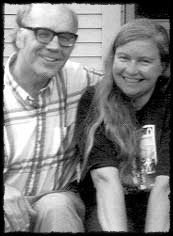
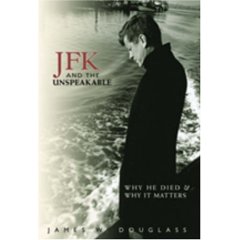
Jim & Shelley Douglass I was gratified to find this little note in the Publisher’s Weekly update about friend Jim Douglass. Simon and Schuster picked up the paperback rights to Jim’s book and chose to release it to coincide with the anniversary of Kennedy’s assassination (47 years ago this week).
Oliver Stone provided the impetus for Catholic publisher Orbis to sell the paperback rights to James Douglass’s JFK and the Unspeakable: Why He Died and Why It Matters to Simon & Schuster, which published its edition this month (Nov.).
Stone held the book up on Bill Maher’s show last year and urged all Americans to read it; he repeated that message in the Huffington Post later in the year. The book argues that Kennedy’s assassination was the result of a conspiracy between the U.S. military and intelligence communities.
On November 8 there was a panel discussion with author James W. Douglass, Oliver Stone, Lisa Pease (coauthor of The Assassinations: Probe Magazine on JFK, MLK, RFK and Malcolm X), and Orbis Books publisher Robert Ellsberg at the Saban Theatre in Beverly Hills, Calif.
S&S’s description of Jim’s book is as follows:
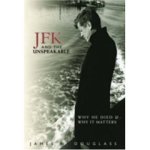 At the height of the Cold War, JFK risked committing the greatest crime in human history: starting a nuclear war. Horrified by the specter of nuclear annihilation, Kennedy gradually turned away from his long-held Cold Warrior beliefs and toward a policy of lasting peace. But to the military and intelligence agencies in the United States, who were committed to winning the Cold War at any cost, Kennedy’s change of heart was a direct threat to their power and influence. Once these dark “Unspeakable” forces recognized that Kennedy’s interests were in direct opposition to their own, they tagged him as a dangerous traitor, plotted his assassination, and orchestrated the subsequent cover-up.
Douglass takes readers into the Oval Office during the tense days of the Cuban Missile Crisis, along on the strange journey of Lee Harvey Oswald and his shadowy handlers, and to the winding road in Dallas where an ambush awaited the President’s motorcade. As Douglass convincingly documents, at every step along the way these forces of the Unspeakable were present, moving people like pawns on a chessboard to promote a dangerous and deadly agenda.
I’ve said it in several previous posts and I’ll say it again – in order to understand the enormity of evil and the explosive power of conversion in modern America, this is a must-read book.
-
Brett Busang: ‘Good Books Turn Our Thinking Along Grooves That Aren’t Well-Established’

"Water Oak" (Capitol Hill) by Brett Busang My friend Brett recently sent me a note commenting on my book Who Killed Donte Manning? Brett’s an amazing artist. I’ve got one of his paintings at home and another hangs on loan in the Sojourners offices. It’s humbling to have someone reflect your work back to you and put it into their own intimate context. Thanks, Brett!
“You sure packed a lot into that little volume. I found myself re-reading passages I did not grasp as perfectly as I might have. The reason? Like the richest of anything, they were multi-faceted and agreeably complex.
Good books turn our thinking along grooves that aren’t very well-established because they just haven’t been used. I’m very grateful for the re-routing.
I’d also like to compliment you on the weaving-together of many strains: ancient history, holy scripture, urban planning, urban warfare, urban ritual. A man prays in a “profane” space. A little boy falls victim to a retaliatory shooting. God is repudiated by men who want to centralize power. Over time, power means military might – but also coffee, which is available in a “socially responsible” atmosphere that has nonetheless supplanted gardens. Grown men groove to the gospel as they buff and shine their cars. More importantly, the mother of a victim embraces the victim’s friends. It’s good to be reminded of the momentary paradise most of us can grasp after an okay afternoon (or appalling shootout.)
I’m going to read it again tomorrow. I think I missed too much the first time.
I spent the last week in a small Massachusetts town. While there, I looked after a friend, made pencil drawings, and read about post-Katrina New Orleans. I asked this friend to drive me along the Merrimac River, along which Thoreau had travelled as a young man. I was utterly bewitched – and am glad I had to return shortly afterwards. I would have otherwise made plans to move there. Not a good idea. I believe, like you, that age-old dramas are enacted in our “evil” cities and feel I should bear witness to at least some of them. Not like you, of course – but in my more cowardly fashion.
Thanks for writing the book. It provided a brand-new context for my own ruminations about half-hearted justice and wasted lives. It invested seemingly fragmentary events with a sense of urgency. And it charged the familiar with grace and meaning.”
-
Bruce Kent to Generals: ‘Don’t wait until you retire to say that wars are illegal or unwinnable.’
 Tens of thousands of Brits marched in London’s Trafalgar Square last week demanding that Britain withdraw troops from Afghanistan. The “Time to Go” public demonstration was organized by the Campaign for Nuclear Disarmament, the British Muslim Initiative, and Stop the War Coalition. The keynote speaker was Catholic peace campaigner Bruce Kent, vice-chair of Pax Christi/UK.
Like the Obama administration, UK Prime Minister David Cameron has said that UK combat troops will be withdrawn, but not until 2015. Bruce Kent’s speech is below:
“It is of course an honour to be with you today to join my voice to the tens of thousands who are calling for the withdrawal of our troops from Afghanistan and a negotiated end to that war which seems to be without end.
The war in Afghanistan is expensive, nonsensical and stupid. Our governments past and present do seem to be incredibly stupid when it come to matters of defence. Amazingly, we are in due course to have, at vast expense, two new aircraft carriers. One we will at once sell. Are we now the world’s aircraft carrier suppliers? The other will join the Royal Navy, but for between 5 and 10 years it will have no planes. ‘Yes Minister’ could not think up a more absurd scenario for comic TV.
I am old enough to remember the British empire. Those days are gone. We are not the world’s policeman. If we want a real war to sort out then how about the Congo where millions have died in the last ten years and a UN Peace keeping force seems to be overwhelmed by the problem.
We are meant to be defeating terrorists, but we are manufacturing them by the thousands. We began this enterprise without the authority of the UN on the coat tails of the United States. It is time to end it. If the Afghan Government – as corrupt as any today – wants outside help then it should come from a Muslim state. We in the so called ‘Christian’ West have so wrecked the Middle East for well over 100 years that there is no credit left on our card. It is time to go.
I say this in front of the families and friends of many who have been wounded or killed in this conflict. Those young lives should never have been wasted. Of course they need every help from voluntary and public donations. But the best help we can give to their comrades is to say NO.
A word to generals, admirals and the like. Don’t wait until you retire to say that wars are illegal or unwinnable. Don’t keep silent when politicians act unlawfully. Say NO at the start and do not leave it to those much, much further down the military pecking order to have the courage to refuse. Some of those are with us today. I salute them.
Congratulations on all your efforts. One day we will learn that real peace is only built on justice and the operation of law.”
-
Junta Proofers Quash Secret Syuu Kyi Coverage
I’m thrilled that news proof readers still have jobs in Burma (unlike the U.S. where proofreaders, fact-checkers, and even editors are now considered superfluous). I’m not thrilled that it’s the military dictatorship of Burma that keeps proofers in jobs in censorship office.
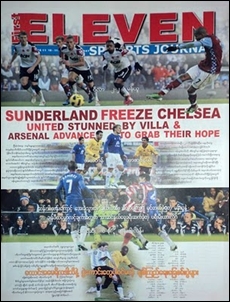
The front page of the First Eleven, with a hidden message announcing Aung San Suu Kyi's release. Here’s a very creative example of how Burma’s “Sports Illustrated” announced the news of opposition leader Aung San Syuu Kyi’s release from house arrest. And how the government censors found out about it. This is creative nonviolent resistance in action.
A leading sporting weekly in Rangoon has reportedly been suspended for two weeks by Burma’s notorious censorship board, according to local journalists.
Burma’s best selling sports journal, First Eleven, led with a front-page story on Tuesday about English Premier League matches which presented a combination of headlines with slightly different colored lettering, cleverly revealing the news of Aung San Suu Kyi’s release.
Run by Dr. Than Htut Aung, the journal ran with three innocent-looking headlines—“Sunderland Freeze Chelsea,” “United Stunned by Villa” and “Arsenal Advance to Grab Their Hope”—but altered the letter colors to spell out a very different message: “Su Free Unite & Advance to Grab The Hope.”
When contacted by The Irrawaddy, staff at the journal refused to confirm the suspension.
However, a proofreader at the state-controlled censorship board, the Press Scrutiny and Registration Division (PSRD), told The Irrawaddy: “The copy we read was in black and white. We were not aware of it. When the publication was released, people quickly began talking about it. That’s how we found out. After that, the Ministry of Information took action against the journal.” Read more.
-
Subscribe
Subscribed
Have a WordPress.com account? Log in now.

