-
‘May Church Bells Sound Louder Than Weapons’

Patriarch Fouad Twal at Church of the Nativity in Bethlehem “May the sound of the bells of our churches drown the noise of weapons in our wounded Middle East, calling all to peace and the joy. A joy which radiates from every face, a rejoicing that penetrates every heart!”
— Patriarch Fouad Twal at midnight Mass in Bethlehem attended by President Mahmoud Abbas, Prime Minister Salam Fayad, and many pilgrims
-
Epiphany: When Three Kings Beat a Royal Flush
 After Jesus was born in Bethlehem in Judea, during the time of King Herod, Magi from the east came to Jerusalem and asked, “Where is the one who has been born king of the Jews? We saw his star in the east and have come to worship him.” –Matthew 2:1-2
Blessed Feast of the Epiphany! The story of the “three kings” who come from “the east” to worship the baby Jesus is a favorite family celebration in Christian tradition. Kids dress up in housecoats wearing paper crowns and fake jewels, bearing gifts, and going from site to site in search of the newborn king.
Of course, they start by looking knocking on the door of Herod’s castle–assuming power begets power. But Herod knows nothing about this threat to his political hegemony, so sends them on their way, with the caveat to tell him what they find. (Though in his vicious paranoia he is unable to let go of even the idea of a rival to his position, so he slaughters all the tiny threats within his reach. Children again bear the brunt of adult drunkenness on power.) Herod’s royal flush is trumped by angels, dreams, and taking the back roads.
As Detroit activist-theologian Bill Wylie-Kellermann reminds us in Another Way:
The magi, of course, carry a similar freight in Matthew’s more modest telling. They act the very embodiment of Isaiah 60. Are these aliens in the land? They stand for all nations and peoples outside of Israel. Do we see them as kings? They kneel on behalf of all authority. Do they bear gifts? Thoughtfully packed from the ancient text. Then Matthew adds his ironies, bitter as myrrh and scented with passion: the imperial hand, displeased, has already conceived a strike force.
In the gospel narrative, the imperial reversal, really a choice, is explicit. Their treasures are not for the palace, so accustomed to drawing tribute and taxes, but for a child at the margin. And though Herod, the imperial puppet king, would lure them into his homeland security surveillance apparatus (and the violence for which it fronts), they quietly demure. Compared to his duplicity, their single-hearted yearning seems almost naive. But they are wise to serpents. These first resisters of the New Testament slip the grip of his scheme. Prompted by dream epiphany, the magi go, what Matthew calls, “another way.”
Eventually, Balthazar, Caspar, and Melchior (as tradition names the Magi) find a barn under a particularly brilliant star. In it resides a small family with an infant. (When I was little, our “kings” sometimes used a cheap pocket compass. Now I suppose it would be a a TomTom XL.)
For a wonderful meditation on the Magi and Epiphany, I recommend reading American cinematographer John Bailey’s essay Cauchetier’s Christmas Card: Adoration of the Magi reflecting on photographs by Raymond Cachetier. Here’s an excerpt:
Images of the Magi first appeared in Christian art in the fourth century as catacomb paintings and on sarcophagi reliefs. They were at first represented in Eastern dress: distant visitors come to give tribute to the new king of the West. The visit of the Three Kings quickly became a central motif in Christian iconography, foretelling the triumph of this new religion. In an email that Raymond Cauchetier sent me accompanying his photos of sculptures of the Three Kings (celebrated by Christians on Jan. 6 as the Epiphany), he said that the dominance of this story in Christian lore is all the more amazing as the only mention of it in the canonical gospels is Matthew, 2:1-11. …
 [Here] is this much-loved, oft-reproduced sculpture from Autun, of the Sleeping Magi. Such an intensely horizontal image is rare in Romanesque iconography and its lateral line is even more focused by the wing and pointed hand of the angel. The sweeping incisions defining the blanket also contribute to the strong left to right movement. Cauchtier’s normal single source light defines an even stronger sculptural depth, but here he has a second source coming from low left. Whether the angel is waking the sleeping kings to tell them to follow the star above them to the stable or to warn them on their return home not to report back to King Herod—has long been debated by scholars. Any guesses?
Read Bailey’s complete essay here.
It’s tradition to bless houses on Epiphany. Using an evergreen branch and a bowl of water, sprinkle your doorway and pray that God will keep watch over you (Psalm 121:8 “The LORD guards you as you come and go, now and forever”). With a piece of chalk mark the top of your doorway with the following: 20 C+M+B 11. (The initials represent the three traveling Magi surrounded by the current year.) This simple celebration will keep you mindful throughout the year of travelers, hospitality, and God’s watchful gaze.
Where is your star? one asks at Epiphany. Where is it taking you? Will you go home by the same path that got you here? Will you go where you are ordered by the national security state or will you instead tune your heart to angels straining to sing you good news?
-
Cindy Sheehan Says “Don’t Go, Don’t Kill”
 A few weeks ago I ran a commentary on Huffington Post titled Christian Support for DADT is a Double Edged Sword. This week anti-war activist Cindy Sheehan added her twist on this same theme with a piece on Al Jazeera titled Don’t Go, Don’t Kill. She says:
Some of us in the peace movement work really hard to keep our young people out of the hands of the war machine that preys on disadvantaged young people in inner cities and poor rural settings.
To see a demographic that is (without appearing to stereotypes) traditionally better educated, more politically progressive, and economically advantaged fight to join this killing machine is very disheartening.
I can see how one could view the repeal as a step forward, framed in the context dictated by the political elites of the Washington beltway. I can imagine much displeasure amongst the military brass – but I cannot reiterate enough how this is not a progressive moment in the social history of the United States.
The US military is not a human rights organisation and nowhere near a healthy place to earn a living or raise a family. My email box is filled with stories of mostly straight soldiers and their families who were deeply harmed by life in the military.
I also appreciated the response from Hank Stuever, a Washington Post writer and author of the book Tinsel, to Sheehan’s piece:
Here’s something you would never hear from the gay-rights crowd about DADT, certainly not here in the epicenter of defense spending and military careers, but nevertheless, I find it curiously spot-on: Just because you CAN join the military, is it the morally just thing to do? Cindy Sheehan (remember her?) making a very good point in an essay for Al Jazeera — THAT’s how fringe this thinking is. But it begs the question: Are there ANY peace activists in the gay-rights movement?
Authentic movements for social justice build allies across lines promoting human dignity. As Dr. King said in Montgomery, “This is a conflict between justice and injustice.” The only real question is which side are you on.
-
New Man on Top: Tobin Takes Over Nun Investigation
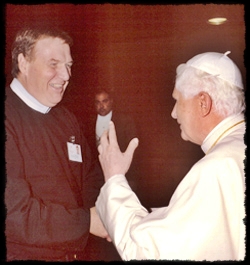 You may not have been tracking the recent switcharoos in Catholic hierarchy, but here’s one to note. The guy in charge of investigating the American religious women’s orders has been replaced. The elder Slovenian Cardinal Rode (he of the flowing robes and multiple robe bearers) has moved on. Detroit native Fr. Joseph Tobin has taken his place.
To put it succinctly, the nuns like this guy a whole lot better. And he’s making nice with them trying to repair the damage the Vatican has done to its relationship with American nuns and the laity who love them.
The first thing Tobin did when he had power of his new office was to acknowledged the “anger and hurt” among U.S. nuns caused by the probe by the Congregation for Institutes of Consecrated Life and Societies of Apostolic Life.
“There’s a great deal of misunderstanding among American religious about the decisions of the Holy See, and in particular the visitation of women religious,” Tobin said in an National Catholic Reporter interview. “Maybe I can offer a different picture of American women religious than the one that sometimes has been presented in Rome,” Tobin said. “My own impression is extremely positive.”
The Vatican scrutiny of American women’s religious orders began in December 2008 and is scheduled to continue through 2011. Many Catholics around the world have criticized the investigation as a heavy-handed attempt to rein in U.S. nuns because regressionists in church hierarchy see them as too independent.
The Vatican’s investigation has become a referendum on defending and promoting the precepts of Vatican II. “Many sisters answered the call of the church’s Second Vatican Council (1962-1965) which encouraged social activism, freedom of expression and conscience and respect for other religions,” reports Michael O’Malley (Nuns hopeful on U.S. prelate’s role in Vatican probe). “Critics believe the hierarchy in Rome is trying to turn the clock back to a more conservative and traditional church.”
“The heart of the issue is not about nuns,” said Sister Diana Culbertson, a retired professor of literature and Scripture at Kent State University, in O’Malley’s article. “It’s about the interpretation of Vatican II. The current hierarchy of the church does not have the same interpretation of Vatican II as we do.”
Culbertson, who refers to the investigation as the “nunquisition,” said: “They see us as Marxist-feminist radicals. Rome has a picture of American nuns that doesn’t correspond to the picture we have of ourselves.
“They want us in our place. But we don’t make vows to the hierarchy. We make our vows to God.”
It remains to be seen how Tobin will handle the infrastructure and procedures of the investigation and how significantly he will involve the Catholic women’s orders. The separate Vatican investigation of the Leadership Conference of Women Religious, an umbrella group that represents the leaders of 95 percent of the nation’s 59,000 nuns, continues.
In December, the University of San Francisco honored Catholic women religious for their contributions to the country and the church by awarding them with an honorary doctorate. Dominican sister and president of the Leadership Conference of Catholic Women Religious (LCWR), Mary Hughes, accepted the degree on behalf of all religious sisters in America.
Sister Annmarie Sanders, a spokeswoman for LCWR, said that they’ve had no communication with the Vatican panel since April. Asked whether she feels the nuns’ conference is being kept in the dark regarding the investigation, Sanders said, “Very much so.”
Recent articles roundup:
When Good (Bad) Things Happen by Sandra Schneiders
Nuns hopeful on U.S. prelate’s role in Vatican probe by Michael O’Malley
New Vatican Leader Extremely Positive on Women by John Allen
Q & A With Fr. Tobin by John Allen
American Women Religious Honored by University of San Francisco by Tom Fox -
Christian Pacifism: It’s A Bible Thing.
 Jim Foxvog from Plow Creek Mennonite Church in Bureau County, Illinois, has a great page set up on the biblical basis for Christian pacifism. This is an excellent source of scripture quotes for forming one’s conscience on the issue of pacifism and faith.
Plow Creek Mennonite (mission statement: “A global village practicing the peace of Jesus”) is a great Christian community providing a powerful spiritual witness in middle America. Stop by and visit if you are ever in rural Tiskilwa, Illinois.
“What would Jesus do? [WWJD] ” Christians rightly ask. Jesus was perfectly capable of self defense. He chose not to defend himself, to let his enemies kill him and even asked that his murderers be forgiven. We are to follow in his ways. There’s a great bumper sticker: “Whom would Jesus bomb?” [WWJB] We are specifically called to follow Jesus example of suffering love and non-retaliation (1 Peter 2:21). Jesus died for the life his enemies (Rom 5:8,10). Jesus gave this as the specific reason to love our enemies, “so that you may be sons of your Father who is in heaven” (Matthew 5:45 ) — to be like him! Jesus was questioned about the death penalty. God specifically commanded it in the Old Testament. Jesus did not say it was undeserved. His answer: “He that is without sin among you, let him first cast a stone” (John 8.7). Does not the same reasoning apply to a nation seeking to “punish” another “evil nation”?
God will take care of us and is fully capable of handling those who do evil. We should not fear people, even those who could kill us (Matt 10:28). This is the basic truth, not some sweet cliché. We are conquerors in all things by being in Jesus — nothing can separate us from the love of God (Rom 8:37-39).
It is a deeply held popular belief that the only way to stop evil is with by violent force. This is the theme of most adventure stories of all genres, of comic books and TV shows and movies. If we trust violence more than we trust God, this is idolatry. God’s truth is that our real enemies are spiritual (Ephesians 6:12) and are to be opposed by spiritual means (2 Cor 10:4). Our culture teaches us to oppose evil with violent force. But God, who created the universe, shows us that the world is not founded on violence, but is built and designed differently. Love is what works because that is how the totality of all that is was designed.–Jim Foxvog (Biblical Pacifism: Christian Pacifism is Scriptural Position)
-
What Wikileaks is Teaching Us about Empire
 I’ve been going back and forth on what I think about the Wikileaks release of State Department cables. I generally come down on the side of Wikileaks, but the State Dept memos dump seemed more like a stunt, as opposed to the earlier release of Iraq material. Francis Shor’s essay, WikiLeaks, Ideological Legitimacy, and the Crisis of Empire, excerpted below, helped me analyze the information release and especially the dangerous backlash through the lens of how empires operate. Empires are almost always antithetical to the dreams of God for how humanity can be. They sacrifice human dignity and feed on fear.
Shor teaches at Wayne State in Detroit and wrote “Dying Empire: U.S. Imperialism and Global Resistance” (find more on the web site www.dyingempire.org). I particularly appreciate Shor bringing in Filipino scholar-activist Walden Bello, a leading defender of empowering the Global South.
While empires try to maintain their hegemony through economic and military prowess, they must also rely on a form of ideological legitimacy to guarantee their rule. Such legitimacy is often embedded in the geopolitical reputation of the empire among its allies and reluctant admirers. Once that reputation begins to unravel, the empire appears illegitimate. …
Given the battered economic and military standing of the United States over the past several years, the hysterical reaction of the American political class over the recent release of State Department cables by WikiLeaks is not surprising. However, it is instructive to note the response of those in the West to such “displays (of) imperial arrogance and hypocrisy” as reported by Steven Erlanger in The New York Times. Erlanger cites an important editorial from the Berliner Zeitung that underscores the question of ideological legitimacy: “The U.S. is betraying one of its founding myths: freedom of information. And they are doing so now, because for the first time since the end of the cold war, they are threatened with losing worldwide control of information.” …
In their desperation to retain the empire, the US political class is undermining the remaining vestiges of the empire’s legitimacy over the WikiLeaks affair. They may also be preparing to expand the definition of treason to include those who are dedicated, as is Assange and WikiLeaks, to freedom of information, especially when it reveals the duplicities of empire. Beyond WikiLeaks, the crisis of empire, according to Filipino scholar-activist Walden Bello, “bodes well not only for the rest of the world. It may also benefit the people of the United States. It opens up the possibility of Americans relating to other people as equals and not as masters.” …
Read the full essay here.
-
Jim Douglass: Why It’s Up to Us, the People, to Practice Satyagraha (Part 10)
 The most important book for any American to read is JFK and the Unspeakable: Who Killed Him and Why it Matters by James D. Douglass.
 Douglass’ investigation into the secret papers finally released during the Clinton era begin to uncover a deadly “family pattern” of behavior in the highest levels of political power. Now, Douglass has written an important article for Tikkun magazine that looks at how the pattern is being repeated again between President Obama, Gen. Petraeus, and Afghanistan.
Below is Part 10: Why It’s Up to Us, the People, to Practice Satyagraha
The ultimate reach of Lilly’s question is a challenging one for us all, and President Obama’s mention of Gandhi is a seed of hope. The month before his election as president, Barack Obama also invoked Gandhi as an inspiration, on that occasion Gandhi as the community organizer of a massive, nonviolent revolution. President-to-be Obama said Gandhi’s portrait “hangs in my office to remind me that real change will not come from Washington — it will come when the people, united, bring it to Washington.”
Obama’s pre-election Gandhi statement included a reference to the war in Iraq: “We’ve watched our standing in the world erode as we continue to lose American lives in a war that should’ve never been authorized and never been waged.”
Candidate Obama’s words on Iraq apply with equal urgency today to the war in Afghanistan and a threatened war in Iran, in the context of a global strategy of war on terror that, as Gandhi would say, “is not the way of truth.”
John Kennedy recognized that the wars he was pressured to wage on Cuba, Vietnam, and the Soviet Union, all claimed as strategic parts of a global war on communism, were not the way of truth. With great courage, he turned away from those wars, and from the false ideology of war that justified them, to the truth of peacemaking. Had he not done so in the Cuban Missile Crisis, our planet would now be a nuclear wasteland. We can give thanks for the courage that took him to Dallas.
Yet the vision of Gandhi and King, and the words of Obama, remind us that the impetus for the kind of nonviolent change that is the condition for our survival “will not come from Washington — it will come when the people, united, bring it to Washington.” To the powers that dominate the president and the world, the most unspeakable reality of all would be our discovery as a people, all over this country and this globe, of a force more powerful than war.
The arc of the universe bends toward justice on earth, if we can believe in it and act on it. Let it be.–James Douglass, from JFK, Obama, and the Unspeakable
-
Jim Douglass: How a President Can Practice Satyagraha (Part 9)
The most important book for any American to read is JFK and the Unspeakable: Who Killed Him and Why it Matters by James D. Douglass. Douglass’ investigation into the secret papers finally released during the Clinton era begin to uncover a deadly “family pattern” of behavior in the highest levels of political power. Now, Douglass has written an important article for Tikkun magazine that looks at how the pattern is being repeated again between President Obama, Gen. Petraeus, and Afghanistan.
Below is Part 9: How a President Can Practice Satyagraha
On the first day of school, September 8, 2009, at Wakefield High School in Arlington, Virginia, a ninth-grader named Lilly asked President Obama, “If you could have dinner with anyone, dead or alive, who would it be?”
The president said his first choice for a dinner companion would be Gandhi, “a real hero of mine,” adding:
If it hadn’t been for the nonviolent movement in India, you might not have seen the same nonviolent movement for civil rights here in the United States…. He ended up doing so much and changing the world just by the power of his ethics, by his ability to change how people saw each other and saw themselves. [Gandhi was able to] help people who thought they had no power realize that they had power, and then help people who had a lot of power realize that if all they’re doing is oppressing people, then that’s not a really good exercise of power.
Maybe we all need to sit down for a meal with Gandhi, one that would be, as President Obama told Lilly, “a really small meal because he [like the impoverished people he represented] didn’t eat a lot.” What Gandhi would say to us over that small meal he did say at the end of his life to a U.S. writer, Vincent Sheean, who traveled half-way around the world to question him on vital matters, anticipating that Gandhi was about to be assassinated — as he would be, in Sheean’s presence, three days later.
As the two men paced a room together, Gandhi told his American visitor, with reference to World War II culminating in the atomic bombing of Hiroshima and Nagasaki, “Your ends may have been good but your means were bad. That is not the way of truth.”
If Gandhi’s earnest conversation partner were Obama, not Sheean, and the time today, perhaps the next question would be: “What is the way of truth in Afghanistan?”
For Gandhi, truth was God. “Truth-force” was his term for nonviolence, satyagraha. Gandhi acted on the belief that there is nothing we as human beings can do that is more powerful, more transforming, than to live out the truth as we know it at the deepest point in our conscience.
In dialogue today with a powerful man who knows that “oppressing people is not a really good exercise of power,” Gandhi would say that hearing the truth and acting on it, regardless of the consequences to one’s power and one’s self, would be the way of truth in Afghanistan and in Washington. As politically confining as the White House is, it is for that very reason an ideal place to live out the truth, as President Kennedy did.–James Douglass, from JFK, Obama, and the Unspeakable
-
Jim Douglass: King’s Global, Nonviolent Vision (Part 8)
The most important book for any American to read is JFK and the Unspeakable: Who Killed Him and Why it Matters by James D. Douglass. Douglass’ investigation into the secret papers finally released during the Clinton era begin to uncover a deadly “family pattern” of behavior in the highest levels of political power. Now, Douglass has written an important article for Tikkun magazine that looks at how the pattern is being repeated again between President Obama, Gen. Petraeus, and Afghanistan.
Below is Part 8: King’s Global, Nonviolent Vision
Martin Luther King Jr. said in his last testament, Trumpet of Conscience, a little book published after his death: “Can a nonviolent, direct-action movement find application on the international level, to confront economic and political problems? I believe it can. It is clear to me that the next stage of the movement is to become international.”
King envisioned an international movement of massive, nonviolent civil disobedience, bringing the business of London, Paris, Washington, and Ottawa to a halt until such centers of autocracy addressed the real questions of democracy. He said we needed to shut down our marketplaces by nonviolent action until business as usual was opened up to the needs of us all, beginning with the poorest, most exploited people on earth. The way our greatest prophet addressed the military-industrial complex was to think and act beyond it.
That is why he planned the Poor People’s Campaign for Washington. He was initiating it in Memphis in April 1968, supporting the sanitation workers’ strike there, when he was shot to death. He wanted all those who had nothing to lose to come together in D.C. that spring and summer — however long it would take — to shut down the government by nonviolent resistance until it agreed to shut down poverty and war. Martin Luther King Jr. was saying that Washington and Wall Street did not have the final say. There was — and is — a world out there, from the heartland of the USA to the heartbeat of the Congo, from those suffering in Appalachia to those struggling in the Amazon. If we are willing to struggle, suffer, and die together nonviolently, anything is possible for our world. King’s global, nonviolent vision is waiting to be realized if we’re willing to carry it out, paying the price just as he did.
King, like the prophets before him, knew the towering powers that overwhelm us when we think small, are themselves small-time. He reminded us that our Pentagon generals and Wall Street barons are not in ultimate charge of reality any more than we as individuals are. “The arc of the universe,” he said, “bends toward justice.”
So let’s not give up on our brother, Barack Obama, or on ourselves. And let’s not give up on our brothers and sisters in the Pentagon and on Wall Street. Nonviolence is the most powerful force in existence. We can all become part of its movement.–James Douglass, from JFK, Obama, and the Unspeakable
-
Gentrification’s Violence and the Conundrum of the Neighbor

Bill Wylie-Kellermann My mentor and friend Bill Wylie-Kellermann, wrote an exceptional reflection on living locally in Detroit and practicing restorative justice in the face of hate crimes.
Looking for real justice: What we can learn from a Corktown attack is a well-crafted example of radical Christian witness in place. I encourage you to read Bill’s whole essay. Here’s an excerpt below:Last Friday, Steve DiPonio, a resident of Detroit’s Corktown neighborhood, pleaded not guilty in Wayne County Circuit Court to felony charges related to the October beating of a homeless man, Charles Duncan, also of Corktown.
DiPonio, according to witnesses, first used his pickup truck to harass several men, including Duncan, bedding down for the night in an alcove of Holy Trinity School, flashing his lights and revving the engine. Then, it is alleged, he beat Duncan repeatedly with a baseball bat, tied his feet with a rope and pulled him toward the truck, threatening to drag him to the river. Neighbors intervened. The prosecutor’s office might well have charged this as a hate crime. Both the weapons and the symbolism bear a terrible weight.
As pastor of St. Peter’s Episcopal at Michigan and Trumbull, both of these men are known to me. I count them each as neighbors. I’m struck that when Jesus was asked, “Who is my neighbor?” he told a parable about a man beaten and left for dead by the side of the road (Luke 10). In our story at hand, I notice a parable of community and hospitality as well.
Charles Duncan has made his home variously in Corktown for at least a decade. He is a regular guest at our soup kitchen, Manna Community Meal. Charlie is a chronic alcoholic, subject to seizures, but a truly gentle person, even if he can get exercised over the fate of certain Detroit sports teams. The homeless folks of Corktown are by no means all alcoholics, but then neither are all the alcoholics in Corktown homeless. He is currently in rehab. And through the District Court preliminary hearings, he has, by my lights, been courageous to keep appearing for all the proceedings. Grant him this heart: He stands up and refuses to be terrorized. He insists by his witness that you don’t have to own property or even rent it to be a member of this community. He declares himself our neighbor.
Steve DiPonio is also our neighbor. For many years, he’s lived down the street. He cares honestly and perversely about Corktown. He is a skilled handyman in neighborhood projects. He participates vocally, even loudly, in community meetings, and was formerly part of the Corktown patrol (think: Neighborhood Watch with yellow lights and walkie-talkies). He was not on the patrol the night of the beating, and has since been removed from its rolls. However, the assault with which he is charged fits into a larger pattern of violence against and harassment of homeless people in the neighborhood. Homelessness is being criminalized and profiled. By looking at someone on the street, it’s presumed one can tell who belongs in the neighborhood — and who doesn’t. Harassment is extended to young people of color as well.
… What happened to Charlie may be seen as the blunt end of gentrification. Poor folks will be pushed to new margins. Homeless people for neighborhoods without homes.
-
Subscribe
Subscribed
Have a WordPress.com account? Log in now.

