I did a radio interview with Latino USA’s Mincho Jacob on Wednesday about the death last week of Roman Catholic Bishop Samuel Ruiz of Chiapas, Mexico.
I’m not sure if Mincho read my Huffington Post column on Bishop Ruiz or if my friend Sean Collins at Latino USA tipped Mincho off that I might be a person to call. Either way I was grateful for the chance to remember Bishop Ruiz with the Latino USA audience.
To listen to the interview, click on the link below and go to minute 3:00.
However, the story before is also worth listening to. It’s with Arizona-based journalist Terry Greene Sterling on the trial of members of the paramilitary group the Minutemen who are accused of killing nine-year-old Brisenia Flores and her father Raul Flores.
New York Times columnist Nicholas Kristof’s ran an excellent column yesterday on the rival religious approaches within the Catholic church. One approach focuses on dogma, sanctity, rules, and punishment of sinners. The other lifts up compassion for the needy, mercy for sinners, and a profligate invitation to the least, the lost, the left out.
Examining the battle between Phoenix’s Bishop Olmsted and St. Joseph’s Catholic hospital – particularly Sr. Margaret McBride, in Tussling Over Jesus, Kristof says:
The thought that keeps nagging at me is this: If you look at Bishop Olmsted and Sister Margaret as the protagonists in this battle, one of them truly seems to me to have emulated the life of Jesus. And it’s not the bishop, who has spent much of his adult life as a Vatican bureaucrat climbing the career ladder. It’s Sister Margaret, who like so many nuns has toiled for decades on behalf of the neediest and sickest among us. Then along comes Bishop Olmsted to excommunicate the Christ-like figure in our story. If Jesus were around today, he might sue the bishop for defamation.
There is nothing new in this dynamic. It’s the yin and yang of the world. Conservatives preserve institutions so that there is a mechanism for advancement from one generation to the next. Liberals draw from an original animating spirit and push the edges of what currently exists in order to allow it to fulfill it’s purpose in the present. In other words, liberals will say If the church isn’t truly the church in the here and now, then what good is it. And conservatives will say, If we don’t have a core belief system that is clear and transferable from one generation to the next then what good is it just acting on what we feel in the here and now.
The trouble is that conservatives tend to consolidate power and then that power bloc needs to be pushed back on so that it doesn’t become a dry and lifeless shell. St. Joseph’s Catholic hospital is one example of many where Catholics are pushing back. Kristoff writes:
Bishop Olmsted initially excommunicated a nun, Sister Margaret McBride, who had been on the hospital’s ethics committee and had approved of the decision [to terminate a pregnancy to save the life of the mother]. That seems to have been a failed attempt to bully the hospital into submission, but it refused to cave and continues to employ Sister Margaret. Now the bishop, in effect, is excommunicating the entire hospital — all because it saved a woman’s life.
Make no mistake: This clash of values is a bellwether of a profound disagreement that is playing out at many Catholic hospitals around the country. These hospitals are part of the backbone of American health care, amounting to 15 percent of hospital beds. Already in Bend, Ore., last year, a bishop ended the church’s official relationship with St. Charles Medical Center for making tubal ligation sterilizations available to women who requested them. And two Catholic hospitals in Texas halted tubal ligations at the insistence of the local bishop in Tyler.
The National Women’s Law Center has just issued a report quoting doctors at Catholic-affiliated hospitals as saying that sometimes they are forced by church doctrine to provide substandard care to women with miscarriages or ectopic pregnancies in ways that can leave the women infertile or even endanger their lives. More clashes are likely as the church hierarchy grows more conservative, and as hospitals and laity grow more impatient with bishops who seem increasingly out of touch.
Apparently, Bishop Olmsted thought that by excommunicating Sr. McBride – a Sister of Mercy – and then effectively excommunicating the hospital itself so that Mass can no longer be celebrated in the hospital chapel that he could somehow make the hospital “unCatholic.” What he fails to realize is that it’s not the name that makes the hospital Catholic, it’s the people serving in the ministry of Jesus and the tradition of the saints. Linda Hunt, the president of St. Joseph’s said, “St. Joseph’s will continue through our words and deeds to carry out the healing ministry of Jesus. Our operations, policies, and procedures will not change.”
Many ordinary Catholics have reached a breaking point and St. Joseph’s heralds a new vision of Catholicism. As Jamie Manson writing in the National Catholic Reporter put it: “Though [St. Joseph’s hospital] will be denied the opportunity to celebrate the Eucharist, the Eucharist will rise out of St. Joseph’s every time the sick are healed, the frightened are comforted, the lonely are visited, the weak are fed, and vigil is kept over the dying.”
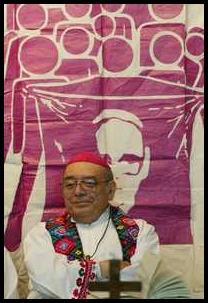
Bishop Ruiz at the Mass on the anniversary of Archbishop Romero's death. José Carlo González.
Samuel Ruiz, the archbishop of Chiapas, Mexico, died this week. I met him in 1993 in Washington, D.C. It was one of my first official “interviews” for Sojourners magazine. I was really nervous, but I knew that I couldn’t miss the chance to talk to this man who was truly a saint. I was put at ease by his humility and humor – as well as his clear passion for his people.
To read more about Ruiz, his role in Vatican II, his dedication to genuine liberation theology, his passion for indigenous communities, his peace negotiations with the Zapatistas, his assistance in founding the pacifist community Las Abejas, then check out my longer reflection Remembering the Little Bishop Who Roared.
But for a quieter memorial, I offer California poet Gary Soto’s lovely poem instead. Don Samuel, presente!
CHIAPAS
by Gary Soto
There is the one who turns
A spoon over like a letter,
Reading the teeth-marks
Older than his own;
The one who strikes a match,
Its light flowering
In his eyes,
The smoke in his throat;
The one who opens the mouth
Of a dog to listen
To the sea, white-tipped
And blind, feel its way to shore.
At night
They walk in the streets,
The dust skirting their legs
Raw with lice
And the wind funneled
Through a doorway
Where someone might pray
For a loaf of good luck.
*
Somewhere the old follow
Their canes down
A street where the front
Pages of a newspaper
Scuttle faceless
And the three-legged dog hops home.
A door is locked twice
And flies ladder a scale of fish.
Somewhere a window yellows
From a lantern. A child
With fever, swabbed in oils
And mint, his face
Spotted like an egg,
His cry no different
Than the cry
That shakes the trees lean.
A candle is lit for the dead
Two worlds ahead of us all.
Gary Soto, “Chiapas” from Where Sparrows Work Hard (Pittsburgh: University of Pittsburgh Press, 1981)
N. 808/97
Dublin, 31 January 1997
Strictly Confidential
Your Excellency,
The Congregation for the Clergy has attentively studied the complex question of sexual abuse of minors by clerics and the document entitled “Child Sexual Abuse : Framework for a Church Response”, published by the Irish Catholic Bishops’ Advisory Committee.
The Congregation wishes to emphasize the need for this document to conform to the canonical norms presently in force.
The text, however, contains “procedures and dispositions which appear contrary to canonical discipline and which, if applied, could invalidate the acts of the same Bishops who are attempting to put a stop to these problems. If such procedures were to be followed by the Bishops and there were cases of eventual hierarchical recourse lodged at the Holy See, the results could be highly embarrassing and detrimental to those same Diocesan authorities.
In particular, the situation of ‘mandatory reporting’ gives rise to serious reservations of both a moral and a canonical nature”.
Since the policies on sexual abuse in the English speaking world exhibit many of the same characteristics and procedures, the Congregation is involved in a global study of them. At the appropriate time, with the collaboration of the interested Episcopal Conferences and in dialogue with them, the Congregation will not be remiss in establishing some concrete directives with regard to these Policies.
To: the Members of the Irish Episcopal Conference – their Dioceses.
For these reasons and because the above mentioned text is not an official document of the Episcopal Conference but merely a study document, I am directed to inform the individual Bishops of Ireland of the preoccupations of the Congregation in its regard, underlining that in the sad cases of accusations of sexual abuse by clerics, the procedures established by the Code of Canon Law must be meticulously followed under pain of invalidity of the acts involved if the priest so punished were to make hierarchical recourse against his Bishop.
Asking you to kindly let me know of the safe receipt of this letter and with the assurance of my cordial regard, I am [sic]
Yours sincerely in Christ,
+Luciano Storero
Apostolic Nuncio
Investigative journalist Mick Peelo, from the Irish TV show Would You Believe?, this week revealed a 1997 letter (see above) from the Vatican warning Ireland’s Catholic bishops not to report all suspected child-abuse cases to police. Apparently, Peelo received it from an Irish bishop.
“Child-abuse activists in Ireland said the 1997 letter should demonstrate, once and for all, that the protection of pedophile priests from criminal investigation was not only sanctioned by Vatican leaders but ordered by them,” writes AP reporter Shawn Pogatchnik. “A key argument employed by the Vatican in defending dozens of lawsuits over clerical sex abuse in the United States is that it had no role in ordering local church authorities to suppress evidence of crimes.”
In 1996 the Irish bishops responded to the massive number of allegations regarding child sexual abuse by adopting very bold policies (see “Child Sexual Abuse: Framework for a Church Response”) that, as Bishop Michael Smith put it, finally “put the child at the center.” In 1997, this new letter reveals, the Vatican immediately sought to undermine the approach taken by the Irish bishops.
“The letter is of huge international significance, because it shows that the Vatican’s intention is to prevent reporting of abuse to criminal authorities. And if that instruction applied here, it applied everywhere,” said Colm O’Gorman, director of the Irish chapter of human rights watchdog Amnesty International.
AP reporter Shawn Pogatchnik explains further the importance of the letter:
In the January 1997 letter seen Tuesday by the AP, the Vatican’s diplomat in Ireland at the time, Archbishop Luciano Storero, told the bishops that a senior church panel in Rome, the Congregation for the Clergy, had decided that the Irish church’s year-old policy of “mandatory” reporting of abuse claims conflicted with canon law.
Storero emphasized in the letter that the Irish church’s policy was not recognized by the Vatican and was “merely a study document.” He said canon law — which required abuse allegations to be handled within the church — “must be meticulously followed.”
Without elaborating Storero, who died in 2000, wrote that mandatory reporting of child-abuse claims to police “gives rise to serious reservations of both a moral and a canonical nature.”
He warned that bishops who followed the Irish child-protection policy and reported a priest’s suspected crimes to police ran the risk of having their in-house punishments of the priest overturned by the Congregation for the Clergy.
Last March, when Pope Benedict wrote his “pastoral letter to the Catholics of Ireland” condemning pedophiles within the church, he blamed Irish bishops for failing to follow canon law, however he made no acknowledgment of the Vatican’s own role in secretly blocking the Irish bishop’s efforts to improve child protection and bring abuser priests to justice.
Would You Believe?’s 40-minute video “Unspeakable Crimes” is a fair and thorough examination of the culture of secrecy around sexual abuse cases that Pope Benedict is both trying to change and completely caught up in. Extensive interviews with members of Voice of the Faithful in Ireland, canon lawyers, bishops, priests, psychologists, and Vatican reporters.
The video is an excellent tool for Catholics who want to reflect together on the ongoing revelations around sexual abuse and how best to advance protection from abusive priests and the culture of clericalism that fosters secrecy and abuse.
The Irish church is currently in the midst of a “visitation” by Cardinal O’Malley regarding the sexual abuse scandal. But, as one person interviewed said, “It’s still not getting to the issue. This is a big problem that’s institutional. It’s bigger than the Irish church.”
Laura Norton Amico walk through an alley in Columbia Heights where a 17-year-old girl was found dead in a garbage container. (Washington Post)
I was asked this weekend why I write so much about the dead. The combination of an earlier article on the bodies of 9/11 victims left in the Fresh Kill Landfill on Staten Island (At the Hour of Our Death), my book Who Killed Donte Manning?, and my recent column for Sojourners Rachel’s Wail for a Murdered Teen appeared to set a pattern.
While the answer could be complicated, it’s actually very simple. In Catholic teaching there are the corporal and spiritual works of mercy. One of the corporal works is to “bury the dead.” One of the spiritual works is to “pray for the living and the dead.” Through my writing, I’m trying to practice my faith.
Attending to the works of mercy can lead one into some strange places. Over the past few months I’ve been talking with Laura Amico who runs a blog called Homicide Watch DC. Today’s Washington Post ran a feature article on her work and included a short quote from me. See an excerpt below:
On the morning of Nov. 15, Laura Norton Amico found herself penned inside a scrum of journalists who had packed a room at D.C. Superior Court for a glimpse of the lead suspect in one of Washington’s highest-profile murder cases: the 2001 killing of federal intern Chandra Levy.
But while everyone around her was jockeying for the best view of Ingmar Guandique, the man who would later be convicted of Levy’s murder, Amico waited patiently for the clerk to call the unheralded case of Vernon McRae, a 22-year-old Southeast man charged with fatally wounding Michael Washington, 63, during an argument in October.
Amico, 29, a former police reporter from Santa Rosa, Calif., has quietly carved out a role for herself as the District’s most comprehensive chronicler of the unlawful taking of human life. Since October, she has documented her efforts on a blog called Homicide Watch D.C. Her mission sounds simple: “Mark every death. Remember every victim. Follow every case.” …
Rose Berger, 47, turned to Homicide Watch D.C. to follow the case of Ebony Franklin, a teenager whose body was found just before Christmas stuffed in a garbage can in an alley near Berger’s Columbia Heights home. A slaying leaves “a hole the community,” Berger said. And to be able to follow the case “allows for healing to happen.” Blogger Aims to Chronicle Every D.C. Homicide
Benedictine monastics have understood since the Middle Ages that in times of great social upheaval, economic distress, and environmental disasters that tear apart families and communties, the church can offer a very particular gift: stability. As Gerald Schlabach writes, “Precisely because it contrasts so sharply with the fragility of most commitments in our hypermodern society, the Benedictine vow of stability may speak more directly to our age and churches than anything else in the Rule.”
When I came to the Columbia Heights neighborhood to join Sojourners intentional Christian community (as it existed then), I had no idea how long I would stay. Now, 25 years later, much of that original community has moved away. However, new communities grows up in the shell of the old, discipled by the witness of those who experimented with the gospel before them. And the Christian work of honoring the dead carries on in an new way.
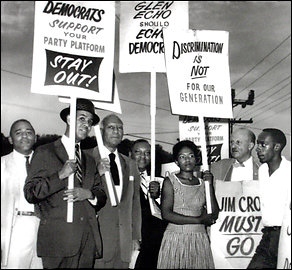
Protesters picketed the racially segregated Glen Echo Park in 1960, near Washington, D.C.. Pacifica radio is playing speeches from Dr. King all day. It’s the best tribute I can think of. It’s like an all day seminar on the very best of American history and religious nonviolence.
The earliest recorded speech in the Pacifica archives is from June 4, 1957, when Dr. King delivered a speech to students at the University of California at Berkeley at the invitation of the Young Men’s Christian Association and Young Women’s Christian Association. His topic was “The Power of Nonviolence”, and in relatively few words King movingly described the principle of nonviolent resistance and the ideals he sought to uphold by using it in his movement. The speech’s conclusion has a famous section on the biblical prophets and “maladjustment.” He says:
Modern psychology has a word that is probably used more than any other word. It is the word “maladjusted.” Now we all should seek to live a well—adjusted life in order to avoid neurotic and schizophrenic personalities. But there are some things within our social order to which I am proud to be maladjusted and to which I call upon you to be maladjusted. I never intend to adjust myself to segregation and discrimination. I never intend to adjust myself to mob rule. I never intend to adjust myself to the tragic effects of the methods of physical violence and to tragic militarism. I call upon you to be maladjusted to such things. I call upon you to be as maladjusted to such things. I call upon you to be as maladjusted as Amos who in the midst of the injustices of his day cried out in words that echo across the generation, “Let judgment run down like waters and righteousness like a mighty stream.”
My community e-list today for the Columbia Heights neighborhood has a reflection by one of our local heroes, Kenneth Barnes, founder of ROOT Inc,dedicated to ending gun violence, recalling segregated D.C. He writes:
I was born and raised in northeast Washington, DC, in a section known as Trinidad. I grew up on Owen Place, a street between Montello Ave and Trinidad Ave, NE. My family moved to Owen Place in 1945, and, ironically, was the first African American family to move onto the block.
I attended Wilson elementary school on the corner of 6th and K St, NE. Wheatley Elementary is on the corner of Neal St. and Montello Ave, NE, within two blocks walking distance of my family home. Yet I had to catch a bus to go to Wilson Elementary over a mile from home and by pass Wheatley every morning.
As a child, I would wonder why but it was one of those mysteries not clearly defined by my family to me and it seemed as a child to be no big deal. My family was from the south and shielded the inequities of segregation and the evils of racism from my brother, my sister, and me. Racism and segregation was a part of everyday life accepted by families like mine from the south as part of their existence.
I remember being in the first integrated class of Wheatley when I entered the 5th grade and still was not totally aware of the segregated society that I had been a part of. I remember studying history and not really seeing or being able to identify with Black people, because all history at that time being taught consisted of the history of western civilization and culture or American (White) history. We learned about George Washington and Abraham Lincoln, Davey Crockett and Wyatt Earp were big frontier heroes. Even God was a white man with a flowing white beard and hair to match, and Jesus Christ was a younger white man with a darker beard and long hair down to his shoulders.
I succinctly remember one black person being taught as being a hero during the American Revolution, and his name was Crispus Attacks. I remember wondering at the time what made him a hero and why was he singled out. He happened to be in a crowd of people that were shot by English soldiers and he happened to be black. I never could figure out what was heroic about that nor, at the time, did I understand the significance of why he, of all the heroic Black people throughout history, was singled out and given to us (Black children) as being a hero.
This naivete of thinking remained with me up until my high school years. I remember about a black lady refusing to give up her seat on a bus. I remember about sit-ins and protests, about Medgar Evars being murdered, about a bombing of a church, and civil rights workers being killed. Even with all that atrocity my most vivid memory is of a remarkable man, a preacher, who began to become prominent as a spokesperson against all of the evils entwined with bigotry, segregation, and racism. He spoke eloquently yet forcefully and firmly. He spoke with a gentleness of conviction, and his powerful message of non violent confrontation as a means of battling racism began to resonate throughout America.
He stood up for us as African Americans perhaps as no other before him. He was, to me, our savior, our Christ. He led marches and protests against racist and segregation against some of the vilest and most ruthless people in this county. He was beaten, stabbed, locked up, attacked by dogs, and water hosed. Yet he seemed to rise, larger than life, above it all.
And he became my first hero. He opened my eyes like no one before me had. I began to listen to his speeches, enthralled by his every word.
I remember this great man being able to call a march on Washington and give perhaps the most magnificent speech ever delivered in the history of mankind, with the entire nation as well as the entire world enthralled. …
I encourage you to spend some time today being discipled by the essays and speeches of Dr. King. Listen to just one today and let the words take root in your mind and heart.
New Zealander Jason Goroncy blogs down under at Per Crucem ad Lucem. I greatly appreciated his riffing off my earlier post Guantanamo: When Will it Get Foreclosed? and providing the deep theological framework necessary for understanding the times in which we live.
Jason is a Presbyterian Minister of Word and Sacrament who teaches theology, church history, and pastoral care, and serves as Dean of Studies, at the Knox Centre for Ministry and Leadership, the ministry training centre for the Presbyterian Church of Aotearoa New Zealand. He writes:
There are times and places about which nothing seems more significant than the sheer energy and violence that states direct against basic freedoms. The snippets of information that filter from these dictatorial seasons – tales of furtive hiding and tragic discovery: hard times and uneasy sleep – describe lives utterly structured by state repression. Authoritarians bent on taking power, consolidating their rule or seizing resources frequently silence opponents with bludgeons, bullets and shallow graves, and those who find themselves in the path of the state juggernaut probably have trouble even imagining protest or resistance without also calculating the severity or likelihood of state repression. Such considerations surely influence whether individuals take action or maintain a frustrated silence, and will over time broadly shape protest and resistance. (p. 1)
My long interest in the people and politics of Burma, in particular, means that I think a lot about this kind of stuff, and particularly about how the community of God might witness to and in the midst of such situations where the abuses of authority birth such blatantly evil fruit and where the climate of hope has been beclouded in fear. [Rose Marie Berger’s recent post on Guantanamo: When Will it Get Foreclosed?, for example, recalled such fruit in another part of the world]. Certainly, all human relationships and institutions live under the constant threat of the abuse of power. And even a cursory reading of history will reveal that the Church too has been both victim and perpetrator of such abuse. (I am aware that already I have used the words authority and power interchangeably here. Certainly they are at least related, and the proper understanding and use of each will decide whether the ways being pursued bring the fragrance of life or the stench of death to a situation.)
The question Jason raises is this: How does the Church or Christians resist the Powers’ abuse as described by Boudreau? Do we take action or “maintain a frustrated silence”? And what are the “weapons of the spirit” with which God arms the friends of Jesus?
Jason explores the role of worship and deep relationship with those who are dispossessed in confronting the death-dealing forces in our world.
It’s with sadness that we mark the death of Sr. Rosemary Lynch, early founder of peace witnesses at the Nevada Nuclear Test Site. And it is with deep gratitude that we recall this woman who was a shining light of faithful leadership and nonviolence in modern American history. She was also co-founder of Pace e Bene, a Catholic peace organization promoting nonviolence.
Rosemary died in Las Vegas on Sunday at age 93 after being hit by a car while out walking. Her legacy will be carried on by the many lives that she touched in her rich and vibrant life. The Las Vegas Sun notes:
Born in Phoenix, Lynch became a member of the Sisters of St. Francis of Penance and Christian Charity community in 1932. After taking her vows in 1934, she went on to teach at a Catholic school in Los Angeles followed by a stint as principal at a high school in Montana. From there, she went to Rome as a representative for her congregation. Her 15 years in Rome included the Second Vatican Council.
After returning to the United States in 1977, Lynch settled in Las Vegas where she joined the staff of the Franciscan Center. That summer, President Jimmy Carter announced that he was seeking funding from Congress to develop the “enhanced radiation” or “neutron” bomb. Soon afterward, news was leaked that the neutron bomb had already been developed and tested at the Nevada Test Site. Lynch decided to do some research on this program and the test site in general. In the course of her exploration, she discovered that a group of Quakers, including Larry Scott and Albert Bigelow, had held the last demonstration at the test site on August 6, 1957.
Spurred by this, she and a group of friends in Las Vegas organized an event at the gates of NTS to mark the 20th anniversary of this activity, to protest the impending production of the enhanced radiation weapon developed there, and to remember the bombing of Hiroshima thirty-two years earlier. They dubbed themselves “Citizens Concerned about the Neutron Bomb.” As it was later reported:
Nineteen people met at the main gate of the NTS before dawn to hold a prayer vigil and conduct a teach in about Hiroshima. The vigilers held signs along the road that led into the Test Site and they were very careful to make signs that supported the workers but objected to testing. One sign read: “NTS Workers Yes, Nuclear Bombs No.” The vigil was highlighted by the visit of Japanese Hibakusha [survivors of the atomic bombings] who wanted to present a book of drawing of the bombs dropped on Japan to the Test Site officials. The vigilers went directly to the guard house at Mercury Station. The Japanese approached the gate house but the guards refused to accept their book. An older Japanese lady, a Hibakusha, extended her hand to the guard and he refused to shake her hand. The small group began a chant, “Take her hand. Take her hand.” Finally the guard gave in and shook her hand. (Michael Affleck, The History and Strategy of the Campaign to End Nuclear Weapons Testing at the Nevada Test Site, 1977-1990 (Las Vegas, NV: Pace e Bene, 1991).
Rosemary was part of the first “Lenten Desert Experience” at the Nevada Test Site in 1982 to protest ongoing nuclear testing and violence. The movement later became known as the Nevada Desert Experience, which still exists today.
It was during those protests that Ediger said Lynch’s character was exposed: She protested issues involving the test site — not the people on the other side of the debate, he said. In fact, Ediger said, through her social activism, Lynch developed “very warm human relationships” with the people in support of the test site.
Rosemary was an apostle of peace. “Eternal rest grant unto her, O Lord. And let perpetual light shine upon her.”
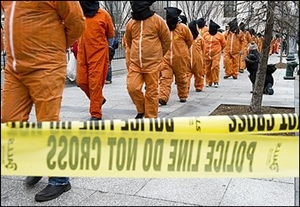
Demonstrators with Witness Against Torture march to the Department of Justice in Washington, DC, on January 11, 2011. (JIM WATSON/AFP/Getty Images)
Please keep in your prayers the fasters who are in prayer at the U.S. capitol between January 11-21 keeping vigil for the closing of the U.S. prison camp at Guantanamo. As an opening to their prayer vigil yesterday, they engaged in a little prophetic street theater in front of the Justice Department.
In August 2007, candidate Obama promised to close Guantanamo, saying “As President, I will close Guantanamo, reject the Military Commissions Act and adhere to the Geneva Conventions. Our Constitution and our Uniform Code of Military Justice provide a framework for dealing with the terrorists.”
In January 2009, one of President Obama’s first official acts was to sign an executive order promising to close Guantanamo within one year. “This is me following through on not just a commitment I made during the campaign, but I think an understanding that dates back to our founding fathers, that we are willing to observe core standards of conduct, not just when it’s easy, but also when it’s hard,” he said.
Christians and others are taking the lead in holding President Obama accountable for his pledge.
A group of 173 human rights activists, each wearing an orange jumpsuit and a black hood and representing the remaining 173 prisoners at Guantanamo Bay, Cuba, rallied in front of the White House on Tuesday to mark the ninth anniversary of the detention center’s opening and to protest the Obama administration’s inability to close it.
“Detainees, halt!” yelled Carmen Trotta, a volunteer with the group Witness Against Torture, who wore military fatigues as he gathered the protesters in Lafayette Park. “Turn left. Face the home of your captor.”
The rally and street theater were organized by a coalition of groups – including Amnesty International, the Center for Constitutional Rights and September 11 Families for Peaceful Tomorrows – that are calling on the administration to either try Guantanamo Bay detainees in federal court or release them.
“We believe in and promote the rule of law,” said Valerie Lucznikowska, whose nephew was killed in the Sept. 11, 2001, attacks on the World Trade Center and who described the military detention center in Cuba as a “living stain on America.”
Last January 2010 passed and we now move into a second year of with 173 men and boys still held in an extrajudicial setting. Obama has learned that the issue “is complicated.” Indeed it is. But it must be done. America’s democracy requires that we “observe core standards of conduct, not just when it’s easy, but also when it’s hard.”
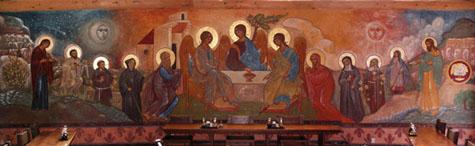
The mural above is found in the refectory at Christ in the Desert Benedictine monastery near Abiquiu, New Mexico.
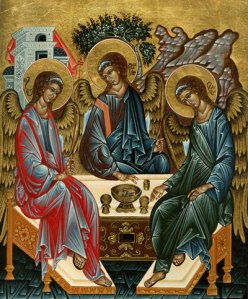
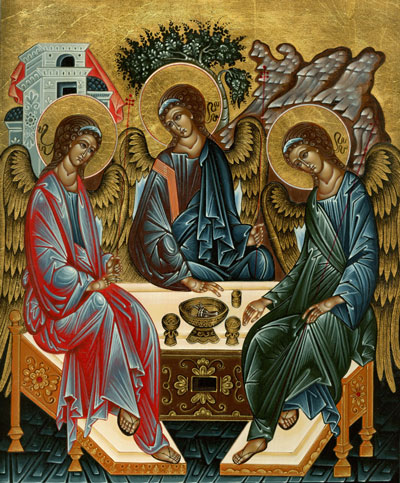
Rubilev's Trinity
Based on Rubilev’s famous Trinity icon, it depicts the Sarah and Abraham welcoming the three angel guests at the Oak of Mamre.
“The LORD appeared to Abraham near the great trees of Mamre while he was sitting at the entrance to his tent in the heat of the day”–Genesis 18:1
In the center of the Christ in the Desert mural is a large scale version of the Rubilev’s icon of the Trinity, represented by three angels, seated at table.
To the viewer’s right is Sarah and to the viewer’s left is Abraham. Behind Abraham is St. Benedict, St. Francis, St. Juan Diego, Mary, and the Burning Bush.
Behind Sarah is St. Scholastica, St. Clare, Blessed Kateri Tekatwitha, St. John the Baptist, and an “Agnus Dei” representation.
The real plot of the Bible is about the liberation of both humanity and nature from our folly. God’s voice does not come through the centre of civil power but from an imperial defector in Moses, through a burning bush and from a dissident prophet Elijah in the wilderness. These ancient traditions portray a God who needs to be encountered through nature. The Bible also offers numerous peons to creation as a mirror of the creator’s glory. There is a lot of talk these days about our need to rediscover enchantment in nature. Let us take Abraham’s first encounter
with God which occurred under the oak tree of Moreh, an “oracle giver” which taps into an apparently universal tradition of the Tree of Life. Then God appears to Abraham as certain strangers under the oaks of Mamre; and later in Judges, the warrior Gideon is given courage by an angel under the oak at Ophrah.
At Christ in the Desert monastery the electricity and water-pumping at the monastery is solar-powered, as sunshine is plentiful throughout the year.
The mural art reflects a tradition now set in the context of the Chama Canyon wilderness in northwestern New Mexico, but the monks whose quiet cenobitic lives are shaped daily by the art also vitalize the mural through their own daily desert encounters with angels, trees, rivers, saints, bread, wine, work, and surprise.
 I did a radio interview with Latino USA’s Mincho Jacob on Wednesday about the death last week of Roman Catholic Bishop Samuel Ruiz of Chiapas, Mexico.

 New Zealander Jason Goroncy blogs down under at Per Crucem ad Lucem. I greatly appreciated his riffing off my earlier post Guantanamo: When Will it Get Foreclosed? and providing the deep theological framework necessary for understanding the times in which we live.
 It’s with sadness that we mark the death of Sr. Rosemary Lynch, early founder of peace witnesses at the Nevada Nuclear Test Site. And it is with deep gratitude that we recall this woman who was a shining light of faithful leadership and nonviolence in modern American history. She was also co-founder of Pace e Bene, a Catholic peace organization promoting nonviolence.