-
What WikiLeaks is Revealing About U.S. Politics South of the Border
 Under the category of “old, but interesting” news, I’ve been reading the NewsNotes from the Maryknoll Office of Global Concerns, where there’s been a very informative roundup on the November 2010 WikiLeaks release of diplomatic cables and their connection to Latin America.
This bi-monthly newsletter is an excellent resource for understanding the on-the-ground stories for international justice work. Under the outstanding editorial guidance of Judy Coode, I always find a treasure trove of information and helpful perspective.
While most press coverage of the U.S. State Department cables revealed by the website Wikileaks has centered on the Middle East, a number of cables have been from and about Latin American countries. Information contained in some messages confirmed suspicions about political leaders, providing new details.
Others have brought new information showing internal contradictions in the policies of the U.S. and other governments. Cables from countries considered to be “oppositional” like Venezuela, Bolivia, and Nicaragua, show how embassies often use biased information from untrustworthy sources. Below are excerpts from the NewsNotes articles produced by Dave Kane, reprinted with permission of 2011 Maryknoll Office for Global Concerns (please support them and sign up to receive their newsletter):
Bolivia: Vice President Alvaro Garcia Linera has publicly supported the Wikileaks organization and posted all U.S. diplomatic cables released that pertain to Bolivia on his official website. He said that he wants people to know the “barbarities and insults” of what he called Washington’s “interventionist infiltration.”
Brazil: Documents show internal division in the Brazilian government in relation to Venezuela. While President Luiz Inacio Lula da Silva refused to go along with U.S. requests to help isolate Venezuela, one cable shows that the Lula administration offered to support Su’mate, a Venezuelan NGO working in opposition to Venezuela’s president Hugo Chavez, in exchange for U.S. authorization to sell a Brazilian training aircraft, the “Supertucano,” to other South American countries.
Colombia: Leaked cables from Colombia are an example of diplomatic actions that are perhaps better to be kept secret. The documents show that former president Alvaro Uribe secretly sought to dialog with leadership of Colombia’s rebel forces, the FARC.
El Salvador: Leaked cables from the San Salvador embassy confirm and provide more detail about how President Mauricio Funes faces increasing division and even subterfuge from his own political party, the Farabundi National Liberation Front (FMLN).
Honduras: A cable sent a month after the coup that unseated President Manuel Zelaya shows how the U.S. embassy had no doubt about the illegitimacy of the coup despite State Department reluctance to act on that fact.
Mexico: Released cables from Mexico show that, despite public praise from U.S. officials toward Mexican police and military, they have great concern that the poorly trained and corrupt security forces are unable to deal with drug cartels.
Panama: The Latin American country where Wikileaks documents have uncovered the most controversial and damaging information is Panama. The cables reveal high-level corruption surrounding a July 2009 contract to add a third set of locks to the Panama Canal, as well as an alleged illegal wiretapping operation by President Ricardo Martinelli. … Another scandal revealed by the Wikileaks cables involved President Martinelli allegedly pressuring and even blackmailing the U.S. embassy to help him spy on political opponents and unions.
Venezuela: A key learning from Wikileaks cables regarding Venezuela is the extent of the campaign by a number of regional government leaders to undermine Hugo Chavez and diminish Venezuelan influence in the area. The cables also show that, rhetoric aside, the U.S. government is not actually concerned about Venezuela providing uranium to Iran or Russia. … From within Venezuela, political opponents also have asked for the U.S. to work to undermine Chavez. Many opposition groups receive funding from the National Endowment for Democracy. Venezuelan Archbishop Baltazar Porras asked the U.S. government to “contain the regional aspirations” of Chavez, according to a January 2005 cable. Porras reportedly offered to organize a joint effort by the U.S. and Venezuela’s Catholic hierarchy and private business sector to try to win over poor communities that had benefitted from the Chavez regime. Porras, the vice president of the Venezuelan bishops’ conference, has denied saying any such thing, classifying the leaked cable as “a science fiction movie script.”
Read NewsNotes’ full content of WikiLeaks and Latin America.
Check out the WikiLeaks full cache -
David Gushee: A Conservative Support for Gay Marriage
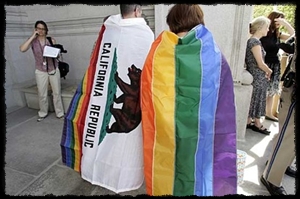 Recently, respected conservative Christian ethicist David Gushee took on the issue of state-approved same-sex marriage. His op-ed will no doubt cause a lot of controversy.
Gushee, a Christian ethicist at Mercer University, gets into it through his reading of English philosopher John Locke (cue cheers from Lost fans) and Thomas Jefferson. Christianity, Locke, and gay marriage examines the forces shaping American political thought, neo-conservatism, the American Constitution, and how we as Christians determine what is a “normative posture of the church” on certain issues of public policy.
Gushee’s argument reflects a number of conservatives and libertarians who – strictly on the basis of the government’s responsibility to protect individual rights — agree that same-sex marriages should be allowed by the State. In my opinion, this is a way for conservatives to get on the right side of history on this issue and I’m proud of those who can get there through the proper application of conservative philosophy.
However, Gushee is not ready for church-sanctioned same-sex marriage. “As a matter of personal conviction,” writes Gushee, ” I am not ready to embrace gay marriage. I cannot imagine performing such nuptials as a minister. I cannot imagine my congregation doing so.” However, he reckons to an alternate position when it comes to the responsibilities of the State.
Read an excerpt from Gushee’s article below:
[T]he news last week was that President Obama and his administration have decided not to defend the 1996 Defense of Marriage Act any longer. This act made it federal law that marriage is between a man and a woman. Cue the predictable howls of outrage at Obama’s decision. As a matter of personal conviction I am not ready to embrace gay marriage. I cannot imagine performing such nuptials as a minister. I cannot imagine my congregation doing so.
But what should the state do? If we reason from classic Christian sexual ethics forward to the role of the state, most traditional Christians (not all Christians) will come to a position of advocating that government hold onto an exclusively heterosexual definition of marriage.
But if we reason from a Lockean posture of limited government and maximum individual liberty, it is quite hard to find any compelling reason why it is any business of the state to decide whether people of the same sex can marry. Efforts to do so recently, as in California, have collapsed under their own empirical implausibility.
So we have a clash here between a Christendom paradigm and a Lockean one. On the one hand we have part of America’s culturally established but fading Christian majority operating from a paradigm that what God wills (as they understand it) should be civil law. On the other we have a Lockean paradigm that the state should only limit individual liberty for the most compelling reasons having to do with protecting the life, liberty, and limb of others.
In 1791, it was Locke, not Christendom, that prevailed in the shaping of our own constitutional order. This means Lockean premises usually win out, as they eventually will and should on the issue of legal recognition of same-sex relationships.
This says nothing about what Christian ethics ought to be on gay and lesbian issues. It says everything about the limits of governmental power in the lives of Americans. –David Gushee
So kudos to Gushee and others for putting themselves out there, with all their traditionalist understandings of Christian ethics still in place.
Learn more about David Gushee, founder of Evangelicals for Human Rights and principal drafter of the 2006 Evangelical Climate Initiative. His books include Religious Faith, Torture, and our National Soul, Kingdom Ethics, and Getting Marriage Right..
-
Osama bin Laden: The Death of the ‘Madman with a Sword’
It is hard to know how to react to the news that U.S. military forces have killed Osama bin Laden, inspirational leader behind the Al Qaeda terrorist network. The mix of relief and grief displayed by crowds in the streets outside the White House and the Capitol building is a human response in such an emotionally charged situation.
At the same time, there is nothing glorious in violent murder — whether in bin Laden’s death or in the horrific deaths of his thousands of victims. “I am not celebrating this man’s death,” said Francesca Jerez on ABC news, whose father was killed on Sept. 11. “That’s not what this is about. It’s about final justice. Now he cannot take credit for anything else. He cannot hurt anyone else.” As Charles Wolfe, husband of a 9/11 victim said in an interview, “We let the Judge of All Things pass justice on [bin Laden].”
A recent article by nonviolence expert Michael Nagler on Libya provides a framework that can be applied to the death of bin Laden and put it into some kind of context. Nagler writes about what Gandhi called the “madman with a sword” analogy:
Gandhi said flatly that if a madman is raging through a village with a sword he who “dispatches the lunatic” will have done the community (and even the poor lunatic) a favor. Here are Gandhi’s exact words, from The Hindu,1926:
Taking life may be a duty…. Suppose a man runs amok and goes furiously about, sword in hand, and killing anyone that comes in his way, and no one dares capture him alive. Anyone who dispatches this lunatic will earn the gratitude of the community and be regarded as a benevolent man.
From other sources, however, we see that to use lethal force without actually being violent is extremely tricky. Remember always, by the way, that we are talking about an extreme emergency. One cannot prepare to use lethal force against such a situation because if one has time to prepare one can prepare nonviolence. Arming airline pilots in case there are hijackers does not count. That understood, several other conditions must be met: 1) One must act as far as possible without anger or fear. One must harbor no hatred of the deranged party. Even lunatics are people. 2) One must not complain if one is injured in the process. Life will not always appear fair to our limited vision. 3) And by far the most important condition: One must not feel that s/he has solved the problem once the maddened person is successfully stopped and innocents protected. Instead, one must dedicate some serious time and effort, to asking how we have created a world where this can happen — and how to change it.
On the edges of the news stories we hear language from the Obama administration that hints at acting with some dignity in the midst of violence. Obama’s careful attention to avoid civilian casualties in the swift attack on the bin Laden house. Also the information that bin Laden’s body is being handled according to Muslim burial customs. This is the kind of dignity that reflects well on Americans — a dignity not accorded to bin Laden’s victims.
My prayer is that this does not become an opportunity to glorify more death, but instead a decisive moment to actively create a world where the violent evil of Osama bin Laden no longer gains a foothold.
-
Poetry: ‘News reach of the women dead in them sleep’
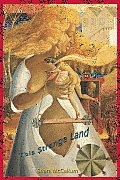 I studied with Shara McCallum in the MFA poetry program at the University of Southern Maine. Her new book This Strange Land has just been published and includes her series of “Miss Sally” poems in Jamaican dialect. Based loosely on conversations with her grandmother, McCallum’s poetry here is stunning and clear.
Miss Sally on the Grandmother Fires
by Shara McCallumHear what I tell yu: God promised Noah,
No more water. The fire next time.
That evening, mi sit down on the verandah
teking in a lickle fresh air when news reach
of the women dead in them sleep.
Lickle by lickle, the rest of the storey come out:
two young boys acting like men, like God himself.
153 dead—and fi what? Fi win election?Mi dear, in all mi years I never imagine
is so low we would stoop.
For a people who know
what it is to be the lamb,
how we go lead our own
to slaughter?Shara McCallum is the author of This Strange Land, just out from Alice James Press. Her two previous collections of poetry are Song of Thieves (University of Pittsburgh Press, 2003) and The Water Between Us (University of Pittsburgh Press). Born of Afro-Jamaican and Venezuelan parents in Kingston, Jamaica, she lives with her husband and two young daughters in central Pennsylvania, where she directs the Stadler Center for Poetry and teaches creative writing and literature at Bucknell University.
-
Abbot Phillip: ‘It is a Struggle to Live in Community’
 “Each of us has a path to faith is his or her life. Faith is a truly personal gift and the choice to accept faith as a gift is also very personal. These first Christians seem to have evangelized by the way the lived together. The reading from the Acts of the Apostlest seems to paint such a wonderful picture of the harmony of the early Christian community. We know, however, from the Acts itself and from the letters of Saint Paul that life was not always harmonious. It was and is a struggle to live in a community completely devoted to Jesus Christ, whether that is a family community, a parish community or a religious community or some other type of community. It is just not easy to live together. Yet it is right at the point of conflict in any community that we are invited to put our finger into the wound and to believe.
As we meditate on the death and resurrection of the Lord, it was not something beautiful, but something almost obscene. It was not glory moving to resurrection but humiliation. When we meet up with defects and sins and ugliness in community, we are walking the way of the Cross and we must believe that out of the defects, sins and ugliness, God still is forming and bringing about resurrection.
The First Letter of Peter tells us today that in his great mercy God gave us a new birth to a living hope through the resurrection of Jesus Christ. This is the same message as from the Acts of the Apostles. We must learn how to place all that seems broken in the hands of a living and loving God, and believe that God is making beauty, goodness and love from it. As we begin to believe, we not only soften, we come to be like Saint Thomas the Apostle: just a little embarrassed because we had doubted so much.
Let us pray today that we can resolutely look at all that seems sinful, ugly, not of God, destructive and so on—and yet embrace it all as part of God’s creation and know that in our faith, God is transforming us and our world. Let us believe in resurrection because Christ is truly risen.”–Abbot Phillip, OSB (Christ in the Desert Monastery)
-
The Hidden World of Hermits
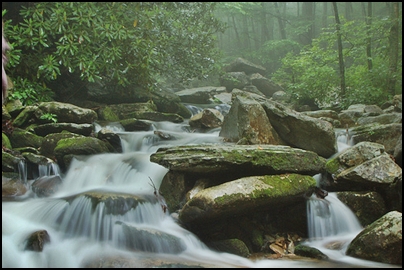 Thanks to Bob Sabath for introducing me to Raven’s Bread Ministry. Karen and Paul Fredette have lived an eremetical contemplative life in the Appalachian mountains for years. They also offer Raven’s Bread newsletter that allows hermits to share their experiences, questions, and reflections with one another.
 I like their description below of how they live where they live. I was especially drawn to the image of Petra, the boulder. As we think about Christ as our rock and setting the homestead of the Christian community on the firm foundation of the apostles, let these images deepen your imagination:
We treasure the peaceful quiet of our home (Still Wood), set on a secluded mountain slope in the Spring Creek area of Madison County, NC. In our stewardship of Still Wood, we are accompanied by Neill and Cynda, our border collies and Merlin, our magical white cat. Our daily routine includes time for contemplative prayer and reflective reading.
In the warmer months, we make use of our outdoor chapel (Beth El Shaddai), a shaded gazebo where we are serenaded by dozens of feathered choristers, accompanied by the murmur of a small waterfall, and delighted by melodious wind chimes. We often meditate on Petra, an immense moss-covered boulder estimated to be among the most ancient rock on the surface of the planet. On her rugged surface, we feel we are seated on the knees of our Mother Earth, contemplating forests which shaded the Cherokee who inhabited these mountains for countless centuries before a white person ever beheld their lush beauty. Touching stone which has endured the changes of millenia reminds us of how brief our lifetime is; how precious are the days we have, and what a gift it is to spend them in service to solitary watchers and pray-ers around the world.
-
Easter Sunday: That Great Gettin’ Up Morning

… Well the prophecy was kept;
Christ “first fruit of them that slept”
Rose with vic’try-circled brow;
So, believing one, shalt thou.
Ah! but there shall come a day
When, unhampered by this clay,
Souls shall rise to life newborn
On that resurrection morn.–from “An Easter Ode” by Paul Laurence Dunbar
-
Cesar Chavez: A Seed of Hope by Aaron Gallegos and Rose Berger
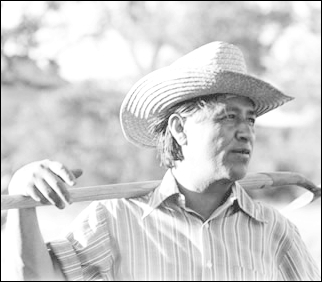
Cesar Chavez “If you want to remember me, organize.” –Cesar Chavez
Today is the 18th anniversary of Cesar Chavez’ death. In memory and gratitude for his work and the work of all those United Farmworkers I’m posting “Seeds of Hope” that appeared in 1993. Cesar, presente!
A Seed of Hope
by Aaron Gallegos and Rose Marie Berger
Sojourners, July 1993The eagle on the red and black banner of the United Farm Workers union can be likened to the Aztec deity, Quetzacoatl, the plumed, phoenix-like serpent-god that dies descending into the Earth, only to be born again by ascending to the heavens.
Along with sorrow at his passing, Cesar Chavez’s death on April 23 at the age of 66 brings a similar hope of rebirth for many Latinos and others who were inspired by his life of nonviolent resistance to the oppression of America’s farm workers. Like Martin Luther King Jr., Chavez represented moral leadership for minorities, the poor, and many others seeking liberation. His commitment to nonviolence, his spiritual rootedness, his invitation to community, his fasts, and his unwavering dedication to the voiceless of California’s Central Valley were the crucible in which we learned justice.
Cesar Chavez was raised in a family of migrant farm workers, moving through the apricot and almond orchards of Arizona and California, “following the crops” after his family lost their farm during the Great Depression. Though he attended 65 public schools, Chavez never went beyond the eighth grade–instead he educated himself in public libraries through the writings of Gandhi and John Steinbeck.
Influenced by the newly formed farm worker ministries active in California during the early ’50s, Chavez went to work with Saul Alinsky’s Community Service Organization registering Mexican-American voters. In 1962 he left to form the National Farm Workers Association, the precursor to the United Farm Workers union. Delano, California, became the site of La Huelga, UFW’s famous five-year strike and national grape boycott that began in 1965 when the union joined Filipino grape pickers striking for higher wages. It was this strike and boycott that revealed Chavez as one of the most inspired and creative labor leaders of our time.
-
Holy Saturday: All’s Quiet on the God Front
 All’s Quiet on the God Front
“I have come to love the darkness.”
by Rose Marie BergerAs a child, I was terrified of Good Friday and Holy Saturday. I dreaded those hours of “time out of time” that stretched between 3 p.m. on Friday when Jesus officially died on the cross and Jesus’ resurrection, with a clap of alleluias, on Easter morning. It was in those in-between hours that God was dead—and we were alone in the world.
Suddenly, there was no spiritual safety net. Chaos ruled the world and we were defenseless against it. The isolation was nearly unbearable. As an adult, I learned theological mind-tricks to protect me from this fear of God’s ultimate abandonment. But I confess, sometimes when I wake at 3 a.m., all I hear in the universe is emptiness.
Recently, a priest friend said that in all his 70-plus years of prayerful discernment, he’s rarely had a heavenly answer. “God’s mostly silent,” he said. I don’t think he meant absent per se; just not prone to conversation or helpful hints on the best next step. God is just very, very quiet.
This is a man who’s given his whole life—every moment—to God for more than 50 years. He’s done tremendous work among the poor. He’s made genuine sacrifices in his personal life. He prays every morning and every night (unless there’s a baseball game on). How come God doesn’t talk to him? Why is God silent?
-
Good Friday Poem: The Messiah After the Crucifixion
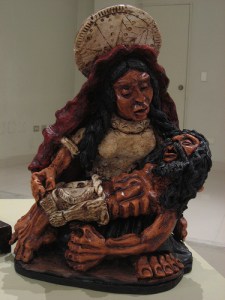
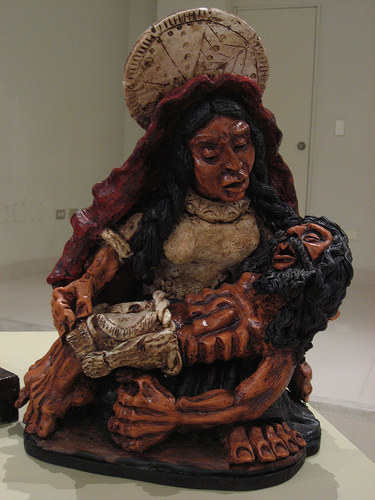
Pieta by Edilberto Merida Iraqi poet Badr Shakir al-Sayyab, one of the greatest modern Arabic poets, was born near Basra in 1926. After World War II several leading Arabic poets began experimenting with Christian metaphor and imagery after work by T.S. Eliot, especially The Wasteland. Al-Sayyab allows the image of Christ to echo his own homeland’s need of resurrection.
The Messiah After the Crucifixion
by Badr Shakir al-SayyabAfter I was brought down, I heard the winds
Whip the palm trees with wild laments;
Footsteps receded into infinity. Wounds
And the cross I was nailed to all afternoon
Didn’t kill me. I listened. A cry of grief
Crossed the plain between me and the city
Like a hawser pulling a ship
Destined to sink. The cry
Was a thread of light between morning
And night in sad winter sky.
Despite all this, the city fell asleep.When the orange and mulberry trees bloom
When my village Jaykour reaches the limits of fantasy
When grass grows green and sings with fragrance
And the sun suckles it with brilliance
When even darkness grows green
Warmth touches my heart and my blood flows into earth
My heart becomes sun, when sun throbs with light
My heart become earth, throbbing with wheat, blossom
and sweet water
My heart is water, an ear of corn
Its death is resurrection. It lives in him who eats
The dough, round as a little breast, life’s breast.
I died by fire. When I burned, the darkness of my clay
disappeared. Only God remained.
I was the beginning, and in the beginning was poverty
I died so bread would be eaten in my name
So I would be sown in season.
Many are the lives I’ll live. In every soil
I’ll become a future, a seed, a generation of men
A drop of blood, or more, in every man’s heart.Then I returned. When Judas saw me he turned pale
I was his secret!
He was a shadow of mine, grown dark
The frozen image of an idea
From which life was plucked
He feared I might reveal death in his eyes
(his eyes were a rock
behind which he hid his death)
He feared my warmth. It was a threat to him
so he betrayed it.
“Is this you? Or is it my shadow grown white
emitting light?
Men die only once! That’s what our fathers said
That’s what they taught us. Or was it a lie?!”
That’s what he said when he saw me. His whole face spoke.I hear footsteps, approaching and falling
The tomb rumbles with their fall
Have they come again? Who else could it be?
Their falling footsteps follow me
I lay rocks on my chest
Didn’t they crucify me yesterday? Yet here I am!
Who could know that I . . . ? Who?
And as for Judas and his friends, no one will believe them.
Their footsteps follow me and fall.Here I am now, naked in my dank tomb
Yesterday I curled up like a thought, a bud
Beneath my shroud of snow. My blood bloomed from moisture
I was then a thin shadow between night and day.
When I burst my soul into treasures and peeled it like fruit
When I turned my pockets into swaddling clothes
and my sleeves into a cover
When I kept the bones of little children
warm within my flesh
And stripped my wounds to dress the wound of another
The wall between me and God disappeared.
The soldiers surprised even my wounds and my heartbeats
They surprised all that wasn’t dead
even if it was a tomb
They took me by surprise the way a flock of starving birds
pluck the fruit of a palm tree in a deserted village.The rifles are pointed and have eyes
with which they devour my road
Their fire dreams of my crucifixion
Their eyes are made of fire and iron
The eyes of my people are light in the skies
they shine with memory and love.
Their rifles relieve me of my burden;
my cross grows moist. How small
Such death is! My death. And yet how great!After I was nailed to the cross, I cast my eyes
toward the city
I could hardly recognize the plain, the wall, the cemetery
Something, as far as my eyes could see, sprung forth
Like a forest in bloom
Everywhere there was a cross and a mourning mother
Blessed be the Lord!
Such are the pains of a city in labor.Badr Shakir al-Sayyab’s poem was translated from the Arabic by Ben M. Bennani, whose book of translations of three contemporary Arabic poets, Bread, Hasheesh, & Moon, was published by Copper Canyon Press (Spring 1975).
-
Subscribe
Subscribed
Have a WordPress.com account? Log in now.

